
Win More Remodeling Jobs by Mastering the Sales ConversationWith Tyler Hunsberger of Hunsberger Builders
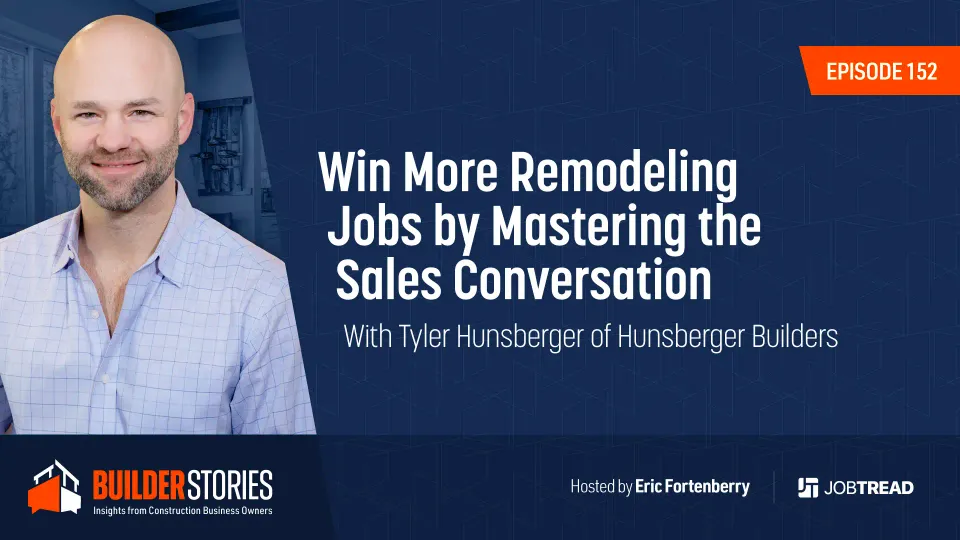

Tyler Hunsberger has won a NARI Contractor of the Year award and earned a spot on Pro Remodeler’s 40 Under 40. He is a fourth-generation contractor who has spent nearly 15 years on the sales and design side of remodeling. Now he is bringing that playbook back to his family’s company after 25 years with no marketing, no estimating, and one single customer. This conversation is a masterclass in how remodelers actually win jobs.
In this episode you will learn:
- How Tyler builds real excitement on a first phone call before he has ever seen the project
- What he does with a lead that is clearly a bad fit for his company
- The approach that earns him reviews far more often than any email or QR code
- How he opens the budget conversation without naming his own numbers first
- The way he delivers a $15,000 change order without losing the client’s trust
Listen to the episode to learn more.
Resources:
Learn more about Tyler and his work here.
Eric Fortenberry: [00:00:00] Welcome to the podcast where we take a deep dive into the stories behind construction business leaders. We will share how they got started, how they found success, and the lessons learned along the way. I’m your host, Eric Fortenberry. Welcome to Builder Stories Welcome back everybody. Today I’m here with Tyler Hunsberger.
Eric Fortenberry: He is a project manager at Hunsberger Design Build. They’re located in Harleysville, Pennsylvania. Tyler’s a fourth-generation contractor. He’s always enjoyed working with his hands, but has really found his passion in building relationships. I think he’s done it for about the nearly, what, 15 years now. So real excited to have you on Builder Stories and to hear your, your story and how you got, got into construction.
Eric Fortenberry: So welcome.
Tyler Hunsberger: Thank you. I appreciate you, uh, you saying that, and I’m happy to be talking with you.
Eric Fortenberry: Yeah. All right. Well, why don’t you kick us off with just, you know, give us a little background, you know, who you are, how’d you get into construction, what led you to, uh, to your career and where you’re at today.
Tyler Hunsberger: Right. Well, my father is actually [00:01:00] third generation. Um, so Huntsberger Builders is my father for three... He would be the third generation. So we still have some old stories of my, you know, my old school Mennonite conservative great-grandfather driving his panel truck with his tools. And, uh, the, one of the funny stories is, uh, his employee got in one time and he saw the, the side panels on his truck with this beautiful red.
Tyler Hunsberger: And he goes, “Why’d you paint your truck, why’d you paint this panel truck black?” And he said, “Well, us Mennonite folks don’t want too much attention, so we, we, I painted it black to just blend on in.” So that’s like the original old panel, 1952 panel truck. And, uh, so I- he then had the business going when I was a kid, and I was on site from about 13 till probably through college, just as a carpenter.
Tyler Hunsberger: And I learned pretty quick that I am a people person. Um, I do enjoy working with my hands around my house, but making a career of swinging a hammer, I, I wanted to be talking to people, I wanted to be doing vision, I wanted to be doing marketing, I wanted to be [00:02:00] scheming out how to better lay out their space.
Tyler Hunsberger: Um, so ultimately, I, uh, pursued the sales and design side. And, um, had a, a actual, a good friend from church, um, Dennis Gehman, and, uh, he is Gehman Design Build, a high-end firm around here. So I told him, “I would love to work with you for a couple years,” and that turned into seven and a half years I was with him.
Tyler Hunsberger: Um, so I did the, the sales, design, marketing side, um, on that side of things in that business. And then what’s really interesting, um, is my father’s company is, I would say one of the only ones in the entire country that has had one customer for 25 years. He’s had anywhere from two to 12 people working for him in the little town of Skippack near here, and most of that town is owned by one guy.
Eric Fortenberry: Wow.
Tyler Hunsberger: And that guy h- is a major investor and has had my father restore the town, quite literally. Um, it’s been over 40, 50 plus [00:03:00] buildings now that have had complete restoration. And now you drive through and it has, like, this German vernacular architectural colonial, early colonial aesthetic. So it’s very popular in the area.
Tyler Hunsberger: My father’s company is, is kind of known for that. But what’s interesting is he’s never had marketing or sales or estimating. It’s all been TNM through all these years. Um, so that was one of my main motivations to go out into the marketplace and learn that from somebody I trust and respected. And, um, ultimately now I’m, uh, we’re starting to ease our way back into the marketplace after 25 years.
Tyler Hunsberger: So it’s a very interesting, uh, time right now.
Eric Fortenberry: That’s awesome. And so is that, uh... And, and, and your, your dad’s company, so is that the same company that you’re with now or did you guys- Correct. Yeah ... uh, re- rename it or, or, or what happened? We’ve
Tyler Hunsberger: joined, we’ve, we’ve joined forces and rather than being Huntsberger Builders like they were for all those generations, we’re focused on more on design remodel now.
Eric Fortenberry: Gotcha. Gotcha. Yep. I mean, you, you, you could have chosen, uh, you know, a lot of different fields to go into. I mean, how, [00:04:00] how’d you end up with, with remodeling and, and, and doing sales?
Tyler Hunsberger: Well, the, the, I do really love actually talking with people about their space and how to improve their life quite literally through these changes in their home.
Tyler Hunsberger: Um, I have sold other things out of college and I didn’t care, frankly. I just couldn’t find a way to care about what I was selling. So when this, since I’m so relationally focused, I love meeting with a family, finding out why their space isn’t working, coming up with new ideas, getting them excited about talking about those spaces and then ultimately walking them through what those steps look like and getting that job completed and, and caring about their aesthetic and their design selections.
Tyler Hunsberger: So that’s really where my passion lies actually in- Yeah ... in helping them see that all through.
Eric Fortenberry: That’s, that’s awesome. I, I mean, I’m curious though, like is there, you know, when, when you think about, you know, remodeling, design build versus, you know, like custom home building, like did you ever explore that avenue as well?
Tyler Hunsberger: Mm-hmm. Not so much. Uh, just that market [00:05:00] around here has changed drastically. Um, so new homes, we haven’t been doing them for, ooh, 25 years. Even the company I was at, recently at, they hadn’t done it for 20 years. Just in our area, uh, it’s mostly the large developers that are doing that or the specific custom homes.
Tyler Hunsberger: So it, it has, the market’s changed in our area. We have a lot of older homes in Pennsylvania so there’s a lot of homes to be remodeled. Sure. So
Eric Fortenberry: why don’t you walk us through like what, what is the, what is the full process of, you know, you got, you got a new lead. How do they find out about you? How do they get in touch?
Eric Fortenberry: Kind of what is that, what does that full life cycle look like all the way through to, to, to getting the project going?
Tyler Hunsberger: Well, I, I’d say a couple things I, I think people will find interesting since I’ve spent so much time on the sales side. I think the, I, I am passionate about walking people through a sales cycle, okay?
Tyler Hunsberger: So like an initial call comes in, one of the things that I always try to focus on, on whether or not it’s a good or bad lead, [00:06:00] I should be getting them excited about their project and kind of fanning the flame. So when they tell me they have a project and it, it might be too small, it might not even be frankly something I’m that interested in, but I can still feed them excitement for their project.
Tyler Hunsberger: I can still kind of ask how it’s gonna impact their life. And then when they tell me kind of specifically about that project, I can start not only qualifying my needs, but more so I’m focused on qualifying their needs the whole time. Like even though I am qualifying them for myself, it should sound like I’m qualifying all of their needs specifically around a project.
Tyler Hunsberger: So what I like to do is if somebody tells me, “Hey, Tyler, I have a, I have a bathroom-” That, uh, I already have the tile in my garage and the vanity in my garage. I, I heard you guys do bathrooms. Does this sound like, uh, something we could do? Rather than being like, “That’s not a great fit for what we do,” I can communicate to them more so about, “Well, it sounds like good job.
Tyler Hunsberger: You’ve already gotten through the design. You’ve already gotten through all [00:07:00] your selections. You already know where everything’s going. It sounds like you wouldn’t have to pay me to do any of that.” See, we’re a design build approach and qualifying that we might not be a great fit for them, but I can still refer them in a positive direction.
Tyler Hunsberger: I can still keep them excited about their project and move them in a, in another direction. So I, I enjoy that front end phase and even as qualifying them, I, I, I still want them to refer us when the time is right for that proper fit. So one-- Just as somebody that spends so much time focused on sales, I do think that gets missed a lot when people hear a phone call and it’s a bad opportunity.
Tyler Hunsberger: They miss a chance to fan the flame of their excitement and ultimately leave a good taste in their mouth. Do you follow me on that?
Eric Fortenberry: Yeah. And, and, and so when you say like refer them to someone else, I mean, are we talking about like another contractor in the area who maybe could just come in and kinda get the work done instead of also doing the full design?
Eric Fortenberry: Right.
Tyler Hunsberger: More of an installer. So there’s different fits in our field for what you’re doing. There’s an installer [00:08:00] approach. There’s gonna be a design build approach. There’s more of a GC approach, right? So just qualifying w- not only what we do, but qualifying what the customer’s looking for and then pointing them in the right direction.
Tyler Hunsberger: Sometimes that’s me, sometimes that’s other people that do good work in their area as well. But, um, one thing I think, um, your listeners might find, uh, useful too, is specifically what we’re selling. Um, when we talk about quality, uh, a lot of people think that’s a selling point. Um, I think it should actually be kind of par for what we’re doing.
Tyler Hunsberger: So I think there’s a lot of people that do good quality work in terms of the actual install. But what you’re selling, they should be able to see that on your pictures. They should assume you’re doing good quality. It’s this long-term relationship that is this massive variable in what we do and in what we sell.
Tyler Hunsberger: So I am constantly, um, building trust, asking questions, building a [00:09:00] relationship, hopefully giving them peace of mind, clear communication, and ultimately building trust. And what I mean by trust is like Appearing reasonable, right? They should think that I’m just a reasonable guy that, that they can work through things with.
Tyler Hunsberger: In the same way like when you’re dating somebody, right? You’re, you’re kinda like evaluating them on a lot of different ways. Not only are you just hanging out, but you’re kind of evaluating how conflict would go, how they would react to things, how they would handle my issues. Are they gonna be okay with the fact that I’m really detail-oriented?
Tyler Hunsberger: You know, all these kind of things. So what I like to really focus on is, I don’t explicitly go there, but I do ... Am always thinking that and a lo- how am I showing that this is a good long-term relationship fit?
Eric Fortenberry: Yeah.
Tyler Hunsberger: Uh, because it- it’s the longest sales cycle, I think, of any service industry, if you really think about it.
Eric Fortenberry: Yeah, so I mean, ’cause even if this project, you know, may- maybe they just need a quick, quick install, not, not a, not a good fit [00:10:00] for you guys, but you never know what that next project. You know, may- maybe now they wanna go do the kitchen, or they wanna do an addition, or something like that, where they’re gonna think about you as a great resource.
Eric Fortenberry: I, I think you’re totally right. I, I hear so many times, you know, the, the contractor just, like, their goal is as quickly as possible to just determine is this a good fit or not. If not, they’re trying to bail, you know, because they don’t wanna, you know, waste their time. But at the end of the day, like, man, eh, there’s nothing worse than hearing somebody who got a one-star review from somebody who, like, they weren’t even a customer, but, like, they just didn’t go that extra step to help make sure that they find the right person.
Eric Fortenberry: You know, it’s, it, it really is a missed opportunity as, as, as you put it there. So I’m, I’m- Mm-hmm ... couldn’t agree more. And, and, and, and again, I think there’s a lot of opportunities to partner with some of those other, you know, those other people in your industry, the other contractors, ’cause you never know, like, maybe the, you know, they’re better suited for these smaller projects.
Eric Fortenberry: But when they get something that’s over their head, you know, they’re gonna think about, “Well, man, this guy’s been sending me a bunch of stuff. Maybe it’s an opportunity for me to give him one,” and it could be a great lead source for you.
Tyler Hunsberger: And even, even then, [00:11:00] when they talk to their uncle who has the really big house that they actually, that guy’s gonna want a lot more design approach, they would still refer you even though you weren’t a good fit.
Tyler Hunsberger: Yeah. So you leave that good taste in their mouth. I think the other interesting thing is, too, about the trust I wanna kind of talk about is I don’t know if people realize how, like, deeply personal our sale ends up being in the sense of I mean, think about how... I won’t make you answer this, Eric. How many people have you had walk into your master bathroom, in your toilet area, in your walk-in closet?
Tyler Hunsberger: How many people get in there? Probably no one beyond you and your wife.
Eric Fortenberry: Yeah.
Tyler Hunsberger: So when you’re talking to someone on initial phone call, it’s amazing how it’s the same conversation I always have. Like, “Oh, don’t mind my mess,” or I can see they’ve put things over top of things, or I’m looking at their toilet that is not cleaned.
Tyler Hunsberger: You know, you need to be the kind of person that they actually are comfortable bringing into these environments-
Eric Fortenberry: Yeah ...
Tyler Hunsberger: and, and building that trust so that [00:12:00] they can admit that they actually really want a bidet seat, and you’re not gonna make some weird joke about it. You know? Like- Yeah ... you gotta get into all these personal conversations about how they’re gonna shave their legs in the shower, and, um, so one of the ways I kinda go into building trust on that is, um, I actually have a video on our email tag that says, “Get to know me.”
Tyler Hunsberger: So upon first contact, they can see a little bit, like, who is Tyler? Like, what kind of vibe does he have? What kind of smile does he have? Is he friendly? What does he like to talk about? So I’ll give them a little introduction about myself, ’cause I’m coming into their house. Not only into their house, into their bathroom.
Tyler Hunsberger: Yeah. Into their closet, and I see their dirty laundry basket there. You know, all these little things that ultimately, I think, lead you to clearer conversation if that trust is built, that they’re comfortable with you being in very vulnerable spaces. Do you follow me on that?
Eric Fortenberry: Oh, yeah. I, I think that’s awesome.
Eric Fortenberry: I mean, the more that they can feel like they already know you by watching a video, by learning more about you like it does, it, [00:13:00] it just, it warms that first conversation, and it’s, “Oh, yeah, I’ve seen that guy around. Like, I know...” You know, like, versus it being like, “Wait, who’s this guy?” Like, you know, it, it can be a little bit defensive for, for some people, uh, when they first meet someone.
Eric Fortenberry: So I, I think, I think that’s a great strategy.
Tyler Hunsberger: Yeah. Even once you, um, once you’re, once I’m getting then in their home too, what a great opportunity to actually get to know them as people rather than just to get to know the project. Because it’s amazing how just simply tied together those things are. You know, as I get into someone’s kitchen in a first floor of a model, “Oh, we wanna remove this wall.”
Tyler Hunsberger: You know, they, they might have an idea, and just simply asking a lot of questions is me diagnosing their space before I prescribe anything. Try to get a really good understanding of what exactly they want to accomplish and why. So, like, I like-- One of the things I like to do too is I like to transition a I like to transition their initial maybe, like, specific, like, “I would like to have a butler’s pantry [00:14:00] across from my, my island over on this side.”
Tyler Hunsberger: And I could get them excited, “Oh, cool. Is that, like, like, gonna be, like, a serving area when you have, like, a Super Bowl party so you can put all your...” And they might say, “Oh, yeah, absolutely. We’re gonna...” And then their idea goes farther. Or they correct me, but in a positive way. “Actually, no. What we’re thinking here, this is gonna be our drink bar.”
Tyler Hunsberger: And I can go, “Oh, you want a drink bar.” You know? So I wanna keep opening that up, but rather than just by asking boring questions on a checklist, I can keep fanning the flame. Yeah. Keep fanning the flame. Get them excited. Remember, a lot of these people watch HGTV. They’re excited about their project. So I need to fan the flame.
Tyler Hunsberger: I need to keep them excited, ’cause I’m excited for them, or at least I should be.
Eric Fortenberry: Yeah. That’s awesome.
Tyler Hunsberger: One of the things I often reference back to is when I... You know, I only got, get married once in my life, so I wanted to get a custom suit. So I went to buy a custom suit, and when I got there, I was, I was excited, Eric.
Tyler Hunsberger: I don’t know. I own one suit, and it’s a custom suit. I got to pick the interior. I was all [00:15:00] excited. And I got there, and they, they called up whatever her was, Martha. Martha came from the back out of her cigarette break. She still reeked of cigarettes. She said hello. She found out I was getting married, said congratulations.
Tyler Hunsberger: And in the next seven minutes, she walked me through the steps without any excitement, without any fun, and I got a suit, but I got no experience on my once in a lifetime project. And I spent some money on that suit. I was very disappointed. I still wear it. It’s a good-looking suit. But I was kind of hoping for somebody to be excited and give me ideas and walk me through, find out who I was, what, what’s my expression, my personality, and I got none of that.
Tyler Hunsberger: Hmm. And I often think that that relates very directly to the way we approach remodeling, um, because unfortunately, it is easy to quick move through selections and kinda get it off of our plate. Um, but that is why we do focus and have that as part of our name, The Design Remodel Approach, because I care about it.
Tyler Hunsberger: I’m excited about it, and I think we should spend [00:16:00] time together working on that rather than sending you to a specific store, and then you just get back to me with whatever works.
Eric Fortenberry: Sure. Are... So when you’re, when you’re kinda having these, these exploratory conversations, like, are, are there, are there certain things that you’re listening for in that first meeting that, you know, you, you feel like are gonna really help you to tailor the, the project and the experience to them?
Tyler Hunsberger: I think my questions are, are, are very living and breathing. I don’t go in with a checklist always, but most of the time I’m, I’m asking them specifically if they say they want an island, “Well, tell me, tell me about this. Is it seating for four? Do you have breakfast here?” Finding-- I want to find out how they live now and also how they want to live.
Tyler Hunsberger: So those are-- I would say those are the two areas that I’m always focused on. How do they live now, and how do they want to live? And what I-- one of my favorite questions is like, “Hey, when this project’s done, like, tell me, like, what you’d be most excited for. Is it a Super Bowl party? Do you host Easter? Is it, uh, breakfasts you can sit there and watch the [00:17:00] birds from your island?
Tyler Hunsberger: Or tell me, tell me what you’re most excited for.” And it’s amazing the variety of answers that you get. Yeah. ’Cause you think it’s gonna be Thanksgiving, but then you find out, yeah, he actually just likes to eat his Cheerios right at, at this window, and that’s what he’s focused on. You know, little things like that.
Eric Fortenberry: Yeah. No, that, that makes total sense. I mean, you know, again, it’s-- when, when you’re living in the home, like, that is, that is what is going to, you know, either make it very livable or could make it miserable. Like, are there, are there certain, like, you know, kind of aspects to, to when you have that opportunity to remodel, you know, that, that every time you find that people get really excited about that, you know, that potential for this, this change that will make that big impact for them?
Eric Fortenberry: Is, is there anything, like, you know, that, that stands out?
Tyler Hunsberger: Um, I would say when particularly, well, the main thing we focus on, right, is the kitchen and bath. So I really love it when both homeowners are equally excited. There are a lot of times that it is a one, one-sided project where [00:18:00] I- it’s either a divorce or a kitchen kind of conversation.
Tyler Hunsberger: Uh, so we, I, I do enjoy when there’s a mutual excitement, but if there’s not, that is a great opportunity for me to keep fanning the flame of whoever’s seems a little disinterested. I need to find out what they want, too.
Eric Fortenberry: Yeah.
Tyler Hunsberger: Um, ’cause they’re, they’re gonna have their needs, and I need to look out for that person to keep them excited about the project.
Tyler Hunsberger: So, um, it’s not so much about me, um, driving it. I’m just trying to fan their flame and ultimately find the flame of what, what, what is exciting them and what’s ultimately driving them to this project.
Eric Fortenberry: S- so when you’re having those meetings, are you trying to make sure that you’ve teed it up where, you know, if, if, if there’s, you know, a, a husband and a wife or two partners or who, you know, who...
Eric Fortenberry: Like, are you trying to make sure that everyone’s there in that initial meeting, or are you willing to take it with just the kind of the person who’s leading this, this initiative?
Tyler Hunsberger: I do ideally want them both there.
Eric Fortenberry: Yeah.
Tyler Hunsberger: There are times that I do it without. I, I [00:19:00] made it a huge deal early in my career, and I have learned that that’s just not how every family works.
Tyler Hunsberger: Um, so I’ve, I’ve gone through entire projects with, with a s- without a single meeting with one spouse. Hmm. Um, I’m talking like six-month projects. Um, they’re traveling or working. Um, so it’s not an essential, but it, it is preferred, and I, I like to just learn about that relationship as we go along. But- Yeah
Tyler Hunsberger: my sales process is typically, uh, you know, an initial phone call, and that phone call is, is just a simple relationship building, finding out about the project. I might get some pictures sent over, and then I will go out on site, meet with them, walk through, get my pictures, get my measurements, but ultimately just asking a lot of questions, getting a lot of understanding of what their needs and wants are.
Tyler Hunsberger: And then, um, we would have a follow-up, either conversation or on-site visit where I kind of go over the full process of what my new number range is and kind of laying out the, what, what the actual [00:20:00] construction phase will look like.
Eric Fortenberry: Yeah, so I was gonna ask, when, when do you bring up budget, and when do you...
Eric Fortenberry: Like, when do you first kind of start throwing out, you know, something to help make sure that you guys are even in the right ballpark?
Tyler Hunsberger: Mm-hmm. Um, I have found that, uh, f- uh, might not, probably never heard of this, but there’s something called a cost versus value report. It’s a, it’s a nationally publishized, publicized document that gives general budget range based on a variety of real estate agents and brokers and industry studies, and they give out, it’s about 24 different projects, and they give a numerical range.
Tyler Hunsberger: So what I have found fairly productive to do is if, if I feel like there is a real need to specifically talk about on an initial phone call, I w- I like to somewhat prime the system and say, “Do you have any idea where a project like this might end up?” And if they say, “I have no clue,” I can [00:21:00] say, “Well, you know, t- one thing I like to reference is a national syndicated study called Cost Versus Value, and it’s in the Philadelphia market.”
Tyler Hunsberger: It even specifically calls out our market, and it gives a general budget range of these areas. So rather than me telling them what my numbers are, I tell them what general numbers are, and then I can say my numbers are gonna be in that general ballpark. So I find that to be a useful way of rather than just asking Tyler what he charges, I can actually reference something specific that I can agree upon is accurate rather than an internet search or some group they have on Facebook that tells them what it should be.
Tyler Hunsberger: Yeah. So that, that is a nice... I enjoy that way of talking about something specific that we can talk about, and then I ultimately end up, um, just... I like to just communicate as clearly as possible. I kind of have a saying of like, I like to kind of underpromise, overdeliver the whole way through. [00:22:00] So rather than be the guy that kind of thinks this is gonna be a $100,000 project, and it ends up at 180, I’m gonna tell you this, this could very well be a $180,000 project, and then we’d whittle that into a specific as our selections and decisions go along.
Tyler Hunsberger: But it, it is a lot of arbitrary numbers, frankly. So that’s why circling back to the trust, like, do you trust what I’m telling you or, or not? And that’s kind of a crux of the whole thing.
Eric Fortenberry: Gotcha. So, so once you get them kind of... We- we’ve- we’ve- we’ve had some good exploration, we’ve got some designs, you’ve got some ideas, or I, I guess kind of you- you’re taking that back, and, and then you are creating the design.
Eric Fortenberry: Do, do you have... Like, do you, do you charge for the design? Do they enter into some sort of an agreement going into this? Like, what... T- kind of walk us through that process.
Tyler Hunsberger: Yeah. So the first two steps of the phone call, the meeting in person, getting my facts, my scope of work, then I have a, the second meeting after that, after I go crunch [00:23:00] numbers.
Tyler Hunsberger: And by... I don’t even like to use the word design, because I’m not sinking in 20 hours into a design to simply bid a project. But I, I will typically give a general sketch, maybe some AI work, and give them an idea of what they’re gonna get, somewhat of an idea, without getting... I won’t give layouts with specific measurements, but I can help them visualize and see what they’re gonna get.
Tyler Hunsberger: And then, um, I have a scope of work, which we just call preliminary estimate Preliminary budget review, right? So we’re just going over a range of costs, and there are options, right? There’s a lot of options that you’re gonna have in there, and that’s just part of some of the variability that we’re getting into.
Tyler Hunsberger: And ultimately, I’m, I’m, I’m hoping to be viewed as honest, truthful, and trustworthy and reasonable as we go along here because, I mean, I- I’ve even told people there have been times that we’ve tried to give exact, [00:24:00] as close as exact estimates. I mean, literally estimating projects for initial scopes. And if that’s off, I’m actually being more dishonest because I’m basing all those on assumptions.
Tyler Hunsberger: So I’d rather give you a range that’s a little more honest than a direct number that’s Kind of just a guess anyway. So giving you a range. So I do not get to hard numbers until we do sign a actual preliminary design agreement, and that’s, that will be based on a percentage of the project and the details of those project, and then I can get them full estimated numbers.
Tyler Hunsberger: But we will start with a scope of work before I get to that.
Eric Fortenberry: Gotcha. And so is that... Does that fee end up, you know, just kinda... that’s just part of the, the total cost, or d- what do you do with that? Does, does it end up getting credited back if they move forward? If they don’t move forward, do they get to take the designs and, and, and everything?
Tyler Hunsberger: Yeah. Do work, work off of it as, like, a retainer. So it is part of the final number and, and [00:25:00] part of that initial kinda range that I give them, but if it ends up being, you know, outside of the direction that they wanna go, then I would’ve, I would have not wasted 25 hours of my time to get them there. But they, they would be moving in a totally...
Tyler Hunsberger: They would have a, a lot of their project figured out. Sure. And then that’s their call what they would do if they would go a different direction. So the whole idea is to not charge them for something they’re not gonna end up doing. That is kinda worst case scenario in my book, so. S-
Eric Fortenberry: so when you do get into the design, how do you help the homeowners, like, find that design that they like?
Eric Fortenberry: Like, how, how do you sorta work with them to... You know, ’cause there c- there can be a lot of back and forth and little wishy-washy, and they don’t know, and, you know, you got two people debating what’s better, you know. How, how do you, how do you sorta help navigate that?
Tyler Hunsberger: Yeah. So it’s, it’s, um, back to even that, like, suit analogy of rather than, um, taking someone to a suit store and helping them pick out a suit, one [00:26:00] item of pants with a tie, with an undershirt, with a jacket, and then you put them all together and you’re like, “Woof, that’s rough.
Tyler Hunsberger: That’s a, that’s a lot.” You know, what we would start by looking at is general views of what suits generally we like, what colors we generally like. So we start with an abstraction. I like to use things like, uh, Pinterest. I like to use things like Houzz. Houzz is a nice collaborative platform. Houzz is where I can send my potential customer a link.
Tyler Hunsberger: They can add photos of things that they like, or I say, “What inspires you?” Or, “What makes you think I could see myself living there?” Don’t get so obsessed with every little detail, but, like, take a look at a space. Could you see your family living in that space? Does that excite you? Keep it simple to start.
Tyler Hunsberger: Start macro. And if you see a picture and it’s just like, “Ooh, I love that kitchen,” all right, note it Put it down and we’re gonna look at it before you start studying and tearing it all apart. Because [00:27:00] sometimes that first glimpse of a beautiful kitchen, when it actually comes time for you to select it, you’ll think, “Oh, this is too boring.”
Tyler Hunsberger: But that’s the trap. You can get too many look-at-me pieces, and it’s just too much. A good simple kitchen is oftentimes very beautiful. But to actually get people to realize that in their selection phase, you have to get them to realize it in the actual, like, kind of general scope of work phase and establish where your main focal point wants to be.
Tyler Hunsberger: If you have a certain color tone or a certain look or texture that you wanna highlight and focus in on, that will typically show up in that initial phase when they start falling in love with different pictures. So h- the reason I say that is Houzz is nice because you can collaborate. You can actually have them put all these photos on an album, and then from there, I can go through that album with their notes already on there.
Tyler Hunsberger: Because the funny thing about Pinterest is if they put an album together, you don’t have any idea what they’re looking at. They might put a picture of this kitchen. You’re like, “Oh, so [00:28:00] you love a nice sage green kitchen?” They’re like, “No, I like that floor.” You’re like, “Oh, geez, I was way off.” So that’s why Houzz is nice, because you can actually kind of collaborate and put your notes all in one place.
Tyler Hunsberger: Sure. That’s a nice initial starting point.
Eric Fortenberry: So how do you handle when the client’s budget, like, it, it just does not match their wish list?
Tyler Hunsberger: Hmm. Well, you address it by what their priorities are. So, like- For instance, how long someone’s planning on being in the home determines maybe how much we spend on their cabinetry.
Tyler Hunsberger: You know, there, there’s a whole world of cabinetry out there in terms of more of a stock to a full custom. And if they’re thinking this home is the next 5 to 10 years, then maybe they don’t go with the forever cabinetry option that’s $40,000. Maybe they go with the $15,000 cabinetry option. And I, I’m certain it’ll hold up well for the next 5 to 10 years.
Tyler Hunsberger: 25 years, it’ll be [00:29:00] there. I don’t know how the f- paint finish will hold up on some of it. But, you know, those are kind of conversations that, that we can have, um, to work them through that. And sometimes it is just showing them options and, and walking them through what those options are. I, I, I’m, I’m the consultant, right?
Tyler Hunsberger: So I’m helping you get to where you want to go, and that’s kind of the way I try to communicate to them.
Eric Fortenberry: So what do you, what do you think makes a client say yes to, you know, to, to one, you know, remodeler over another when, when the bids are close, you know, fairly comparable? Like, what do you think that, that it is that actually wins that job for you?
Tyler Hunsberger: Well, you know what’s funny? Is one thing I found is if you get a younger couple that has never done remodeling before, they might in fact go more towards price. But if you get someone that’s been through remodeling before, a lot of times they know that there’s a lot more at stake than the number. And it’s amazing how many times, Eric, I have gone into a kitchen [00:30:00] and I just, I s- rather than saying, “Wow, what a beautiful kitchen,” because I can tell it was just done.
Tyler Hunsberger: I might be there for their bathroom. They’ll, they’ll say, I’ll say, “Oh, this looks like you just redid this kitchen.” That’s the way I’ll ask the question to find out what’s really going on. And a lot of times, the reason I’m there is, “Oh, what a disaster.” But you know what, Eric? It’s actually a beautiful kitchen.
Tyler Hunsberger: It’s actually done very well, I can tell. But getting there was horrible. They hated it. Yeah. It was a disaster. But they actually got the kitchen. So it’s very interesting that that is something that in our industry I think is different than most. That you can get the product in the end, but it can be a terrible experience that you would never recommend that, that That contractor.
Tyler Hunsberger: So when, when I, when I work with people, um, and typically going over all of this, right? It’s like kinda getting back to what I talked about, like building trust, building, building the relationship so that you can handle some hard conversations [00:31:00] because that’s kind of part of these relationships too.
Tyler Hunsberger: There’s a lot of conversations- Yeah ... and touch points that you get into.
Eric Fortenberry: So when you, when you’re talking with a, you know, potential client and they’re, they’re describing this, you know, this experience that they went through with another contractor and it, and it sounds like it just wasn’t, wasn’t a good one, like do you see any common, you know, themes or, or, or kind of just s- things that keep coming up over and over where like it, it’s like these contractors are doing that same thing that just leads to a poor customer experience?
Eric Fortenberry: Like have you ever kind of seen any commonalities across, across these different conversations that you’re hearing about?
Tyler Hunsberger: I would say a, a lot of them are around the relationship. Like, ultimately, when you really get deep down, it’s about the relationship in terms of communication, timelines, delays, um, who is this random sub that came in that I don’t feel comfortable with, you know?
Tyler Hunsberger: And the, the... Ultimately, if you take [00:32:00] all those variables, to me, it comes back down to the communication, and did the contractor own it or try to talk it away and help them walk through that? So to me, it still is back to the relationship piece, even though there’s a lot of other, um, pieces under that umbrella.
Tyler Hunsberger: You follow me on that?
Eric Fortenberry: Yeah, yeah. And, you know, again, I, I think the, the one known we know about construction is that there will always be the unknowns, and, and just, you know, situations are gonna come up, and, and I, and I think you’re totally right. It’s, it’s, it’s how you handle that situation. And so, like, I’m, I’m curious, you know, again, like, you’re, you’re, you’re, you’re exploring this, you know, project with, with, with, with some people.
Eric Fortenberry: Like, how do you reassure them that, you know, you’re not gonna be just like that last contractor who, you know, had a great design, had a, you know, promised them the world and a great experience, but then, like, you know, they, they end up falling short. Like, how do you, how do you help somebody get over that fear, you know, that, that poor experience that they, that they, that they had last time?
Eric Fortenberry: Like, you know, ’cause that’s gotta be just irking the back of [00:33:00] their mind like, “Man, this just sounds like that same situation.” But, like, you know, it didn’t have anything to do with you on the sales side. It’s when we actually get into the project and everything out of that. Like, how, how do you kinda reassure people about, you know, that that’s, it’s, it’s not gonna be a repeat?
Tyler Hunsberger: Yeah. I, I, I will often, um, uh, this is kind of a funny answer, but I will oftentimes just ask m- a lot more questions about what they have going on and just keep, keep opening up the wound, essentially. Like, find out what, what, what happened here, what happened here, and ultimately that lays me a great blueprint for the way I communicate in the future with them- Mm
Tyler Hunsberger: because I know their pain that they’ve gone through before. So I, I don’t look at it necessarily like I’m selling. I, I can think of one or two times that someone has literally kinda said, “How are you gonna improve on this?” But if I find out their pain, then that helps the way I communicate all my [00:34:00] steps and find out what exactly that would just really bother them.
Tyler Hunsberger: And honestly, a lot of the time it is just communication- Yeah ... as, as, as, as I find out. But you know what’s kind of funny, Eric? I have, uh, a strange passion in my job, and it is around, um, hard conversations. I think, um, hard conversations are something that is It’s just kind of built into our industry. And when you see it on HGTV, it’s always like, “Oh, no.
Tyler Hunsberger: Look, we have a sewer line coming down this wall. Uh, we’ll tell you more after the commercial break.” Yeah, and it always seems like... But, like, in real life, this is really tough stuff to have to tell someone about 7,000 or a $15,000 change order. And, um, it’s, the way I think we go about this from a contractor standpoint is just massive in the entire thing.
Tyler Hunsberger: So, like, um, I find... I’m, like, [00:35:00] very passionate in, like, feeling their pain and being right there with them and trying to digest it all. So, like, one of the things I would typically do is just, like, one of the things I’ve learned, I’ve, I’ve watched a lot of YouTube videos on this and some negotiating classes and things like that, but one of the things I’ve learned is to, to s- get right to the point.
Tyler Hunsberger: Don’t small talk around it and then throw out the huge fish on the table. It’s get right to the point and prepare them that they’re not gonna like what this is, but also give them agency in their decisions. Like, let them, walk them through all the problem-solving pieces of wh- how, why are we here? What are our other options?
Tyler Hunsberger: Give them every option you can possibly give them to help them make the right decision, not give them the only option.
Eric Fortenberry: Yeah.
Tyler Hunsberger: Ask them to make that decision.
Eric Fortenberry: So what do you think the biggest mistakes are that, that you see remodelers make in the design phase?
Tyler Hunsberger: Um, I would say the [00:36:00] biggest mistake you can walk into in the design phase is b- is not updating your budget and your numbers as the project scales.
Eric Fortenberry: Mm.
Tyler Hunsberger: Because the project will scale or change or climb, and if you start at a range, and then you go through months of design, and you don’t update anything, don’t communicate clearly, you could end up in an entirely different world. And that is not good communication, which ultimately leads to contracts not getting signed.
Eric Fortenberry: Yeah. That’s, uh... Yeah, makes total sense. You know, so I’m also curious, I mean, a- again, you, you, you’ve won the, the NARI Contractor of the Year award. You’ve made Pro Remodelers 40 under 40. You know, what opened up these doors, and, and what would you tell someone else who, you know, would love that kind of industry recognition?
Tyler Hunsberger: Industry recognition, I’m not sure about that. Uh, I would say in [00:37:00] terms of What I would recommend is just the, the goal at the end of the project is always the referral and the review. And with that kinda in mind from the beginning, all your interactions with them ultimately end up leading towards that goal, which ultimately should turn into more work and a positive reputation.
Tyler Hunsberger: If you can keep that as your main focus, even from the very first phone call all the way to the end, it’s, it- that’s it. Like, I think that’s really it.
Eric Fortenberry: Yeah. I, I, I’m pretty sure you have, uh, NA- NARI certifications in universal design and kitchen and bath remodeling. Like, have those certifications, you know, made an impact on, on, on your ability and, and, and your work, and, and do you think would, would that have helped?
Tyler Hunsberger: Right. Yeah, so NARI is, uh, the National Association of the Remodeling Industry. They offer a variety of [00:38:00] certifications. I would definitely recommend them. We even have some of our field guys do them. Um, it, it keeps you up to date on some standards. Um, definitely gives you more formal training on, on what we’re talking about here, and, uh, you know, particularly in the-- I would say the most important for me of those two would be the kitchen and bath design aspect to kinda give you very well-versed industry knowledge on all that.
Tyler Hunsberger: It’s quite a test, but, um, it’s worth your time. Yeah. And, um, and then s- yeah, being specific about, like, you know, universal design, uh, uh, kinda e- envelops a lot of different things. So I would, I would say that fo- focusing on developing yourself in your craft, even under formal certifications, I think is important.
Tyler Hunsberger: I don’t know why in remodeling it doesn’t always seem as important as other industries. Maybe the, the names aren’t as fancy, but I do think it is just as important as those other industries to get yourself certified.
Eric Fortenberry: Sure. A second ago you mentioned, you know, kind of [00:39:00] the, the after the project and, and, and, and the follow-up and trying to, to win the reviews, things like that.
Eric Fortenberry: Can you kinda tell us what, what is the-- What does that look like for you guys? How do you do that, that post-project, the, the, the wrap-up, the kind of, you know, after the fact? W- w- what’s your process look like there?
Tyler Hunsberger: Yeah. After, uh, after the, the fact, we would typically, you know, be obviously collecting the final check, and then we would typically have a 30 days after the project’s complete, a percentage due as well as kind of a client reassurance, uh, that their project, you know, if we have to go back and adjust their drawers in their kitchen because now all the s- the weight of the silverware is, they’re not sliding as well or something, you know, we, we can go back and adjust those things.
Tyler Hunsberger: Kinda gives them a peace of mind. Um, but by that point, I would say that peace of mind comes on the front end because when they’re signing the contract, ’cause by that point, the, the trust is already built and they know we’re not going anywhere. But that’s more of a front-end trust builder. Um, and then, you know, a final walk [00:40:00] around.
Tyler Hunsberger: I spent an hour and a half the other day In, in a, in a kitchen just talking about their life and finding out about what’s been going on, talking about their new kitchen, how it’s gonna be used, how they’re storing things, and, um, that’s kind of the fun part to me, um, seeing how they’re, they’re moving in, the exciting things that their brother-in-law said about their kitchen.
Tyler Hunsberger: I love hearing all that. I love hearing the feedback on, on how th- they have, like, this beautiful new space that the whole family, even extended family, is super excited to come and see, and that, that’s fun. I like h- I like hearing the personal side. Like, tell me what your aunt said again. That was awesome.
Tyler Hunsberger: Like, I like that.
Eric Fortenberry: Is your, I mean, like, you know, again, it, it, it, it, it sounds awesome. Sounds like you’re having a great, you know, great really fulfillment from seeing you actually deliver something that’s made a meaningful impact in that, in that client’s life. I mean, you know, again, a- aside from that, like, I mean, h- how do you parlay that into...
Eric Fortenberry: You know, are, are you, are you asking for referrals? Are those just coming naturally? Do you-- Are you asking for the reviews, or are those, you know, you just kinda letting those happen? Like, [00:41:00] is there something else that kind of these, these, these, these follow-up conversations can lead to, maybe another project?
Eric Fortenberry: I mean, like...
Tyler Hunsberger: So to be frank, the last company we’ve a- I was at, we tried every little thing of email drips, of, like, we even had a scannable card that you flashed over your phone, and it took you right to the website. It all still comes back to just when I’m at your house asking for a review and actually even showing them how to do it if they’re an older person and, like, walking them through the link.
Tyler Hunsberger: Um, that is still, the old-fashioned way is still a hundred, uh, 95 out of 100 times I, I can do it that way rather than sending an email. Um, I still do it, send the email asking for a, a referral, but I still enjoy in person the most.
Eric Fortenberry: Yeah. Have you ever gotten into a situation where a client just isn’t quite happy with something, and, and how do you handle that?[00:42:00]
Tyler Hunsberger: Oh, definitely. Um, a lot of times though, the client isn’t happy with something because we’re not done yet You know what I mean? Yeah. So as the pr- as the project’s building, they’re seeing something and, and meanwhile, you know, the project manager’s like, “Well, yeah, I’m, I’m... Give me some time. I, I, I’ll, I’m getting there.”
Tyler Hunsberger: And then if something comes in at the end, you know, it... We think, we think we’re done, but they think we aren’t, we then just have to get back to our general discussions of what our expectations are. And remember, if, if they assume that I’m reasonable, then we can reasonably talk about this conversation. If they assume I’m not reasonable, then these are hard conversations.
Eric Fortenberry: Yeah.
Tyler Hunsberger: But hopefully I’m still the reasonable Tyler that they got in the beginning, and then we can talk about these things like a man and a woman or a man to man about what needs to be done. Or I’ll be honest with you, that’s not really part of what we’re [00:43:00] doing. And talk about why, and if they can understand that, then we can keep moving.
Tyler Hunsberger: If they can’t, then I need to do better of explaining why.
Eric Fortenberry: Yeah. Well, look, I, I can already tell, I would love to have you as my contractor. I, I, I can just... I can see the passion, you know, just, just flowing through you and just how excited you get. And, and I think you’re so right that, like, when people bring that, you know, to the table and, and they can really try to focus on making this an enjoyable, a fun, exciting time.
Eric Fortenberry: Like, this is, you know, again, this is, this is arguably probably the, the, the largest investment these people will ever make, their- Right ... their most valuable asset, and, like, they, they should be so excited to make that investment. And like, you know, I just, I think, you know, I, I, I believe in, in energies. I think, you know, when, when, when people come in with that, that energy, that excitement, like, it, it elevates the entire room.
Eric Fortenberry: It makes everybody around you that much more excited. It’s, it’s, it’s contagious. And so, you know, I, you know, again, I, I have no doubt that that has [00:44:00] made, you know, you so successful. I mean, you, you have built an award-winning career, you know, inside of a company. I mean, y- y- you know, even rather than starting your own, you know, you have been able to create this, this, this phenomenal, you know, career and you’ve made a huge impact, you know, within, within your company there.
Eric Fortenberry: I mean, I, I’m curious, like, what would you say to, to, to all the talented project managers, lead carpenters, all those people out there who are listening, you know, who, who probably assume that their only way up is, is, is to start their own business and, and to, you know, to, to be a business owner and have to, have to go back and just build it from scratch.
Eric Fortenberry: Like, what, what would you say to them? Because, you know, you clearly have found a great path forward, and you have really been able to, to, to, to maximize the opportunity that, that you’ve got here. And I mean, again, you, you’ve done a phenomenal job within a company. Like, what, what would you say to those out there who, who, who might not realize that they can, they can do that same thing as well?
Tyler Hunsberger: Yeah. I, I think, ugh, I kind of hate how cliche this feels, [00:45:00] but I think if you have a distinct- Passion’s a strong word, but if you have a distinct, real energy around something that you can do of high quality and it does excite you to do it to a high quality, here’s... You’ve heard that before, but here’s, here’s what I would recommend.
Tyler Hunsberger: Find a company that appreciates that in you If, if you feel appreciated, that, and you get energy from doing it, I think you will be rewarded because that company will find what you’re doing. Like, I love what Tyler does. Like, I, I know I can give him a job, and he’s gonna go and do a good job, and he’ll be proud of that job.
Tyler Hunsberger: Um, I think a lot of people have, have that energy, and they know that they’re getting good or can be good or are good at something, but if they don’t feel appreciated by where they’re at, it can die on the vine and become a bitter, [00:46:00] resentful experience even though the talent and the quality is there. So finding that where you can feel appreciated and recognized, just simply recognized for what you’re doing, I think will continue to bring more fruit in your career.
Tyler Hunsberger: And my, my piece of vi- advice on that would be like, it is ... And I needed this too. It’s a bigger world than you think. Sometimes you think there’s not other opportunities out there, but you do have to just look and put yourself out there. And I think God leads you in different directions and, and ultimately, you know, there’s a plan for you.
Tyler Hunsberger: So keep, keep looking. If, if you’re not being appreciated and you feel totally ... You have some skills that you’re building towards, but find where you can be appreciated and look for that, and I think you’ll know.
Eric Fortenberry: Yeah. No, that, that makes total sense. And, and again, I, I think, too, it’s, it’s about remembering that, like, you know, i- i- f- for you, I mean, Tyler, you, you, you come in and you deliver a great experience on the front end of these projects, but in order for that to actually be fulfilled, you [00:47:00] need that team of people around you who are going to be able to deliver on that experience and on that promise.
Eric Fortenberry: And, and so, like a- again, it’s, it’s, it’s about making sure that you are with the right team and the right people who not only appreciate you but can live up to that high standard, that bar that you are setting, you know, that expectation that, that you expect and that the client expects. Like, you know, there’s, there’s probably nothing more frustrating than, than being on a team where, like, you know, th- they’re just gonna under- under-deliver every time, and that makes your job even harder.
Eric Fortenberry: You know, so, like, I, I think it’s about really finding that right company, that right team, those people that, that, that truly embody, you know, the values and, and the mission, the vision of the organization so that everybody’s on the same page and everybody is, is executing at that high caliber.
Tyler Hunsberger: Absolutely.
Tyler Hunsberger: It’s a, a, it’s all about team. It’s always about team. Yeah. You’re exactly right.
Eric Fortenberry: So look, you know, I, I, I really appreciate you sharing, you know, a little bit more about your process. And, and, and, and, and again, it’s, it’s very obvious to [00:48:00] me, you know, how you have been able to build such a great career and have had so much success.
Eric Fortenberry: But, you know, I, I wanna just, you know, kind of this, this final question, I wanna open it up, you know, to, to you. Like, what- What is the best piece of advice that, that you would give, you know, to, to contractors, to builders, to, to people who, you know, are in similar situation or, or maybe earlier on in their career?
Eric Fortenberry: Like, you know, what, what is that one or two piece of advice that you think would make the biggest impact on them?
Tyler Hunsberger: I think we can get... This is off the top of my head here, so I haven’t thought about this, but I think we can get so caught up with the details and the day-to-day drudgery of the lumber and tile and siding and footers and rafters that we’re doing, that we forget it’s still a people exchange, and it’s all about the people, and it’s all about the client experience and the service that we’re giving them as people.
Tyler Hunsberger: And hopefully we have a great relationship down the road. Like, I love that if that, if I can [00:49:00] keep that front and center, I love that I can text an old customer about a random sporting event, and we can just talk about that. Or I love that I can just drive by and wave and stop in and see them out there.
Tyler Hunsberger: Like, I love those kind of relationships that happen, and I’m running into them at Ace Hardware or something like that. You know, those, to me, that’s actually, like, the real fruit of my labor, I would say, the, the, the relationships that, that end up coming from that.
Eric Fortenberry: That’s awesome, man. I, I, I, I love that. I, I think at the end of the day, you’re, you’re absolutely right.
Eric Fortenberry: Like, people are buying from people. People’s experience is, is, is dictated by, you know, the people that they’re working with, the people that are showing up every day. I mean, I, I think it is so important that, you know, we, we all focus on delivering a great customer experience because at the end of the day, there’s always gonna be challenges with construction.
Eric Fortenberry: You know, but, like, I, I can, I can, I can promise you, like, you know, 6, 12 months down the road, like, that person, that... your client, they’re not gonna remember the intricate details [00:50:00] of the build and what came up and this and that. But what they are gonna remember is how you made them feel when that situation arose.
Eric Fortenberry: Like, were you proactive? Did you communicate? Did you hold their hand and navigate them through the process to reassure them that it would all end up all right? Like, you know, it’s, it’s, it’s all about our feelings and, and our relationships, and you, you have said it best here today, Tyler, and I’m just, I’m so grateful that you’re willing to come on and share, you know, your experience and how you have built such a great company, how you deliver such great customer experiences.
Eric Fortenberry: It’s, it’s very apparent. Your work is, is, is awesome. You know, so I just, I, I wanna thank you for being a great role model for everyone else out there and, and for just sharing what has worked really well for you guys.
Tyler Hunsberger: Hey, appreciate that, Eric. This was, this was a pleasure. Thank you. Awesome.
Eric Fortenberry: Well, thank you so much, Tyler.
Eric Fortenberry: We’ll see you soon.
Tyler Hunsberger: All right, have a good day. See
Eric Fortenberry: ya. All right, bye. Thanks for joining us for this episode of Builder Stories. We hope you enjoyed the conversation and gained valuable insights that can help you in your journey along the way. Don’t forget to [00:51:00] subscribe to the show and leave us a review.
Eric Fortenberry: And as always, if you or someone you know has a story to share, please contact us at builderstories.com. We’d love to hear from you. I’m Eric Fortenberry, and remember, every builder has a unique story. Keep building yours