Build Stronger Relationships Across Your CompanyWith Rachel Simon, Speaker, Executive Coach, and Best-Selling Author
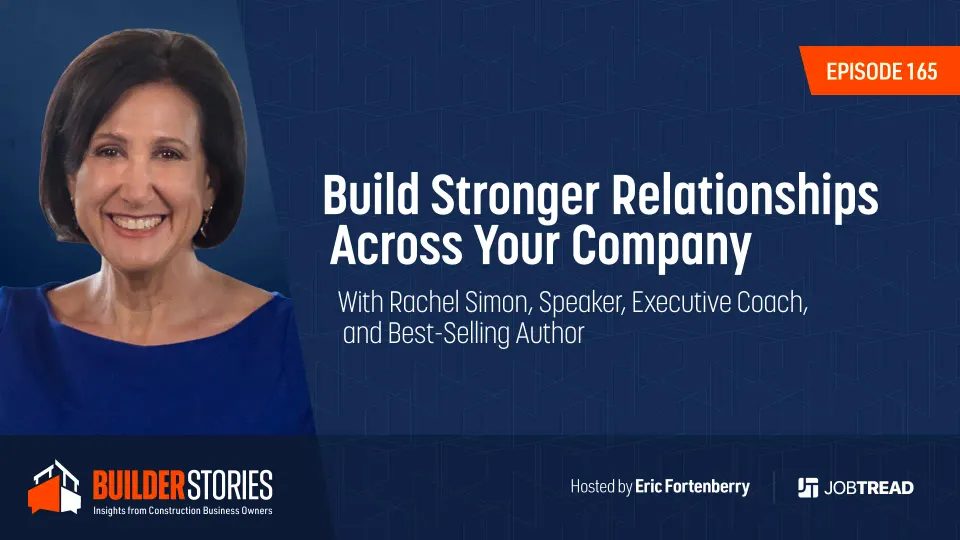

Everyone tells you to network. Almost nobody tells you exactly how to do it. Rachel Simon figured it out over a 31 year career at AT&T, 15 of them as a vice president. She’s also seen the crucial role that workplace relationships play in retention, job performance, and company culture. In this episode, she breaks down the eight relationships everyone needs at work and the one people overlook the most.
In this episode you will learn:
- The twist on “it’s who you know” that changes how you think about networking
- The relationship gaps that push good employees out the door
- How to network when you swear you don’t have time
- What to do when someone keeps turning down your invitations
- The part of relationship building AI can’t do for you
Resources:
Hear the full conversation on Builder Stories. Learn more about Rachel and her works here.
Eric Fortenberry: [00:00:00] Welcome to the podcast where we take a deep dive into the stories behind construction business leaders. We will share how they got started, how they found success, and the lessons learned along the way. I’m your host, Eric Fortenberry. Welcome to Builder Stories
Eric Fortenberry: Welcome back everybody. Today, I’ve got a special guest with us. We’ve got Rachel Simon. She is a keynote speaker, executive coach, and author located right here in Dallas, Texas. Super excited to have Rachel on the show today. She has spent 31 years at AT&T, including 15 of which she was a vice president there.
Eric Fortenberry: She’s got a great book, Relationships at Work: How to Authentically Network Within Your Company. That came out back in 2023, and really excited to, to, to share that she is going to be a keynote speaker at the JobTread Women’s Summit that’s coming up this January 2027. Real excited. Her talk is gonna be about the eight [00:01:00] relationships that you need at work.
Eric Fortenberry: So again, we think that this is very relevant for everyone. Excited to have her on the show. Welcome to Builder Stories, Rachel.
Rachel Simon: Hi, Eric. Great to be here.
Eric Fortenberry: So excited to have you. So why don’t you give us, uh, you know, g- give us a little bit of your own kind of background. You know, uh, what, what, what got you interested in, in, in workplace relationships?
Rachel Simon: Yeah. So I spent my entire career at one company, which is, uh, a little bit of an anomaly these days. I joined back, uh, when we were just the phone company, and I hate to date myself, but we sold the phone that was on the wall, and our big upsell opportunities were call waiting and caller ID. So yeah, it’s been a while.
Rachel Simon: So you can s- imagine how much transformation I have seen in the telecommunications business. So entire career, 31 years at one company, and one of the things that I love to do is to mentor and develop people. I love to lead mentoring circles, where you have several people at one time. And about 12 years ago, one of my circles asked me if I’d put together something to teach someone how to network.
Rachel Simon: I was like, “No. No, I, I don’t even know what I’d say.” [00:02:00] And they, they’re very persistent. They said, “Rachel, you’re really good at this.” And I had to think about it. I was like, “I am good at this, but why?” Because I am a massive introvert, and people are always shocked to hear that because they mistake being an introvert with, um, you know, just being bookish and not being able to, uh, carry a conversation, and I absolutely can carry a conversation.
Rachel Simon: And then I realized that I’m really good at building relationships one on one. And so I put together a presentation for this mentoring circle, and it turned out to be pretty popular. I would do this presentation all the time within my company. Every time I would do it, someone said, “You should write a book,” and I did.
Rachel Simon: You already mentioned it. Thanks for that great plug, especially since 100% of the profits go to United Way of Metropolitan Dallas. That’s awesome. And, um, then that put me on a whole different path in life. I started to get asked to speak quite a bit at other companies and conferences and associations, and 31 years felt like the right time to wrap up my career, and now this is what I have the pleasure of doing.
Rachel Simon: And I’m so passionate about it because nobody teaches us how to build these relationship, Eric. They just say, “Go [00:03:00] network. Go meet people,” but they don’t teach us how. So that’s what I’m passionate about doing.
Eric Fortenberry: Yeah. That’s awesome. So I’m, I’m curious, like, in your time at AT&T, like, what, what did you notice about the people whose careers really took off?
Rachel Simon: Well, I mean, I’m gonna sound like a broken record over our time here together, but it’s all about who they had a relationship with. And here’s a big aha moment I had. You love the phrase it’s who you know, but I actually realized it’s not who you know, it’s who knows you Ah, kind of mind-blowing, right?
Rachel Simon: Yeah. It’s who knows you, who knows your work, who knows your reputation, who knows what you could do, who will give you a stretch assignment, who will, you know, help you to, um, to grow and reach your dreams. And so that’s what I started noticing about people, is the people that were well-connected, it kind of gave them this like big s- you know, invisible spotlight, so to say, where they would get exposure opportunities, and they would get, um, you know, appraisal ratings and bonuses and everything else, and those are the kind of people that I started to study, and I realized it all came down to those one-on-one relationships.[00:04:00]
Eric Fortenberry: Yeah. That’s great. Well, again, your, your, your talk is gonna cover the eight relationships that you need at work. And can you kind of preview us, uh, you know, what, what those might be?
Rachel Simon: Yes. This is a little bit of a teaser. Um, and I, I tell my story in the presentation through a jigsaw puzzle, and, um, because our, our jobs are hard.
Rachel Simon: They’re, they’re, they’re complicated, and sometimes it’s like going into work every day and the jigsaw puzzles are all, all over the place, upside down. There might be two boxes all at one time. Yeah. Um, so your boss, of course, is the most important relationship. Your boss is the one that says, “I am employing you to put together this puzzle,” right?
Rachel Simon: Um, your mentor is the one that says, um, “I’ve done this puzzle before. Let me show you exactly how I did it.” Um, third one is gonna be mentee, and I use that word a little bit loosely because what I mean by mentee is we should always be helping someone. We should always be training someone. We should always be welcoming someone.
Rachel Simon: “Oh, I, I struggled with this puzzle, too. Let me show you how I figured it out.” Um, we have the challenger. The challenger are the ones that say, “Are you sure that piece goes there? You sure? You sure there isn’t a better way to do that [00:05:00] puzzle?” Uh, the trusted colleagues, the trusted colleagues are the ones that say, “Oh, I know this puzzle’s really tough, you know, but I’ll sit here and you can vent, you know, while you do that puzzle.”
Rachel Simon: Uh, your advocate, your advocate talks about you when you’re not in the room. Your advocate is the one that is saying in another room, “You know who’s great at doing puzzles? Erica,” right? “You need somebody that’s a bright ray of sunshine, right? That’s gonna be Danielle.” Um, and then the person of influence.
Rachel Simon: The person of influence is the person that says, “I have that exact puzzle piece you need, and I need this puzzle done, too. Let’s work together for it.” So that’s seven, and then not surprisingly, the last one has to be you. It has to be you. It is your puzzle. You could have the best mentor in the world. You could have the best boss in the world, but if you are not investing in your own development and your own relationships, it’s all for nothing.
Eric Fortenberry: Yeah. That’s, that’s interesting. You know, again, to, to sort of really lay out and think about all of those different relationships that- Yeah ... that you could have at work. I, I’m curious. Are, are there, like, any that you see that people most often skip or, or, or don’t, you know, focus enough on?
Rachel Simon: Well, it, it’s situational, of course, [00:06:00] right?
Rachel Simon: Um, but the one that I’m always gonna say you have to have, the great relationship with your boss. You just do. Some people say, “Oh, my boss isn’t likely,” and then they’ll, they’ll kind of, you know, retreat to their corner and just put their head down and do their job. Mm-mm. You gotta get your boss to like you.
Rachel Simon: You gotta get your boss to trust you. You gotta get your boss to, to be on your side. That’s the one that requires just a little bit more, um- Emphasis, because your boss controls everything. Your boss controls, you know, your livelihood. Um, there’s nothing worse than coming to work every day with a knot in your stomach.
Rachel Simon: We don’t need that, right? And so, um, I really teach people if they have a relationship lacking with their boss, that is the first one that they have to focus on. I’m not saying the rest are gravy, because it’s situational. Sometimes you really need that great mentor. Sometimes you really need that great relationship with somebody in another department.
Rachel Simon: But the one that people overlook the most is gonna be their boss.
Eric Fortenberry: S- so I Am, am I right to assume that these, these relationships, like the same person might be able to be in, in multiple of these categories?
Rachel Simon: Well, in a perfect world, [00:07:00] um, yes. In, in a perfect world, your boss is also your mentor and your challenger- Yeah
Rachel Simon: right, and your advocate. But then I always challenge people to say, “Wouldn’t it be better if you had eight people in your corner?”
Eric Fortenberry: Yeah.
Rachel Simon: Right? Wouldn’t it be better if you had 16 people in your corner, right, if you double that? So yeah, in a perfect world, you have one person that plays multiple roles for you, but don’t stop there.
Rachel Simon: The more people that know you, know your work, know your reputation, um, that’s what makes your job more fulfilling.
Eric Fortenberry: Sure. So again, our, you know, our, our audience here is, you know, a lot, lot of business owners, business leaders. You know, how, how can, how can these leaders, you know, build real relationships with their employees who report to them?
Eric Fortenberry: Are there, are there any specific kind of, you know, tangible things that, that you might be able to, to, to shed some light on here?
Rachel Simon: Yeah, and I love that your audience is made up of business owners because, um, I developed this presentation when I was at a big company and talking internally, but of course, as I’ve, you know, started to speak, uh, all over the world, I realize how applicable this is for business owners as well.
Rachel Simon: You just substitute, uh, [00:08:00] boss with your customers, right? They’re the ones that are ultimately your, your boss. So you have to have a relationship with your customers. Um, but to your question about, um, you know, are there tactical things that you could do to get to know your employees, um, man, this is the one thing AI can’t do is relationships.
Rachel Simon: You have to get to know your people.
Eric Fortenberry: Yeah.
Rachel Simon: You have to get to know them. You could ask AI for a compliment, and you could ask them, you know, what they know about your employees, and that’s great, but you have to put that extra step in and take the time to get to know them as a person. Um, if it’s something that you struggle with, write it down.
Rachel Simon: Write it down. You know, once you have a, a conversation with someone and ask them about their family and their vacation plans and what they like doing outside of work, um, just, just write it down. That way, next time you meet with them, you can take it out and reference them. They’ll feel so good that you remembered something specific about them.
Eric Fortenberry: Yeah. And would you say, you know, ’cause, ’cause, ’cause a lot of, you know, again, a lot of our, our, our audience here, they, they may leverage the subcontractor model where, you know, they have a lot of subs that are working for them. Sure. Would you say that these relationships can, [00:09:00] can translate to, to that as well beyond just those employees?
Rachel Simon: Oh, 100%, and I’d probably put those people in, um, that seventh relationship I talked about, the person of influence, right? Yeah. And so they don’t really fit into another category. They’re not an employee. They’re not a mentor. They’re, they’re not an advocate, but wow, you both need this puzzle done. You both have, you know, every vested interest to making sure that it goes perfectly.
Rachel Simon: Yeah. So yes, this, those relationships are absolutely critical, um, and especially in these kind of subcontractor relationships, your reputation is tied to them. Yeah. And if the, if the project sinks, if it doesn’t go well, well, so go, so goes you. And so it’s imperative that you have that relationship, that you have that trust where you, if something goes off the rails, where you can say, “Let’s, let’s, um, you know, drop everything and figure this out and move forward together.”
Eric Fortenberry: So, so what would be like one small step that, that someone could, could take this week to start building a key relationship?
Rachel Simon: So I, um, I read a [00:10:00] book that really influenced e- me many years ago, and it was called Never Eat Alone. And you don’t have to read the book, because the title kind of says it all that, uh, you know, you have to eat anyway, you may as well break bread with other people.
Rachel Simon: And I made that a huge practice in, um, in my life when I was working, and now, um, still today. We’re, we’re recording this at 10:00 AM Central, and I have lunch plans to, to meet with somebody later today, um, that I try to eat or get coffee with somebody, um, just about every single day. And when people say, “Rachel, how do you have time for that?”
Rachel Simon: It’s just something that I build into my day. It’s just something that I make as a priority. If you put, you know, an important meeting on your calendar, it gets done. So something simple that you can do, ask somebody to get a coffee, right? Ask somebody to grab lunch. Um, you don’t even have to spend any money on this one, right?
Rachel Simon: Um, I’m going to bring a brown bag today. You wanna, you wanna just go ... It’s a beautiful day. You wanna go sit outside and eat? You wanna take a walk? You could do virtual. Um, s- I, I used to go to lunch or coffee with people every single day up until 2020, and then, [00:11:00] of course, when the pandemic hit and we shifted so much to virtual, and that ended up being such a blessing because I used to go to lunch or coffee with just people in Dallas, and then I started to have these virtual coffees with people all over the world, and now that’s something that has really kept with me.
Rachel Simon: So one thing that you can do today, um, or before, you know, the, the sun goes down, is reach out to one person and just say, “You know what? We’ve been working on this project, and I don’t even know that much about you. Can we do coffee? Can we get a virtual coffee? Um, you know, I would just love to get to know you better.”
Rachel Simon: I bet you’d make their day.
Eric Fortenberry: Yeah, that’s, that’s awesome. You know, I, I feel like, you know, again, as, as business owners, people are often just, you know, very focused on, on, on the day-to-day, the blocking and the tackling, and getting every single thing done that they got to get done on their plate, where, you know, sometimes they don’t take that step back and, and say, “How can I make sure that I’m strengthening the team and the relationships, and, like, you know, the culture?”
Eric Fortenberry: And, and that’s where I, I sort of feel like that, that always kind of takes a backseat to, uh, you know, the, the, the pressing fire at hand or the issues of the deal that we’re working on. And so, [00:12:00] you know, it does, it, it seems like that can be a challenge for people who, you know, again, are extremely busy.
Eric Fortenberry: They got a lot of responsibilities. H- how do you, how do you advise them to kind of make that time when, when they feel like they don’t have it?
Rachel Simon: I would 100% argue that building these relationships is actually a time saver. Because when you run into a fire, when you run into, you know, something going on, when you have that relationship, you can just pick up the phone and say, “Hey, hmm, what’s going on?
Rachel Simon: We ne- we need to get on this,” rather than, you know, trying to figure out who does what, who might know somebody that you can get to, rather than jump- jumping on a cold conference call and trying to get things done. So, um, there’s another book that I love, um, on networking that influenced me also many years ago, and I love the title.
Rachel Simon: The title says, Dig Your Well Before You’re Thirsty.
Eric Fortenberry: Hmm. I like that.
Rachel Simon: So good. So good, right? Um, of course, the modern-day equivalent is, you know, charge your cell phone before you go out of the house, right? But, um, but But it’s, um, dig your well before you’re thirsty. If you [00:13:00] invest in these relationships now, it’s gonna pay dividends down the road.
Rachel Simon: So I absolutely hear you, Eric, when you say that everybody is so busy, and when you have, you know, 15 things, um, to tackle in a day, you think, “Oh my gosh, I don’t have time for coffee. I don’t have time.” Yeah. Um, but, um, I really believe with every fiber of my being that it’s a time saver once you have those relationships down the road.
Eric Fortenberry: Yeah, that’s, that’s, that’s super insightful ’cause, you know, again, uh, uh, I think a lot of people just don’t take the time and, and they’re really, maybe they’re just not managing their time. You know, they think they’re managing it, you know, but it’s, it’s, it’s like there’s, there’s so many other ways that, like, you gotta sometimes be more strategic and don’t just let the pressing needs of every single day overwhelm you to the point where you’re not doing the, the, the bigger picture, the, the team building, the relationship building.
Eric Fortenberry: Like, I mean, that, that stuff will ultimately be the difference maker for you. You know, it’s not if you got that proposal out the door or not, it’s did you build a great team of people, and do they want to show up for you and work for you every day? You know, I think that can- Yeah ... that, that’s the [00:14:00] longevity play.
Rachel Simon: Well, you get it, and there’s, you know, a million studies out there that I could quote that, uh, companies with great cultures, um, when people wanna come to work, that it’s better for the business. Um- Yeah ... you know, how much does it cost to recruit and hire and, and, and train somebody new rather than keeping the great employees you have?
Rachel Simon: How much better is it when you have tenured employees that know what they’re doing rather than making, you know, honest, you know, mistakes because they’re new? Yeah. So, so much good business comes out of these strong relationships, strong culture.
Eric Fortenberry: So how, like, let’s say, you know, again, we’re, we’re a business leader, you know, we, we spend, you know Or, or kind of have this split between, right, the office and the field.
Eric Fortenberry: You know, a lot of our, our, our, our people are out there in the field that, you know, you, you may not see as, as often as the people who are in the office with you every day. Like, you know, y- y- you talked about kind of virtual meetings. I mean, are there, are there other strategies or are there other things that, that, that they can do to make sure that they are getting that same quality time in with those people who are out in the field, you know, that they [00:15:00] might not just, you know, see every day and, and, you know, again, kind of out of sight, out of mind?
Eric Fortenberry: Like, you, you don’t want them to feel that way, you know, but, but they may feel like, “Well, you know, I got a job to do. I got, you know, this, this, this work to get done.” Like, you know, and maybe is there ever that resistance from, you know, from, from someone who, who may not want to make the time to meet with you, but you know it’s important?
Rachel Simon: Um, yes. Yes. Um, that sometimes, uh, I get the question of, “Rachel, I’ve reached out to somebody, and, uh, they don’t wanna meet,” right? “They don’t wanna get lunch. They don’t wanna get coffee.” And so then I go through a little bit of a flowchart in my mind to say, “Do I need this relationship, or do I just want this relationship?”
Rachel Simon: If I just want the relationship and I’m not getting anything back from them, that’s okay. There’s other people to build relationships with. Um, there could be a thousand reasons that they don’t want to. Maybe they don’t have time. It’s not a priority. Maybe they don’t like me. Hard to imagine, but maybe they don’t like me.
Rachel Simon: All right, so if it’s just a relationship that I don’t want, I’ll just let it go. But if it’s a relationship I need, then I’ll keep at it. Then I’ll keep at [00:16:00] it. Then if they say, “Gosh, I’m so busy,” it’s like, “Oh my God, I completely get that. When’s a better time for you?” Um, you know, lunch might take an hour.
Rachel Simon: Doesn’t have to be lunch. Can we get coffee? That’s more 30 minutes. Okay, I don’t have 30 minutes. Hey, when you’re on your job site, can I come by and see you? And when you take your 10-minute break, can I just, you know, pull up beside you and, and chat with you? Right? So there’s, uh, there’s so many strategies that you could make to work for the timeframe you have
Eric Fortenberry: Yeah.
Eric Fortenberry: You know, I know you’ve, you’ve, you’ve done a lot of research on why people leave jobs. Mm-hmm. You know, how do you, how do you think that the relationship comes into play, and where is that in the, in that list of, uh, reasons why they leave jobs?
Rachel Simon: Well, um, I, I saw a great study, I don’t have it in front of me, but it’s by Gallup, and they had the top 10 reasons why people leave.
Rachel Simon: And number one, I can’t do anything about, that’s usually money, right? Um, but then it’s like reasons two, five, seven, and nine, there’s like four or five reasons that all tie back to relationships. Yeah. That, um, um, I’m in a silo, and I [00:17:00] don’t know people. I don’t have a great relationship with my boss. I don’t understand the priorities of the company.
Rachel Simon: All these things that relationships would fix. That, um, you know, I too have been in some different roles throughout my career where I didn’t feel like I mattered, right? So why stay if you don’t matter? But then once you have that relationship with your boss, with your team members, and you know that you are part of a team getting something done important, that’s when the fulfillment hits.
Rachel Simon: Remember that whole, uh, Psych 101, the, uh, Maslow he-hierarchy of needs? Yeah. Um, hopefully your audience knows what I’m talking about, ’cause I’m probably gonna get it wrong. But, you know, first we have to worry about food and shelter. But the ultimate goal of life is to have that self-actualization, to feel like we matter, and feel like the work that we’re doing is important.
Rachel Simon: And especially in, um, the work that your listeners are, are doing, gosh, y’all are building something. You’re building something that, um, could really matter for people’s homes, their, their, their shelter, [00:18:00] bringing people together, restaurants, office buildings. They’re building something that matters. And when people feel like they’re actually a part of that, um, that’s where that fulfillment comes in.
Rachel Simon: But you only know that if your boss is communicating. You only know that if your team members are thinking, “This is not gonna go south on our shift, because we care too much.”
Eric Fortenberry: Yeah. You know, it’s, it’s interesting. I, I see a lot of people who, they, they have very high turnover and, you know, there’s, there’s, there’s often that, kind of that natural like, you know, you, you just sort of wanna blame everyone else, and you wanna say, “Oh, that was the wrong person,” or, “We made a bad hire,” or, you know, whatever it was, like, “They weren’t a good fit.”
Eric Fortenberry: Like, I mean, a- are there any things that, like, as leaders, you know, a- any particular habits that, that, that we should take on that would help us to continually earn our team’s trust and, and hopefully keep that person, you know, or get that person even more bought in and motivated and wanting to go above and beyond for the team?
Rachel Simon: Yeah, it’s, um, getting to know them as a human being. Um, I, you know, had this long career, and my very last role, I was, um, our vice president of [00:19:00] privacy, data protection. And, um, I, I joined that organization in the legal department. I was not a lawyer, and, um, this fell, fell under legal. And, uh, we have an amazing general counsel, um, at, at, at that company.
Rachel Simon: And I’ll never forget, he sent out a note to all of his vice presidents, um, so a level be- two levels below him, right? There was a boss’s boss. He sent a note out to all of us to say, I’m summarizing, um, “I am so busy. I am so, so, so busy, but you know what? I gotta eat breakfast. If anybody ever wants to meet me for breakfast one day before the workday, please let me know.”
Rachel Simon: And, um, and of course, you know, you know me, I’m like, the ink wasn’t even dry on the email before I’m like, “Yes, yes, yes.” Um, but it surprised me how few of my peers did it, right? Hmm. Here he is giving this gift of h- his time. So if somebody’s offering their time, um, of course take it. But I love that he did that.
Rachel Simon: He reached down into his organization, remember he was my boss’s boss, and got to know his people, [00:20:00] and he started his day a little bit early to be able to do it, and that just really, really stuck with me. Yeah. And so, you know, um, l- let’s, you know, take the example of going out to a job site, you know? If, if you were to send a note to say, you know, “I’m gonna come just 15 minutes early, and you know, pull up with some donuts, you know?
Rachel Simon: Um, if anybody wants to come say hello.” Remember, not everyone’s gonna do it. Here’s all these, you know, wonderful colleagues of mine that didn’t take advantage of it. Not everyone’s gonna do it, but how much will it matter to that one person that does?
Eric Fortenberry: Yeah. No, that’s, that’s great.
Rachel Simon: Yeah.
Eric Fortenberry: You know, and, and again, I, I see, you know, a lot of times, you know, people will end up hiring, you know, m- maybe people who have a little bit less experience, but they’re super hungry, super motative- motivated.
Eric Fortenberry: It seems like that’s where those like, you know, those, those mentor relationships, you know, could, could play a huge role in these, in these peoples’, you know, career and, and, and really, you know, feeling, you know, that, that they’re very valued and that they’re learning, and it’s more than just that paycheck.
Eric Fortenberry: But like, what, what would you say, like what... If, if someone wants to, you know, have that mentor relationship with [00:21:00] someone else at their, at their, at their work, like what, w- what’s required to make it work on both sides? Because it is a two-way commitment. How, how do you, how do you think about that?
Rachel Simon: Oh, 100%. I, I actually love this question because I think mentoring is so important.
Rachel Simon: I saw a really good quote about mentoring where it says, uh, “Mentoring is when one person’s hindsight becomes another person’s foresight.” Hmm. And I just think that that really just encapsulates mentoring. Like, “Here, here’s what I did. It didn’t work. Learn from me.” Or, “Here’s what I did, and this, you know, will get you to the head of the class if you follow this advice.”
Rachel Simon: Um, you said that mentoring is a two-way street. Yes. So, um, throughout my career, I was matched with people, like as a mentor-mentor several times. Never worked. Never worked. You know, we had a s- a six-month commitment, so to say, and yeah, we met, and it, it was lovely, and it didn’t last. But you know what relationships did last is the ones that happened organically.
Rachel Simon: It’s the ones where I saw someone speak at a panel, and I would reach out to them and say, “Gosh, everything you said just [00:22:00] really, um, resonated with me. Do you mind if I pick your brain for 20 minutes?” Yeah. And then those relationships I still have today. I would love it when people would reach out to me and said, “Rachel, I think you’ve, you know, walked this road before.
Rachel Simon: Do you mind if I pick your brain?” Those are the ones that really resonate with me. And every time you think that you’re afraid to do this, because it’s scary, it’s scary to put yourself out there and send someone a text or an email and say, “Can I get some time with you?” Every time you’re afraid to do that, think about how you would feel if someone reached out to you, right?
Rachel Simon: Yeah. If somebody reached out to you and said, “Gosh, you know, I admire your wisdom and I admire, you know, how you handled that really difficult conflict. Um, do you mind if we, you know, just spend 15, 20 minutes together?” Oh, wow, they noticed me. Yes, of course, I’d be happy to. So every time you get nervous to reach out to someone, think about how you would feel.
Rachel Simon: And, um, going back to what we talked about in the previous question, if, um, if you don’t get a response, it’s okay. Move on. Yeah. Everybody’s not gonna think about it the same way you do. But somebody will [00:23:00] bite, and then you’re gonna have this beautiful relationship.
Eric Fortenberry: Yeah. Now, Rachel, earlier you, you mentioned AI, and I, I’d, I’d love to kind of go down that path with you a little bit, because, you know, again, as, as, as, as we see more and more builders, contractors, you know, businesses, they’re, they’re bringing AI tools into their companies, into the workplaces.
Eric Fortenberry: You know, we even see, you know, again, a lot of people are now going to AI to ask questions and get coaching and advice. Yeah. Like, what, what do you, what do you see happening, you know, and specifically kind of with those, those workplace relationships as AI becomes more and more prevalent in the business?
Eric Fortenberry: Like, is, is, are there any issues or concerns about like, do we need to be protecting kind of certain, certain things? You know, AI- Well ... you know, again, I, I don’t think it can do everything. So I’m curious kind of where, where you see its impact on, on culture and, and, and people and relationships.
Rachel Simon: We don’t know, right?
Rachel Simon: We’re, we’re gonna... Let’s date this re- this conversation, Eric, and, you know, let’s listen to it in 10 years, and we’re gonna think, “Oh, y’all were so cute not, not, you [00:24:00] know, thinking that AI, you know, was gonna do X, Y, Z.” We don’t know. We don’t know. We’re so, um, we’re so new to this. But what I do know, um, when people say, “Rachel, how can I use AI to help build relationships?”
Rachel Simon: Uh, it can help, um, maybe find people on LinkedIn, you know, that might have, um, similar job titles. So it, it could help you locate people. It could even help you write, um, help me write a warm email to someone asking them a coffee. Absolutely use it for that, but it can’t have the conversation. It can’t have the conversation, and that’s what makes a relationship special is the dialogue.
Rachel Simon: I’ve never had a relationship fully developed by texting, by emojis, by an email. Um, I only have relationships developed by having this kind of face-to-face conversation. And so you can absolutely use AI to give me a list of questions, uh, summarize his background so I could ask him some questions, but you have to do it.
Rachel Simon: It, it- Yeah ... it can’t be that substitute. And, you know, having the right relationships, um, not only can propel your [00:25:00] career and your fulfillment, all the things we’ve already talked about, but, hmm, also AI is probably gonna take away some jobs. And if you have those relationships, the more you have, the more people that might save you from that if there is a surplus, a downsizing, the more people that know you and know your work.
Rachel Simon: So we can’t rely on, on AI for everything.
Eric Fortenberry: Yeah. You know, it seems like as, again, as, as, as business leaders, you know, who, who are using AI, you know, like, like you said, I mean, being able to, to use it to, to help kinda craft those- Yeah ... those messages to, to try to tee up those, those times that we can spend, spend together.
Eric Fortenberry: You know, I mean, I, you know, and I, and I know even for me, I mean You know, we, we do a lot of interviewing, we’re meeting a lot of people. Like, you know, being able to kind of say, “Hey, you know, here’s who I’m meeting with. Can you help me, you know, just come up with a list of questions and things- Yes ... that might be interesting that can help, you know, make this a, a really, you know, fruitful conversation?”
Eric Fortenberry: You know, I think sometimes people feel like they’re, again, more, more introverted. They, they don’t feel like they’ve got great people skills. They might feel nervous or anxious, like, meeting with other people [00:26:00] face-to-face. And so, you know, do, do you see AI being able to sort of maybe help, you know, kind of facilitate some of that discussion for someone who maybe it just doesn’t come naturally to them?
Rachel Simon: Yeah. A- absolutely. And, um, you know, in, in my book, I have a whole chapter on how to make the most of a networking session, some questions that you can ask. My biggest flex in life will always be, by the way, that I wrote my first book without AI. That’s a big flex. So, so, so, you know, I have questions that you could ask, and now AI, you can say, “Give it...
Rachel Simon: Give me 200 questions that, that I could ask.” And you could put in their bio and everything else and, and make the question specific. So yes, that’s a great use of AI, but you’re the one that actually has to do it and have the conversation.
Eric Fortenberry: You know, it’s, it’s interesting too, though, you, you brought up, you know, even text messaging.
Eric Fortenberry: I mean- Absolutely ... you know, it’s, it’s... I- I’ve seen so many people who, you know, again, they’re, they’re trying to resolve this heated situation with a, a back and forth, you know, text or back and forth email, and it’s like, man, like- Yeah ... there, there’s so much that you lose, you know, the, the contextual clues and how, you know, this is actually, you know, [00:27:00] resonating and is message sent really message received.
Eric Fortenberry: Like, what are your thoughts on, like, when does it make sense to, to have a, a conversation via text or email versus actually getting on the phone or getting face to face?
Rachel Simon: Yeah. Well, you... I think you, you’ve already su- summed up the answer perfectly, that sometimes it’s just going back and forth and you’re getting nowhere, and you’re missing all that context, and you’re missing the emotions and the frustration.
Rachel Simon: Um, but you can’t pick up the phone effectively unless you have a relationship. Of course, you could pick up the phone, but is it more effective if you have the relationship? It’s hard to just pick up the phone and call another business owner, another CEO, um, when you’re in the thick of things and say, “Can we resolve this?”
Rachel Simon: But if you know them, you know, “Hey, Joe, how’s it going? How, how’s your family? How was that trip to, to Palm Beach,” right? Um, but if you know them, um, then it makes it so much easier to, to do that. But yes. If you... I mean, I don’t have a, a, a hard fast rule of how many texts you have to have go back and forth before you pick up the phone, [00:28:00] but you’ll know.
Rachel Simon: You’ll know it when you see it. No. If it’s more than three or four, just, just pick it up- Yeah ... um, and say, “Can we just chat about this?”
Eric Fortenberry: Yeah. No, it makes, makes total sense. You know, I wanna talk a little bit about, you know, the, the, the women and, and when we’ve got, you know, the women in the room. Like, what, what relationships do you think matter the most for, for a woman who is, is often the only woman in the room in this industry?
Rachel Simon: Yeah. Well, um, you know, my, my first several, uh, roles with, with the company I spent in call centers, and it was mostly women. And so I, I grew up, you know, with, with a lot of women. And then when I transitioned to roles in finance, it was the opposite, right? And I was with mostly men. And, um, so I finally understood the dynamic people were talking about.
Rachel Simon: And it’s not, um, right versus wrong, it’s just different. It’s different. Different communication styles, different needs. Um, I’m speaking with a huge sweeping philosophy right now, but sometimes men just wanna get down to business, whereas women care a little bit more about the feelings. So sweeping generalization, but that [00:29:00] describes me, that it’s hard for me to work on a business problem without being emotionally invested as well.
Rachel Simon: So, um The best mentors that I have had, and I’ve had w- women and men, but the men- best mentors I’ve had have been men. Um- Yeah ... when we talk about those advocates that are people that have talked about me when I’m not in the room, those have been men. And so I am just begging the men here, advocate for the, for the women, right?
Rachel Simon: Talk about them when they’re not in the room. If you get a project done, um, sprinkle their name into conversations, right? “We could not have done this without, without, um, Susie,” right? “Do you know who had the insight that really broke, cracked this all open,” right? “That was, that was Betty.” So, um, advocate for people, sprinkle their name into conversation, bring them to the table.
Rachel Simon: Some of those mentors that I mentioned, they, they said, “Do you wanna sit in on this meeting?” Um, women, if you’re listening, always say yes, right? If you’re invited to the table, always take that seat.
Eric Fortenberry: Yeah. I mean, that’s, that’s great advice, and, and again, I think, you know, as, as business leaders, you know, it’s, it’s important that [00:30:00] we understand, you know, the differences about how people might want to communicate and, and h- and, and, and so, like, I mean, a- a- are there any other kind of tips that you, you might see for, you know, uh, business leaders developing those, those connections, you know, and, and how do they sort of best navigate the differences?
Eric Fortenberry: You know, I mean, I, you know, and again, I would say, you know, a lot of people and, you know, w- regardless if they’re male or woman, like they- Yeah ... they may have different communication styles and, and preferences, but, like, you know, specifically here, like with, with women because this is a male-dominated industry.
Eric Fortenberry: I mean, that’s just the fact of, of, of, of, of, of it here in construction. But like, are, are there any, you know, specific things that, that as, as men, do they need to, to do differently or take into account when trying to make sure that they’re building that same high-quality relationship?
Rachel Simon: Yeah. Um, when you mentioned my bio, um, you said I’m an executive coach, and so there’s an assessment that I discovered a couple years ago that I love to do with my clients, and I love to do it with teams.
Rachel Simon: It used to be called [00:31:00] Strengths Finders, but then Gallup bought it, so now it’s called Gallup CliftonStrengths. And, uh, the premise is that there’s these 34 strengths, and everybody has different strengths, and how do you work together effectively? So, um, you’ve known me for 38 minutes here now, um, but this is not gonna shock you.
Rachel Simon: My number one strength is harmony, right? I don’t like conflict. I like people to get along. I, I, right? I, um, I’m just very harmonious. My number 34 strength, so my, my biggest weakness, is command. I’m not the person that just comes into a situation and says, “I need you to do this. I need you to do that.” Um, they’re both needed, both needed strengths.
Rachel Simon: But understanding a team’s strengths and who is strategic and who likes the harmony and who is the i- who are the ideators, who could put it into, um, i- into operations, those are all so great to understand about, about your team. Um- Because once you realize how everybody’s wired, that’s when the team really starts to- Mm-hmm
Rachel Simon: click on all, on all cylinders. That if I am into [00:32:00] harmony and I want my whole team to, you know, prioritize that, we might not get anything done. We just sit at the table and sing Kumbaya all day. But once I understand, right, who can come up with ideas and who can put them into motions and who has that discipline and responsibility.
Rachel Simon: So all this to say is understand the different strengths. You don’t even need an assessment to do it. You probably, if I challenged everyone to write down your, your team’s three big strengths, you would know it. Um, but once you understand their strengths, play into it. Play into it. Yeah. And don’t try to suppress it.
Rachel Simon: Bring it out so that way they can be effective.
Eric Fortenberry: Yeah, I, I, I love that. And, you know, again, we, like, we, we do kind of some of that personality testing before they even- Yeah ... you know, join the company. But, you know- Oh, that’s so smart ... I’d encourage everyone to- Mm-hmm ... to take that time, you know, because when you can really understand your team members, like, you are going to have such a stronger, you know, cohesive bond and, like, your, your working relationship will drastically improve versus if you never take the time to get to know each other and, you know, it, it just, it can make those, those, those tough, you know, conversations even harder, or they can make it harder [00:33:00] for you to be able to, to give, you know, compliments and feedback in, in a way that will be, you know, most, most ideal, you know, for that, that person.
Rachel Simon: That’s right.
Eric Fortenberry: I’m curious, so, so what, what made you wanna speak at, at JobTread’s, uh, you know, w- Women’s Summit? It’s, it’s our, it’s our inaugural event, you know, in, in, in January here, January 12th. You know, I’m, I’m curious what, what was the draw for you to come?
Rachel Simon: Well, um, you know, I mentioned that I retired from corporate America 18 months ago, and it’s been, um, dang, it’s been the most amazing, um, 18 months, and I’ve gotten to go all over the world now, um, to, to speak.
Rachel Simon: And so when your team reached out to me and, um, asked me if I would do this, I mean, you know, what, what’s that whole, “You had me at hello,” right? Once they told me the, uh- Yeah ... the audience, and, um, who this could really help, you know, by helping, um, people understand these eight relationships and the tactics to build them, um, it was a no-brainer.
Rachel Simon: It was a no-brainer. I was honored to be asked, and I really think that I have something of value to offer this audience, so I’m, I’m thrilled to be [00:34:00] joining.
Eric Fortenberry: Mm. I love it. Well, we- Yes ... we really appreciate you, uh, you, you doing that. Yeah. You know, and again, your, your involvement has, has, has been awesome. I mean, a- and maybe you can even share, so, you know, you, ’cause, ’cause you’re deeply involved in, in the local community, lots of initiatives.
Eric Fortenberry: Mm-hmm. Like, you know, what, what all, what all have you gotten involved in that you feel like has made the most, you know, meaningful, meaningful impact for you?
Rachel Simon: Well, I, I sprinkled this, uh, charity’s name in when I mentioned my book, um, United Way of Metropolitan Dallas. Um, all the profits from my book go there.
Rachel Simon: But, um, I’ve been involved with them for probably 15 years or so, and, um, I’m on an, an advisory board. And everything that I believe in, United Way believes in also. And so they are an umbrella organization that helps, you know, so many needs in our community. But getting involved in something that speaks to your heart also is great for your soul for relationships.
Rachel Simon: Because once you get involved, and once you’re, um, packing meals together and painting a house together, um, all those things, um, it checks off lots of boxes for you. It helps you [00:35:00] to serve the community, but also helps you to build those relationships within the community. So find something. Um, I’m a big proponent of finding something outside of work that, you know, speaks to you.
Rachel Simon: And if it could help you professionally, even better, right? If it helps you with some relationships that help your business or help you grow, help you learn new skills, even better.
Eric Fortenberry: Yeah. You know, I, I think getting involved in, in, in your local community, it’s, it’s a great way- Yeah ... for any business to, to, again, like you said, take, take a little bit of time outside of work, outside of the day-to-day- Yeah
Eric Fortenberry: you know, and just spend time with your coworkers and, and, and really, you know, appreciate those moments that you have. Like, it, it gives you something to do. It’s an activity where you’re all working together on the same page, trying to accomplish, you know, something that will have some greater benefit beyond, you know, you and your company.
Eric Fortenberry: It’s, it’s about, you know, really helping others and, and I think there is a, a ton of growth that comes through that. And, you know, we, we encourage people to, to do that all the time. And I mean, you know, we, we go do a lot of, you know, com- community involvement there, and, and I think it’s something that, you know, again, people just don’t
Eric Fortenberry: They, they must not [00:36:00] understand the real, you know, benefits and the value out of it because the ... there’s always an excuse why they don’t go do it, and they don’t go take that time, and they don’t go find those opportunities. And, you know, again, I, I, I would, again, encourage everyone, like these are such important opportunities that, that you do take advantage of because, you know, again, that’s
Eric Fortenberry: At the end of the day, like, i- i- your success is going to be heavily dependent on your team. That’s right. And the better you have those, those relationships, then like the more effective and more productive and more results you’re gonna be able to drive as, as, as a team versus a bunch of individuals working in their own little silos.
Rachel Simon: That’s right. That’s right. You get it. You get it.
Eric Fortenberry: Well, look, I, I’m just so excited that, that, that, that again, you, you’ve agreed to come and spend this time with us at, at, at JobTread Connect and, and at the, the Women’s Summit there. You know, as, as we, as we kind of wrap it up here, I mean, y- what, what would, what would be, like if you had to kind of give like the, the best piece of advice, you know, that, that, that you might be able to share with our audience, you know, with our contractors here who, you know, want, want to, want to be able to [00:37:00] improve, you know, their relationships and, and their company and their culture, like what, what would that advice be for them if, if you had to pick one or, you know, one or two things?
Rachel Simon: I would say don’t, don’t be afraid. Don’t be afraid. It, it’s scary. I’m asking you to put yourself out there, and that’s scary, right? You could be rejected, you could be ghosted, right? But what’s the upside, right? The upside is so much fulfillment and happiness and joy. Um, you know, um, building relationships is challenging, um, but being disconnected and lonely is challenging.
Rachel Simon: Yeah. So, um, there’s, it’s challenging both routes, which will get you to, um, a better place overall. So don’t be afraid.
Eric Fortenberry: No, I, I, I love that and- Yeah ... and again, I, I think with a lot of things in life-
Rachel Simon: Yeah ...
Eric Fortenberry: you know, the first time you do it, it’s, it’s obviously the scariest. There’s a lot of unknowns. Yes. But as you get more and more comfortable, like it does, it becomes easier and easier, and then to the point where like now you’re really enjoying it and you want to do it, and you miss when you, when you don’t, you know, get, get, get those opportunities.
Eric Fortenberry: So, you know, I, I think don’t be afraid is, is great advice for everyone out there. You know, again, you’ve, you’ve shared a [00:38:00] lot of insight about the importance of really focusing on the relationships within our companies and within the workplace. Like, it, it, it can make a huge difference. You know, we have seen this time and time again.
Eric Fortenberry: And so I, I’m just, I really appreciate you coming on, you know, sharing a little preview here of, of, of what your talk will be. Uh, we’ll be sure to, to list out, you know, those, those books you mentioned as well. I’ve, I’ve, I’ve heard of all of them. I think they could be great, you know, resources for, for, for business leaders wanting to learn and grow.
Eric Fortenberry: You know, obviously we, we’ve got your book as well. You know, so, so thank you, Rachel, for, for coming on, for sharing all this insight, and can’t wait to see you at JobTread Connect in, uh, in January 2027.
Rachel Simon: A true pleasure. Thanks for having me, Eric. You’re a great interviewer. Thank you.
Eric Fortenberry: Oh, thank you. Well, have a good one.
Eric Fortenberry: See ya. Thanks for joining us for this episode of Builder Stories. We hope you enjoyed the conversation and gained valuable insights that can help you in your journey along the way. Don’t forget to subscribe to the show and leave us a review. And as always, if you or someone you know [00:39:00] has a story to share, please contact us at builderstories.com.
Eric Fortenberry: We’d love to hear from you. I’m Eric Fortenberry, and remember, every builder has a unique story. Keep building yours.