
Automate the Obvious, Personalize Everything ElseWith Steven Ross of Renovating KC Design and Remodel
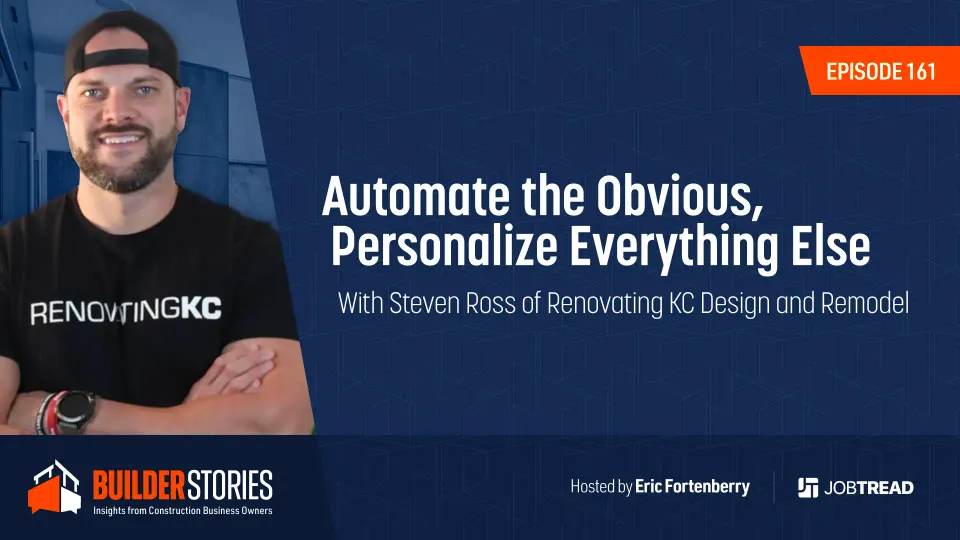

Steven Ross and his brother Ben started Renovating KC in 2020 and “did everything the wrong way.” One early mistake cost them $90,000 on a single project. Five years later the Lenexa, Kansas firm landed at No. 139 on the 2025 Inc. 5000. In this episode Steven reveals the secrets behind that explosive growth. He also shares how his team uses AI to move faster than ever while delivering an experience no computer can match.
In this episode you will learn:
- The campsite strategy that keeps his rapid growth on track
- The best pace to keep you growing at the optimal speed
- The simple rule he follows for deciding what to automate
- The hiring approach behind his 35-person team
- When micromanaging becomes the right move for your team
Resources:
Hear the full conversation on Builder Stories. Learn more about Renovating KC here.
Eric Fortenberry: [00:00:00] Welcome to the podcast where we take a deep dive into the stories behind construction business leaders. We will share how they got started, how they found success, and the lessons learned along the way. I’m your host, Eric Fortenberry. Welcome to Builder Stories
Eric Fortenberry: Welcome back everybody. Today I’ve got Steven Ross, the owner and president of Renovating KC Design and Remodel. They’re located in Kansas City, Kansas. Super excited to have Steven on. They’ve got an extremely fast-growing company up there in, in Kansas City, so really, really can’t wait to hear this story.
Eric Fortenberry: Welcome to Builder Stories, Steven.
Steven Ross: Awesome. Thanks Eric. I appreciate you having me. I’m really, uh, really a big fan of JobTread and you, what you’ve done professionally, uh, with all of your companies and JobTread specifically. So man, I’m excited, ready to rock and roll here.
Eric Fortenberry: All right. Well, let’s do it. I lo- lo- love hearing that.
Eric Fortenberry: So why don’t you kick us off, a little bit of background. Yeah. How’d you get into construction? What led you to, to start your business? And, and tell us a little bit about [00:01:00] what you guys do.
Steven Ross: Yeah, for sure. I kind of want to play us a, a little bit of a, uh, a, a game here, and it’ll lead into, I think, what we’re gonna talk about.
Steven Ross: So I want to explain Renovating KC in two ways, and then we’ll talk about which one makes the most sense, and it’ll lead in, I think, to what we’re talking about. So, uh, the first one, uh, is a little bit more scripted, a little bit more AI generated, right? And then the second one will be more of a story. So, uh, the AI version is, you know, Renovating KC is a design build firm located in Lenexa, Kansas.
Steven Ross: We have 35 employees. We do between 80 and 100 projects a year. Uh, we have, you know, full service design, build, remodel, et cetera. Um, you know, we’re passionate about our clients. Uh, we service mainly the Johnson County, Kansas area. Been in business for five years. Uh, the owners are, uh, three of us, but mainly me and my brother and then another gentleman named Derek Thomas, and we have a lot of fun doing what we do.
Steven Ross: So that’s the AI version, right? All right. So let me tell you m- let me tell you the story, okay? So my brother and I started this about five years ago. [00:02:00] We’re five years into this bad boy. Uh, we grew up with a nuclear engineer father, made us build everything. We got into construction back in 2010, right out of the recession, still in college, trying to flip homes, doing it all the wrong way, losing a ton of money, having a good time doing it, but we learned a lot of things along the way.
Steven Ross: In 2020, COVID hit. Uh, my background’s in real estate, but 2020 COVID hit, me and my brother were like, “All right. We’re done flipping houses for now. The design build market is real, so we’re- we already know how to do a lot of this. Let’s get some design staff on board and let’s get rolling here.” So- Eric, we did everything the wrong way.
Steven Ross: Everything was wrong. We lost so much money, so many clients. We’re self-funded. We don’t have a line of credit. We don’t have a bank backing, anything like that. We just cut our teeth all the wrong ways, which is how we were able to scale, I believe, so quickly, and our customers never knew it, right? Our clients that we-- There’s one client specific.
Steven Ross: We lost $90,000 on this project. [00:03:00] Client never knew it because it wasn’t their fault. It was our fault. So as we continued to bootstrap this thing, self-fund this thing, learn things the hard way, we grew into a design staff, project management staff, construction management staff, field staff, field crew.
Steven Ross: We’ve got some of the best carpenters in Kansas City, some of the best designers in Kansas City. It’s a family-owned business My job here is to take care of the 35 people and all of their families, right? I get emotional about this when I talk about it, but when... We had a company meeting two weeks ago. I cried in front of everybody.
Steven Ross: It was awesome. When I look at all of them, I think about their families, and I think about what decisions do I need to make for Renovating KC that protects both the employees and the team here and, and their whole ecosystem, right? So that’s a little bit about us. I’m super, super passionate about this business.
Steven Ross: We own other trades businesses, other, uh, investment businesses outside of Renovating KC, but I spend the majority of my [00:04:00] time here, ’cause I, I just love it. I love the people, I love the clients, love the projects. We get to build something. It’s really fun. So that’s the more real version about us, so. I
Eric Fortenberry: love it, man.
Eric Fortenberry: Yeah. Yeah. I absolutely love it. Love the passion, too. I, uh... Look, I, I, I have cried multiple times in front of my team as well, and it’s, it’s just tears of joy, you know? And the passion that, that flows through. I mean, people tell me I wear my heart on my sleeve, and-
Steven Ross: Yeah,
Eric Fortenberry: you have to ... it’s 100% true.
Steven Ross: Exactly.
Eric Fortenberry: Man, that’s, it’s super awesome, though, that, you know, you and your brother, you’re, you’re able to, to start, you know, by, by, by buying rental properties, you know, doing, doing that whole deal. Where, where do you think... Where did that entrepreneurship mindset and that, that, that entrepreneurial drive, where did that come from?
Steven Ross: Yeah. Uh, probably from my parents. You know, my mom, uh, she was an entrepreneur. My dad, like I said, nuclear engineer, so kind of the best of both sides of the brain. You know, one’s a think tank guy, one’s a sales gal, and, uh, we kind of got the best of both worlds. So we’ve always felt like that kind of growing up.
Steven Ross: You know, we were having garage sales, selling stuff out of our garage that my [00:05:00] parents didn’t want us to sell. You know, we were doing, uh, a mobile car wash, things like that. So I think it’s just been in us our whole lives, and we’re not afraid of risk. And, uh, I played baseball growing up all the way through college, so I was...
Steven Ross: Baseball will teach you one thing, and that it’s okay to fail, and the faster that you can get over failure and o- onto the next play, onto the next thing, the better off you’re gonna be in life. And that translated really well for me. Some guys get frustrated with that, but it translated very, very well for, for me to business, to where I’m not afraid to make mistakes.
Steven Ross: I don’t want to think about something for two weeks. I’d rather think about it for two hours, chat with the team, and then implement and go, and then By the time I’m on version three or four, we’ve perfected it before the other guys even started it two weeks later. So I’m just not afraid of that. I’m a super competitive guy, so is my brother, so we just, we like to get in and get after it, and, uh, it’s okay to make mistakes.
Steven Ross: We all do. Everyone likes to pretend like they got it all figured out, they know what [00:06:00] they’re doing. “Yeah, I’m the best in the world at this, this.” It’s like, no, you’re not. Like, we all suck, you know, at certain things. Yeah. So it’s just okay, it’s okay to admit that. It’s like you just gotta get over it, you know?
Eric Fortenberry: Yeah. So- 100%. Yeah, we, we, we love hiring, uh, athletes, you know, people who are just that, that natural drive to, to compete, to win. You know- Yeah ... a super, super good skill to, to, to have. You know, it’s, it’s, it’s interesting, too, you know, I, I, I also, I, I think making mistakes is, is totally fine, totally healthy, as long as when you make a mistake, you take the time to learn from it and understand, like, “How did that happen?
Eric Fortenberry: What led me down that path that ultimately wasn’t the right answer?” And then- Yep ... make sure you don’t keep making the same mistake over and over and over again. I mean, that’s, that’s when you got a real problem is if, if you can’t course-correct and kind of, you know- Yeah ... adjust whatever those, those, those factors were that, that sort of- Yeah
Eric Fortenberry: you know, led you, led you astray. But-
Steven Ross: It’s kind of that ego, right? You know, it’s like if, if people have an ego and they want to pretend like they’re, they were correct and they’re gonna stand by what they- Yeah ... it’s like leave your ego at the door. I try to do that every day. [00:07:00] And, you know, I’ve got a big enough ego for everybody here, and I leave it at the door every day saying, “I’m vulnerable.
Steven Ross: It’s okay to make mistakes.” Yeah. You gotta flush it. You gotta learn from it and move on. And the team appreciates it. Um, if it starts at the top, that I make the most mistakes, I’ve made the most mistakes and the most expensive mistakes than anybody else here. So, uh, if I can admit that and get over it and be vulnerable about it, you know, the team will follow suit.
Eric Fortenberry: Yeah. You know, I, I feel like that’s, that’s also sometimes, you know, it’s, that, that’s where you find the real innovation is, is, is when you’re trying something new, when, when you’re going, you know, kind of down a path that, that hadn’t been forged before and it’s like, you know, sometimes there is a little bit of that, that, that risk.
Eric Fortenberry: And you know what? It doesn’t always pan out and, you know, as long as, as long as you kinda, you know, cut, cut your losses as quickly as possible and, you know, try to, try to make, make amends if, if need be, you know, it’s, I, I think it’s a very healthy part of business.
Steven Ross: Yeah. Absolutely. I
Eric Fortenberry: love it- You know, so-
Eric Fortenberry: man. I love it ... s- s- so interesting enough, you know, we, we also started kinda right there in the, in the, in the heat of COVID, so, so I know firsthand how, how challenging it, it can [00:08:00] be. You know, what, what, what would you say, like, what, what did you see as some of, some of the biggest challenges that, you know, that, that, that COVID and, and, and just kind of that, that whole era sort of posed to you all and- Yeah
Eric Fortenberry: and how’d you overcome those?
Steven Ross: It’s been fun. I feel like we’re kind of growing with JobTread together. I mean, I think we al- almost started pretty close to the same time. I think you guys were a little ahead of us. Um- But we, you know, we had a previous software to this, and when we jumped over, it was like, okay, I feel like we’re connected correctly because JobTread’s doing the same thing that we’re doing.
Steven Ross: And, uh, kinda going through the COVID cycle together. And, uh, you know, something for us was just... COVID was great. Money was cheap. People were living at their houses, working at their houses. So it was the best time probably in the last 20, 30, 40 years to be in the design build space resi- for residential because money was cheap, people were living at home and working at home.
Steven Ross: Yeah. So we, we got real lucky there. Where we struggled was with the amount of growth that we were [00:09:00] having. When we turned the lights on, if you will- ... uh, it got... You know, I’m a sales guy, so for me, I was like, “Let’s go. Let’s every- We can do all your projects. Let’s make it happen.” And, uh, you know, you get 20 projects at a time, and you’re only six months into this, and you’re like, “Holy smokes, guys.
Steven Ross: We’re way out over our skis,” both from a cash flow perspective, a tracking perspective, a scheduling, you know, we’re letting our customers down kinda thing. So- Wow ... for us, it’s always been how to scale Slightly more than you’re comfortable with, but not scale too fast. So luckily, we learned that lesson early, and then we’re, we’re able to course-correct without going out of business because we were too s- you know, too quick.
Steven Ross: But that was the biggest thing for us was just scaling too quickly, trying to throttle that back a little bit and make sure- Yeah ... we could, uh, you know, grow at like a, a, a proper pace.
Eric Fortenberry: Yeah. You know, I’ve, I’ve definitely seen a lot of people who, you know, they’ll, they’ll, they’ll throw fuel on the fire before they’re ready for it.
Eric Fortenberry: You know, it’s like, it’s like, it’s like putting on a, a [00:10:00] second-story house before you’ve got, you know, a solid foundation below you. I mean- Yeah ... at some point it’s just gonna come cr- crumbling down on you. So, you know- Yeah ... I do think it’s, it’s important for businesses to, to really have a well-oiled machine before you start trying to, to, to accelerate and, and, and put that foot on the gas there.
Eric Fortenberry: It, it, it really- Yeah ... can, can help you to keep that sort of much more controlled- Yeah ... you know, growth versus just let- letting it, letting it loose and then again, kinda catching that wave where, you know, at, at any moment, you know, you could just get a rush of bunch of leads, bunch of customers, bunch of projects going, and then- Yeah
Eric Fortenberry: you know, you get into a situation where you can’t even, you can’t deliver on the demand, and that’s, that, you know, again, that, that, that could hurt your reputation, which- Yeah ... ultimately will, will cost you a lot more in the long run.
Steven Ross: Yeah. It’s about being as slightly uncomfortable in the pace of s- of growth, but without being irresponsible, you know?
Steven Ross: Yeah. We can’t take on too many projects, but we wanna... My, one of my favorite sayings is, uh, you know, “We’re building the airplane while we’re flying it.” You know? We, we wanna, we wanna keep the airplane in the, in the sky, but we’re still building it, we’re still tinkering it, we’re still making it better. [00:11:00] Uh, but we can’t, you know, we gotta have some sort of an airplane to start with.
Steven Ross: Sure. Right? And then we can’t work on it too aggressively while it’s flying. That’s when it crashes, too. So, um, yeah, scaling and growing for us has always been my number one kind of role, responsibility, making sure that we can throttle that up and down, you know, as the business wants to grow, wants to add employees, uh, wants to add, you know, new mar- you know, either new markets, cities, things like that, uh- Yeah
Steven Ross: new services. Uh, that’s always kind of been my core competency here is kind of managing that ecosystem.
Eric Fortenberry: So when you first started the business, like what, what were your goals for it and, and, and, and what kinda drove you, and then how have, how have those goals evolved over, over the last several years?
Steven Ross: Yeah. That’s a good question. So my, my background is in, uh, real estate investing. I was also a home inspector for 10 years. Did between three and 500 home inspections a year. I was a licensed realtor as well. The only thing I used my license for was to buy investment properties. But I was in that world adjacent to the design build space and [00:12:00] construction, uh, mainly on the inspection side.
Steven Ross: It was just like, golly, people are buying these brand-new homes, or they’re buying these flipped homes, or they’re buying these remodeled homes, or they’re just buying these j- junk homes that D- you know, DIY th- So I just, I saw the other side of it, and then- 5% of the time when I was inspecting a really well-built home or a really well, you know, remodeled home, I was like, “God, this is so rewarding.
Steven Ross: Finally, somebody took the time to do it right.” Um, so for us, that was, like, where we really wanted to go. It’s like, let’s start this. Our main goal is to provide a, a, an exceptional experience for our clients on the build side, and then we tacked on the design side. So then it was like, okay, how can we bush- push the envelope from what the homeowner can get, uh, from the design side while pricing it correctly and keeping them in, in their lane of budget, while also still at the end of it, you know, building and constructing something that was of good quality?
Steven Ross: That was one of our main goals, um That was the pie in the sky, you know, [00:13:00] we’re all excited kids, let’s get this company off the ground, and then you get a couple years into it, you know, you’ve got 15 employees that you gotta feed. Payroll gets pretty, you know, pretty large on a weekly basis. Yeah. It’s like, okay, my goal has to change from a this is a cool idea to now we’ve gotta really build out the machine for sustainability to last through these heavily scare, you know, scaling situations.
Steven Ross: Um, so that’s where j- honestly, you know, whether this was JobTread, uh, you know, podcast or not, I talk about JobTread nonstop here. I always say, “If it didn’t happen in JobTread, it didn’t happen.” Uh, my team is so sick of me, you know, saying that, but it’s the truth.
Eric Fortenberry: Yeah.
Steven Ross: And being able to latch onto a platform that could manage, at that time, most of our services.
Steven Ross: Now, today, it’s virtually all services, but you know, a few years ago, it was most of our services li- you know, uh, our, our action items and our scheduling and, and billing and invoicing, all, like time c- all that lived in JobTread. So for us, it was like, okay, Steven and Ben, my brother, it’s like we gotta build this out to the, to [00:14:00] the best of our ability to make sure we’re setting up this machine to handle more revenue.
Steven Ross: And not just more revenue, but more profitability come, you know, 12 months, 18 months, 24 months. So it kinda moved from pie in the sky concept idea to holy shoot, you know, we gotta, we gotta build this thing out to where, okay, we feel like we’ve got it built out pretty well. Let’s put our foot back on the gas.
Steven Ross: Yeah. Okay, let’s rebuild what broke, and then let’s, you know, continue to do it. So right now we feel like we’re on version-
Eric Fortenberry: Mm ...
Steven Ross: probably five or six of what Renovating KC is. Uh, the systems, the processes- Mm ... the people, et cetera. And, you know, I’ve got a huge tank of gasoline dumped all over this thing right now.
Steven Ross: So- Nice ... we’re enjoying it.
Eric Fortenberry: Yeah. Uh, w- wanna dive into that a little bit more. I’m, I’m curious first, though, with, with you and Ben, your, your brother, I mean, y’all have been in business together for, for, for quite a while. How do you guys split, like the, the, the, the roles, the responsibilities, decision-makings?
Eric Fortenberry: Like what, what’s kind of each of your, each of your- Yeah ... your lanes there?
Steven Ross: Yeah. So for me and Ben, then also for Derek, the thir- the third guy, he’s more of the financial, kinda back end. He’s [00:15:00] not really customer facing. But he, he does a good job. He’s a huge AI guy. He comes from the tech world, comes from the software world, so he’s our kind of our secret weapon when it comes to, uh, implementing all of these great platforms that we have.
Steven Ross: Uh, but for me and Ben, it was always kinda... We’ve always just, you know, as kids, we never really argued and never really fought and, you know, n- none of that. So, uh, when we started this, it was, I’ll say, a little bit more so my idea, and he was like, “Let’s do it. I’m with you. You know, y- you make the calls. I’ll add the advice.
Steven Ross: I’ll tell you when you’re being an idiot, and you kinda just, you make the mistakes. As long as you know how to fix them, let’s go.” So we kind of established that- I hate the, you know, pecking order early, and he makes plenty of calls. I don’t make 100% of the calls, but, um, we established that a little bit early.
Steven Ross: Now, as the business has evolved, uh, I oversee m- most of pre-construction. So the, the marketing, the sales, the initial consultation, the design, the project [00:16:00] management, the project prep, everything that kind of goes into pre-construction, inevitably leading, leading to that construction contract being signed, I kind of manage that ecosystem.
Steven Ross: Then there’s the blended gray area between contract signed and day one of demo, you know, where Ben and I both have to work together with our separate teams to make sure that the project is set up for success, and then he mainly oversees construction. So all the construction managers, the field staff, everything that happens in that ecosystem once a project is in production, uh, he’s gonna manage k- you know, that.
Steven Ross: We can both step in in any facility, so if there’s a customer that I need to run out to that’s already in construction, I can do that. If I’m out of town and there’s a sales call that pops up, you know, he can run out and do that. But we’ve got a pretty good lane that we stay in, and the gray area we let be the gray area.
Steven Ross: You know, multiple o- owner businesses, they fight and fight and fight in that gray area like they’re gonna fix it. Like, it’s okay realizing it’s the gray [00:17:00] area, it’s gonna stay the gray area. So whenever that scenario pops up of like, well, does Ben need to handle this? Do I need to handle this? Like, you just figure out that solution, that situation together, and you move on.
Steven Ross: You don’t try to solve the world’s problems of this gray area. Uh, and that’s where a lot of multi b- owner businesses get into a, a, a headbutt, because they’re trying to solve the gray area. Certainly. So for me, it’s like, stay here, stay here, and then when we g- when we get here, let’s work through it and move on, you know?
Eric Fortenberry: Yeah. You know, and a- again, uh, it’s, it’s clearly worked for you guys. It, think it was, uh, c- what, couple, was it last year, 2025, or, uh, you guys were ranked, uh, number, uh, 139 on the Inc. 5000, which is, uh, incredible.
Steven Ross: Yeah.
Eric Fortenberry: You know, that’s, uh... We, we, we were, uh, this year we were 155, so-
Steven Ross: Nice.
Eric Fortenberry: Congrats ... you know, kudos, kudos to y’all for, uh, getting even higher up there.
Eric Fortenberry: I mean-
Steven Ross: Yeah ...
Eric Fortenberry: you know, I think, I think at that time you, you were the second fastest growing design remodel company in the nation. Yeah. You know, which is, which is huge. You know, uh, what, number, number eight in, uh, in, uh, in, in, in construction. I mean- Yeah ... again, like, just extremely impressive growth.
Steven Ross: Yeah.
Eric Fortenberry: You know, I’m, I’m [00:18:00] curious, I mean, how, how do you think, like, h- how, how did you Think about kind of going into that, you know, scaling up your systems, your processes, like building out the team, because a- again, it, that, that takes a lot of effort to, to be able to reach that level of growth and then to be able to, to, again, not, not have the wheels spin off is, you know, kind of getting over couple million is, is, is, is, is, is, is one thing.
Eric Fortenberry: But, like, you know, just to, to be able to, to still deliver for each and every one of your customers, I mean- Mm-hmm ... it’s, it’s, it’s not easy. Yeah. So what, what, what, what can you share about how, how, how you would, uh, you know, when you think back, like what, what, what helped you do that and- Yeah ... and how did you, you keep delivering?
Steven Ross: Probably a healthy dose of just being a l- a little bit insane probably helps. Uh, just kind of being a little bit of an idiot sometimes, uh, in a good way, I guess. But, uh, all the cliche things, I mean, we have really good team members that work here. We have really good clients. I mean, all those things are givens for us, too.
Steven Ross: Um, it’s no different than anything else. Um, but just our ability to just [00:19:00] I see it, uh, I call them campsites, which is a stupid analogy, but I always try to figure out these campsites, right? So I try to get Reno KC to this campsite, and meaning the systems, the people, the process, all of that is successful for the revenue and, and profitability goal that we’re at at that point in time.
Steven Ross: And then Ben follows me, and he sets up camp in that campsite, and I move on to build the next one. So the next one is probably, like, the next quarter, the next six months, you know, maybe the, maybe the next year. But really it’s quarter by quarter, you know, two quarters at a time maybe. And I’m trying to get to that next campsite, see what I think our business is going to need from a how many construction managers, how many project managers, do we need to hire additional design staff?
Steven Ross: And because I have my hand on the, and my foot on the throttle for sales, because I do 100% of the initial sales call. Uh, we don’t have a sales team. Our designers don’t go out and run sales team or sales calls. Uh, our director of design, she’ll come with me if it’s a, a moderate or, or higher-end [00:20:00] lead opportunity.
Steven Ross: You know, because we are a design build. I’m not a designer at, at trade, but she is, so I’ll bring her with me. Um, but I still do 100% of... I’m on, let’s call it 98% of the sales calls. And so as I’m building the future campsite of what I think Reno should be for the next quarter, I can simultaneously throttle up my number of sales, uh, trying to get the funnel filled for when we get to that next campsite.
Steven Ross: So it’s kind of like if I didn’t have my foot on the throttle for, for sales, it would be really challenging to go ahead and forecast that next kind of wave of what Reno is gonna look like, that next campsite. But because I, I still have that, I’m able to throttle at the same time, if that makes sense.
Eric Fortenberry: Yeah.
Steven Ross: So-
Eric Fortenberry: No, I mean, what, what I’m hearing is, again, it’s, it’s very intentional planned growth. You know, you, you’re, you’re looking at where you’re at, where you’re at today and saying, “What do we need to do to get to that next level?” You know, I see a [00:21:00] lot of people who spend all this time up front, you know, focusing on scaling and, and they’re overengineering and building out, you know, these elaborate processes when they, they really don’t have, you know, the, the team or, or, or even the demand or the size and scale or, you know, really the, the need- Yeah
Eric Fortenberry: to focus on that. Yeah. You know, I, I think your approach, and again, it’s, it’s been our approach too, is like, you know, you, you need to, to continue to, to level up and scale as you need to do that.
Steven Ross: Yeah.
Eric Fortenberry: And in the meantime, just focus on execution. Yeah. You know, when you start to see those problems and you see the bottlenecks, you see the things that, you know, are, are, are becoming issues, then you-
Steven Ross: Yeah
Eric Fortenberry: dive in, figure out what can you do better, and then take it to the next level. I love the, the kind of the campsite analogy and then, you know, building out the camp behind you. I mean- Yeah ... makes, makes total sense.
Steven Ross: Yeah. And I mean, that brings us almost full circle to my silly, you know, intro as far as doing it two different ways is There, there’s, there’s a lot of, a lot of money, a lot of PE firms coming into all trades, right?
Steven Ross: Whether it’s design build, or any of the subs, or [00:22:00] really any trade right now. There’s a lot of new money, new ways of doing things coming into that. One is AI, technology, et cetera. So it’s interesting to see guys and, and gals and companies that have the background and the roots of before a lot of this was a thing.
Steven Ross: And I, I’ve not been doing this for forever. You know, I’ve only been in construction for 15, 16 years, so it’s not like it’s... I’ve, I’ve been doing this for 50 years. But there was a huge shift. The last five to six years has been a monster shift in how these businesses are operated. And to your point, people wanna come in here and they wanna build out the most perfect platform and the most perfect systems, and, “I’m gonna have my t- automated text set up for when my sales come in, and I’m gonna...”
Steven Ross: And all of these obvious things that are good, but they don’t have the, they don’t have the personality behind it, right? They don’t know how to build the relationships, both with their employees, their subcontractors, their vendors, and their clients. So I- it’s interesting to see people kind of come in and [00:23:00] over-engineer the idea that a computer can run this business, uh, which it can run a lot of it.
Steven Ross: Don’t get me wrong. We do all of that. But it’s interesting to see how they struggle because they’re like, “Why can’t I get... Why are my sales conversions down?” Or, “Why can’t I get a, a higher, you know, average contract value per remodel?” Uh, it’s because they struggle with that kind of personality of it. So I always say, uh, automate the obvious and, and personalize the experience.
Eric Fortenberry: Yeah.
Steven Ross: Right?
Eric Fortenberry: No,
Steven Ross: that’s, that’s- All the obvious things, uh, that JobTread has to offer, that Claude and ChatGPT and all these other... You know, I’ve got voice-to-text. We wear voice recorder. I mean, we do all of the things. We, I feel like we were, we weren’t the first to do it, don’t get me wrong, but, like, we were an early adopter of technology in this space years ago, and we were blowing people out of the water ’cause we were getting our proposals back within 24 hours, and they were mostly correct.
Steven Ross: Some were wrong.
Jessica: Yeah.
Steven Ross: Uh, [00:24:00] and we were, we were scheduling out properly. We had time cards with location tracking. We had daily logs that we could prove what our guys were doing that day, or if there was a warranty call. We, we were kind of an earlier-ish adopter in some of that stuff. And people that are coming into the space now, it’s all they know.
Steven Ross: So they come into it and they’re like, “Well, I’ll have this do this, and I’ll have this do this, and I’ll have, you know, this platform do this, and I’ll have this AI agent going out and doing this stuff while I’m sleeping,” like all that other stuff. Uh, but they lost the personal experience touch. So Design build is a high-end thing.
Steven Ross: You know, our average client spends about a quarter of a million dollars with us this year. So before we ask them to go spend a quarter million bucks, we have half-million-dollar clients. We have done several projects over a million dollar rehab budget. This is not new construction. So I can’t facilitate to that client, uh, with a computer start to finish.
Steven Ross: Again, we automate all of the [00:25:00] obvious, all of the things that JobTread has to offer, all the AI, all the-- We do it. We try to do it, and we’re continuing to get better at it, but we certainly... The number one thing for us on growth is the team is personable. It-- the experience we provide in a very chaotic industry, in a very stressful environment for our clients to live through a remodel, our design team makes it fun.
Steven Ross: Our project management team works together with our clients to make sure that we’re driving a, a project towards a budget goal and not just blowing it out of the water and trying to sell them something they don’t need. And our construction staff, I mean, our construction staff is operating in people’s most core thing, like their home.
Steven Ross: So The, a computer can’t come in and, and operate in somebody’s house while their kids are here, and the dog’s doing this, and the kitchen’s torn apart, and we gotta figure out how to do laundry, and we got in-laws coming in town. Like, our construction staff, because of how they were trained before us and with us, [00:26:00] they provide such a personal experience to the client that just can’t be matched.
Eric Fortenberry: Yeah.
Steven Ross: And so while I say always automate the obvious, let’s get, let’s kind of flip the script back a l- in time a little bit, and don’t forget about that personal touch to make sure that the experience feels like a person. Uh, like teachers right now, it’s funny to hear, there’s teachers in middle school, elementary school, high school, college, going back to pencil and paper.
Steven Ross: Right? Yep. And it’s for a lot of reasons, because students can cheat online on the computer. It’s pretty obvious. But we’re also gotta get back to some of that, “Hey, I’m p- I’m a person. I’m here to, I’m here to collaborate with you. I’m here to partner with you on your home, the most core thing in your life other than your family.
Steven Ross: I’m here to collaborate with you on that.” So- Mm-hmm ... if I could share anything with anybody who’s listening on this, whether it’s experienced or new or whatever, it’s like, do, automate the obvious. Do all of the things. You guys rolled out, like, three updates in the last 10 days. I can’t even keep up with them all.
Steven Ross: We’re gonna train on those, we’re [00:27:00] gonna implement, we’re gonna do all, all or most of those things, but at our core, we don’t wanna forget who we are. Yeah. And we’re, we’re fun to work with, we’re personable. We’re gonna provide such a high-level experience with all of the obvious software, technology, AI in- embedded in it that the homeowner won’t even maybe know about.
Eric Fortenberry: Yeah. So. You know, S- Stephen, I, I, I could not agree more with you. And, and again, I, I’m a software guy. I’m a technology- Yeah ... guy. I, I think, you know, and, and, and what, what you’re hearing from, from, you know, from you and what, what I’ll, what I’ll echo is that, you know, for both of us, the, the reason we were able to achieve such a high level of growth is because of our team and the people that we have put in place here.
Eric Fortenberry: You know, at the end of the day, you can have the best technology in the world, but if your team is not there, then it, y- again, you’re, you’re, you’re gonna struggle. You’re gonna struggle to grow and to scale. Yeah. I think first and foremost, like, I give all of our credit here at JobTread to the people that are on our team.
Eric Fortenberry: And, you know, I think that is something that You know, at the, at the end of the [00:28:00] day, you know, we, we can all leverage technology, uh, all day long, but, like, people want to buy from people they like, they trust. Like, they want that human, and I think that is gonna become even more important- Yeah ... as AI continues to, to take over all- Yeah
Eric Fortenberry: sorts of areas of our life. Like, people are gonna just, like, crave this, this, this relationship with others. Mm-hmm. And, and, and, and that’s where, again, if, if I could give any advice as well, it’s like, Man, focus on building a phenomenal team who understands your mission, your vision, your core values. You know, they need to be able to truly represent you and your company when you’re not there and, and, and for them to be able to kinda carry on and, and, and own, you know, their, their job and their role.
Eric Fortenberry: You know, that is just so important in this day and age, and I think it’s gonna become even more important.
Steven Ross: Yeah.
Eric Fortenberry: You know? So I’m, I’m
Steven Ross: curious, do- It’s exactly why you, it’s exactly why you do this. It’s exactly why you do this podcast. Yeah. ’Cause you wanna talk to real people using your software and your team’s software, how they’re using it, what the [00:29:00] feedback is.
Steven Ross: Like, we’re not all here just to blow smoke and rainbows and butterflies. Like- ... you guys do a great job of making sure we feel heard. And the amount, you know, years ago, you guys are big, you guys are big now, and I still get that per- uh, JobTread Bobby, he’s my, my guy. Uh, I don’t know his last name. I just call him JobTread Bobby.
Steven Ross: He’s, he’s been our guy for years. I got his, I got his direct line. He’s like, “Hey, Steven, what do you need, dude?” Um, the personal touch is still there. Yeah. And you guys are so... You’re just like us. Like, you guys have grown so much over the last few years, but you haven’t lost the, the touch of being connected to your users.
Steven Ross: Yeah. Which is easy to do for you guys. I mean, you’re big, and it’s a software company. It’s not supposed to be about the personal touch. But any time I’ve been, you know, in conversation with you guys or Bobby or you or whoever, it’s like, these are real people- Yeah ... doing real thing, solving real problems.
Steven Ross: So- 100% ... I appreciate that about you guys.
Eric Fortenberry: Yeah, no, I appreciate that. I’m curious, though, can, can you sort of shed a little bit of light into like what, what did your team growth look like? I mean, you know, again, it started off with just a couple of you. I [00:30:00] mean, now you’ve got, what, over 30 people. Mm-hmm. You know, sort of walk us through over the years.
Eric Fortenberry: I mean, when did you know that you needed to start building out more of a team? You know, where did you, where did you hire first? Kinda- Mm-hmm ... what, what were those key roles early on? ’Cause I see a lot of people who struggle to, to, to really find that balance of like, should I hire somebody, or should I keep doing it myself?
Eric Fortenberry: Yeah. Can I, can I afford, you know, to pay that person? Like cash flow, you know, what, what happens in a couple months if, if, if sales don’t keep growing how they are? Like, you know, there’s, there’s this real, you know, challenge that I think people have and- Mm-hmm ... and partly because they’re, they’re probably not, you know, budgeting out their, their growth and planning.
Eric Fortenberry: But it’s, it’s also, I think, a mindset of like, you know, not, not believing that they can hire someone who can do the job just as good as them. Yeah. So how did you guys navigate this?
Steven Ross: Yeah, it’s a common thing. I mean, the, the, the hiring process is an ever-evolving l- layer O- of an ecosystem. And what I mean by that is I always give the worst answer, and it’s a, it is a cliché answer, [00:31:00] but like I hire people for the person, and then I find them the seat.
Steven Ross: Because again, five years ago when we were just starting, we didn’t have any seats. We didn’t, we didn’t have a building. I mean, we didn’t have anything. So we were hi- I was hiring people because I was like, “You seem like a problem solver. You s- you, you seem like you care. You seem like a tru-“ Like all the obvious things, but it’s like problem-solving for me was like, okay, if I can...
Steven Ross: I have all these tasks that I’ve gotta figure out over the next year. Can I fraction off 10 of those and give them to you, or 10% of them and give them to you? So the first few hires was very much like, how can I hire problem solvers to put p- things in place? I could get this off of my plate. Then the next wave happens, right?
Steven Ross: So we hire a director of design. We went through two of them. The, the director, Jessica Berry, who’s here now, I mean, she, she’s incredible. So now I don’t have to worry about the next designer or a design intern or a junior designer or, you know, I don’t... She’s gonna manage that ecosystem. She’s gonna come to me for advice and say, “Hey, [00:32:00] Stephen, a-a- am I allowed to add on to the team in this capacity?”
Steven Ross: We’ll have a financial conversation about that, and then it’s like, “Yeah, this sounds like a good fit.” And we’re hiring people. I mean, we have a couple designers that are right out of school, and I’ll put their work up against anybody in Kansas City to- today. Today. They’ve been h- one of them’s been here for six months.
Steven Ross: I’ll put her work up against anybody in Kansas City today. And the only reason I ever would’ve looked at her or hired her is because of the director of design role that I filled before that. Does that make sense? So it’s like, it’s hard to give this one, you know, plot answer of like, “Well, I hire on this way.”
Steven Ross: It’s like it’s going to evolve based off the people that you have in your ecosystem. And as the ecosystem gets bigger and you g-
Eric Fortenberry: Mm ...
Steven Ross: get that kind of, I don’t like the term mid-level management, because we just ha- we just have one director, and then it’s us and everybody else and, you know, management, whatever.
Steven Ross: We don’t have this huge organizational chart where it’s like I gotta funnel this and funnel that or whatever. We’re super nimble, super quick. So as long as [00:33:00] you can get a couple of those key people there, then kind of let them manage their ecosystem a little bit. I’ve made the mistake of saying, “Well, hire the right people and they’ll do the rest.”
Steven Ross: I’ve done that. Uh, we hired a general manager and did that. It was a real big problem. You know, um, we weren’t, we weren’t setting ourselves up for success. Yeah. And that role doesn’t exist here anymore ’cause we don’t need it. Um, because of a lot of things that are technology or AI or automation or whatever, a lot of that role we don’t need.
Steven Ross: Mm-hmm. And then now because my time’s freed up, I can come in and pour into these teams and give them the management, the leadership and all that that they need. Um, so we’re hiring for different layers based off what’s kind of above that, if that makes sense.
Eric Fortenberry: Yeah. So. No, I mean, i-i-it’s just so cool to hear, you know, your strategy and your beliefs here ’cause like they, they, they really just mirror exactly what, what we’ve done and what we believe.
Eric Fortenberry: I mean, I, I am a super big proponent of having as flat of an organization as possible. Like, the, the [00:34:00] notion of, you know, needing to have, you know, all these kind of middle man- you know, managers and, and, and all this like, you know, bureaucracy, like I, I hate it, you know? And like, it’s, it’s like when you hire great people who are rock stars, you do not need to sit there and manage them.
Eric Fortenberry: You need to clear the path for them- Yeah ... to go and let them fly. Yeah. And, and, and I think that’s when you know that you have an incredible hire and an incredible organization is when- Yeah ... they, they don’t need that, that micromanagement. I mean, yeah- Yeah ... you, you gotta set the vision and the direction at the top, but- Yeah
Eric Fortenberry: you know, again, your, your people can take ownership, and they can go solve the problems. They can go put out the fires. Yeah. They can deal with the challenges that, that you otherwise would have. You don’t need someone, you know, in between you and them to, to translate. You know, it’s, it’s like these people are smart, and they’re driven, and they’re motivated, and they can go do it.
Eric Fortenberry: Yeah. And so I’m, I’m totally there with you.
Steven Ross: You know- And, and that cha- and that... Well, the level of that changes, right? It’s like we wanna set it and forget it. We wanna hire this person, forget it. Like, that, that level of interaction or [00:35:00] micromanagement with that manager or that team, it’s gonna change, right?
Steven Ross: Yeah. So we’ve done- The team w- team loved it, right? Trust me. Uh, we did high intensity boot camp last fall for weeks. It was every day whiteboard, what do y- I... It was micromanaging to the T, and we had to do that because of the amount of funnel that we had to work through.
Eric Fortenberry: Mm-hmm.
Steven Ross: Now it’s, uh, after that it was a little bit like, “All right guys, I’ll see you next week,” kind of thing.
Steven Ross: So that, that level will change based off the influx, the volume of your business, the, the caliber of people that you have. And so again, some advice I could give is don’t feel like I always have to go hire that guy, that gal, and they’re gonna do their job and I have to forget it. Like, it’s gonna change.
Steven Ross: It’s- Yeah ... it’s like a rollercoaster. It’s like some days you will need to microman- micromanaging is not a bad term. It’s, it’s a bad term if implemented poorly. Yeah. But micromanaging is okay if the, if, if it demands it, if it needs it, but then you gotta back off again and let that person- Trust them ... do their thing.
Steven Ross: Yeah.
Eric Fortenberry: Yeah. You know, the, the other interesting thing that I, that I picked up on here [00:36:00] too, and it’s, it’s, it’s also our belief, I mean, you know, it- it’s really about finding the right people and, and sometimes, you know, when, when, when somebody may, you know, look phenomenal on paper, they’ve got, you know, decades of experience, like that person still might not be the right person.
Eric Fortenberry: You know, that you have to really find that, that, that well-rounded individual who, you know, sometimes somebody who is, is, is hungry, they’re motivated, they’re smart. You know, they may have more potential to come into your business and to grow with you- Yeah ... and have that flexibility, that adaptability to, you know, where, where you can mold them into the resource that you really need- Yeah
Eric Fortenberry: you know, versus somebody who, again, they, they may know, know and have been doing this and could do it blindfolded, you know, but if they don’t fit with the culture and if they’re not able to, to, again, be a team player and, and, and be adaptive to your, you know, structure and your environment, then they also might be the wrong fit.
Eric Fortenberry: You know, it’s, it’s really- Yeah ... about finding that, that good, you know, [00:37:00] person who, who can truly, you know, fit in with your company and the stage and the, and, and, and the growth and everything that, that you’ve got going on. And so, you know, I think it’s a, it’s a very important balance and, like, we spend a lot of time, you know, with all of our potential hires.
Eric Fortenberry: Like, you know, we, we do kind of initial calls and interviews, but then we bring them in and, like, we do group interviews. Like, we want our entire, you know, team or kind of whoever’s team they’re gonna be on to, like, get to know those people- Yeah ... and look for, you know, any red flags. Like, I know I can get super excited about someone and, you know, I think, man, this person’s got all this experience.
Eric Fortenberry: They’re gonna be great. But like, you know, those, those, those rose clo- colored glasses can, can also lead me to miss things that our team may pick up on. And the people who are gonna be side by side with them every single day, at the end of the day, are they gonna wanna go and grab a drink or grab a, a, you know, a meal with this person?
Eric Fortenberry: Like, it’s so important to find that good culture fit.
Steven Ross: Yeah. I love that. It is. I mean, it, it’s all cliche and it, it, when you re- like, when you get past the cliche of that, and I b- I, I believe you guys are there based off our conversation just in the last five [00:38:00] seconds, but, like- There’s a big sense of weight that comes off your shoulders once you actually do that, right?
Steven Ross: Because we all talk about it. It’s like, well, have them interview here and do that. Eh, we all talk about it, and then there’s a point in time where you’re hiring and you’re like, it clicks.
Eric Fortenberry: Yeah.
Steven Ross: And you’re like, “Holy smokes, this actually does work if we just hire based on our gut and what everyone else thinks- Yeah
Steven Ross: and all of the variables in play, not just what’s on paper.”
Eric Fortenberry: So I, I wanna kinda go back to, again, the sort of the, the systems, the tech. You know, like, y- you know, you, you guys started the business and, and were going for a while. I mean, I think you joined us, you know, in, in 2023. You know, what... Was there something that kind of like led you, you know, or pushed you to, to switch to adopt, you know, JobTread, whereas, you know, before, like, y- you just like what was it?
Eric Fortenberry: You know, what, what was it? What, what- Yeah ... happened that you knew that you needed, you know, to do something different from a, from a systems and software standpoint?
Steven Ross: Yeah. That’s a funny transition, and maybe you meant this, maybe you didn’t, but where I’m gonna go with it I think you’ll like is like, so we were using BuilderTrend.
Steven Ross: A- and I’ve [00:39:00] not, I’ve not looked at BuilderTrend for, uh, since then, I don’t know, three and a half, uh, almost four years now. But we were using BuilderTrend, and I just remember thinking there, it’s too slow. The, the, the, uh, the improvements, the roll-outs, the, the engineering, it’s, it’s too slow, right? With, with amount...
Steven Ross: We didn’t have Claude back then, but we had a pl- the internet existed in 2023, believe it or not. So it’s like, there was plenty of reasons that they could have expedited their growth. And so we, we took a initial consultation with, uh, with JobTread. I can’t remember, uh, who the person’s name was who we chatted with, but I, I remember walking away from that mee- I didn’t listen to anything.
Steven Ross: I didn’t listen to any of the features. I pro- I, it wasn’t, I don’t even think I was leading the call. I think it was just kinda sitting in the background on my computer. But I remember leaving with the exper- with, with the thought and the experience of like, I think they’re gonna grow faster than any other platform.
Steven Ross: They’re gonna think forward. They’re not gonna roll out, you know, uh, improvements monthly. They’re gonna roll them out as they happen. Um, and we’re not have to pay for them. [00:40:00] And so honestly, I left that thinking like, “Guys, we’re getting ready to pour gasoline on this years ago. We need a, a, a platform that’s gonna do the same.”
Steven Ross: We couldn’t have made a better decision. I mean, the, the, the amount of things that you guys have done for our business, for our Sc- screw the numbers of all of this. The comfortability and the experience that our team has by being able to use a platform like JobTread is worth more than can I, can I know geo-track where this guy was on this...
Steven Ross: Yeah, like, that’s great. We need all that, but it’s, like, the experience that our team doesn’t have to come fight a software every day, because that happens. I mean, me and you are both jaded to the fact that we use the same software, but there’s companies that use software. I’ve got a lot of buddies in the commercial space, and they use these big, clunky softwares, and the worst part of their job is using their damn software.
Steven Ross: And it’s like, what? That shouldn’t be a thing, you know? So we appreciate what JobTread brings from a [00:41:00] user experience, which gives our employees a better experience, which makes me look better, right? Yeah. So I like that.
Eric Fortenberry: Well, so I’m, I’m curious, you know, again, with, with... You got, you got a large team. They’re, they’re very active on JobTread.
Eric Fortenberry: I mean, you, you guys are, you know, truly, you know, pushing the bounds of it and, and, and, and have, you know, adopted just about everything. You know, I’m curious, how did you go about implementing, you know, this with your team? Like, you know- Yeah ... there’s, there’s this natural, you know, resistance to change that, that, that people, you know, typically will, will, will feel when, whenever- Yeah
Eric Fortenberry: trying to implement a s- new system. I mean, how, how did you, how did you approach it with, with your team?
Steven Ross: So I mean, all grassroots to start with, you know, just trying to figure it out, watching your guys’ videos, annoying the heck out of JobTread Bobby, just take, telling him to teach me how to do this thing.
Steven Ross: Um, but I mentioned Derek earlier, so Derek’s kind of our AI secret weapon. So his s- his background is in software. He also does AI implementation, uh, uh, for another, you know, as another business. So we are really lucky to have him here to where he can come in, [00:42:00] build these things out, come train me, I can troubleshoot it, and then we can roll it out to the team.
Steven Ross: Um, we were having weekly meetings. When Claude, when you guys rolled out the Claude open API, you know, uh, ChatGPT integration, it was like, “We’re not doing anything construction-related for the next week.” “We all gotta figure out how to use this,” because Derek had already... He, uh, already had a plan. Like, he was already in the system through several different other platforms.
Steven Ross: Uh, and he was like, “All that wasted time for JobTread Bobby to call us and tell us how the API’s open.” So it’s like, uh, you know, we have that secret weapon with Derek, right? And with our team, we’re a younger team. The average age here is in the 30s. Uh, we’ve got some OGs out in the field. We’ve got some OGs here in the office that have been doing this forever, but our team’s really used to me changing things quickly, sometimes annoyingly quickly.
Steven Ross: But they’re okay with me saying, “Hey, guys, new plat-“ So we rolled out a new platform last week. It tracks everything on their computer. It gives me mobile, you know, a, a, a local time card based off their movement on the [00:43:00] computer. But so it’s like, “All right, Steven’s off to another tangent here, so let’s figure this out,” you know?
Steven Ross: So they’re, they’re, they give me the grace to say, “It’s okay that Steven’s being a little annoying on this stuff. Let’s get into it, because if he see, if he thinks it’s gonna help, it should help. Sometimes it doesn’t, sometimes I am wrong, but it should help.” So they’re okay with that. So- Yeah ... uh, most of my...
Steven Ross: I mean, we have an open-armed, uh, uh, uh, concept office up front. We’ve got 12 desks just in a circle shape. We can all see each other’s computer. We invested in double monitors, really nice Macs, you know, Mac computer. And, like, we’ve got s- We, we look almost kinda like a tech company up front because it’s like we are you know?
Steven Ross: Within a certain extent, uh, we’re an extension of JobTread and extension of all of our platforms we use. So it’s like they’re on board for it. And I’ve got a guy who ran his own business for 25 years. He joined us last year, and he told me the other day, he goes, “Steven, if you would’ve thought that I was gonna build a basement budget within an hour on a, on a computer using AI and JobTread, I would’ve [00:44:00] told you you were crazy.”
Steven Ross: And that was 12 months ago. Yeah. He would’ve said that six months ago, honestly, when he was working here. Yeah. That you just, once you kinda, once you kinda taste what it will do for you, it’s just like it’s gonna work. Yeah. It, it’s, it’s ones and zeros, it’s mathematic. It works. If you just use it correctly, it works.
Eric Fortenberry: I, I think the, the thing I’m hearing and, and it’s always been, again, sort of my, my, my strategy is like make sure that your people understand the why behind the request. Yeah. You know, when, when they understand that this is going to help you do your job better, help you be more efficient, help the company win more jobs, grow, scale, like, and in turn, that again keeps food on everyone’s plate.
Eric Fortenberry: Yeah. We can all win here. I think when they, when they have that understanding, they’re, they’re much more likely to give you that benefit of the doubt. They’re, they’re open-minded, they’re willing to try, they get it, versus when people come in just, you know, heavy-handed, you know, “Hey, use this or you’re fired,” you know?
Eric Fortenberry: That, that never works. Yeah. It’s never a good dynamic. And so, like, what, what I’m hearing, again, is, and, and it’s also, again, how we [00:45:00] operate is it’s, it’s all about making sure they understand the why- Yeah ... before, you know, sort of making them- Yeah ... making them do things. I’m, I’m curious- And
Steven Ross: it’s like, I don’t, I don’t have, like, some...
Steven Ross: I don’t sit in the... You know, I have in the pa- like, I have an office, I have a private office. Like, I’ll come sit in here sometimes and work, but, like, I got a full workstation that looks just like everybody else’s.
Eric Fortenberry: Yeah. Love
Steven Ross: that. And most of my day I’m up there, turn around, “Hey, uh, I see what you’re doing here.
Steven Ross: Let’s do, let’s do, troubleshoot this together.” You know? It’s like The whole mantra of like, “I’m gonna be a business owner, and I’m gonna hire the right people, and they’re gonna run this for me, and I got these AI agents, and they’re gonna do it at night, I’m gonna go sit on the beach.” Not how it happens.
Steven Ross: That’s bullshit. Yeah. It’s bullshit. I don’t know if I could cuss here, but I, sorry I did, but it’s like, it’s just... Sure, there’s some verticals where you could do that. Design, build, construction, remo- It’s not one of them.
Eric Fortenberry: Yeah.
Steven Ross: So if you wanna be successful in this, you gotta be willing to put in the effort with the team, uh, to get the results that you want.
Eric Fortenberry: Couldn’t, couldn’t agree more. I’m curious, I, I wanna dive in a little bit. I mean, again, you, you got a unique resource here with Derek, who’s- Yeah ... very well-versed on AI. Like, you know, what, what could you share? I mean, what, what have been some of the, you [00:46:00] know, the, the most impactful, you know, use cases for, for you all?
Eric Fortenberry: You know, how, how are you leveraging AI? H- how have you connected it to, to JobTread? Like, where have you seen the biggest- Yeah ... benefits?
Steven Ross: Yeah, so, uh, for starters, getting it all hooked up. So whether it’s with you guys or somebody, like, for starters, you gotta get the whole thing hooked up. It’s, it’s a learning model, right?
Steven Ross: So the more you use it, the more inputs you have, the better outputs you’re gonna have. So the step number one is just getting the thing set up, right? After that, it’s about using the thing. So we have to teach and train our people to where, uh, instead of where they used to go for information like Google or whatever, they go to the right system, they go to the right platform.
Steven Ross: So a real ex- a specific use case that we use is, like I s- I joked earlier, if it’s not on JobTread, it didn’t happen. We, uh, use a voice recorder, a, a, a automated note-taker. Almost every single one of our meetings, both internal and customer, is recorded. We let them know it’s okay. Nobody deals, it’s legal.
Steven Ross: Uh, we transcri- we take the [00:47:00] transcript, not their version of the summary. We take the transcript. It’s all, the, and s- a part of this is automated. Some of it’s still manual that we’re working on, but most of it’s automated. You know, Claude will come in, it’ll clean it up. It, it has a project built, an artifact built for what we know it should look like, what our pr- like, what I want the verbiage to say.
Steven Ross: I mean, I say a lot of words on sales calls, so it knows, like, what Steven’s just BS’ing, you know, shooting the shit on, or what we’re actually, like, need to put into our proposal here. So it knows what that is. It exports that directly into JobTread. I go in, review it, boom, it’s sent. I can have a design and project planning proposal out, literally, I could do it from my truck in the driveway.
Steven Ross: I don’t, because that just is a little, like, okay, if you sent out this quick, that’s, that’s BS. But I’ll get back to the office. I try to send them out within 12 to 24 hours. I mean, n- 95% of my proposals are sent out within 24 hours. So that’s a very specific use case on how we use a couple different platforms, but because JobTread is the hub, that’s where everything goes out [00:48:00] of, um, it allows us to use these other platforms fairly seamlessly to get that data into JobTread.
Steven Ross: And then in, you know, hopefully they sign and they move on with us. Now, as that project goes to the design team, project management team, et cetera, um, they have all this historical data, so they have that transcript from what Steven told them on the initial sales call. They have all this information ready to go throughout.
Steven Ross: So I can hop into Claude, uh, is, is one of the main systems we use, while I’m sitting with a million-dollar client at the table, and I can ask Claude questions and have it reference JobTread live. Client has no idea. I’m just sitting there talking, “Did we ever discuss doing a double bypass door in that closet or we...”
Steven Ross: And it’s like, I get this answer back immediately, and the client’s like, “Holy smokes, these guys are really listening,” you know? So it’s like, those are some very specific use cases because of the ability to tie all these platforms together, uh, we seem a lot smarter than we really are. We’re really not that smart, you know?
Steven Ross: Uh- You know, it’s like we just use [00:49:00] the systems correctly. Uh- That’s awesome ... and we know how to relate to people. That’s all this game is, is know how to use your systems and treat the people with r- you know, with respect and with personality. So, um, I, I mean, I could go on. How we build our budgets. We used to, you know, we used to have the budget template.
Steven Ross: You go in, you add cost item. I’d add cost gr- like ye- all that was manual years ago, and now it’s like the template’s already built. Claude already knows what we’re looking for. We put the transcripts in. We put the design in. We put the floor plans in. We put the selection sh- you know, selections in. It’s like It’s 80% there, 90% there sometimes.
Steven Ross: And a project manager can go in and review that estimate, make sure it’s all correct, and have it sent out in a few weeks or days, versus that used to take six to eight weeks to get us a, a $600,000 project. To get that estimated properly and accurately would take months.
Eric Fortenberry: Yeah.
Steven Ross: I mean, we can have that done in weeks now.
Eric Fortenberry: 100%.
Steven Ross: Or
Eric Fortenberry: days. Well, I’m curious, what, uh, what, what voice recorder are you guys using? Are you using Plaud?
Steven Ross: We use Plaud, yeah. Yeah. Yeah, we use Plaud. I like it. It seems to work pretty well. Um, [00:50:00] w- again, the Campsite analogy, we, we, we have them all. I haven’t invested enough time yet into really under... You know, you can label your, you can label the, the voices and the, and the teams, and you have it spit out certain things.
Steven Ross: We haven’t even gotten to that yet, um, because it’s working for what I need it to work for, so I don’t need to spend any more time on it yet. Eventually we’ll get back there. I’ve, I’ve learned... The other, another really good piece of advice I’ve learned is, like, have your task list, have your whiteboard items of, like, what you want to try to accomplish, right?
Steven Ross: Like, if I want to implement voice recorders or I want to imp- y- you know, i- i- input something else, like, you have your ta- everyone has their task list, right? So months ago, this has probably been six months ago, I stayed up for, like, two nights in a row building out new dashboards on JobTread for each team, each per...
Steven Ross: Like, I was like, “All right, I got this tile. I gotta build this report.” And, and it works. You know, it was a little, it’s a little cl- this is ages ago it seems like. But it’s like, all right, it took me, like, 20 hours and I built out, I think it was seven or eight different dashboards. It was, like, 100 different tiles.
Steven Ross: And it was like, all right, cool. And then [00:51:00] last week, what did you guys do? You rolled out this automatic tile. I’m like, “Son of a...” So I ma- I updated, ’cause that was a Campsite. I built it, and I, I forgot about it. So last week, this week I’ve come back to it, and with your guys’ new system and help, I was able to refresh those dashboards, get them to look right, pull the data right, added a couple new ones, and that took me maybe an hour.
Steven Ross: So it’s like, that’s why I chose you guys years ago, and I didn’t know any of this was gonna happen. I, I’m not saying I could read the future. But I felt like you guys were always gonna push the boundary, always gonna wanna push for more and more and more, and never just be settled with, “Cool, we have these dashboards and these customized tiles.”
Steven Ross: Like, that’s a hell of a feature.
Eric Fortenberry: Yeah.
Steven Ross: But now I can build it in minutes exactly what I want, and it’s like- Eric, you should have told me this stuff was coming out. I would have saved a couple nights of sleep back then.
Eric Fortenberry: You know, I, I, I know, but, uh, you know, hindsight’s always 20/20, right?
Steven Ross: Exactly. It’s, uh- Gotta
Eric Fortenberry: keep us
Steven Ross: guessing
Eric Fortenberry: yeah, the, the new AI, just the, the reporting, the dashboard building, I mean, it’s, it’s, it’s crazy. I [00:52:00] mean, forms, I don’t know if you’ve tried the AI form builder. I mean, it’s, it’s pretty wicked, uh, just, like, uh, how fast it can do it and, and, and really, I mean, how spot on it is. Like-
Steven Ross: Yeah ...
Eric Fortenberry: things that you might not have even thought of, it’s already picked up on and, and, and, and can go and just kinda give you that, that insight just- Yeah
Eric Fortenberry: immediately. I mean, it’s, it’s pretty powerful. And we’re, we got, we got more, uh, more AI features coming out here in the next- I love it ... uh, next couple weeks, so we’re, uh, we’re, we’re still just getting started. But, you know, I do think, you know, we, we, we sort of, you know, the, the, the timing, you know, was, has, has just always been, been really right for us.
Eric Fortenberry: I mean- Yeah ... you know, the fact that, that my co-founder, you know, really built this kind of as, as, you know, what we call an API first company. I mean, to most people that doesn’t matter and doesn’t, doesn’t even need to come up, but, like, it, it is, like, our core. And, and our own app sits on top of and consumes our own API, which, you know, that’s what enabled us.
Eric Fortenberry: Mm-hmm. As soon as Anthropic open sourced that MCP- Yeah ... you know, boom, within, like, days we rolled that out. We were the first ones in the construction- Yeah ... space to, to have that. And, and, and, like, I mean, it was like overnight we saw, [00:53:00] like, thousands of Claude accounts got created- Yeah ... you know, because that was like, “Hey, we, you know, we recommend Claude right now.
Eric Fortenberry: Like- Yeah ... you know, get in there and- It’s, it’s, the, the impact that it has made has just been phenomenal. And then- Yeah ... you know, as, as, as AIs continue to evolve, I mean, now we’ve got our own kind of, you know, our own models that, that we’re able to provide directly within JobTread so people don’t have, you know, Claude or Chat or Grok or whatever it is.
Eric Fortenberry: Like, you know, we’re, we’re giving them that, that early taste, you know, of, of what AI can do for them. Because believe it or not, the majority of the market still hasn’t adopted, you know- Yeah ... e- e- really any software. It’s, like, only, like, 30% of the market has adopted software, period. But, like- Oh, yeah ... again, this, this, this AI is, I think, really waking people up- Yeah
Eric Fortenberry: where they’re realizing, like, “Man, we gotta get on the bandwagon or we’re, like, imminently gonna get left behind.”
Steven Ross: Yeah.
Eric Fortenberry: And so it’s, it’s, you know, I think we’ve done a, a really good job of sort of positioning ourselves over the years to be ready for this. Yeah. And now that it’s here, now that we’ve got, you know, the, the ability, you know, and then even seeing, like, third-party companies are, are able to build their own, you know, AI, you know, [00:54:00] bolt-on solutions and agents and all this stuff just because they can, again, use that API.
Eric Fortenberry: Yeah. It’s, it’s just opened up so much opportunity and, you know, I think it’s... it’s a great time to be a builder right now. Yeah. Especially when, when you’ve got your systems dialed in, your, your platform, you know, your, your, your software kinda built out, like, you can just, you know, scale to, to, to the moon as, as long as you can keep building the team- Yeah
Eric Fortenberry: and getting the right people. You know, I think that’s, that’s one thing that people can’t forget- Yeah ... you know, is that it’s, it’s not just the systems. You gotta also have a great team that can deliver- Exactly ... you know, those, those, those, those, uh, those great experiences for your customers, so.
Steven Ross: Exactly.
Eric Fortenberry: S- su- super cool, man, to, to see all of the growth and the success that, that you guys have had.
Eric Fortenberry: You know, I’m, I’m curious, like, what’s the, what’s, what’s the longer term, you know, vision here? Where, where do you wanna... where do you wanna take the company- Yeah ... in the next, you know, five, 10 years?
Steven Ross: Yeah, that’s a good question. I mean, I ask that to myself every once in a while. It’s like I, I love... I’m, I’m so passionate about the team right now, our clients, what we’re doing.
Steven Ross: I love coming to work every day. So, like, if you ask me right now, [00:55:00] I’m s- I’m g- I’m good. Like, our, the team is... Like, we’re gonna keep doing our thing. We’re gonna grow as, as quickly and as responsible as we can. You know, uh, like I mentioned earlier, you know, PE firms are coming into this space w- with a huge wave of cash all across the country, and I kinda right now still like competing against those P- you know, those PE-owned firms, ’cause it’s just, it’s-
Steven Ross: it’s too easy, you know, to just say, “Well, my brother and I grew up in Kansas City. We’re bor- “ Like, it’s like, it, “Okay, done,” you know? And, and we’re personable, and people like us, and we like to have fun. It’s like we make it, the experience enjoyable. Yeah. So it’s like, you know, right now, honestly, like, we’re good, you know?
Steven Ross: We’re gonna keep growing. Uh, we wanna continue to add additional services, uh, whether it be on the design side of things or whether it be on the construction side of things. I mean, we wanna kinda con- just keep over, you know, overanalyzing, overthinking, kinda continue the growth that way. But, uh, I mean, we’re, we’re good.
Steven Ross: Like, we love it. Yeah. Everybody here is just... I mean, I’d like to give you some answer like, “I’m gonna sell this thing in five to seven years for ch- 25x on Ebitda.” It’s like, no, we just, you know, enjoy the [00:56:00] moment kinda thing.
Eric Fortenberry: Yeah. Same, same here, man. We’re, we are lo- loving the journey. Just, you know, we, we, we only, we only get, you know, one, one life, one career.
Eric Fortenberry: Yeah. You know, spend it doing the things that you love surrounded by the people you care about. I mean, I, I think that’s so important. Um, I’m curious, is there anything that you would have done differently if, if you were starting over today or, you know, kind of what, what have, a- anything that you’ve learned along the way that, like, would have helped you- Yeah
Eric Fortenberry: you know, from the beginning?
Steven Ross: Yeah. Sheesh. Uh, I mean, all the obvious, you know, hire, hire the right people, hire better people, spend more time on the people, less on the business, you know, all the obvious things. But, you know, for today, for 2026, 2027, like I kinda mentioned earlier, it’s like people that are coming to this space now, don’t get overwhelmed with, this is oxymoron, don’t get overwhelmed with the technology.
Steven Ross: Don’t get overwhelmed with the AI and that you have to be some sort of computer wizard, you know, to work this stuff. It’s like, get back to the basics. Like, do autom- Again, automate the obvious, right? So, like, try to automate those things, try to figure out how [00:57:00] they work, try to make sure that your processes are set up.
Steven Ross: But, like, figure out how to have the most fun at work, and try to provide the best experience to your client from a very personable level, and that’ll make you more successful. It’s, clients know that we make mistakes now. It’s okay, we share that with them. “Hey, guys, we screwed that up. Like, we’ll fix it.
Steven Ross: Don’t worry about it. It’s no big deal.” Like, don’t try to be some perfect robot that’s built on AI. Like, it’s okay. Like, people wanna... People relate to that. I mean, homeowners also make mistakes, too, right? Yeah. We pretend like our clients are perfect. They’re not either. So it’s like, try to figure out how to get enough and get dangerous enough with the software, with the AI, but don’t forget about before this was a thing, we had to do this the old school way with making a phone call when a tough conversation needed to happen, or going to the project and putting your tail between your legs and say, “Hey, sorry, we screwed this up, but we’ll fix it.”
Steven Ross: You know? It’s like, don’t forget those kind of core rooted things, and enjoy the amount of software and technology that you have that we didn’t have all [00:58:00] this when we first started. Again, we’ve only been doing this for a handful of years, but the guys that have been doing it 25 years are laughing at me like, “What does this guy know?
Steven Ross: He’s only been doing it for five years.” But it’s like, our, our business does overlap the pre-AI and the AI shift, so I feel like we’ve lived two lives. So, you know, don’t forget the personality side of this. Yeah. That’s why we’re really successful here.
Eric Fortenberry: Man, Steven, this has been awesome. Yeah. You know, there, there you have it, you know, from- Yeah
Eric Fortenberry: from one of the fastest growing, you know, remodel design builders out there. Like, I, I’m just, I’m so, so excited and so grateful that you came on, you shared- Yeah ... behind the scenes how you have built such a successful company. You know, I, I’m super excited to see your continued growth. And for everyone else out there, I mean, uh, this is just a glimpse of what you can learn from this man.
Eric Fortenberry: You know, if you’re not coming to JobTread Connect- Yeah ... Steven and his team, they will be presenting this year. I’ve got
Steven Ross: Jessica right here. Can she say hi, Eric?
Eric Fortenberry: Yeah. Come on, Jessica.
Jessica: Hi.
Steven Ross: What’s up?
Eric Fortenberry: How’s it going? Welcome.
Jessica: All that, all that personality he was talking about, that’s me.
Steven Ross: Yeah. Awesome. We’re, we’re doing, we’re doing the tag team training [00:59:00] down there at JobTread Connect, so it’ll be really fun to hear both from apparently the personality and then also the, you know, the, the, the process side of things.
Eric Fortenberry: Well, we can’t wait to, to, to have y’all there. You know, again, very, very grateful that you’re willing to open up and share, you know, your playbook with this entire industry. It’s super exciting what you all have, have been able to accomplish. You know, you are the new standard for construction. Like, I, I feel like you truly embody that.
Eric Fortenberry: You’re such great role models for everyone else out in the industry. And, you know, again, for, for all of you out there listening, like, these are the people that you want to meet, you want to be in the room with, you want to learn from. Go do what they’re doing, and you can build an extremely successful and profitable business.
Eric Fortenberry: So again, thank you both for, for everything- Yeah ... that you’ve done to, to be such great role models and leaders in this industry. We really appreciate it.
Steven Ross: Awesome. Yeah, we appreciate it. Thank you. Thanks, Eric. All right. We’ll see you down there. I’m staying at your house, right?
Eric Fortenberry: Uh, you’re, you’re welcome to. I, I got a bedroom, uh, after this, absolutely.
Eric Fortenberry: If you,
Steven Ross: if you need
Eric Fortenberry: a place- Perfect ... I got you.
Steven Ross: Cool. All right, we’ll see y’all. All right, man. Thank you. Bye. [01:00:00]
Eric Fortenberry: Thanks for joining us for this episode of Builder Stories. We hope you enjoyed the conversation and gained valuable insights that can help you in your journey along the way. Don’t forget to subscribe to the show and leave us a review.
Eric Fortenberry: And as always, if you or someone you know has a story to share, please contact us at builderstories.com. We’d love to hear from you. I’m Eric Fortenberry. And remember, every builder has a unique story. Keep building yours.