
Running a Legacy Pool Company Like a StartupWith Jillian Childs of Craft Master Custom Pools
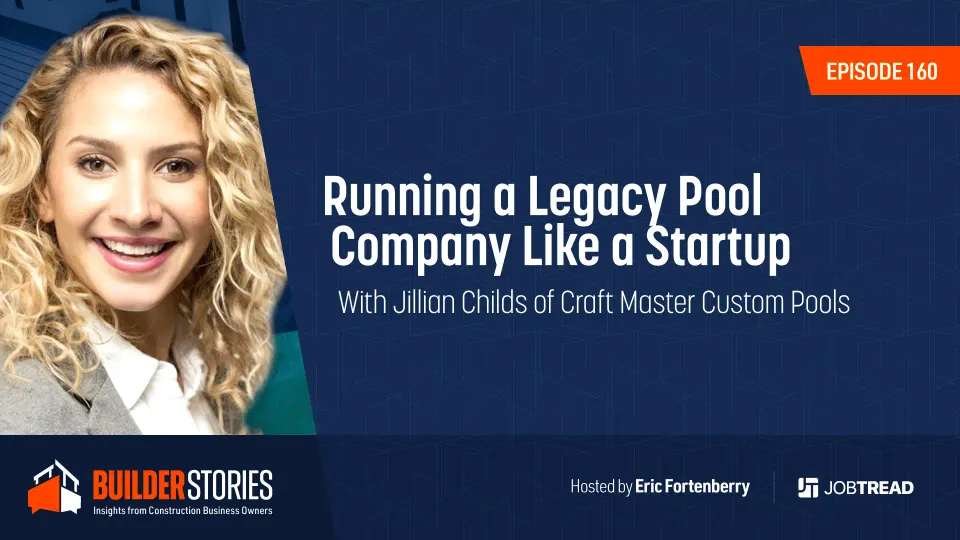

Jillian Childs went from running field marketing at Tesla to owning a South Florida pool company with her husband, Christian. They took over 150 open projects on day one, and every single one lived in a manila folder. In one year, Jillian rebuilt the operation inside JobTread with robust processes and streamlined automations that wipe out hours of tedious admin work. Now she’s using AI to recover revenue that was slipping through the cracks.
In this episode you will learn:
- The revenue red flag Jillian looks for before buying any business
- How a single AI audit uncovered approved change orders that never got invoiced
- The training approach that helps a team with mixed tech skills adopt new software
- Why Jillian puts her ad dollars into Meta and skips Google entirely
- The simple list exercise that shows you exactly where to hire next
Resources:
Hear the full conversation on Builder Stories. Learn more about Craft Master Custom Pools here.
Eric Fortenberry: [00:00:00] Welcome to the podcast where we take a deep dive into the stories behind construction business leaders. We will share how they got started, how they found success, and the lessons learned along the way. I’m your host, Eric Fortenberry. Welcome to Builder Stories
Eric Fortenberry: Welcome back everybody. Today I’m excited.
Eric Fortenberry: I’ve got Jillian Childs. She is the co-owner of Craft Master Custom Pools located in West Palm Beach, Florida. Really excited to have Jillian joining us today. She actually bought her pool company with her husband last year and has a lot of impressive experience with marketing. She’s worked at several large companies, including Tesla.
Eric Fortenberry: Uh, also really excited to have, uh, Jillian as, as one of our moderators for the Women’s Summit coming up in January. So, you know, really appreciate you, you hopping on here. Welcome to Builder Stories.
Jillian Childs: Yeah, I’m really, really excited to be here. I, I can’t wait to share kind of our experience as, uh, co-owners.
Jillian Childs: My husband and I took over Craft Master a little over a year ago. So [00:01:00] happy to talk through everything and looking forward to the hour.
Eric Fortenberry: Awesome. Well, yeah, why, why don’t you, why don’t you give us a little bit, little bit more insight, you know, who you are, how you got into construction, you know, what, what led you and, and your husband to go buy the pool business, pool, pool cover business?
Eric Fortenberry: Yeah, great
Jillian Childs: question. It’s certainly been a journey. Um, so I’ll kind of take you back two years ago. Uh, so my husband was working in corporate America. Um, I was working in corporate America. We went through, uh, uh... It’s a little bit of a sad story to begin with, but we’ll get onto the positive side soon. We went through, um, a series of a couple losses, uh, during the summer two years ago, which led to, uh, my husband and I really questioning what we wanted to do for the next stage of our lives.
Jillian Childs: And, um, and we were looking at different industries to get into. So we were definitely discussing, uh, you know, what type of company to buy. Um, from my personal experience in marketing in corporate America, I definitely saw a complete shift when ChatGPT and OpenAI, uh, and Claude and Anthropic and all of those, um, big [00:02:00] companies, uh, with all of their AI tools started coming into the marketplace.
Jillian Childs: Uh, there was a time in my career, um, about three years ago where, uh, my boss at the time called me up and said, “Hey, we’re letting your entire team go on Tuesday. Do you want to stick around, um, and run marketing?” And so, uh, I saw that as, one, a big, scary situation, but also, two, um, uh, AI was taking over a lot of marketing roles and has continued to do so.
Jillian Childs: So, um, him also coming from a corporate background, AI has been taking over some of, uh, the roles that he was in. Uh, he was at IBM for a number of years, uh, previous to this, um, handling partnerships with Cemex and, and a couple other big construction companies. And so, uh, when we started going down this hole, we really wanted to understand, you know, what was probably a little bit more AI-proof in terms of industries where AI wouldn’t necessarily be affected in the next 5 to 15 years.
Jillian Childs: Um, and if it [00:03:00] was affected, it would really bring, uh, uh, leverage to the company, um, and tools that could optimize, uh, work efficiently and effectively and really take that to the next scale. So, um, we had looked at a transportation company. We had looked at signage companies. We had kind of gone through this exploration with a number of business brokers.
Jillian Childs: Um, and then a pool company came, uh, uh, on, uh, I, I don’t want to say on board, but essentially a business broker reached out to us before it was public-facing, um, and asked us if we were interested in taking a look. And so that has now turned into where we are today. Uh, that short conversation, um, has landed us Craft Master Custom Pools through a year, uh, about a year of due diligence.
Jillian Childs: Um, and, uh, here we are.
Eric Fortenberry: That’s awesome. A, a, a, a year of due diligence, huh? That’s, uh, that’s quite the, quite the, the, the, the, the length of time there to, to, to go study the, I guess the, the industry, the company. I mean, what, [00:04:00] what, what did you look at when you were deciding whether you wanted to buy the business or not?
Jillian Childs: Yeah. We were looking at, um, one, areas of opportunity. So we’re in South Florida. Uh, pools are, you know, in everybody’s backyard here. There is a ton of growth opportunities here with new, um, communities being built, people remodeling their pools from older generations. So, uh, the market is hot here, and it’s ever-expanding.
Jillian Childs: Um, so that had product market fit already in terms of where we were located. Uh, secondly, you know, going through kind of the brand reputation and the financials and looking at all of those things in terms of where we wanted to be with our lifestyle. That was part of the due diligence process. Um, and then, uh, ultimately, my husband had to get his CPC license, and so we really did a deep dive into him doing the training and making sure he got that license, uh, contractor, um, specialization in pool construction.
Jillian Childs: And so that was, that was roughly a [00:05:00] 16-week, um, you know, course in terms of getting that license and really studying through it and making sure that we could square away, uh, the finances with an SBA loan, ’cause that is how we funded the business.
Eric Fortenberry: Nice. You know, when, when you think about your experience, I mean, again, you, you worked at some, some very large, you know, companies, you know, Tesla, you know, Sotheby’s, you know, uh, other companies.
Eric Fortenberry: Like, h- how do you feel like the experience from, from corporate America, you know, translated to, you know, buying a business, now being a, you know, a co-owner, you know, entrepreneur? W- what do you think the biggest, uh, you know, kind of transfer of, of, of skills and experiences has been for you?
Jillian Childs: Yeah, so I’ll talk directly about my experience throughout my career.
Jillian Childs: So I started off in luxury marketing, which gave me the framework of what a really nice brand and customer experience looks like, how to deliver to customers, what their customer expectations are, um, how to set expectations with customers from the very beginning. Uh, and so that, that kind of [00:06:00] helped me frame the second part of my career, which has been mainly in startups.
Jillian Childs: Tesla, when I was there, was going through their biggest high-growth stage. There was a time, uh, in 2017 where we didn’t know if we were gonna still be around in a couple months. And so- ... um, I would say the startup culture that I’ve been in involved with for roughly 15 years now has been a really great starting point in becoming an owner and operator of a business.
Jillian Childs: So you have that kind of luxury lens that I took from the customer experience side. Masked with working at a startup, you have to wear all hats all the time. It doesn’t matter what department you’re in, you get thrown, uh, to the wolves, so to speak, and you have to figure it out. And it’s not for everybody, but it’s for that, you know, entrepreneur kind of mindset that really wants to grow, learn, expand, uh, and find solutions and, um, reiterate on that as many times as possible until you get a really, really great experience for your customers and a really great product for them.
Eric Fortenberry: Yeah. You [00:07:00] know, so it, it’s interesting that, you know, again, kind of you were able to sort of take that experience and, and then go and, and, and evaluate, you know, these, these businesses that, that, that you may wanna buy. You know, for, for everyone out there who, you know, may- maybe they’re builders and they’re, they’re thinking about they may wanna sell their business one day, like what, what do you feel like, you know, makes a contracting business attractive to a potential buyer?
Eric Fortenberry: Like were, were there any things in particular that just, you know, you... when, when you saw you knew that this was really exciting for you and, and, and you wanted to buy this business?
Jillian Childs: Yeah. I would say so starting off, again, the product market fit and, uh, and it was a legacy brand. So the previous owners had been around for 20 years, so that was, uh, a substantial, I think, uh, key learning for us in terms of, hey, there is an established book of business, um, and we wanna take over that book of business.
Jillian Childs: And ultimately, you know, there was an established brand name already in the market, and so we just, uh, that helped in terms of customer [00:08:00] reputation and moving forward, uh, in terms of where we wanted to be with the companies that we were looking at. So, you know, the, the pool building company, uh, obviously Craft Master now compared to, uh, a sign company.
Jillian Childs: I was also looking at, um, you know, their book of business. What does their revenue margins make up? So, you know, from a sign company, th- uh, there was one sign company we were actually looking at, and I realized that most of their revenue was coming from one single customer. So you’re looking at, oh my goodness, if you lose this customer along the way, there goes your entire revenue.
Jillian Childs: Um, whereas here, you know, the volume was very high, the product market fit was high, um, the margins were great, and, uh, and you have an established book of business that can be residential and both with builders and then u- ultimately you could expand into construction, uh, with commercial side. Um, you could expand into service routes.
Jillian Childs: So there’s just a, a potential of market expansion, whether [00:09:00] that’s sticking with just residential and, um, builder relationships, or if you wanted to expand service lines and departments, uh, that was all there in terms of the growth opportunity.
Eric Fortenberry: So when, when you, when you guys sort of transitioned the, the ownership, like how, how big was, was Craftmaster at that time?
Eric Fortenberry: I mean, did- h- how many employees did they have? Like, what, what was, what was kind of the size o- of them?
Jillian Childs: Sure. Um, so we had about, uh, eight field team employees, which we’ve kept on board throughout the process, and the husband and wife that we, um, acquired it from was real- they were running the office operation, so it was really the two of them, um, plus, uh, one permanent coordinator and then one admin.
Jillian Childs: Um, and so that was just, uh, it was a very lean office team, um, and, uh, the field team. So we’ve come in and we’ve really expanded and tried to learn where we should hire, where we shouldn’t hire, and we’ve gone through, you know, uh, [00:10:00] many iterations over the last year in terms of learnings for that.
Eric Fortenberry: So, so what, what did the transition look like and, and how did you make it as, as seamless as possible?
Eric Fortenberry: Like, you know, the, the existing husband and wife who are running it kind of handing over the reins. I mean, did they stay involved? What, what’s ... Do they, do they have an ongoing role? Like, h-how did you guys kinda try to make sure that you kept the team and the business operating and, and, and not, you know, not kinda stumble when, when there was this transition?
Jillian Childs: Yeah. So I’ll, I’ll tell you that the week that we closed on the business was the craziest week of our lives. So we closed, uh, the business on a Monday. I had my daughter, uh, my first daughter, um, and only daughter, uh, three days later. So, um, Christian, my husband, walked in Tuesday to the entire team to introduce himself as the new owner, and then Wednesday, um, my doctor called me and said, “It’s time to be induced.
Jillian Childs: Go to the hospital.” And, uh- ... and then we had a baby. So, uh, four days into, uh, my daughter’s new life, um, Christian [00:11:00] was, uh, essentially the new one running the show, um, and out of the home for, you know, 16 hours a day and trying to figure this all out. So, um, from a transition perspective, um, you know, we came in, we really wanted to meet everybody and welcome them with open arms.
Jillian Childs: Um, we spent some time on a transition stage with the previous owner, so they were on board for about three months until they transitioned out of the business. Uh, we worked through, um, you know, what team members were needed and what team members, uh, we wanted to move forward with in terms of replacing, uh, which is never an easy thing to do.
Jillian Childs: Um, but also a must when you, you know, take over your own business. You wanna make sure that everybody’s speaking your same language and on your team. So, uh, from the transition perspective, you know, the field team that we did stay on board, they were all very, all very excited, um, to kind of have some fresh leadership, uh, and, and guidance.
Jillian Childs: And so, um, I [00:12:00] would say that transition was really smooth in terms of the field team, ’cause we kept them all on board. And then ultimately, uh, the previous owners exited the business within three months. Um, and then we kept kind of some of the office or the other office staff member on board, and then ultimately, um, decided to kinda revamp what we wanted the company to look like.
Jillian Childs: So hopefully that answers that question a little bit more.
Eric Fortenberry: Yeah, so I mean, when, when you sort of think about like the big, you know, the, the, the big picture changes, you know, what, what did, what did you know that you wanted to change kind of going into this, but ... And what did you also know that you wanted to keep the same?
Jillian Childs: So great question. Okay, two things. O- one, I wanted to change the office immediately. So we, uh, within three, um, yeah, no, I would say within five months we started a complete remodel of the office. So, um, uh, we renovated, pretty much gutted it from bare bones and put it back together. Uh, it [00:13:00] was certainly, um, a dated office, and I wanted to bring it up to speed and really make it modern and, um, feel like, you know, people really wanted to work there, uh, and that they had a clean space to work in.
Jillian Childs: Um, that was, uh, an instantaneous thing. Um, other things that I wanted to change, so, uh, anybody looking to purchase a business from, you know, a, a, a family looking to retire, so to speak, ’cause I know we’re in that baby boomer stage where they’re exiting businesses right now. Um, I wanted to digitize this business and really provide automations and workflows and system processes.
Jillian Childs: So when we took it over, everything was in a manila folder, um, all pen and paper. Uh, I can’t tell you how many file folders were in the back. Um, 10 years of file folders, if you can just imagine what that would look like, uh, in your warehouse. And then, um, really creating the system processes to get structured in a new company a- and make it our own.
Jillian Childs: So, um, [00:14:00] I- since I’ve worked in technology backgrounds and engineering backgrounds for pretty much my, most of my career at this point, um, that was a really need to figure out how to structure that and then how to build a team around it. So, um, uh, the other thing I wanted to bring on are really high growth, uh, performers in terms of, you know, getting a little bit of a diverse background into the pool business.
Jillian Childs: Um, I would say, you know, I, I find that pool business is, um You know, it’s not, uh, there’s not new, fresh faces coming into the pool business every day. So I really wanted to create a diverse culture, uh, in terms of staff members. So I brought some, um, folks on that I used to work with at Tesla, um, and helped kind of create that system processes, uh, and the growth-minded mindset that I really wanted to take to the next level.
Jillian Childs: Uh, things that I wanted to keep: customers. Customers, customers, customers. Um, I wanted to keep them happy. I wanted to keep them smiling. I wanted to keep them referring business to [00:15:00] us, um, and, uh, make sure that our craftsmanship was improved along the way. So, uh, I know you said stay, but I also wanted to improve our craftsmanship, um, a- and really nail down really great subcontractors to work with, so.
Jillian Childs: But staying the same, customers all the way.
Eric Fortenberry: That’s awesome. So how, how did the team react, and, and, and what was their, and what, what was their response to, to, to new ownership, new management, you know, the, the, the changes that, you know, that, that, that, that you guys brought forth?
Jillian Childs: Yeah. So the field team, um, you know, th- they’ve kind of been doing the same roles that they were in before.
Jillian Childs: So I, I would say we haven’t totally adjusted, um, everything on the field team side. The, so they, I don’t think that they saw necessarily a huge change in their day-to-day operations. They had, you know, pools that they were, uh, working with, um, punch list items to complete, uh, plumbing to complete, all of those sorts of things.
Jillian Childs: What we did kind of, um, [00:16:00] transition was the office staff. So, um, bringing them on board, uh, a- and giving a fresh face to Craft Master and making sure that we, you know- We’re developing a culture where we’re all, um, able to learn from each other. We have a very tiny office, so, um, w- what I’m mean by that is that, you know, everybody’s asking questions, and I want it to be a learning culture as well.
Jillian Childs: Um, and I’m sorry, I probably got distracted from
Eric Fortenberry: your
Jillian Childs: question.
Eric Fortenberry: No, that... Yeah, no, you know, look, I, I think change is, is obviously, uh, you know, is, can, can be scary. And, you know, it, it can, it can make people kind of worry about their job and their role and what’s gonna happen. And so, you know, again, I’m, I’m just sort of interested in, in, in what did you do in order to, you know, to, to, to reassure the people, you know, at least the, the ones- Right
Eric Fortenberry: that you wanted to keep, and, you know, w- was there anything in particular that, that, that you tried to do with each and every person to kind of ease that, that, that anxiety that can inevitably come from, you know, [00:17:00] from, from such a large change to the business?
Jillian Childs: Yeah, so you know, I, we looked at every staff member and we had compensation reviews with them.
Jillian Childs: We wanted to make sure, you know, employee agreements were all mapped out. Um, and then we provided, you know, additional benefits, uh, and wanted to layer in, um, some healthcare stipends, uh, some additional PTO, um, and, and really see, you know, which w- which one of our staff members could maybe use an increase in their salary a- and keep them enticed to stay on board with us.
Jillian Childs: So, uh, that was certainly one of the pieces in terms of reassuring them that we have their back. And then, um, my husband has been in the field working with them, so you know, he, he does the sweat and grind, uh, each day as much as he can. Um, a- a- and really showing that we are gonna show up for our team and be involved in the business.
Jillian Childs: Uh, you know, we had, uh, I would say at the beginning of this year, we had a [00:18:00] friend of mine come in and kind of do a open discussion of like what’s working, what’s not, w- let’s have an open discussion of where we can find solutions and put some, um, solution... Put some processes in place to pr- drive those solutions.
Jillian Childs: So I think the opportunity to speak up, um, and, and have their own voice heard, that’s something that’s really meaningful to me in any culture that I’ve been in in a corporation. I, again, want that to feel like any employee can come to us with any question that they have, and it’s going to be listened to, uh, heard, and if they have a solution in mind, like test and try it out and implement it from there.
Eric Fortenberry: Yeah. So, so what, w- what were, or what are, you know, you and your, your husband’s kind of primary roles and, and responsibilities? Like, what, what’s y’all’s day-to-day look like?
Jillian Childs: Yeah, the, the day-to-day is pretty insane. So, um, I am wearing, uh, the HR hat, the IT hat, the JobTread hat, the, um, [00:19:00] marketing hat, the warranty hat, the legal hat, um, and I th- may- there’s probably one more in there.
Jillian Childs: Oh, and recruiting. Um, so, uh, I know I mentioned HR, but I was kinda thinking about that in different ways. My husband is, um, handling most of the customer communications, uh, and establishing sales, and also being that field supervisor, um, for a number of our projects.
Eric Fortenberry: Yeah, and y- you mentioned you, you brought in kinda some, some high-powered, uh, you know, people, even a couple people from Tesla.
Eric Fortenberry: I’m curious, what, what roles did, did they go into?
Jillian Childs: Yeah, so, um, Jamila, who was our general manager for the last year, she’s now moved into our sales director role. So, um, and then we had another project manager that came on board from Tesla, who used to work in the service space. So, um, at... I, I worked at Tesla for four years.
Jillian Childs: Um, uh, the people that work there can do anything and everything. I really believe that. They are the hardest workers, um, that I’ve ever met in my life. So, I wanted to try to take, uh, some of that [00:20:00] talent and, and serve it as an, a, as a way where we can establish our own, um, business and grow. So, um, with that being said, you know, uh, yeah, we’re, we’re all wearing a lot of hats, and, um, I...
Jillian Childs: There were diverse backgrounds from roofing companies. We had, uh, a, c- uh, just a diverse background of people.
Eric Fortenberry: Yeah. That’s great. You know, you, you mentioned one of your goals was, was really to, to digitalize the business, and all the folders and papers, and, you know, you said now, you know, one of the hats you wear is the JobTread hat.
Eric Fortenberry: So, I’m, I’m curious, like, how, how have you seen JobTread be able to sorta help you accomplish that goal of, of, of digitalizing the business, and, and, you know, kind of where, where did you guys start with implementing that, and, and yeah.
Jillian Childs: Yeah, so I’ll kinda break that out into a couple different sections. So, JobTread was being used by the previous owners, but only for invoicing.
Jillian Childs: So, they were really only using it as a bookkeeping software, which now that I’ve really [00:21:00] I’ve gone through JobTread from tooth to nail. Uh, it’s just amazing in terms of the abilities JobTread has to, uh, scale a business and provide functionality. Um, so we started off, uh, as my, uh, as I was, uh, you know, when, when, when you’re a new mom, they always say, “Sleep when the baby sleeps.”
Jillian Childs: Well, I did not sleep when the baby sle- slept. I was busy building SOPs. So the first stage of getting into this business was trying to map out what our process looked like. So what are we trying to, uh, develop here? What are our biggest bottlenecks? What do we need standard operating procedures on? Um, and how do we s- uh, put that into JobTread as an easy system where it’s rinse and repeatable, um, later down the road?
Jillian Childs: So the first, I would say, four months was really building out those SOPs. And then, um, my team was using JobTread in the background, but we were using it, uh, and, and building it out at the same time. So, uh, [00:22:00] I, I always like to say this, and it doesn’t maybe hit on everybody’s mark, but we established a legacy business where we took...
Jillian Childs: We acquired a legacy business operating like a startup. So y- your hair is on fire with the amount of work and, uh, work in prog- We had 150 open projects that we took over. Wow. So the volume was, uh, really, really high. So you’re, you’re trying to handle all the customer, um, customer construction project schedules while also trying to build out the systems and processes in the same vein.
Jillian Childs: So, uh, after those SOPs were done, um, we started building out the scheduling function in JobTread. Uh, we have now looked at redoing the estimator tool, so I’m digging into that right now to make sure that it works with the parameters and everything that we wanna set up for budgetary purposes so we can scale and have more salespeople come on board and make that really easy.
Jillian Childs: Um, the to-dos function has been something that [00:23:00] has really gotten the team aligned in terms of their responsibilities. Um, uh, uh, the forms that just rolled out recently, I’ve been using the forms everywhere. I now have gate re- gate stops where we don’t have, you know, a checks and balances system in place.
Jillian Childs: That checks and balances system has now been added in terms of, you know, warranty forms that the homeowner needs to sign off on, or the punch list items when we’re going through, or inspe- uh, s- inspection forms that the field supervisor needs to sign off on before we actually call an inspection in. So JobTread has really provided the system where we can create the customer experience, uh, and showcase in a digital form how to digitize the business, and so have that as a customer selling point, um, and saying, “Hey, you know, you can look.
Jillian Childs: Everything’s on this portal. Um, you can see the stages of your project.” Uh, we’ve implemented to-dos in the last six weeks, uh, [00:24:00] the daily to... Uh, excuse me, the daily logs, not the to-dos. Um, so we’re finally getting kind of... I- it’s taken a year, but we’re finally getting the structure in place, the team trained, and, uh, things working more smoothly.
Jillian Childs: So, uh, for example, um, you know, the Claude integration into JobTread has been absolutely incredible and have saved me, I, I don’t even know how many hours of my life. But I’m building out an entire, uh, essentially AI agent to handle all of our warranty requests, ’cause that’s been something I’ve been handling.
Jillian Childs: And so, you know, uh, it’s helped me build out the forms. It’s helped me build out the work orders that I send to our, uh, warranty providers. Uh, they communicate directly with me through JobTread. Um, so it’s been really just a great, robust tool where everything can be used for your business in one place.
Eric Fortenberry: Yeah. That’s awesome. I, I love that. You know, and, and I think One of the most important things, though, that you said was, like, at, at the very beginning, you took the time to really map out your [00:25:00] processes, and you identified the bottlenecks. You know, I, I think that is, that is often a step that so many people skip over.
Eric Fortenberry: They just... They see everything that, that, that JobTread can do, and they just, they wanna go implement all of it day one, and it’s like, well, hold on. You know, like, let’s, let’s really understand, like, what is currently working and what’s not working, and where are those bottlenecks? And, you know, when, when I, when I took over the construction business that, that I, that I, where I built the first version of this, I mean, like, that was the first thing that I did as well, is I, I shadowed everyone to try to understand, like, what is the current process or often lack thereof, you know?
Eric Fortenberry: And then what were the challenges that people were having? Because, like, when you truly understand the process, you know, whether it’s a good process or bad process, like, that will help you to then design what will be a better process. And so it sounds like you really took a lot of time upfront to, to establish, you know, those, those, those, those SOPs and those best practices, you know, and I, and I, and I can tell, again, you, [00:26:00] you clearly have learned a lot about building pools, you know, in that, in that process.
Eric Fortenberry: And so I gotta believe, like, a lot of that probably came in that early couple months of, of really learning, you know, the business before jumping in to try to revamp all the systems. Is that, is that accurate?
Jillian Childs: Oh, completely. You know, I’m still doing a ton of data cleanup on the back end in JobTread, so what we have now can be the bible of our business moving forward.
Jillian Childs: And I realize that bible is not going to cha- uh, not gonna stay the same every week or every day, but if we get 90% of that built out, where it’s scalable and the systems are there, and we can train the staff on how to use them, then there’s no reason that we can’t do a kind of a rinse and repeatable cycle when we have customers, um, come on board and new sales being made.
Jillian Childs: Uh, having come from startups and Tesla a- and a number of other startups throughout my career, um, chaos will continue to be chaos until you put structure in place. So your hair is on fire every day. Well, [00:27:00] please take a step back, slow down, write down what your process is, and then start implementing that from the solutions.
Jillian Childs: Um, so, you know, I, I, I just say... I’m so sorry. Um, so yeah, the chaos is chaos until you build it out in JobTread.
Eric Fortenberry: Yeah. W- when, when you have gone to sort of implement these, these new processes and, and, and, and have kind of trained the team, like, what, what was their reaction? I mean, you know, did, did you get Any pushback or, you know, it’s, it’s very common for people to kind of have that, that natural resistance to change, right?
Eric Fortenberry: Like, it doesn’t matter if the change is clearly gonna be better. I think it’s a natural human tendency to, you know, not, not always want to, to, to change. So, like, how did, how did your team handle that and, and, and w- was there, you know, kind of ongoing training, ongoing issues? Like, how did you, how did you get them comfortable?
Jillian Childs: Yeah. So, I, I think that’s, I think the biggest learning curve for me coming from a corporate [00:28:00] background into a construction background is that the technology, you know, uh, skills aren’t as profound as you would find in a normal corporate background. So, um, you know, some people really need help trying to send a text message.
Jillian Childs: Some people really need help, you know, just opening up their Gmail and checking their login. So what I’ve tried to do in terms of training is really break this out by function and in little like one-hour segments with the team where we can all have our computers open, we can walk through a job or a task or the schedule.
Jillian Childs: Like, for example, we just rolled out a new scheduling template about three weeks ago. So, um, I spent two hours with the team one morning, and I was like, “This is what we’re focusing on. Um, a- and let’s walk through a project together and see where we get stuck.” And so I, I think, you know, you, as [00:29:00] the owner, you have to train your team.
Jillian Childs: And so, uh, from, fr- from a business owner standpoint versus, you know, an employee standpoint, um, what, uh, one of my biggest learnings in the last year has been like you can’t expect people maybe in this industry to just take it and go with it and, you know, you give a direction and they’re... Y- you need to train them from process step one to process, you know, 100 on how you want your business to be run.
Jillian Childs: So the training piece of that is sitting, talking through it, enforcing it. Um, if they are having questions about it, sitting with them again, rolling through it, uh, then following up with them as many times as necessary to see if they’re getting any bottlenecks or gaps in there. Uh, I would say the, one of the hardest things has been, um, you know, getting subcontractors to really see the work orders and get acquainted with the system.
Jillian Childs: So, uh, that piece I’ve been trying to push as much [00:30:00] as possible in terms of, hey, if you wanna do business with us, this is a tool that you’re gonna have to learn, and I’m happy to talk you through the tool and what that looks like. Um, and some subcontractors have been really, you know, great about wanting to hop on board with us.
Jillian Childs: Some have not, but there’s a lot of subcontractors out there. So, um, I, I say that in saying, you know, as a business owner, you have to teach your team the way you want things run, and you have to understand that- Maybe not all of them come from the same technical background that you might be coming from, and you need to spend the time with them learning what their challenges are, and then finding the solutions that are gonna work for them too.
Eric Fortenberry: Yeah. No, that’s, that’s, that’s well said. I’m curious how, you know, you, you mentioned kind of you’ve, you’ve kind of connected Claude and JobTread and it’s, you know, building out a warranty agent. I mean, how, how else have, have you all been, been using AI? You know, we, we, we obviously we, you know, put out the, the AI connector and, you know, you can connect to Claude, Chat, kinda any of those, you know, that you wanna bring.
Eric Fortenberry: You know, we’ve [00:31:00] also rolled out some of our own native AI tools in there. Like, how, how have you seen AI, you know, make an impact on your business and, and, and how do you, you know, see... What, what are those best kind of use cases for it?
Jillian Childs: Oh, man. Uh, phew. I, I have been living in Claude, so, uh uh, in the last week, I’ll tell you Five things that have made my life a lot easier.
Jillian Childs: One, I’ve used Claude to do an entire audit of all of our active jobs and see what change orders have not been invoiced to customers yet. That was one that, uh, seemingly you would think, you know, you’re not needing to audit, but I would highly recommend just doing a, a full audit of, you know, is there a change order?
Jillian Childs: Has it actually been invoiced? Has it been signed off on, or is it just sitting somewhere and, you know, a customer approved it, but we actually haven’t invoiced? So, that was a big audit that I’ve done in the last week. Um, yesterday, for example, uh, I’ve been trying to build this pool handover [00:32:00] package to completion for our customers.
Jillian Childs: So, um, I spent, I don’t know, three hours finally focused directly on that. And so we now have a template, uh, under document templates that is that pool handover package. I’ve added some branded, uh, warranty coverage and, uh, water chemistry care documents that I also put together. And now we have that as a standard operating procedure when we close out any project.
Jillian Childs: Um, I have done an audit of every single subcontractor that we’ve had in our system and vendor that we don’t have a COI on file for or a W-9, and asked, uh, Claude to put together an email and send that out to each vendor in our system to get updated documents to make sure that we are all compliant for any audit that we might ever, um, have to go through.
Jillian Childs: Um, invoices, uh, I now have-- Um, so I’m handling a lot of the bookkeeping right now. So now I have an automation built out, uh, that every Monday Claude [00:33:00] sends me an update on the job stages and our milestone payments and where I need to invoice for the next project stage. So I can go through one by one and say, “Hey, okay, this customer’s ready to receive this invoice.
Jillian Childs: I’m gonna send that invoice out now and collect it.” So, um, I, I would say from a budget standpoint too, you know, uh, yesterday I did an audit of, hey, where did we not have subcontractor labor actually built into some of the active jobs that we’ve bid out? Now we need to go back and, like, actually work through those budgets and make sure they’re all squared away with subcontractor labor built in and a-as a line item.
Jillian Childs: So, uh, the use cases go on and on and on. Uh, I, I mean, I can’t tell you how amazing it has been. I mean, uh, also, like, it helped me put the SOPs that we created in Excel documents into an actual scheduling template and Put all the gait reviews and the dependencies and the [00:34:00] checklist together, and it’s just been a really fruitful experience of being able to finally get to this point where our hair is not completely on fire every day, and we can spend some time really putting that structure in place that will take us to the next level.
Eric Fortenberry: That, that, that is a, an incredible list right there of, of, of just a few ideas that, you know, and things that you’re, you’re doing. But I, I’m, I’m curious, I mean, like How did you even figure out what things to go do and, and, and like, you know, ’cause again, so many people like, you know, the, the challenge is they don’t know what they don’t know.
Eric Fortenberry: And so like, I mean, you, you just, you know, listed off some extremely, you know, valuable, y- you know, a- actions and, and, and things that you can use, you know, AI for here. But like, h- h- how are you sourcing these idea? Where is the inspiration for this to, to even know to have Claude go audit all of your jobs to find change orders that haven’t been invoiced?
Eric Fortenberry: I mean, you know, what, what, what’s led to, to this, to this discovery of these, these potential use cases?
Jillian Childs: Yeah. I [00:35:00] think that’s a, that’s a great question. So, you know, we had some changeover on our team. Uh, and so some of our employees, uh, left to go to other places, and so their responsibilities landed on my lap.
Jillian Childs: And so the first piece of... There were a couple things, actually. So the first piece for the change orders, for example, we lost our in-house bookkeeper, um, about a month ago. And so when I started digging into the files and seeing some of the things, I was like, “Oh, this change order was never sent out.” So li- light in my head went off, “Hey, how many other jobs did we actually not send the invoice out, but we have the approved change order, but we just never collected on it?”
Jillian Childs: So that’s where I started saying, “Hey, well, you know, Claude could certainly audit this for me rather than me spending, I don’t know, weeks trying to go through each of these. Um, you know, I... Claude just built me an entire Excel spreadsheet saying, “Hey, here’s each job. Here... A- and tab by job. Uh, here’s where, you know, the [00:36:00] contract was.
Jillian Childs: Here is where you actually installed maybe a different set of equipment that you hadn’t charged for and what the change order should actually be. Um, or if we actually had a change order approved and we didn’t send it out yet, flagging that.” So, um, that was one example. Uh, I would say it’s been typically when we have lost a staff member and I start going through kind of where their function was and digging into maybe why there was a delay on something, um, and how could I make that delay not happen again in the future.
Jillian Childs: And that’s where the light bulbs go off for me, like, how do I speed up a process that is taking too long, and where do I have gaps across the business that are liabilities that could be costing us money? And, you know, you’re always worried about the bottom line. Um, and so that’s where I really wanted to start.
Jillian Childs: And then even on the warranty side that I mentioned, like, I’ve been doing all the warranty claims previous to about a month ago. A [00:37:00] customer would call or they would email into info@ Um, and we would go back and forth asking for pictures of their model and serial numbers of their equipment. Then I would have to send another separate email to, um, to our warranty providers, and it was just like, this can be way much, uh, like a much smoother process if I just spent, you know, 10 hours really working through this and automating it.
Jillian Childs: So like, yesterday was another example of, okay, I’m gonna use the form builder, uh, in JobTread. I’m gonna build a warranty form. I’m gonna then have Claude, uh, build a new landing page for me on my WordPress website. Then I’m gonna make sure it connects and creates a new job for me for a warranty job when that gets submitted, and it’s gonna notify me, uh, the minute that job is submitted so I can follow up on it immediately.
Jillian Childs: It’s also gonna create a work order already drafted in draft form for our warranty providers that I just needed to review and press send [00:38:00] on, and then I can send a, a homeowner update saying, “Hey, this has already been submitted. Uh, you will be hearing from our warranty provider within, you know, 24 hours.”
Jillian Childs: So, that alone has cut down on so many hours, uh, of just tedious admin work that you don’t need to do anymore.
Eric Fortenberry: Yeah. Well, and, you know, again, I, I, I love that, you know, you’ve rolled up your sleeves to really get into the, the nitty-gritty and, like, I, I think, you know, that’s so important for, for really for any business owner to...
Eric Fortenberry: You know, I’m, I’m a big believer, like, you should truly understand what the roles and responsibilities are for everyone and then, you know, have a, a, a very good, you know, understanding of like what are the expectations on how they should complete that job and where are the opportunities to improve, you know, that, that, that job and how they’re doing it.
Eric Fortenberry: And so I think by you taking on those, those positions and, you know, again, maybe temporarily, maybe, you know, figuring out how to sort of completely automate it and, you know, not, not have to rehire, but, like, just [00:39:00] having that hands-on experience. You know, clearly it’s, it’s really empowered you to build out the, the specific solutions that you need and, and, and again, just understanding AI and where its strengths are, you know, has, has allowed you to, to, to really complement, you know, the team very nicely.
Jillian Childs: Yeah, it’s been, uh, it’s just been a great work in progress. Uh, there’s... I, I could tell you there’s probably a notebook of things that I still wanna build out, but, uh, this all kind of came to a head ’cause I also noticed that our team at one point was just using the activity as a catchall for everything, and I was like, “Okay, there, there’s an invisible accountability cloud happening here.”
Jillian Childs: You tag somebody, but it’s not notifying that person that this is the to-do and when there’s a due date. So I was like, “There has to be a better system to use in, in JobTread than just having the activity as a catchall.” And so that’s where, you know, the tasks and to-dos started building out, and I was like, “Okay, now we’re gonna train the team on how to use this and step away from activity.”
Jillian Childs: I’m still trying to figure out how to hide activity in general from [00:40:00] everybody, um, so I can just focus them on their to-dos and tasks. So yeah, I, I... You know, if you have an idea, Quad can help you build it out. Um- Yeah ... it’s just... Uh, or whatever AI tool you prefer, but, um, yeah, I, I couldn’t speak more highly of it.
Eric Fortenberry: Yeah. Well, that’s, that’s awesome. I love that. You know, I, I wanna also ask about, about marketing because, you know, again, with all of your, your experience in marketing, like, you know, you, you’ve done a, a, a really good job of humanizing, you know, the Craft Master, you know, brand on, on, on your website, on social.
Eric Fortenberry: Like, you know, w- what would you say, what do you think have been, you know, some of the biggest, you know, changes that you’ve implemented, you know, with the marketing and, and, and, and the brand for the business? And, you know, what, what do you think are, are, are really kinda the most important marketing concepts that, that, that anyone, you know, running a, a contracting business should be focused on?
Jillian Childs: Yeah. So, uh, jotting some notes as you’re, uh, as you’re mentioning that. So one, the, the logo that the [00:41:00] old owners had I was not using anymore. It was so dated. I, I am very much a polished luxury logo type person, and so I really wanted to update our some- our logo to something that set ourselves apart from everybody else in the space in South Florida too.
Jillian Childs: You’ll find, you know, a lot of our competitors have, uh, I would say, more fun-ish type logos. And if you’ll see ours, like, we, we have our normal logo, Craftmaster Custom Pools, but then we have different pool shapes that we now put around that depending on where we’re, where we’re advertising, um, or, you know, what documents that we have.
Jillian Childs: So I wanted to create that fluid kind of fun but also luxury feeling coming from my luxury marketing background. Um, you know, people are spending anywhere from $75,000 upwards to $300,000 on a pool, so, uh, I wanted that to speak to the customer a little bit more. Uh, the previous owners really didn’t even have a website.
Jillian Childs: Uh, when we took [00:42:00] over, there was not... Th- this still baffles me. They didn’t have a single photo of a completed pool they had done in 20 years.
Eric Fortenberry: Wow.
Jillian Childs: So I had to start from scratch. So we built a website. We built an entire brand guide. I started getting professional photography of our completed pools and started putting together kind of case studies under our projects on how we worked with the customer, what our process looks like.
Jillian Childs: We’re going through a iteration of our website right now where I’m adding some more to that. Um, so website was first. Uh, well, I’ll say the brand was first, then came website. Um, I implemented a referral program, so I’d highly recommend that. This is a very much referral based business. So I wanted any homeowner that we’ve ever done business with previous to our ownership to understand that they could earn money if they, you know, whether that’s off of their active project or afterwards where we could send them a gift card, that they could earn money off of that.
Jillian Childs: So the referral program has been, um, [00:43:00] successful. Uh, we just, uh, started doing meta advertising about, I don’t know, two months ago Minimal spend, uh, but great ROI. Um, I, I would say with $1,000, if you have $1,000 in your marketing spend, go do Meta ads. Um, I have one running right now for more of the luxury, uh, side of the business, where it’s targeting, um, homeowners in specific HOAs where the, you know, pool- the home start prices are, like, 5 million plus.
Jillian Childs: And then I have a different kind of value package offering ad running towards the more broader communities. Um, both of them have produced, uh, you know, within $1,000, over 20 new consultations for us. So, uh, they’ve been really performing well. Um, speed to answering any sales inquiry will win in the market above all else.
Jillian Childs: Uh, they want... Uh, so a couple [00:44:00] things on that. We do... Our market down here, um, there’s a mix of, you know, your tech-savvy younger folks, but you have a mainly kind of retired community down here. And so, you know, Facebook groups, get involved with the Facebook groups. Uh, they’re all talking on Facebook. Uh, again, with the Meta advertising, you can, you can target within a mile of, you know, whatever residents you wanna target or whatever, um, lifestyle you wanna target.
Jillian Childs: I think Meta advertising’s great. I do not do any Google advertising. Um, I am... In my career, I have by and large not liked Google ads. Um, I think they... I’ve even had a Google representative say, “You’re, you’re spending money to get spam.” And so I really stay away from Google. I know that there’s a lot of companies that push Google ads.
Jillian Childs: It’s just, sure, you can get a lot of leads, but are they quality leads? I’m not sure. Um, events, I am very much a believer. So in my [00:45:00] entire corporate career, I have had very small marketing budgets to work with, Tesla being one of them. We did a lot of guerrilla-style marketing. Uh, I ran, um, field marketing there for four years, and so we did pop-ups everywhere we possibly could, whether it’s a little tiny farmers market down the street or an art show or a builder show.
Jillian Childs: You know, when you start getting into the trade shows land, you know, your, your budget definitely increases for the trade show. But if you can find smaller events to just get your brand out there, you know, you might spend three or four hours on a hot Saturday, but you might get five leads that you didn’t have before.
Jillian Childs: So I’m a, I’m a big proponent of networking, um, speed to answering customers, and then, uh, Metas and referrals. So, um, tho- tho- those are my bread and butter in terms of, like, a marketing package. Uh, at some point, I would like to expand a little bit and maybe test out print, but print can... It, it’s really hard to figure out ROI on print these days,
Eric Fortenberry: so.
Eric Fortenberry: Yeah. [00:46:00] H- how have you leveraged video?
Jillian Childs: Um, so we’re getting more involved with video right now. So th- my starting point was just getting photos and some drone footage of our pools that we completed. Now I’m really trying to bring the face of Craftmaster. So like my whole goal now over the course of the next kind of two months is to introduce our team members on, uh, on Instagram and our social profiles by doing a little clip of them on a job site.
Jillian Childs: Uh, making it really informal, but telling them about their experience and telling, you know, the audience about their experience. So, um, you know, my husband just did one not too long ago. He, uh, uh, by and large is not a social media person, so I knew he was uncomfortable doing it, but he did a great job, and it was one of our best performing videos.
Jillian Childs: So, um I think video, uh, versus static imagery. Um, static is nice, but people are engaged more with an animation or a video of some sort. Um, you know, you’ll get more content likes if you’re [00:47:00] after the social side of things. Um, so I say all that in saying I would like to get more video as we go along, but I’ve just had to get the structure in place first.
Eric Fortenberry: Yeah. No, that, that makes a lot of sense. I mean, look, you’ve, uh, cl- clearly, uh, ha- have got marketing, uh, on, on, on point, so that’s, that’s, that’s awesome. Great, great job there. I’m, I’m curious, kind of taking, taking a, you know, step, step back, kind of looking at the bigger picture. I mean, what’s, what’s, what’s the longer, uh, you know, the bigger vision here?
Eric Fortenberry: You know, what, what’s the 5, 10-year plan? Like, what are you guys, you know, what, what are you and Christian want to do with the business?
Jillian Childs: Yeah. We wanna, we wanna grow and become the best pool builder in Florida. So, um, w- our sights are high, uh, our expectations are high, and we have lofty goals. So, um, where we started, you know, was just getting the foundation up and running, and we’re still working on that foundation every day.
Jillian Childs: Uh, in five years, I hope that we maybe acquire a couple locations of other pool builders north of us and, um, really build kind of a [00:48:00] Florida footprint and maybe expand to a different state. We have a home out in Colorado, so maybe that’s potential. You know, I, I think when you get into a specialized trade and you learn that specialized trade, that’s a, that’s a skill you can take anywhere, uh, across the world, wherever you wanna grow a market.
Jillian Childs: And you... Once you have kind of that foundation, you can grow and scale and so that’s, that’s the goal. Our sights are high and, uh, we have no plan on stopping anytime soon.
Eric Fortenberry: I love it. I love it. That’s, uh, it’s, it’s, it’s an incredible story you’ve shared here, Jillian. I, I really appreciate you, uh, you know, opening up and kind of sharing this.
Eric Fortenberry: You know, I know it’s, it’s a perspective that, you know, we, we haven’t had on the podcast a lot, and I think you’ve got a very unique, you know, opportunity here to, to really come in and, and, and take a business, you know, to a whole new level. So it’s, it’s exciting to see all the changes, all the updates. You know, it’s, it’s, it’s really cool.
Eric Fortenberry: You know, I’m curious just as, as we wrap up here, like, do, do you have any, you know, kind of favorite advice that, that you might give to all the contractors out there listening today? Just any- [00:49:00] anything that, you know, you, you wish you would’ve known earlier on or that you would do differently, you know, if you were starting from scratch?
Jillian Childs: Oh, man. Um- Hire for the skill sets you’re weakest in. Uh, so if there’s an area where you just... You know, uh, I had a... This was a good piece of... So I have two bits of advice that come from former life that I think have helped me here. So one, um, write down a list of what you love to do, what you like to do, what you never wanna do again.
Jillian Childs: Hire for the things you never wanna do again, and maybe for some of the things you like to do. But make sure that you’re weakest areas you hire for to fill that gap. Because what you don’t wanna do if you’re bad at something or you don’t like doing something, is being stuck doing that every single day and being dr- drowning in it.
Jillian Childs: Um, two, uh, another bit of advice, hire slow, fire fast. If, uh, you find that you don’t have the right team member on board, [00:50:00] um, don’t waste time ’cause they’re probably spending your money in a way that is not fruitful to your business. And so, you know, that has been, I would say, one of the hardest learnings for me, um, just because I get really connected with everybody that we hire, and I want it to feel like family and, you know, I, I really go out of my way to try to, uh, connect with every individual.
Jillian Childs: So, um, but I... That has been a learning, and I would certainly recommend if you realize that there are mistakes being made and you can’t coach through that, then it’s time to try to find a new person. Um, thirdly, don’t be scared to test and learn from things. I, you know, I think if you have an idea of how something’s gonna work out, it’s probably not gonna work out that way, uh, honestly.
Jillian Childs: Uh, you know, uh, being fluid in terms of finding solutions and what to test on, and if, if you’re testing something and it’s not [00:51:00] working, like stop it immediately and move on to something else. If it is working, double down and do more of that. So, you know, I, I think that’s where my startup background has really helped because, you know, if...
Jillian Childs: I, I fi- One of the things that our general manager likes to tell me is like, “I really love that you and Christian are always open to ideas and iterating,” because I’ve worked for people that have this, you know, lay down the law type of attitude and, “This is how I want things done,” even though it’s really not the best way of getting things done.
Jillian Childs: And, um, you know, I, I really want everybody to be able to say, “Hey, I know this better than you guys do.” And you know, I’m not an expert in everything, so I expect the people that we hire to be experts in their areas and come to us and saying, “Hey, you know, we could do it better this way, and let’s test it and run with it.”
Jillian Childs: So I just say be fluid in solutions and be fluid in terms of trying new things.
Eric Fortenberry: I love that. That, that is, that is all phenomenal advice, you know, again, clearly spoken from, from, from years of [00:52:00] wisdom and experience. So, you know, thank you for, for sharing that, for sharing your story. You know, I’m excited to see where you and, and, and Christian take this business.
Eric Fortenberry: I have no doubt y- you’ve got a lot of, uh, very exciting and, and, and bright, successful moments coming for you here in the, in the near future as well as in, in the long term there. Because, you know, what, what I know is when you get the right leaders at the helm and they build the, the right team, they put the right systems and processes in place, you know, they love what they do, they’re passionate, excited, and committed You know, the, the, the sky truly is the limit here now.
Eric Fortenberry: I just, I, I see that, it’s radiating from you. I know you guys are gonna have a lot of success, and I can’t wait to, to see it all come to fruition here.
Jillian Childs: Thank you very much. Uh, really excited. I, uh, I hope to have a great update in a year from now that things are just kicking, kicking butt and taking names, so
Eric Fortenberry: Awesome.
Eric Fortenberry: Well, uh, you know, we will have to do a, uh, one-year, uh, recap. We’ll, we’ll, we’ll, we’ll put that on the books now, but yeah. Thank you, thank you again, Jillian, for, for coming on and sharing all this. Really appreciate it.
Jillian Childs: Thank you so much, Eric. It was really nice [00:53:00] speaking to you.
Eric Fortenberry: Awesome. Have a good one.
Jillian Childs: Yeah, you too.
Eric Fortenberry: Thanks for joining us for this episode of Builder Stories. We hope you enjoyed the conversation and gained valuable insights that can help you in your journey along the way. Don’t forget to subscribe to the show and leave us a review. And as always, if you or someone you know has a story to share, please contact us at builderstories.com.
Eric Fortenberry: We’d love to hear from you. I’m Eric Fortenberry, and remember, every builder has a unique story. Keep building yours