
How to Eliminate Surprises Before Construction StartsWith Morgan Thomas of Homestead Builders Group
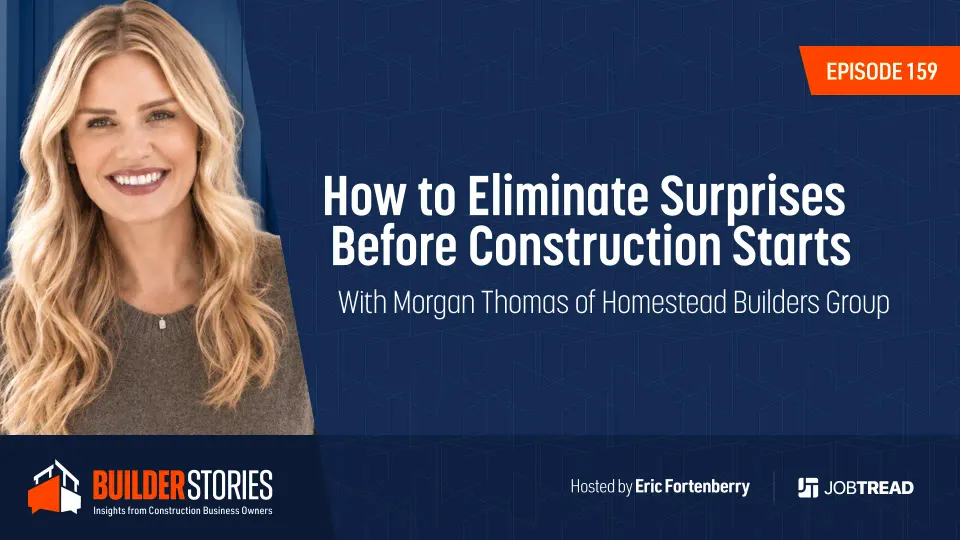

Morgan Thomas spent 15 years in commercial and residential construction before launching Homestead Builders Group in Healdsburg, California, with her business partner. Her promise to every client is a project with no surprises. Morgan believes most construction mishaps can be caught with upfront investigation before anyone picks up a tool. In this episode, she shares how she built her new company around that promise from day one.
In this episode you will learn:
- How an itemized preconstruction agreement makes every responsibility clear before demo starts
- Why an old-school whiteboard keeps crews accountable every day
- The “superpower” that allows her to forecast accurately, know when to hire, and dial in her pipeline
- The simple social media habit that turns architects and designers into referral partners
- What keeps disagreements between co-founders from damaging the partnership
Resources:
Hear the full conversation on Builder Stories. Learn more about Homestead Builders Group here.
Eric Fortenberry: [00:00:00] Welcome to the podcast where we take a deep dive into the stories behind construction business leaders. We will share how they got started, how they found success, and the lessons learned along the way. I’m your host, Eric Fortenberry. Welcome to Builder Stories
Eric Fortenberry: Welcome back everybody. Today I’ve got an incredible business leader. We’ve got Morgan Thomas. She is the co-founder and director of construction at Homestead Builders Group. They’re located in Healdsburg, California. Very excited to have you on the show. Welcome to Builder Stories.
Morgan Thomas: Thank you. Thank you for having me.
Morgan Thomas: I’m pleased to be here.
Eric Fortenberry: Absolutely. Well, why don’t you, uh, kick us off? As, as usual, I like to get just a little bit of background, you know, who you are, how you got into construction, you know, what, what, what led you to, to start your own, uh, your own construction business?
Morgan Thomas: Okay. My construction journey started in a bar.
Morgan Thomas: I was bartending my way through graduate school. One of my regulars that [00:01:00] sat at the bar top every night was a general contractor. He was mostly commercial construction. And after a while he wore me down. He was looking for somebody that could use a computer. He was working on a really outdated project management software, but was working on one that was above what his technical capabilities were, and he really needed somebody to come in and help him manage, um, how to facilitate the project management software and interface with his architects.
Morgan Thomas: And, uh, was willing to let me still stay in school and work around my schedule. So I made the leap, and then fell in love with the construction industry, and I was running my own project within six months and dropped out of grad school and never looked back. I worked in commercial construction for about four years, and then I, um, had my first baby and decided that, uh, traveling for, you know, larger scale commercial projects probably wasn’t as conducive to having a newborn.
Morgan Thomas: And I [00:02:00] transitioned to, uh, residential construction, uh, at that time, um, and worked as a project manager and then a production department manager and then the general manager, um, of a design build firm before branching out and starting Homestead with my co-founder, who also worked at, um, the design build firm with me as well.
Eric Fortenberry: That’s awesome. Yeah. I, uh, I, I love that journey and, uh- ... you know, again, someone who, you know, really found their calling, their passion to, to, to drop out of a, you know, grad school and just change career directions is, uh, you know, it’s, it’s telling. You must really have, uh, really have enjoyed it.
Morgan Thomas: It is... It’s such a wonderful industry and it’s exciting.
Morgan Thomas: You, you’re constantly learning and there’s new challenges. I love a good problem-solving moment. So there’s never a shortage of those in construction. It’s never boring. A different office every day. I get to work in beautiful properties all, all over, you know, where we live. And so I love it. That’s awesome.
Morgan Thomas: I’m obsessed with it. So tell us what- So is my business partner, that’s why we, we work so well together.
Eric Fortenberry: Yeah. That’s, that’s great. So, so tell [00:03:00] us a little bit more, like what, what types of projects are, are you guys doing at Homestead? You know, what’s kind of the average, you know, size and, and duration? Kind of what, what do you, what do you guys do?
Morgan Thomas: Yeah. We are heavily focused on remodel. We do maybe one new custom build a year, but then 90% of our projects are, are remodel. And we pr- Aren’t necessarily-- We don’t disqualify based on the size of the project. So we’ll take a kitchen remodel, and then we’ll do a whole home remodel with an addition, and it’s down to the studs.
Morgan Thomas: And I like to have a few of different sizes going at a different, uh, different, at the same time because I just feel like it helps me manage our resources better that way with projects of various size. Um, but yeah, we, we love to work in, you know, the custom remodel world, and we partner with outside designers and architects to do some really creative, beautiful things.
Morgan Thomas: And if, um, if a client comes to us and doesn’t have a designer, sometimes we’ll help them facilitate, uh, with our own [00:04:00] pre-construction services, um, design and permitting. So we kind of do it both pathways.
Eric Fortenberry: Yeah. That’s great. You know, so you-- It sounds like you, you spent a lot of time, you know, working inside other companies, you know, kind of as, as an employee, as project manager, kind of various roles.
Eric Fortenberry: You know, it, it, it’s, it’s, it’s, it’s awesome that, you know, you, you decided to take the leap to start up your own business. You know, I’m, I’m curious, like, what, what was that, what was that transition like? I mean, going from kind of, you know, again, having established systems and processes and, you know, then ha-having to just turn around and just rebuild everything from scratch, figure out your own infrastructure.
Eric Fortenberry: You know, what, what, what were some of the first systems and first things that you set up at, at Homestead, and kinda how, how did, how did you decide what to do first?
Morgan Thomas: So yeah, that’s a good question. I would say that we, we real- w- we bought JobTread like day one to keep things organized. I really w- have benefited from JobTread.
Morgan Thomas: I, I onboarded it at my former company as well, and [00:05:00] so that was one of the very first things that we did. Um, you know, being able... Having the opportunity to do it on our own, we feel really fortunate to be able to, to do that. We’ve built some really strong relationships in our community with trade partners and vendors and, and, and clients, and, and I think that that has really allowed us to, to branch out on our own and, and take a chance.
Morgan Thomas: It’s been a tough few years in the industry, so it feels like a crazy time to s- get started, but also it was the right time for us, and we’ve been really fortunate to, um, really rely on those relationships that we have built over our years in this industry, in this county, and be able to take a lot of what we learned at, in our former roles and, um, at our former companies and bring that in.
Morgan Thomas: I mean, I still use a lot of the things that I learned in commercial construction. I think that the systems and processes that I implemented at my... I- in all of my roles [00:06:00] has, has really been founded in that very diligent, disciplined approach to documentation, to having a system and, and having really clear communication with all of the, all of the parties and agents involved in the project.
Morgan Thomas: All of that really roots in my, um, my commercial construction background. And then, you know, we’ve just kind of parlayed all of that we’ve learned along our journey and used it to, um, to really... It feels like a startup, but a, a startup on steroids because we’ve been doing it together for so long, and we’ve failed a lot along the way and tried things that didn’t work.
Morgan Thomas: And so coming into it with all of that experience it already under our belts, it’s felt like it was, um- It was an, it was a, just an extension of what we’d already been doing in our career.
Eric Fortenberry: Yeah, I, I, I can’t agree more. Having real experiences is so critical to, to how quickly and, uh, you know, how, how, how, how much, uh, time and, and, and, and, and effort, you know, really does have to [00:07:00] go in sort of figuring everything out versus already knowing what you need to do and just h- you know, figuring out how to get there is, is, is, is often, uh, a little bit easier when you kinda have a vision and know, you know, where, where you’re going.
Eric Fortenberry: You know, this is, you know, JobTread is, I guess, kind of, you know, I had a, had a software company and then I took over and I ran a construction company, and so this is kinda, you know, now I have a construction software company. It was definitely a lot easier, though, on the, the third business versus, uh, you know, kinda starting off at, at the beginning.
Eric Fortenberry: Um, I’m curious, like w- when you, when you think about, though, I mean, you know, again, I, I think your kind of, your most recent company before this is, you know, 45, 50 people, something like that. Like- Mm ... when you think about, like transitioning to, you know, from, from, from such a large company to starting from scratch, like w- what do you think, like, what were some of the biggest pain points that you experienced, you know, hav- having to just start over?
Morgan Thomas: Um, trying to do high-quality work without all of the resources that I’m, was accustomed to having. You know, I ha- I had such a strong carpentry team at, at the former company, and we had all of the [00:08:00] tools and the trucks and all of the things already kind of in place. And so trying to, um, recapture that same, uh, quality and, and experience that honestly we
Morgan Thomas: Yeah, I feel like my business partner and I have built a pretty strong reputation for ourselves as delivering really high-quality work. And so to keep that up with a very, uh, small resource pool compared to what we had at our disposal before has been an adjustment. Obviously, we’ve been able to build and grow and, um, start to acquire those resources again.
Morgan Thomas: But, um, on day one, I was like, “Oh, uh, I have to do all of the steps all by myself-” “... ’cause I’m ju- it’s just us now.” So, uh, it was, um, a lot of g- you know, getting back to our grassroots, things we hadn’t touched in a very long time because we had such a large team. But it also was refreshing because it just was a great reminder of like, I do love doing all of this work, and I missed being able to project manage when I [00:09:00] was running such a team of 40.
Morgan Thomas: Like, I didn’t get to touch projects anymore in a hands-on way. And so getting to be able to do that again, I think, has just reinvigorated both of us. I mean, of just how much we really do love the work and enjoy it so much. And so getting to kind of go back to the basics has felt really fun and just exciting again.
Eric Fortenberry: Yeah. That’s awesome.
Morgan Thomas: Yeah.
Eric Fortenberry: I’m curious, you know, so, so it sounds like, you know, again, kind of you r- remodels, I mean, you got one, you know, new addition maybe per... or one, uh, you know, new build per year. But like when, when you first kind of, you know, started thinking about, you know, starting this and doing this, like what, what, what were your thoughts on like what types of jobs you should target first?
Eric Fortenberry: And like, you know, again, I, I, I interview a lot of people, you know, they always say, you know, “When we started off, you know, doing, you know, small jobs, you know, whatever we could take, you know,” just, and it, and it sort of naturally, you know, progresses over time for people. And as they get more confident, you know, they get more experience, they start taking on larger and larger projects.
Eric Fortenberry: What did it look [00:10:00] like for you though? Because you came in with, with experience.
Morgan Thomas: Mm-hmm.
Eric Fortenberry: You know, what, what was your initial target and, and is it, is it the same or has, has it evolved?
Morgan Thomas: I would say that we really believe that our strengths lie in w- a more complex remodel project, and that is where I think we offer the most value to clients.
Morgan Thomas: And so that is very much what we went after right from the beginning. And we’ve been fortunate so far that we’ve been able to just really lean heavy on our, on our network, and we’ve gotten a lot of word-of-mouth referrals for some really great projects through that w- way, and so we haven’t had to do a ton of active marketing, um, which we recognize is w- we are so fortunate for, especially given the current climate of, of the industry.
Morgan Thomas: Um, but we really do think that that complicated remodel, if there’s, you know, specific issues that need, you know, just a level of like rallying the troops, let’s get everybody on the same page, let’s have some tr- transparency and [00:11:00] clarity and, and, and some really w- you know, guided meetings so that we can arrive at some clear decisions and help facilitate the decision-making process.
Morgan Thomas: We have a very robust con- pre-construction process where we identify all of the possibilities and really narrow down what the scopes are, who’s responsible for what, and that is w- what we believe if we can really pre-plan strongly, then we’re gonna avoid all of those surprises in construction. And that is ultimately what we’re trying to do, is eliminate surprises.
Morgan Thomas: And complicated remodel projects, I think, are plagued by that really casual like, “Oh, well, we’ll see when we open up the walls.” And that I think is just a little bit of a, a lazy way to approach it because most surprises in construction aren’t real surprises. Most of them can be really easily identified if somebody spends the time to do a little bit of upfront work and investigation and do a little bit of research.
Morgan Thomas: And so we really do focus on, hey, we wanna make sure we have everything identified and everybody [00:12:00] is very clear about the path for execution, so that when we hit go, it’s only about execution and deliverables, and very little about, uh, ver- verifying in field. We don’t wanna do any verification in field. I wanna do all that before we actually start on tools.
Eric Fortenberry: Yeah. That’s, uh, that’s awesome, and that’s, that’s really smart. And you know, I think that would also give a lot of confidence to, you know, a potential customer when they’re evaluating you versus, you know, some others, you know, being able to know that you’ve already figured out all the, you know, potential unknowns in the, in the future.
Eric Fortenberry: You know, you, you’ve, you’ve gone that extra mile to really determine that. I’m curious, do you-- Like, what is, what is kind of the sales process look like? Are you all, you know, charging upfront? You know, do, do you have some design agreements? Do you have-- You know, are you charging for estimates? Like, how, how does that kind of, you know, someone’s interested, they reach out to you, what’s the full process look like to get them all the way into, you know, construction?
Morgan Thomas: Yes. So we do have a prequalification process that is handled by, um, my partner Candace. [00:13:00] She runs kind of all of pre-construction. That’s her world. I, I obviously-- There’s overlap for, um, both of us. But she does all the prequalification, and then if, if she believes that the project is a good fit, that it’s a, a client that we could really help, or it’s a designer or an architect that is open to allowing us to collaborate during the pre-construction phase, then we’ll move forward with...
Morgan Thomas: We have a really, um, clear pre-construction agreement that we do charge for our services. But it’s also, like, more like an à la carte menu where we say, “Okay, these are all of the things that need to happen during pre-construction.” You know, s- uh, material specifications, the permitting, y- all of the red line reviews, um, managing all of the a-architects and engineers and, and interior designer specifications and furniture and all of the things.
Morgan Thomas: And so we make a list, and it-- give them a dollar value. If you want us to do these things for you, this is what it’s gonna cost. We do our pre-construction services [00:14:00] on a fixed price for each one of those, one of those buckets, and then the client decides if they want us to do it. And then if they don’t want us to do it, they have to tell us who is gonna do it.
Morgan Thomas: Who on your team is responsible for the permit? If not us, that’s okay. Is it gonna be your architect? So that then we know what we’re responsible for managing, and they know what actually has to happen in pre-construction. Because I think a lot of clients aren’t prepared for how much work has to go in before they start tearing walls out.
Morgan Thomas: And so that, I think, is a good introduction for clients to really understand the level of upfront investment to get the project into a healthy place so that it can be successful in construction and not have all those change order horror stories that everybody tells their friends over dinner. So-
Eric Fortenberry: Yeah
Morgan Thomas: we really do believe that that pre-construction process is critical. And if a client’s not willing to engage in a pre-construction agreement with us, then they weren’t gonna be a good fit
Eric Fortenberry: Sure. When, when are, when do you find that you guys are being brought into [00:15:00] the process? Is, uh, is the, is the client typically already hired an architect, you know, is, is bringing that, you know, and they’re bringing you in?
Eric Fortenberry: Or are you saying, “Hey, you know, I think you need to go hire an architect. If you don’t want us to, you know, help manage that, then you need to go find someone and bring them to the table”? Or, or kind of how, how, how does that, how does that work?
Morgan Thomas: I would say right now our project mix is probably 50/50. 50% come to us, um, without any having met with any kind of design team or architect, and then 50% are coming to us through our architecture partners that think that this project would be a good fit, and they are bringing it to us.
Morgan Thomas: Our architects that we work with, we, we have a really great relationship and rapport where we can help them with real-time pricing feedback when they’re doing, you know, design revisions and they want to understand some value engineering opportunities, or what is the budget implication for these installations.
Morgan Thomas: Um, so that, you know, we don’t... It’s sad to see beautiful projects get designed and never built because there wasn’t consideration for the budget. And so we want to be that partner for architects- Yeah ... and designers, that their [00:16:00] beautiful work actually does get to be seen and become real. Um, and so if we can provide them real-time pricing feedback as they’re going through their design iterations with their client, um, that those partnerships, I think are the ones that we have that are the strongest for outside design and architecture.
Eric Fortenberry: Sure. Who, who was like, who, who was your first customer? Like, when, when you decided to start this, did you already have an idea or know who that was gonna be? I mean, you said it was kind of word of mouth and referrals, but like- Mm-hmm ... like, how, how quickly did, did, did you get that first, that first customer?
Morgan Thomas: Um, before we even had all of the paperwork really done with all of the, you know, corporation documents and e- and the license moved over, um, my children go to a school here in Healdsburg and we have a moms club where we do moms night once a month. And it, we were out and, uh, and I was just sharing like, “Oh, I’m going out on my own.
Morgan Thomas: We’re doing this.” And one of the moms was like, “Oh my gosh, perfect timing. My shower broke today, and I really need you to just take this opportunity to remodel the bathroom [00:17:00] because it’s an ugly bathroom anyways.” And I was like, “Oh, that sounds great. Let’s do it.” So- Nice ... having that personal network, I think does really help supplement that.
Morgan Thomas: When times get lean, I think it, there’s still people that need work done on their homes, it’s just they’re gonna go to people that they know and people that they trust. And so having, um, that addit- you know, branching out outside of just the industry, just our personal networks and really having a lot of support in those networks has been a huge, um, bolster to us for just incoming projects, or them referring us, our friends referring us to their friends that they know are doing work in their homes.
Morgan Thomas: So that was our first one, and we- Yeah ... just finished it, so
Eric Fortenberry: Awesome. Well, congrats. Yeah. That’s, uh, that’s, that’s exciting.
Morgan Thomas: Yeah.
Eric Fortenberry: I, I’m curious when, you know, when you think about- establishing, you know, relationships with, you know, architects, designers, you know, realtors. Like, you know, there’s, there’s a whole bunch of people who could potentially be referring, you know, [00:18:00] jobs to you guys.
Eric Fortenberry: Like, h- how do you, how do you think about getting in with those groups, and, like, what efforts have you put to, to really try to build those relationships and find the right, you know, the right kind of mutual, you know, partnerships that, that you can form to, to, to grow the business?
Morgan Thomas: Just like where you identify what a good client looks like for you, we sat down, we wrote the characteristics of what is a good architect partner or a good interior design partner, f- because we do believe that all of our relationships should be win-wins.
Morgan Thomas: Same thing with our clients. It should be a win-win. And this, uh, the architects and the designers that we work with, we wanna feel that they have that same dynamic with us, where they f- they’re happy to work with us, we’re happy to work with them, and we both are mutually benefiting from the relationship.
Morgan Thomas: And so we put together just a list of qualities and characteristics of designers and architects that we’ve worked with in the past that we had really successful projects with. Why did that go so successfully? And then what do we want to do as far as work that we’re really [00:19:00] interested in doing, um, and, and made that kind of, you know, ideal list of c- of qualities, and then we just actively started t- can I, can we take you to coffee?
Morgan Thomas: And sitting down with different architects and designers and saying, “Hey, we love your work.” Sharing their work. We share their work on our, on our socials a lot, and comment, like, “This detail is so clean and so well executed because of X, Y, or Z,” and tag them in our re-share of their work. And so many of them have been like, “Oh, we’d love to go to coffee with you.
Morgan Thomas: You guys obviously have, you know, a good eye for the detail,” and we really want contractors that do. And that’s what we tell them all the time. We are a contractor that really believes that as much as carpentry is a skill, protecting the integrity of the design is also a construction skill. And, and I think that historically, there’s always been this adversarial relationship of, “Ooh, it’s con- the production versus design, and they’re fighting on the job, and the contractor just wants to make it ugly and [00:20:00] builder grade, and the designer wants to make it in- crazy, and it doesn’t work.”
Morgan Thomas: And I think that breaking down that really bad trope and saying, “Hey, like, we actually really wanna build amazing, beautiful stuff, too. Like, we want it to look awesome.” Yeah. “So here’s what we can do to preserve the design intent but make it feasible or make it more affordable or” and really have a, build that strong rapport with them where they understand, like, I’m not trying to make your, take your beautiful art and gut the soul out of it and make it builder grade.
Morgan Thomas: I’m trying to help. And, and finding, um, architects and designers that want that help and want that feedback and that two-way relationship has been, um, really successful for us.
Eric Fortenberry: That’s awesome. I, I, I couldn’t agree more that, like, when you can find those win-wins, like, that, that is the best possible scenario and, and, and, and it’s not...
Eric Fortenberry: You know, the worst thing for a, for a, for a relationship partnership is when it feels that it’s just one way, you know? And, and I think, like, when, when, when you’re getting clients from them and when you can bring them in and give them clients, [00:21:00] like, that, that truly does build a very strong two-way relationship and just understanding that, like, look The, the, the potential customers could reach out to any of us, and when we can kind of work together, like, that’s how we’re gonna deliver the best possible product, and then everyone wins because you can win that customer over when they feel confident that everyone’s gonna work well together.
Eric Fortenberry: And, you know, the fact that, you know, you’ve already done this before, like that I think also bodes well to, to, to getting those deals done.
Morgan Thomas: Yeah.
Eric Fortenberry: I, I love the, I love the strategy of like, you know, going and, and, and, and not just meeting them and, and shaking hands, but like, you know, following their socials and then engaging on their socials.
Eric Fortenberry: Like, what a great way to, to, again, keep your, your brand, your company front and center, you know, in front of them. Because, you know, we all know, I mean, everyone loves the, the engagement, the more likes and comments. Like, that kind of one thing, you know, triggers it to show it to more people. And so, like, the more that you can do to really help boost up, you know, their presence and their work and, and, and give those compliments, I mean, that, that seems like a great strategy that, you know, I, I- Yeah
Eric Fortenberry: I hadn’t heard that before- Yeah ... but I, I love that.
Morgan Thomas: It works. And we do-- we’ll [00:22:00] go to, like, the house tours and the design showcases and take our own photos of like, “Oh, this is such a great, clever way to do this termination,” like, “This is amazing,” and, and g- and then tag them and, and then try to facilitate a relationship where we can, “Hey, we’d love to take you to coffee.
Morgan Thomas: We’d love to take you to lunch. We wanna, you know-
Eric Fortenberry: Yeah ...
Morgan Thomas: we wanna build cool stuff with you.” So-
Eric Fortenberry: That’s awesome ...
Morgan Thomas: it’s worked well for us.
Eric Fortenberry: Yeah, I love it. And then, uh, you know, again, uh, y- you’re getting, you’re getting that great, you know, content on your social. You’re creating- Yeah ... awareness for them. Like, I mean, again, everybody’s winning here when, when, when you’re doing those types of activities.
Eric Fortenberry: So I think that’s, that’s awesome. I’m curious, what’s the, what’s the bigger marketing strategy? I mean, I, you know, I, I see you got a website. You know, obviously you guys have started kind of doing some social stuff. But, you know, I mean, you’re, you’re, you’re blessed to have, you know, those, those referrals, the word of mouth.
Eric Fortenberry: But I mean, at some point, right, like, you have to also prepare for, you know, how are we gonna get kind of the, the, the, the, the people out there that don’t know us, and they, they, they don’t know anyone that we know? Like, h- how are you kind of thinking about marketing and, and, and the strategy there?
Morgan Thomas: We are [00:23:00] really community focused, and I think for us, trying to build a presence in this community is the most important thing.
Morgan Thomas: So being able to sponsor, you know, the local sports teams and doing, you know, in the FFA and buying, you know, from the 4H kids for their pigs, and being able to sponsor school events, and just trying to build a strong relationship and presence within the community that we work in, I think is our biggest long-term, um, marketing plan.
Morgan Thomas: And it, it’s a little, um, slower and more grassroots, but that’s just more authentic to who we are, and I think that it allows us to build a more authentic presence and build those relationships long-term, um, that allow us to be successful. We, you know, d- digital ads and print ads get so expensive so quickly and, and I just, I don’t know that
Morgan Thomas: I think in certain markets it really works. We’re in a fairly small market, and so that, I feel like, has not been as successful for [00:24:00] us in the past, just because I think that it’s more about who you know in this county, because it is so small. And so it’s more about when people are ready, I want them to already know who we are, but I want them to know us for who we are and not just the ran- you know, just a name.
Morgan Thomas: Not just Homestead, but just that we’re w- or what, who we really are and what our brand is and, and what our brand promise is, which is that, you know, you’re gonna go into your project with an immense amount of confidence and clarity and certainty about the decisions that you’re making. And that is always the commitment that I’m gonna make to our clients time a- time again.
Morgan Thomas: That is what we are always striving to do. No surprises, lots of certainty. So for some clients, that is, that is a really good fit, and we want them to be able to find us. But they’re here in our community, so ours is much more grassroots. And our office is really strategically located. We’re right downtown, and so there’s a lot of people that walk right by to get coffee, and so I think just the visual presence of being in the [00:25:00] community is really important for our
Eric Fortenberry: marketing.
Eric Fortenberry: Sure. So I gotta ask, and, you know, again, a, a very small percentage of this industry is, is women. Mm-hmm. You know, and, and, and you and your co-founder, Candice, I mean, you, you are two women founders here building a construction business. Like, how do you think that has, you know, helped or hurt you in, in terms of launching this new company?
Eric Fortenberry: Like, h- uh, do, do you feel like, you know, you, you’ve, you, you run the company differently than others? Like, do you see it as a strategic advantage? Like, I’ve talked to many other women run, run, uh, construction businesses, and they, they, they feel like it’s actually a huge advantage, and I’m curious what, what are, what are your thoughts on that?
Morgan Thomas: Yes. This is the question everybody always asks. It’s my least favorite question because I feel like there’s a lot of pressure to answer on behalf of all of us, and I feel like everybody’s experience is off- is very different. I feel very fortunate because my experience in construction has been a very positive one, and I don’t think that that has been true for all women in this [00:26:00] industry, and I don’t think that that’s true for all women in the industry right now.
Morgan Thomas: But I do think that there are a lot of women that pioneered this industry before us that have made it a lot more possible for me and people like me and my fa- my co-founder to have a lot of success and enjoyment in our work and it not be an issue. That being said, like, there’s no denying that if you call Homestead, you’re going to get a blonde woman at your front door, and we can’t hide that that’s what’s gonna happen.
Morgan Thomas: So we do kind of have to lean into it. Like e- if, if that’s gonna be an issue for you, we’re not the right fit, right? And I believe that competency is the great equalizer, and I really let our work speak for itself. I don’t know if it’s an advantage, but I do think that we approach our work In the, in a specific way from our own life experiences, from who we are, from being mothers, from being, you know, women.
Morgan Thomas: I, I, I, you know, there’s no denying that that does impact how we [00:27:00] approach our work and how we do everything in our daily lives. So I think that one thing that I do believe we do really, really well is we, we can really imagine the user interface at the end of how somebody lives in their home, and building a custom home is, like, the ultimate goal, right?
Morgan Thomas: It is such an awesome opportunity for the people that get to do it. To, to design a space for how you’re, you are gonna live and operate in that space is so cool and such a fun thing to get to be a part of. And so getting to talk to clients about how they cook or how they shower even. Like, we get very comfortable with our clients, and maybe there is a little bit of comfort level for clients to share because we are women.
Morgan Thomas: And a lot of people in those conversations are couples, and you know, the wife usually is making a lot of decisions in that dynamic about her home. And so I think maybe we do get [00:28:00] better data to make decisions off of because people feel comfortable to have those types of conversations with us where we can make better decisions about the build.
Morgan Thomas: Yeah. But it definitely is, um... I, I- my name is Morgan, obviously, and that has some gender neutrality to it. So a lot of us interface only via email a lot, right? And then you finally put a, put a face to the email name, and you’re like, “Oh, hello. It’s finally nice to meet you.” And I have definitely gotten over the course of my career several times where they’re like, “You’re not at all what I was expecting.”
Morgan Thomas: And I, I’m like, “I get that. That’s okay. It does- it doesn’t offend me.” Um- Yeah. Yeah.
Eric Fortenberry: That’s awesome. H- have you... I, I mean, it sounds like you, you haven’t necessarily had kind of some of the, the same, you know, challenging situations that, that I’ve heard from others. But, I mean, has there ever been any, you know, challenges with, with the crews, with anyone, you know, subcontractors, people who just blatantly disrespecting you solely because you’re a woman?
Morgan Thomas: I mean, I’ve had a few. I mean, I’ve been in this industry for 15 years, so [00:29:00] there’s definitely cases or instances that are one-offs. They’re few and far between, but it definitely does happen. Um, more it’s like, uh, pet names or like, “Oh, don’t wor- don’t worry about it, sweetheart, we’ll do it later,” kind of a like pet brush off.
Morgan Thomas: Um, or I’ll get mistaken for the client or like the homeowner. Like, uh, if by a sub, you know, and it’s just well intended. They’re not being rude- Yeah ... or, or disrespectful, but I’ll pull up to the job site and start talking and asking questions and, and they’re, “Oh, you have such a lovely house.” And I’m like, “Oh, thank you, but this isn’t my house.
Morgan Thomas: The... I’m the general contractor on this project.” And then, and you know, their bosses know me, but they may not. Yeah. And so that happens quite frequently. Um, I’ve had a few, and, and if, you know, if working with a female in this industry is an issue, like it becomes an iss- it becomes apparent very quickly, and then we just don’t work together anymore.
Morgan Thomas: And, and, and I’m fortunate to be in a position where I get to make those decisions, where, hey, that sub, not a good fit for us, we’re not gonna work with them anymore, [00:30:00] right? Sure. So it hasn’t been a major issue for me over, well, thankfully. You know, I feel very grateful and, um, we have a very beautiful little island of wonderful subcontractors and vendors that really support us and refer us and pick up the phone, happy to come to our projects.
Morgan Thomas: And I, and I think that that’s all it is, is being professional, expecting a certain level of decorum on your projects, and setting a tone, um, for how you present yourself and how you interact with everybody on your job site. And mutual respect, I think is met, you know, with positive, you know, reaction. And so they know that when they, when they come to my project, I’m ready for them.
Morgan Thomas: I have all the answers for their questions. If I don’t have it, I’m gonna get it, and I’m gonna make sure that they are not wasting their time, that they’re being able to be profitable on my projects, and that we’re building really great high quality work. And so I think that that trumps any kind of issue or, you know-
Eric Fortenberry: Yeah
Morgan Thomas: dynamic.
Eric Fortenberry: Yeah. I’m sure, I’m sure the reality is too you, you’ve probably seen magnitudes [00:31:00] more, uh, projects, much larger scale projects than, uh, than, than many of them have, have even been involved in. So having that, having that experience is, is, is tremendously valuable.
Morgan Thomas: Yeah.
Eric Fortenberry: When... W- what’s your... So what’s your, what’s your thinking around kind of what, what’s your team look like today and sort of where do you see building out the team?
Eric Fortenberry: Like what, what do you, what do you kind of want to create from, from an, an employee standpoint? H- how are you gonna structure your team?
Morgan Thomas: So we, I think, are going to design intentionally small, but be able to hit above our weight class is kind of how we really want to be able to do it. Be efficient and effective in the way that we, we manage ourselves and our projects, um, so that we can do great work and not have to say no to really great work if we, um, if it comes our way.
Morgan Thomas: So we right now, Candace runs pre-construction, and so she’s handling all of the sales and marketing, and she’s, uh, doing all of the, if there’s drafting required, permit acquisition, she’s [00:32:00] handling that. I do all of our estimating. Um, and right now I’m doing all of our project management, but I’m hoping that that, um, changes soon.
Morgan Thomas: I do think we’ll add a project management, um, seat to the team here in the next two months. And then we have one self-performed carpentry crew that’s coming together, but I think we’re gonna expand and have two. Um, so I’m thinking probably the sweet spot for us is about 10 to 12 people, um, which we’ll probably be at, I would think, in the next six months
Eric Fortenberry: Yeah, that’s great.
Morgan Thomas: Yeah, yeah.
Eric Fortenberry: And, uh, I mean, uh, it, you know, obviously, I, I, I know as, as a fellow entrepreneur, you know, we all put on a lot of hats and we try to do everything ourselves for as long as we can. But, you know, again, it, it, it seems like at, at some point, you know, I, I do feel strongly that it’s important to figure out, you know, who can you bring onto the team that can start taking off those hats for you so that, you know, you and your co-founder are able to kind of, you know, also spend time working on the business and not just in the business.
Eric Fortenberry: You know, so it sounds like you, you see kind of both, I [00:33:00] mean, at some point, you know, you got the estimating, the project management role are sitting squarely on you right now.
Morgan Thomas: Yes.
Eric Fortenberry: Is, uh, is, is, is the thought that, like, you know, you want to be able to onboard and train people on, you know, kind of your systems, your processes, and then ultimately you- you’ll, you’ll feel comfortable handing that off to, to, to a team of people?
Morgan Thomas: Yeah. So I think what I would do, my goal is to bring somebody in that I can kind of work alongside for a good amount of time, that then before they start running projects autonomously because, because I want them to become really familiar with the systems and also with just our standards of quality.
Morgan Thomas: It’s really hard to quantify that in custom construction where it’s just like a checklist. Um, a lot of it is judgment, and I think that that comes with just time and more reps. And so giving them an opportunity to do that under, with my guidance for a while, um, but then take the things off my plate that I don’t love doing, that don’t bring me joy to do, um, and then helps free me up with a little bit more bandwidth, um- Yeah
Morgan Thomas: would be [00:34:00] ideal. And then we’re doing the same thing. We’re gonna hire another pre-construction seat to help with sales and marketing on, on the front end so that Candace’s attention can be focused on the things that actually do grow the business, right? That is the ultimate goal is that our attention is not on the low-hanging fruit, but on the stuff that actually moves the ball forward.
Eric Fortenberry: Sure. You know, I see a lot of people who, a- again, they, they, they start the business and they, they get overwhelmed. They, they get, you know, kind of stressed. They’re, they’re trying to, you know, carry that ball, you know, by themselves for a long, long time. You know, have, have you all thought about and, and have you built, you know, some sort of a, you know, a, a financial model or do you have an annual budget for, you know, the business?
Eric Fortenberry: And so, like, do you use that to help sort of inform, like, when is the right time to hire that person? Because I, I can’t tell you the number of times I, I see people, they wait until it’s too late, and they wait till they’re just, like, drowning, and then they, they, they just immediately, you know, take the first person that walks in the door, which, you know, m- a lot of times is their spouse or partner and it’s like, you know, I’m sure they’re great people and they love you a lot, but they’re not the [00:35:00] right people to hire.
Eric Fortenberry: You know, so how have you kind of thought about, you know, you know, how, how do you make the decision when is the right time to, to, to make that next hire?
Morgan Thomas: Yeah. Candace and I are both, uh, data obsessed, data driven humans, and so we have like Budgets and spreadsheets and forecasts, um, all, all probably over detailed.
Morgan Thomas: And one of the things that we did do right away that I think w- has been kind of a little bit of our superpower is we hired an outside bookkeeper, fractional CFO, and shout out to Keaton. He’s amazing, and he is, um ... That piece of it can take on a life of its own, so just getting that off of our plate so we could focus on the projects was really helpful.
Morgan Thomas: But then he w- is also loves data, and he loves that we love data, so he’ll just send me all of these different models of forecasting if we hire at this rate, if we hire at that rate, and he builds me epic spreadsheets that I get to, um, we get to incorporate [00:36:00] into, you know, that having that piece where you can really trust your numbers and know your numbers and know what your pipeline is looking like and what the likelihood of producing that pipeline is, you know, associated with the calendar, is so important.
Morgan Thomas: And so being able to dial in your WIP and dial in your pipeline so that you really know where you’re at right now, how you’re performing, and what you’re expecting to, if you continue those trends, and being able to identify those trends is so important. Um, so being able to have, you know, a lot of confidence in the, in the numbers has been able to allow us to feel like we have a good map for when we can add different pieces into the team.
Eric Fortenberry: That’s awesome. Yeah. I, I, I absolutely love that, and you know, I, if, if I were to make a bet, I, I would bet on you and Candace’s success is tremendously higher than so many people that I talk to solely for the fact that from day one you have planned this out, and that you understand your numbers, and that you’re using data to make informed decisions, [00:37:00] and that you’re not just, you know, reacting and waiting until it’s too late and just flying by the seat of your pants.
Eric Fortenberry: Like, that is truly one of the biggest differentiators between what will make somebody successful and somebody not is how have they set themselves up from day one? What does that foundation look like? And, and, and again, like, just having that understanding I, I think is so important, and, and it sounds like you guys are, are well on your way, uh, to, to, to being able to, to build a very, very successful and healthy business.
Eric Fortenberry: I’m curious, so again, I’ve, I’ve, I’ve interviewed a lot of people, I’ve talked to a lot of people that, you know, some of them solo owner/operators, some of them have a business partner. How do you and Candace, you know, uh, stay on the same page? How do you think about as, as leaders and as, as, as, as co-founders here, how do you work together?
Eric Fortenberry: ’Cause, ’cause obviously there are gonna be disagreements. You know, there are gonna be times where, you know, Candace says, “Go left,” you think, “Go right.” You know, how, how do you guys kinda resolve that and work through those challenges? You [00:38:00] know, uh, it’s just, it’s, it’s so unfortunate when you, when you, when you see two partners who, you know, it maybe it starts off good, but they don’t have good practices and habits and don’t have good communication.
Eric Fortenberry: And then something happens and, you know, the whole thing blows up over, you know, over an argument or, you know, lack of communications. Like, h- how have you all planned to, to make sure that that doesn’t happen with, with you all?
Morgan Thomas: Yeah, that, that’s a really good question. I think that, one, I’m very fortunate that Candace and I do have such a strong working relationship, and we’ve been tested and tried over many, many, many years of working together in really high intense environment.
Morgan Thomas: Um, just, I mean, uh, the building industry in our, in our county has gone through so many ups and downs in the last, you know, five, seven years. And so getting to weather that storm together already, I think has really built a really strong foundation for us. Um, but I also think that there’s a really- critical part of our relationship is that we have very clearly [00:39:00] defined roles and very clear strengths, and the things that she is good at are the things that I am not good at, and the vice versa.
Morgan Thomas: And we don’t, like we, we don’t, um, we don’t mince words. We’re very direct communicators, and we have this kind of o- open communication policy where like you, you, you’re not gonna hurt my feelings. I need you to give me the truth. I need you to tell me what y- you need to tell me so that we can get to the solution to this problem sooner, because letting it lie as a problem is, is gonna create way more pain than us just getting it out on the table.
Morgan Thomas: Let’s work together. And, and you know, we have a lot of mutual respect for each other, where we can duke it out, ’cause we do, um, about certain things about work, and, and this is my perspective and I’m doing risk mitigation and I’m worried about this and this isn’t gonna execute well, and she’s, you know, got a lot more vision and a lot more dream and a lot more, you know.
Morgan Thomas: And I’m like, “Okay, well, we gotta boil that down because th- there’s no way we’re gonna be able to execute that- Like, let’s start with this step, and then we [00:40:00] can take that one, next one on. And I think that what we do is just complement each other’s skills, but also have this understanding that, like, at the end of the day, I still care about you, I still care about your family.
Morgan Thomas: Like, it’s all good. Like, work is work, and we both love it, and we’re so passionate about it. But we are really well-aligned in what our ultimate goal is, is to build a really healthy, strong company that we’re really proud of, that does work that we’re really proud of, that we love coming to every day. And that being-- Having clarity around where we’re trying to go, and then being able to duke it out about how we get there, knowing that, like, I might not win and she might not win, but somewhere in the middle is probably the right answer.
Morgan Thomas: Yeah. And I think we, we, we do that very often.
Eric Fortenberry: Yeah. No, I, I... You know, again, I, I believe that, you know, when, when you can argue both sides of a point, that’s when you truly understand it. And so being able to see other people’s perspectives and take that into account. You know, one of our, one of our, our, our mottos here, our favorite motto is, “May the best idea always win.”
Eric Fortenberry: You know? Yeah, that’s a great one. It really [00:41:00] doesn’t matter who came up with it. You know, I tell people all the time, like, I, I, I don’t, I, I don’t want anyone to just go and do something because I said it. Like, I want people to be comfortable pushing back on anything and everything and, and let’s really get into the details to make sure that some- someone’s idea is a good idea and it is something that we should, you know, move forward with.
Eric Fortenberry: And, and I think having that, you know, mutual respect and, and always remembering like, look, everyone’s intention is, is to, you know, win. Like, we, we want to, to do the best job that we possibly can. And, and so I think, you know, oftentimes, though, when, when you have two, you know, co-founders and people up, up at the top, like, it’s so important that there is that strong relationship that, you know, that, that, that unified front that, you know, you all can, can come into any situation with anyone, you know, whether it’s, you know, employees, trade partners, clients, and, and, and together you have that unified front.
Eric Fortenberry: Even if, you know, behind the scenes you’ve, you’ve argued about it countless hours and, you know, y- you know, someone maybe doesn’t feel great about it, you know, I think it’s important, though, you [00:42:00] know, from a leadership standpoint, you know, you, you, you can lead the people and, and ultimately, yeah, you, you gotta make a decision to move and, you know, I think it sounds like you all have a, a really strong relationship that, that bodes well for that.
Morgan Thomas: Yeah, and we definitely keep it divided, right? We have meetings specifically to talk about projects, and then we’ve got meetings where we specifically talk about the business, and we’re really clear about, like, that conversation needs to wait because right now we need to stay focused on this, but we’re gonna add it to the agenda for the topics, and we’re gonna talk about that.
Morgan Thomas: We’re gonna get into it when we have the time carved and set aside to get into it. Yeah. And I think that helps. ’Cause if the conversation is just, like, sprinkled throughout your workday, it can also start to get a l- get a little muddy.
Eric Fortenberry: Yeah. So when you think about, you know, recruiting, right? R- recruiting, you know, trade partners, subs, you know, employees, what’s, what’s the strategy there, and, and, and do you have, you know, specific, you know, characteristics, traits, you know, experience levels?
Eric Fortenberry: Like, kind of what, what do you look for, and how do you, how do you make sure that you’re, you’re bringing the right people, you know, in, into the fold that will help, you [00:43:00] know, push the business forward?
Morgan Thomas: Great question. I think for trades and vendors, it’s a little bit different. We definitely go on, I’m gonna take referrals from the people I already have great relationships with that I trust their judgment and trust that they’re, they know my work and they know what I’m looking for.
Morgan Thomas: So if they’re telling me, “Hey, you really should meet this plumber”, then I wanna meet that plumber because they know what my expectations are, what my quality standards are, and they, and I already think that they are doing such a great job at it that I’m gonna value their opinion and take that referral.
Morgan Thomas: Usually what we’ll do is, like, have them come into the office, meet with us. I wanna understand what their process is. How do they like to estimate? How do they, how do they manage their, their bookkeeping? Is it them? Is it their wife at their kitchen table? Is it an outside bookkeeping source? Like, what-- I just really wanna understand how their business is structured so that I can see if is it a good-- are-- can we be a good partner to you- Mm-hmm
Morgan Thomas: and how our business model works, and then give them a really clear understanding of, like, [00:44:00] this is our pre-construction process. This is how our contract is structured. This is what the expectations look like for you to be a sub and vendor for us. And then it, if that is exciting for them, then we move forward, and if they’re like, “Whoa, this is a lot of paperwork,” then we’re like, “Mm, this is probably not gonna be a good fit.”
Morgan Thomas: Um, so we kinda do a different strategy with subs and vendors. I find hiring in-house labor to be a much more, uh, difficult task. Um, it’s just hard to know from an interview or a question process, um, you know, what, what can they really build. And in California, you can’t really do, like, working interviews.
Morgan Thomas: Like, there’s so many labor laws that we have to abide by, and so it’s more about, um, clear feedback loop and really sticking to that 90-day, uh, period where we’re really are assessing you. And if you clear your onboarding period after 90 days, then, then we feel really confident about you being a part of the team.
Morgan Thomas: But having a [00:45:00] very structured, this is the expectation for your first 30 days. They get a, like, an outline of, like, this is everything that you need to be able to do by day 30. Then same thing for 30 to 60, and then same again for 60 to 90, and just having a lot of clarity about what the expectations are for that role and for them personally and, and then Having real time feedback where like, “Hey, we missed the mark here,” and understanding why and seeing how they receive feedback and then hopefully it’s a good fit.
Morgan Thomas: Yeah. But it’s really hard to do interviews in a way where you can really tell if somebody’s gonna meld with the team. I’ve had people that interview fantastically and I’m so excited about, and then they don’t work out, and then I’ve had people where I interview and I’m like, “Oh, I’m not sure, but maybe we give them a shot,” and then they turn out to be amazing.
Morgan Thomas: So- Yeah ... it’s hard to tell for, for hires, I think, interviewing.
Eric Fortenberry: It is.
Morgan Thomas: It’s a hit. So if anybody has like the secret sauce to interviewing and then please send it my way ’cause I need it. I need it.
Eric Fortenberry: Yeah. Well, I didn’t, I didn’t realize in California [00:46:00] that you can’t do, uh, like working interviews or get to kind of like s- see how they actually perform for a couple days.
Morgan Thomas: It’s really tough. There is a very strict, uh, process for all... Well, I mean, California is its own beast. Yeah. So yes.
Eric Fortenberry: I’ve heard.
Morgan Thomas: Labor compliance is a real, is a real challenge.
Eric Fortenberry: Yeah. So when you think about, you know, again, managing projects, holding people accountable, you know, are, are, are there, are there any like kind of k- KPIs, you know, key, key performance indicators that, that you think have been really instrumental for you all?
Eric Fortenberry: And I mean, obviously you got JobTread. Has that been able to help? Like how, how do you, how do you think about kind of managing your, your, your, your production?
Morgan Thomas: Yeah, I mean, there’s defin- I’m a big data person, like I already said, so JobTread and having high level visibility that I can check on it all the time, ’cause I do, is fantastic.
Morgan Thomas: And I think that having that level of visibility has allowed me to, um, catch things quicker, and so then it’s allowing me to do [00:47:00] a little bit more, like, uh, on-the-job training instead of it becoming only, like, punitive, like, “Hey, your job slipped. Here’s your month-end, you know, whip,” and like, what happened?
Morgan Thomas: But, like, being able to catch more early indicators where it’s like, “Hey, this seems a little weird. What’s your game plan for addressing that?” Has been helpful for me in managing. Um, I would say that definitely KPIs are a huge part of how we kind of assess the team, but I think that understanding and clearly defining what success really looks like so that when they don’t meet it, it’s obvi- they already know because it’s not vague, and it’s not like...
Morgan Thomas: I have, I go old school, as much as I love JobTread and we have the QR codes all over the job sites for them to find the specs, I go old school with a whiteboard and I write, like, this is what needs to happen today, and this is what needs to happen tomorrow, and this is what needs to happen Wednesday. And the guys will go through and, like, cross it off, and there’s a little bit of, like, satisfaction of being like, I got this done [00:48:00] today, and it’s done.
Morgan Thomas: And then I have them upload a picture of the whiteboard as part of the daily log, and it’s easy to see, like, oh, we’re making traction because sometimes those big projects, all the little things will stack up to the end, and then that adds two weeks on at the end, and it’s like we, but if we actually backtracked it and broke it out properly and got through it sequentially and systematically, then we wouldn’t have this, like, massive list of things that still need to get done.
Morgan Thomas: So being able to really paint what that picture of success is and this is what needs to happen, and then it’s very easy to say, “Hey, we said this is what needed to happen, and you agreed that this was what we were gonna get done this week. What happened?” And some, you know, stuff happens. Sometimes there’s a very logical reason why something didn’t happen, and then what’s the game plan for getting it done, and when do we need to re-calendar it?
Morgan Thomas: But, uh, that process of, like, moving it on the schedule and re- erasing it and rewriting it on the whiteboard, I think, is that tangible experience of things are slipping, and I think that that helps keep people motivated and, [00:49:00] and clear about the direction.
Eric Fortenberry: Yeah, that’s great.
Morgan Thomas: Yeah.
Eric Fortenberry: I’m curious, I mean, a- again, you, you, you sound like you’ve got everything dialed in, buttoned up-
Eric Fortenberry: you know, a well-oiled machine already. What, what would you say, like what, what’s been your biggest challenge so far?
Morgan Thomas: Oh, man. I think, I think our biggest challenge so far has been we want it all and we want it right now. And so being able to understand when to pump the brakes and say, “Okay, that’s a next year goal, and this is what we need to focus on this year,” I think re- we’ve had to kind of reshuffle the deck and reprioritize a little bit because of things that thankfully we’ve had such a huge, um, great support kind of right out the gate.
Morgan Thomas: We got more projects into the pipeline than we were anticipating for the first year, and so that has taken a lot of my active attention of like I thought I was gonna be building more business and less projects, and I’m building a lot more projects and maybe a little less business, which is super fun for me.
Morgan Thomas: But also, um, [00:50:00] just trying to reprioritize and, and also make sure that we’re not losing focus on the things that need to happen in order to build the business, ’cause we know that that foundation is so important and we don’t want to get too far over our skis. But we also really, um- We really want it to be great, right?
Morgan Thomas: And we’re both really well-aligned and, like, we want it and we want it all right now. So just- Yeah ... learning the patience of, like, it’s gonna have to come in due time so that we can build it strongly and not, um, too fast too soon, too much too soon. We just have to, we have to be more systematic in our approach.
Morgan Thomas: Yep. And that’s been really tough.
Eric Fortenberry: Absolutely. He- just curious, h- has there ever been a, a moment where, like, you doubted yourself or thought maybe you made a mistake, and you should have kept your day job or ... Oh,
Morgan Thomas: goodness. Um, d- no. I am so... I feel very confident in this endeavor. I am so fortunate, and I feel so grateful to be able to be in a position to do [00:51:00] it.
Morgan Thomas: Um, I have a lot of great family support, so there’s a little less pressure for me in that regard. So I’ve had this opportunity to build something awesome, build something I’m proud of, build something that I want my daughters to be proud of, and I think that that is not something that everybody has the benefit of, and I recognize what a blessing that really is.
Morgan Thomas: Um, but no, I, I, I’m, I love it. I’m in it every day. I, I wish there were more hours in the day for us to work on it- ... ’cause I wanna be n- you know, light years ahead of where we are already. But, um, I am-- I don’t second-guess it ever.
Eric Fortenberry: Yeah. I love it. That-- you sound just like me. I mean, I, uh- You know, my, my dad would tell you that, uh, the, the, the notion of failure just doesn’t even compute for me and, uh, you know, I’m-- You know, I, I, I can sense that confidence.
Eric Fortenberry: Like, you, you believe in yourself. You know that when you set your mind to something and you work hard, you will be able to achieve it. And, you know, I, I, I can just, I, you know, I, I think the passion, too. Like, the thing that just is, is really coming across is how passionate you [00:52:00] are about building this business and, and how passionate you are about having, you know, great projects and being able to deliver these great experiences for your customers.
Eric Fortenberry: And like, you know, I think at the end of the day, like, yeah, th- this, this, this is hard. You know, building a business is very, very hard, and I think it really comes down to, you know, the, the, the, the mindset, you know. And especially, you know, with, with founder’s mindset, like, you know, you, y- y- you can either let these, these challenges, these hurdles that come at you, which again, they, they’re constantly thrown at us, you know, you, you can let that overwhelm you and stress you and frustrate you and cause, you know, doubt- Or, you know, you, you can just take it for what it is, and you prioritize your list, and you do one thing at a time, and, you know, you, you appreciate the journey.
Eric Fortenberry: You know, because, like, if, if, if this was super easy, right? Like, I mean, how much fun would that really be? You know, it, it, it makes it that much better when, like, you go through a challenge, and then you come out the other side, and, like, you overcame it. You know? Like, I think that’s very rewarding and it’s, it’s, it’s exciting, you know.
Eric Fortenberry: And, and it sounds like you’ve got that same kind of, you know, mindset [00:53:00] that no matter what gets thrown at you, like, you’re gonna figure it out and you’re gonna overcome it.
Morgan Thomas: Yeah. It’s great. I love it. And then, and how fortunate are we to get to come in and do something that we love doing every day? Like-
Eric Fortenberry: Exactly
Morgan Thomas: if I had to drag to a job I hated, that would be- ... that would be terrible.
Eric Fortenberry: Yeah. I, you know, and again, I tell people this all the time, like, if, if you don’t wake up excited to, to, to go to work, to, to, to go to your job, to do whatever you’re gonna do that day, then, like, you got a problem. And, and the reality is, like, you know, you’re the only one that can fix that problem.
Eric Fortenberry: You know? So many people just keep doing the same thing over and over, and they’re unhappy, and they’re depressed, and it’s like, you’re not doing yourself any favors. You’re not doing that company any favors. Like, you need to, like, figure out, like, how do you make sure that you put yourself in the right position where you can focus on doing what is gonna make you excited and you passionate?
Eric Fortenberry: ’Cause, like, life is too short to not love what you’re doing, you know? And, and, and I think it’s so important that we surround ourselves with people that we care about, that we wanna spend time with, and we’re focused on, you know, doing good and, and, and things that, like, [00:54:00] make us feel fulfilled. You know, because there’s, there’s so much more than just a paycheck and money.
Eric Fortenberry: Like, if you truly wanna be happy, you know, you gotta figure out, what is it that I should be doing every day? And, and, and again, like, it doesn’t mean you have to be the boss or the owner or the founder. You know, you can have any role within any company, and when you are in the right role, you’ll know because you’re excited about it.
Eric Fortenberry: Exactly. You know? And you want to go do that. So it’s, you know, it’s, it’s, it’s just so fun and exciting to see somebody, you know, who, who has already figured all these things out. I mean, you, you clearly are on the right path, and I’m just... I’m excited for you and for Candice. Oh, thank you. Like, I think y’all are gonna build an incredible business, and I, and I can’t wait to, like, watch it unfold.
Morgan Thomas: Awesome. Well, if you’re ever out in wine country, we would love to host you. Come on by. We’d ha- take you out for a glass of wine.
Eric Fortenberry: Yeah. Well, that’s, uh, where, where, how, how... I’m not even really sure where, uh, where, where, uh, what, Healdsburg is?
Morgan Thomas: In- Is that- Healdsburg, yeah. Healds- So we’re, uh, we’re like an hour and 15 minutes north of San Francisco-
Eric Fortenberry: Okay
Morgan Thomas: um, in [00:55:00] Sonoma County. Okay. So right in smack dab in the heart of wine country. There’s vineyards everywhere around here. Um,
Eric Fortenberry: but- Oh, that must be nice.
Morgan Thomas: It is.
Eric Fortenberry: It’s beautiful. I was gonna say, we’re, we’re going to, uh, we, we’ve got our regional workshop in LA in, uh, I think it’s maybe a couple weeks. So prob- Oh, yeah.
Eric Fortenberry: I saw that ... probably a little bit farther, uh, far- farther for you than, uh... But-
Morgan Thomas: Yeah ...
Eric Fortenberry: you know, look, I, I really appreciate you coming on and, and, and sharing this, this journey and the, your, your story. I mean, you guys are, are, you know, off to, off to a great start. I, I love it. Uh, as, as we wrap up here, I’m, I’m curious though, like, I mean, what, what advice would you give to, to someone else listening who, you know, may- maybe they’re currently working for someone else or they’re thinking about starting their own thing, like, you know, what, what, what guidance, what advice would, would you give them?
Morgan Thomas: I would say do your research, make sure that you have a game plan before you execute, but then trust your gut, right? If you’ve done the research and you’ve verified, like, hey, here’s all the things that can go wrong, and here’s all my plans for if and when one of those things happen, then [00:56:00] you’re ready. Go ahead.
Morgan Thomas: Take the jump
Eric Fortenberry: It’s awesome. I love it, you know, and, uh, you know, I, I, I just, I, I can’t wait to see where you all can, can take your business. I mean, it, it sounds like you’ve got all of the right pieces. You’ve built a very strong foundation. I mean, obviously you’ve, you’ve got a lot of really valuable experience and are delivering great projects for your clients.
Eric Fortenberry: So it’s, it’s gonna be a fun journey, uh, for, for us to follow along. I appreciate you bringing in JobTread at day one. You know, it’s, uh, it’s, it’s always very exciting to see a company from, from the ground, you know, get built up and, and over the years. I, I have no doubt that, that you all will be very, very successful.
Eric Fortenberry: So thank you for, uh, for, for, for letting us, uh, you know, just play a small little role here in your journey and, uh, you know, appreciate you coming and, and sharing this with others. I think it will be very motivational and, you know, again, I, I think we need more women in this industry, so always love showcasing, you know, other successful women-owned businesses, people who are making a really big impact.
Eric Fortenberry: You know, there, there, there really is no reason that women can’t be successful in construction. But we gotta amplify these success stories and [00:57:00] get that out there, and I’m sure you already know. Hope you know, you know, we’re hosting our inaugural women’s summit at, uh, the day before JobTread Connect this year in January, so that’ll be, uh- Yeah, I saw that
Eric Fortenberry: really
Morgan Thomas: exciting. That’s exciting. Yeah. Very cool. Well, thank you so much for having me. This was great. It was so nice to get to talk to you and I’m excited to, uh, to stay in touch.
Eric Fortenberry: Awesome. Well, great job, Morgan. Thanks. Look forward to,
Morgan Thomas: uh,
Eric Fortenberry: speaking again soon. See
Morgan Thomas: ya.
Eric Fortenberry: Thanks for joining us for this episode of Builder Stories.
Eric Fortenberry: We hope you enjoyed the conversation and gained valuable insights that can help you in your journey along the way. Don’t forget to subscribe to the show and leave us a review. And as always, if you or someone you know has a story to share, please contact us at builderstories.com. We’d love to hear from you.
Eric Fortenberry: I’m Eric Fortenberry, and remember, every builder has a unique story. Keep building yours