Lessons From an Outdoor Living Builder Who Almost Shut It All DownWith Casey Laughlin of Texas Outdoor Oasis
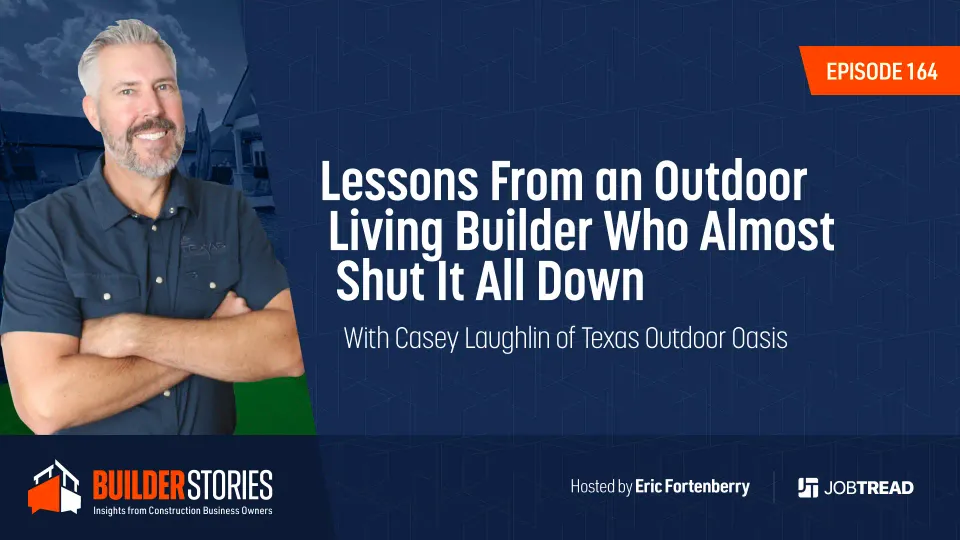

After a key team member left and took a major project with him, Casey Laughlin was ready to refund every deposit and shut down Texas Outdoor Oasis for good. Then a retired carpenter walked through the door and saved the company. His influence over Casey’s entire approach to business is the driving force behind the company’s growth to 23 team members. Casey reveals how he rebuilt from the brink and kept Texas Outdoor Oasis strong for more than a decade.
In this episode you will learn:
- The video strategy that has homeowners recognizing his team before they ever shake hands
- Why a video with only 20 views can still land a new client
- The software setup mistake he’d undo if he could start over
- The moment that finally broke his micromanagement habit
- How an outside perspective helped him spot problems hiding in plain sight
Resources:
Hear the full conversation on Builder Stories. Learn more about Texas Outdoor Oasis here.
Eric Fortenberry: [00:00:00] Welcome to the podcast where we take a deep dive into the stories behind construction business leaders. We will share how they got started, how they found success, and the lessons learned along the way. I’m your host, Eric Fortenberry. Welcome to Builder Stories
Eric Fortenberry: Welcome back, everybody. Today, I’ve got Casey Laughlin. He is the owner of Texas Outdoor Oasis, located in Wylie, Texas. Really excited to have Casey on. He’s got a very interesting story, and I think it’s gonna be really, uh, really great insight for, for everyone out there listening. So, without further ado, I wanna welcome you, Casey.
Casey Laughlin: Thank you, Eric. I’m excited to be here.
Eric Fortenberry: Well, why don’t you kick us off? Give us, you know, a little bit of background, who you are, how you got into construction. You know, what type of work do you guys do?
Casey Laughlin: Sure. So, um, uh, I, as you said, owner of Texas Outdoor Oasis. I started this company in 2001, and actually started in the green industry, uh, out of a job, uh, and just decided to start [00:01:00] mowing some yards.
Casey Laughlin: I’d done it over the summer with a friend. It really started from there. I, I borrowed a lawnmower from my dad and went and threw some door hangers out. I had a young family, new wife, young son at home, had to make a good living, so, or had to make a living, uh, had bills to pay. So, we started there, and I had no business background, just straight out of high school pretty much.
Casey Laughlin: Um, started mowing, realized that I didn’t wanna stay in that truck as-- any longer than I had to, so I started looking at how I could scale. And by doing that, I, you know, how many yards do I need to where I could hire a helper, and then how many do we need till I could hire a driver and start getting out of that truck and moving on.
Casey Laughlin: So basically from there, I grew that into a decent sized business. We had about 600 clients. Uh, started doing some landscape projects, some sizable jobs And in 2009, we landed a landscape project, uh, over in Dallas, and part of my scope, they wanted me to build some structures, which I had no experience with.
Casey Laughlin: We were just, uh, hardscapes and landscape at that point. So [00:02:00] I was introduced to the owner of Texas Outdoor Oasis at that time, and, uh, we-- he, he was a pure talent, could really hand draw anything and bring it to life right there on canvas in front of you. So I said, “Hey, you know, here’s what we have.” We, we, we saddled up, got into the project together, and, uh, everything was going well at first, and then I realized that he was having some financial difficulties and then started learning more of his story.
Casey Laughlin: Uh, this was in, like I say, ’09, right in the middle of the house market crash and, and he was struggling pretty good, had a bad business partnership that, that, uh, hurt him pretty well. So, uh, I made a small offer to purchase the business and help him find out-- climb out of his debts and, uh, that, that he owed some of the, the contractors and vendors.
Casey Laughlin: And, uh, January 2010, we took over ownership of Texas Outdoor Oasis with him still the, the day-to-day operator of it. But, uh, it’s been an exciting journey.
Eric Fortenberry: That’s awesome. You know, so I, I-- and I assume [00:03:00] you must have built that, uh, kinda starting off with the, the, the, the lawn maintenance, the, the green business.
Eric Fortenberry: I mean, you must have built that to the point where you were able to, to afford to make that offer, which is, uh, which is really exciting. I know that’s a tough business to, to build and scale.
Casey Laughlin: You know, the, the lawn business actually proved to be very bulletproof even in the recession, which was surprising.
Casey Laughlin: Uh, it, it-- we grew year over year and, and never had a downturn so, uh, it did allow us the money and, and to have the funds to take something like this and kind of run with it so.
Eric Fortenberry: Yeah. So, you know, in 2009 when, when you were looking at, at this business, you know, Texas Outdoor Oasis, I mean, what, what, what did you see that made you want to buy it and to, to own it there?
Casey Laughlin: It was just neat and exciting, and it was a, a bolt-on to what I already had. You know, we were wanting to get more into the landscape portion of it, and if we could offer the landscape with the kitchen and outdoor living, some things that we brought together on that project, it was just fun. It was new, um, and it just, you know, felt like a good [00:04:00] natural bolt-on to our existing clientele and, and business.
Eric Fortenberry: Yeah, and I think I, I remember you, you, you had, you had shared that you actually hit a million in revenue your first year after the purchase. Is, is that, is that right?
Casey Laughlin: Our first year we did, yes. I... And so I was keeping my landscape business separate. We, uh, took Texas Outdoor Oasis as the name for the construction side, uh, moved my landscape portion of it to that, kept the maintenance side business, uh, separate.
Casey Laughlin: And we were able to take just Texas Outdoor Oasis alone and generate a million the first year.
Eric Fortenberry: That’s awesome. How, how does that compare to what he was doing beforehand?
Casey Laughlin: So he was, uh, going job to job. So when, when I, when I contracted him in Dallas after I got to know him a little better, he told me, he said, “Man, when you called, uh, I was out turning in applications trying to find a job.”
Casey Laughlin: So he had fizzled it down to, to nothing.
Eric Fortenberry: So what do you, what do you, what would you attribute that growth to? I mean, you know, to, to come out of the gate swinging like that, you know, breaking a million is, that’s, that’s extremely, uh, impressive.
Casey Laughlin: You know, [00:05:00] it, the marketing had almost everything to do with it.
Casey Laughlin: Uh, we recognized... So we were in Rockwall at that point, and Rockwall was still struggling to bounce back. Uh, but there was this huge influx of new business moving in up north around Frisco, Allen, McKinney. Uh, State Farm was building a headquarters, uh, bringing people in from California and out of state.
Casey Laughlin: So we just started marketing that area real heavy, and there was not a saturation of outdoor living companies at that point. So we, uh, we, we took quick advantage of the market and scaled pretty quickly with it.
Eric Fortenberry: Yeah. So sounds like you had, had a couple, couple great years there. I mean, now, okay, keep going.
Eric Fortenberry: I hear in 2012 it, uh, m- might’ve had a little bit of a, a twist there.
Casey Laughlin: It wasn’t all sunshine. So yeah, and so I, I did not do a great job of learning the business. I was the, the one pushing the marketing and pushing the funding to keep it afloat, you know, get it off the ground and keep it floating. Uh, but I didn’t learn the day-to-day.
Casey Laughlin: I didn’t learn how to sell it, design it, uh, so, so I really set [00:06:00] myself up for failure. Um, we had a project that was well into the six figures that had landed on our desk. We had it designed out, ready to build, and I walk in one morning, and his desk, those plans, and everything that went with, with, with it were missing.
Casey Laughlin: Uh, he wouldn’t answer his phone. Like I, I knew, you know, it was just that deep gut, like something’s wrong. So anyway, so he, he thought that, uh, the, the guys that I’d purchased his business was working with us, thought it was-- he could take that and probably put himself back on his feet and back in business, uh, which didn’t pan out.
Casey Laughlin: He’s, uh, selling air conditioners last time I heard. But, uh, where it put me was in a really bad spot because I had not educated myself on what we were doing. Mm. And it was just me and him. I didn’t have backup plan. Uh, he had all the trade connections. Um, and it, it, uh, it set us back in our seat pretty good.
Eric Fortenberry: Dang. That’s, uh, that’s, that’s tough to hear, man. So you, you end up shutting the business down right after, after that? [00:07:00]
Casey Laughlin: So we, uh, I had a secretary at that time, and we were still rocking and rolling with our maintenance. So I basically told her, I said, “Hey, get ahold of these cl-“ At that point, we were doing 50% deposits.
Casey Laughlin: Uh, most of these jobs were in the 7 to $15,000 range, and we’d take half up front. So we probably had 10 on the books that we were gonna be building, and I didn’t know enough about it to even get them started. So I called her and said, “Hey, just, uh, get ahold of these customers, send them all their money back, and we’re gonna shut this thing down.”
Casey Laughlin: And I don’t know if it was that day or the next, she calls me and says, “Hey, there’s a guy that just walked in the door up here, and I really think you need to talk to him before we give all this money back.” And I said, “Well, okay. Well, um, let’s check it out and see what he has to say.” And that’s when I was introduced to Tommy Redfern.
Casey Laughlin: Um, Tommy was a early 60s maybe, uh, retired carpenter and basically told me, “Hey, I’m, I’m too old to swing a hammer, but I know [00:08:00] everything about this, you know, what we’re trying to build here.” Uh, I told him, you know, financial situation we’re in. He, uh, he could actually see our office from where he lived.
Casey Laughlin: And he said, “Hey, man, I’m, I’m, uh, you know, widowed. I don’t, I don’t have a, uh, a lot of overhead, and I don’t need much to come to work for you.” So, so we, we buckled down. We ended up giving those customers their money back, uh, kind of re-regrouped, started from scratch, and built it back up pretty quickly, um, under, under Tommy’s help.
Eric Fortenberry: Wow. And, and you kept the same brand and everything too?
Casey Laughlin: We kept the same brand. Uh, what Tommy taught me was a different mindset. Uh, we went into the business Oh, uh, going after quantity versus quality, and there was one other builder in town that was just building a ton of patios, and we were trying to compete with him.
Casey Laughlin: Uh, we didn’t have the buying power he had, and, uh, it was killing us. Our margins were low.
Eric Fortenberry: Hmm.
Casey Laughlin: Uh, a lot of the finish out work back then, we were doing like fence pickets for underpinning on these cedar structures, and it, it, you know, for what I [00:09:00] knew, it looked great, but for Tommy, with a little bit keener eye for detail, he said, “Man, we’re just not doing a-- You know, this isn’t gonna be it.”
Casey Laughlin: So, um, he helped me focus on quality instead of price, and I said, “Tommy, we’re not gonna sell any of these at that.” Uh, bless you. So we, uh, uh, he went to a tongue and groove finish out, just a, a lot cleaner, high detail finish, but it ran our, our price up about $6 higher than the next guy in town. And, you know, we sold one.
Casey Laughlin: I said, “Okay, well maybe there’s something to this.” Then we sold another, and it just started coming on strong. And, uh, he’s the one that convinced me that we need to focus way more on the finished product than what the, what the price is, and if our quality is there, then people will buy it.
Eric Fortenberry: Yeah. That sounds like a great, great lesson.
Eric Fortenberry: Well, what else would you say that you took away from kind of that first phase of the business? I mean, you know, obviously there’s a lot that was riding on that, on that, on that original, that original guy. Like, I mean, what, what do you think about, you [00:10:00] know, with, you know, what advice would you give others who, who may be in a similar situation on, on how to, how to protect themselves a little bit more?
Casey Laughlin: Yeah, you know, either learn it yourself or, uh, don’t put all your eggs in one basket. You know, with, uh, you know, the way that went, I probably could have had at that point even afforded to have another designer in or, um, you know, there’s some pay scales that can make that work. Uh, my best bet at that point would’ve been to, to at least know enough to get by until I could find somebody else, but I didn’t even have the basics of education on it.
Casey Laughlin: So, uh, I think not having all my eggs in one basket, uh- That was a good lesson at that point, and, uh, and I’ve, I’ve been real, uh, cognitive, you know, since then to not do it, and I’ve, and I’ve overcome some challenges because of the diversification past that.
Eric Fortenberry: Sure. So walk us through what, what’s kind of this, the second phase of this life with, you know, with Tommy.
Eric Fortenberry: I mean, how, how have you grown the business since then and, and what does it look like today?
Casey Laughlin: Yeah. So, so with Tommy, uh, we did a great [00:11:00] job of training some carpentry crews. He spent time out in the field with these guys, just really hands-on. Uh, we trained up two really, really good crews. Um, and I’m talking detail training to where they would have a patio completely built, and if they put up one bad rafter that maybe had a knot hole in it, he would make them take it out of a completed structure.
Casey Laughlin: Like- ... something difficult to do. So, uh, just that, that high attention to detail I think has lived on with us. Uh, Tommy unfortunately passed away, uh, about 24 months ago, but uh, man, his, his legacy lives on with us today. So, um, you know, just the, uh, the mindset, um, of let’s keep focusing on quality and price is gonna land where it is.
Casey Laughlin: We can’t go after the cheapest contractors out there and expect to get top quality work. So just everything has to align to build a reputation that we wanted to be, uh, to establish in this market.
Eric Fortenberry: Sure. And so how, how have your projects evolved? I mean, you know, it sounds like you were kind of doing, you know, a little bit [00:12:00] smaller, $7,000, $10,000, $15,000 projects earlier on.
Eric Fortenberry: What, what does it look like today?
Casey Laughlin: Yeah. So we still build quite a few outdoor structures, outdoor living areas. Well, we have an entry point of $50,000 right now for outdoor living. Uh, in 2017, we entered the swimming pool market, and, uh, right now our average pool is just under $200,000. So, uh, our, our scale of pro-- which the economy has helped that some, with just everything, uh, you know, pushing up in price over the last few years.
Casey Laughlin: But, um, yeah, we’ve definitely taken on larger projects, have a lot larger team. I think we have 23 currently, uh, on our sales and project management team, and then other, others as far as field employees go. But, uh, yeah, the scale has been, um, slow. You know, we had this-- During COVID, we could’ve had this explosive growth.
Casey Laughlin: Uh, we took a controlled version of that and moved forward with it. We did grow. We grew 15, 20, you know, one year 30%, uh, but we, we did it very controlled to where we can control our, um, quality. [00:13:00] And, uh, it didn’t put us flat on our back when things did slow down. Uh, you know, we didn’t have to see that, uh, I know a lot of companies had up to a 50% reduction in, in revenue when the big boom, uh, after COVID for the outdoor living area shut down.
Eric Fortenberry: Yeah. I mean, that’s, uh, some impressive team growth there. I mean, it sounds like you’ve, you’ve really invested in your team and, and have built out a nice, a nice group there. Kind of what, what else would you say that, you know, you, you’ve done to, to make sure that you’ve got the best team in place to, to, to fulfill that high quality standard that you’ve set?
Casey Laughlin: You know, I don’t know everything and, uh, therefore I can’t teach everything, and I realized that real early on. So we’ve taken advantage of a lot of education that’s come out recently. Uh, when I entered the pool business, which is a whole nother interesting story by itself, uh, I hired a project manager from a company that it was a local home builder that went to jail that was building some swimming pools, so I hired his project manager to get our division started.
Eric Fortenberry: Hmm.
Casey Laughlin: But, [00:14:00] um, nonetheless, some of the things we were doing, we were just doing because it was the way they’d always been done. And what I realized when I got into the pool business that that’s what, uh, pretty much how the industry ran. It’s like this is the way we’ve always done it, no rhyme or reason. The codes were very loose on it, standards were very loose on it.
Casey Laughlin: Uh, PHTA, which is Pool Hot Tub Alliance, and Watershapes University over the past five to seven years, I would say, have really put a ton of, uh, education out into the market. And, uh, both of them have programs you can go through and, and really learn build standards. And so we’ve taken advantage of that and, and put a lot of our guys through the PHTA side of it, uh, is the one we chose.
Casey Laughlin: But, uh, I think both are equally beneficial and, uh, just well-trained, well-educated and seeing how things are supposed to be done and bringing that back and, and raising our standards.
Eric Fortenberry: Yeah, I mean, I-- my, my understanding is [00:15:00] that’s a, uh, uh, that’s a real investment that you’ve made there, uh, to, to invest in those programs.
Eric Fortenberry: I mean, h-how would you say you’ve, you know... H-how have you measured, you know, the, the return on that and, and can you directly see the impact that, that, that training has, has made on the team?
Casey Laughlin: I think it brings, uh, a level of competence. Um, what we see is, you know, uh, continuously innovating our build standards.
Casey Laughlin: If we’re looking at the projects we’re building today, they are nothing like the projects we were building seven, eight years ago. Uh, just com-- you know, uh, and, and all that’s coming from training and, and putting the, you know, meeting of the minds together when everybody gets back, “Hey, what’d you learn?
Casey Laughlin: What’d you pick up that we can do better?” Um, it’s a, it’s a tedious course. It’s, uh, typically, I think it’s 24 hours of classroom. So for me to sit and, and pick up 24 hours of knowledge in a three-day course is impossible. But if we can send everybody there and they can pick up [00:16:00] 10 things that are valuable, five things that are valuable, bring it back to our team, it, it just raises our whole, the, you know- Our whole product
Eric Fortenberry: Yeah.
Eric Fortenberry: No, absolutely. I mean, we’re, we’re obviously big on, big on education as well. You know, I, I think a lot of people when they, when they look at these opportunities, you know, sometimes the, the, the investment and the cost can, can get in the way of, of, of making, you know, the decision to, to send their team. I mean, well, you know, if you kind of think back or, or thinking about for someone earlier on, I mean, like how, how soon would you have invested in, you know, this, this team education and, and helping them to, to really get those certifications?
Casey Laughlin: So we had our first major failure in... We started building pools in 2017, and we had our first major fail- failure in 2017. And it would’ve... The, the, the failure cost us enough money that w- it would’ve paid for everybody currently that I’ve put through this education to, uh, to take care of those expenses.
Casey Laughlin: So, uh, I, I tease people, you know, I’m not college [00:17:00] educated, but I, I’ve paid my dues. I, I could’ve, uh, probably paid my way through Harvard with a doctorate at this point- ... with just the school of hard knocks of, of doing things wrong and learning from them. But, um, but yeah, uh, uh, if we’d have trained early on, we could have avoided a lot of pitfalls that we’ve fallen into.
Eric Fortenberry: Yeah. Now, you know, I wanna transition to kinda talking about just, again, sort of, sort of your systems and, and, and, and software that, that you’ve used. I mean, it was, it was up until, like, 2024 you s- you had shared that, like, you ran the business on whiteboards and, and, and multiple different softwares. Like, what, what forced you to change?
Eric Fortenberry: Like, what, what led you to, to, to kinda go and find, you know, find JobTread?
Casey Laughlin: You know, Eric, I, uh, I open the computer and hope that it comes on. And then I open my email and hope that it works. I’m just not a techy guy, right? So I, I grew this business off of yellow pads and, and whiteboards, and it was very effective for a long time.
Casey Laughlin: Uh, what we realized is as we had a project management team out in the field, we have sales team out, you know, doing their deal, [00:18:00] we had really no centralized hub for data. Uh, and we were starting to see some, you know, the cookie crumble a little bit, I guess would be a good word for it. Just, just things were, were starting to get missed.
Casey Laughlin: Um, you know, we were using, at that point we had Dropbox, we had a invoicing system, QuickBooks obviously. All these different little things that were working for us, but, um, you know, if an employee left, we were working off Excel sheets. A lot of times we’d lose all of that data. So this, uh, you know, we, we...
Casey Laughlin: JobTread has really put everything into one, one spot where our whole team has access to it.
Eric Fortenberry: And I think did, did you all, like, try to custom build something or, or hire someone kind of e-earlier on to... I guess then, then it got shut down or something like that? What, what was that?
Casey Laughlin: A-another nightmare. Uh, so in, in ’24, July of ’24, we signed on...
Casey Laughlin: So Pentair is a pool equipment manufacturer, and we were real heavy on them. It’s the first one we took on when we started building pools. Uh, they were great. And, uh, they said, “Hey, we’ve, we’ve built or [00:19:00] developed this program for our pool builders that sell all Pentair equipment, and it’s an operating platform that really gives us similar to what, you know, JobTread does, but it was specifically catered for this group of builders.”
Casey Laughlin: So we, uh, went with their team and started paying the monthly dues. They helped us build it out. And from July till December, we built on it, and we were gonna launch it January 1. And like December 20th, we get an email that says they pulled the plug on this program. So, uh, a lot of wasted time and just heartbreak.
Casey Laughlin: Like we, uh, our team was bought in, we saw the vision, we saw where it was headed and was gonna do big things for us. Uh, estimating platform, operating platform, like it was all in one. But, uh, uh, it was a major setback.
Eric Fortenberry: What do you think that, you know, ultimately sort of helped, helped you to learn about, you know, when choosing technology?
Eric Fortenberry: I mean, what, what are the important things to, to look for?
Casey Laughlin: You know, Eric, I don’t have a great answer to that [00:20:00] question. Uh, you know, we felt safe with that. We felt stable. It was a well-established equipment company. Um, you know, they-- it’s, um I know when we went back to market, we went with somebody well-established.
Casey Laughlin: Uh, we looked at, you know, uh, three big platforms, I guess, and then settled in on JobTread thinking that it fit our profile the best. We actually loved the fact that you guys were local to DFW as well, so that was a deciding factor.
Eric Fortenberry: Yeah. So, so when you, when you decided to get it, w- tell, tell us what, what was your implementation process like?
Eric Fortenberry: What, what did you, you know, kind of w- what was the mandate when you first started? ’Cause, ’cause I, I think you had kind of one employee in particular who, who spent time building it out. Is, is, is that right?
Casey Laughlin: We did, and she did a phenomenal job of building it, but she built it with bad direction. Uh, I told her, uh, “I want this system to look as close to our whiteboard system as possible-
Casey Laughlin: and as close to our, our Excel sheet, uh, type of estimating as possible,” and I thought it’d be an easier transition for our [00:21:00] team. Um, and, and looking back now, that was horrible, uh, direction that I gave her. Uh, the, the software’s capable of so much more than what we’re doing with it currently. Um, and now we’re looking at, okay, now how do we overhaul this, that we, we have our...
Casey Laughlin: So we’ve been on it for a full year now. Um, everybody’s comfortable using it, but there’s a lot more that it can do, uh, if it was set up better from the get-go.
Eric Fortenberry: W- so, so what, what advice would you give, would you give someone who, who, let’s say they’re starting today, like, what, what do you wish you would’ve known starting out that, that you think might help them to, to have a cleaner implementation?
Casey Laughlin: Yeah. I, I think, uh, listen to the JobTread implementer instead of listen to your instinct or, or wanting to keep things the way they’ve always been, uh, would be one. Uh, you know, for us, we integrated with a fairly good-sized company. Um, a lot of moving, a lot of hands here that had to learn it, and I think for us, if we would’ve [00:22:00] hired a, uh, even a contractor to come in and help us build this out and that understood the formulas, that’s one big thing we missed is understanding the formulas.
Casey Laughlin: Um, and it, it’s just hard to turn back. Yeah. So, uh, I would say listen to the professionals and, um, uh, don’t be scared of change, and I think- Yeah ... that’s, I lived in fear of change, and that’s what led us down to where we are now.
Eric Fortenberry: Yeah. No, that, that, that makes sense. And you know, again, uh, the formulas, the parameters, I mean, it’s, it’s definitely kind of down that rabbit hole a bit, and we actually even just released some, some AI to, to help build the formulas and teach people a little bit more about it.
Eric Fortenberry: But yeah, it, it certainly can be, uh, can feel a little daunting, you know, and, and, and, and, and we recognize that, and that’s, that’s just like what you said. That’s why our team’s here. We wanna help you. You know, we’re, we’re excited to help people and, uh, you know, I, I, I think the, the notion of, you know, it, it’s, it, it doesn’t, it doesn’t have to, you know, be exactly how it was before to, to be able to kind of get the real value and, and, and I think being open-minded about, you know, are there better ways, because that’s, you know, again, that’s, that’s [00:23:00] the difference between technology today and, you know, technology, you know, 10, 20 years ago.
Eric Fortenberry: Yeah. It, it does continue to evolve and adapt and- You know, when, when you’re, when you’re limited on just what, you know, a spreadsheet or a whiteboard, you know, or whatever it is can do, and, and you try to just stick to that, then sometimes you could be missing those bigger opportunities.
Casey Laughlin: Yeah. Yeah, and we did.
Casey Laughlin: And, and w- you know, uh, now we’re talking to consultants to try to overhaul it for us. So it, it’s a, uh, it- it’s a work in progress, and always will be, you know? Yeah. You can always, uh... We’ll learn ways to do things better. Uh, I can say our implementer with you guys, we’ve, we’ve dealt with Ross from the get-go, and he’s been phenomenal, so.
Eric Fortenberry: Yeah, that’s awesome. So I wanna ask you a little bit about, you know, your, your sales and, and marketing. You know, I, I know that you guys have, you, you, you’ve got a video that gives a detailed look at your entire build process. You know, each team member, they, they, they, you know, they talk through kinda what, what they do and their role.
Eric Fortenberry: You know, h- how have you used, you know, video and, and, and marketing and kinda that educational content to, to inform your sales process and, and, and ultim- [00:24:00] ultimately the customer experience?
Casey Laughlin: Yeah, so it’s funny. I, you never know when this stuff hits or lands. Uh, you know, marketing’s kinda one of those deals you, especially on, on social platforms, you throw a whole bunch of stuff at the wall and hope something sticks.
Casey Laughlin: But, uh, it, it, I don’t end up on a lot of job sites these days, but when I do and just talk to people, you know, especially at the beginning of the process, I’ll ask, “Hey, do you have any questions?” And I’ve never seen them like our Facebooks. I’ve never seen them share anything that we’ve done, but they’ll say, “Hey, I, I understand the process because I’ve seen all your videos.”
Casey Laughlin: So if you rewind, that’s a deciding factor when they’re, when they’re in their buying process is, “Hey, these guys, I, I kinda understand what they’re doing, uh, understand their process.” My goal is, if I show up on site, they’re gonna know I’m the owner of the company, and they’re gonna say, “Hey, I’ve seen you.
Casey Laughlin: I’ve seen your videos.” So, uh, putting a name with a face, and the same with our designers and project managers. Like, it, it, if we go knock on that door, we want them to recognize us before we even [00:25:00] meet them in person for the first time. So, uh, I think that coupled with just the depth that it shows of our operation, that you’re not dealing with just a one-man show, that if I get sick tomorrow, your your whole project’s in jeopardy, that we do have a team, and we do have the depth to handle, uh, these are large projects that they’re signing us on for.
Casey Laughlin: So we have
Eric Fortenberry: the-
Casey Laughlin: That’s great ... the handle it.
Eric Fortenberry: You know, I think, I think video is so powerful, e- especially in this day and age, and, and, and, and just like you talked about. I mean, just the, the ability for, for a client to really get to know you, get to see how you, how you operate, how you communicate, you know, how you explain things.
Eric Fortenberry: I mean, that, that, that is such an important component of choosing a contractor, is how do you feel about working with this person, when they can get a glimpse of that before they’ve even, you know, gone too far down the road. I mean, that, that can just be such a powerful, you know, influence for them. H- How have you guys used other video, and, and, and how did you ultimately decide to, to, to invest in video, and, and how do you, how do you get your videos produced?[00:26:00]
Casey Laughlin: So it’s been a, it’s been a little bit of a rollercoaster of a ride too. We started, uh, I jumped onto Facebook pretty early promoting business. I think we Probably 2011, we put our first Facebook post out, uh, for Texas Outdoor Oasis, and it was just sharing photos, and we actually, uh, started using it as our, our portfolio.
Casey Laughlin: Uh, when we’d go to a customer’s house, instead of having this paper book of portfolio, which was common back then, uh, we would, we would pull up our Facebook page and scroll through and show current projects and that kind of stuff. But, um, you know, we realized that video was, was becoming popular and, and we were pushed by our web development company and some marketing agencies that I’d talked to that said, “Hey, video’s gonna be king.”
Casey Laughlin: So, uh, we, we started making it. Uh, my son actually for the last few years was doing all of our content, and he would make a schedule beginning of the week. He would, you know, run out to projects, try to catch our project managers in action, have them talk about small details, uh, get around our office with the sales [00:27:00] team.
Casey Laughlin: He would do all the editing and all the posting. Uh, he’s now moved into project management, so we’re in kind of a lull and looking for that next, uh, we, we will be hiring another social media, uh, person here r- here soon. But, uh, you really almost, uh, you know, you either have to walk around with a camera and turn it around and talk into it, or you have to have somebody to follow you around with it.
Casey Laughlin: But it is, it, you know, video is king right now.
Eric Fortenberry: Yeah. No, it’s, it’s such a great, a great resource and, you know, we, we’ve got a, you know, in-house marketing team as well, and I mean, we have a couple people dedicated to social and to video and creating social content. I mean, you know, I, I, I, I can, I can share that, you know, again, we, we have also seen firsthand the impact of, of being able to, to, to really build that brand and that awareness and like, you know, people feel like, you know, they’re, they’re part of the journey when they can see the behind-the-scenes and they see all the- Sure
Eric Fortenberry: the what’s happening. It’s not just the, the pretty marketing, you know, fluff. It’s, it’s, it’s actually kind of who, you know, who are these people and what’s it like, you know, being part of their company [00:28:00] and kind of those, those moments where, you know, not everything is, you know, rainbows and butterflies.
Eric Fortenberry: It’s, there, there is, you know, hard work that goes on behind the scenes and not everything goes as expected. But, like, I think that level of transparency that, that video and, and, and, and, you know, good social content can provide is, is, is, is all, you know, powerful in how it can build that trust, you know, with, with the companies.
Eric Fortenberry: And, you know, I’ve, I’ve seen a lot of times where people think they can just kinda have AI whip out some, you know, some, some, some video that’s just not genuine. It clearly is, you know- Yeah ... just produced by AI, and like that, that, that type of content just doesn’t hit the same as, you know, when it, when it is genuine, it is real, and it’s, you know, kind of that, that raw, you know, just, just organic content that can be created.
Eric Fortenberry: You know, I think that that really does build a l- a, a lot of, you know, a lot of loyalty and, and, and following and trust.
Casey Laughlin: It really does. And, and I would say too, if you’re just new to video, don’t get discouraged. Uh, I think that, you know, we judge it by how many people like our videos or share our videos, whatever that is.
Casey Laughlin: But, uh, if people are [00:29:00] watching, you know, you only need one person. W- you need one of the right people to watch it. Yeah. You need one of that ideal client to watch it, and that’s a new deal for you. So- If you’re not getting a ton of likes or a ton of views or whatever, just keep at it. Uh, it only takes one that can take off on you.
Casey Laughlin: And like I say, you can have a video with, with 20 views, and if one of those viewers is the right viewer, uh, that, that video’s hit home and done its job.
Eric Fortenberry: Yeah, you know, and, and I think too, it’s, it’s about, you know, telling the story over time. You know, just because, you know, the, the video doesn’t get a ton of engagement today, I mean, the, the fact that it is there in your timeline, you know, you never know when, when a, when a prospect’s gonna be, you know, kinda going down that path and, and, and doing their research and, and trying to get to know you.
Eric Fortenberry: And, like, just having that content created, you know, and, and available for them to consume is, is extremely powerful
Casey Laughlin: And I’ll, I, you know, even as a consumer, uh, if I’m purchasing something, I go to another company’s Facebook or Instagram, whatever it is, and this is where the consistency plays off. If I see a huge gap, I think of [00:30:00] problems.
Casey Laughlin: Mm. So if they’re, uh, consistent right now, but maybe they want a year with no social post, um, it makes me question what, what happened in that year? Were they, were they struggling? Was... You know, it, it just raises red flags. So I think the key is consistency. Whe- Yeah ... whether the videos are landing, uh, you know, you’re not...
Casey Laughlin: Ev- every one of them’s not gonna be a winner, but it shows the, that shows the timeline. Time in business. If you go back on ours, you’re gonna find pictures all the way back to 2011, so that shows that, hey, we’ve, we’ve been in this market for 15 years now. Uh, which, you know, it, it, it’s all building that customer, uh, trust.
Eric Fortenberry: Yeah. Absolutely. And do you, how, how often do you try to get your, your clients to, to come on and, and share their story, and what, you know, what the journey was like? I mean, do, do, do you, do you try to kind of interview them, you know, maybe, you know, after the project and, you know, ask them, you know, “Well, how,” you know, “Well, what was the problem?
Eric Fortenberry: Well, why did you go looking for a contractor? How did you choose us?” Like, what was, what was the experience like?
Casey Laughlin: You know, we, our new marketing team is, is really pushing that hard. [00:31:00] Uh, we just did a video shoot last week, and have another one tonight. Uh, the one tonight’s gonna be exciting. It, it, this was almost a $750,000 project, uh- Wow
Casey Laughlin: that we built at the end of last year, and we are excited to get this one on film. Customers are loving it. Uh, they’re planning a little party tonight so we can show the interaction and how people are using the space. So, um, eh, I see a ton of value in it, and, uh, it’s, you know, what better word of mouth than, than a true testimonial from somebody that you’ve done the work for and, and see them enjoying the space?
Eric Fortenberry: Yeah. That’s, that’s, that’s powerful, man. And I- I’m curious, so, like, if, if, you know, obviously, you know, you, you gotta have a lot more than just a pool back there that, that you’ve done for that client, but, like, if somebody reaches out to you and, you know, let’s say they’re, you know, the ho- homeowner calls, and they’re, they’re, they’re interested in a pool, like, how do you, how do you approach the rest of the backyard?
Eric Fortenberry: Because that, that seems like it’s also a big opportunity to, to kinda do it all at once.
Casey Laughlin: You know, really, what makes us so unique in the market is our ability in outdoor living. Um, I think that in the, in the local market here, [00:32:00] we, we’re, we’re sitting real top, you know, real close to the top of the mountain as far as our abilities in outdoor living.
Casey Laughlin: So it’s, uh, it, it’s a big piece of it, and I think the, if you define your ideal client, our ideal client is gonna be that pool with the outdoor living project. Uh, landscape makes a nice bolt-on service. It’s something we’re real competent in. We have some great landscape designers. But, uh, yeah, I, I think the, the pool has to be the staple, and everything is designed around it.
Casey Laughlin: But ideally, you’re looking for a functional space. Uh, so we could put together a master plan if, you know, say the pool’s this year’s project, and the outdoor living’s next or vice versa. It’s important that they, they flow together. Uh, we create space to where they’re gonna, you know, uh, people can move around naturally, and it doesn’t look like an afterthought
Eric Fortenberry: Yeah.
Eric Fortenberry: No, I love that. You know, I don’t, I don’t know if I shared, uh, ear- earlier, but, uh, you know, it was, it was very, uh, it was, it was a really cool way that, that, that you actually got, uh, recommended to, to come on Builder Stories. It was, it was one of your team members, uh, had, had mentioned [00:33:00] that, you know, you’re such a great leader and, you know, suggested that, that, that, that you come on here.
Eric Fortenberry: I mean, h- walk, walk me through your, your leadership style. Like, h- how, how, how would you say that you approach leadership and, and maybe even h- how has that evolved over the years?
Casey Laughlin: Eric, I’ll go back to 2001, and I was a, a high-level OCD micromanager- ... as I started growing my team, and found out through the years that that is probably not the most effective style of management.
Casey Laughlin: Um, I’ll tell you what broke me of that is, uh, the guy that I purchased Texas Outdoor Oasis from, it was all I could do to get him to show up with shoes on. Like it was, uh, just sit in my office sweating, steaming, trying to blow it off in the mornings, like just aggravated, you know, past the point of no return.
Casey Laughlin: And it broke something in my mind and said, “Hey, you know what? Maybe, uh, maybe I need to back off a little bit.” And, uh, so, so what I focused on, Eric, was building the platform for s- for success, and if I hire the right people and [00:34:00] supply the right platform and put the right guardrails in place, um, people can be successful.
Casey Laughlin: And then the other theory is hiring up. If I don’t f- uh, I, I need people around me that are smarter than me, and I didn’t always have-- I always wanted to be the smartest man in the room up until, uh, a few years back, and I said, “Hey, for me to grow, I need to be around smarter people, and there are smarter people out there that wanna be in this industry.
Casey Laughlin: Let’s go find them.” So- Yeah ... uh, my team now pushes me as much as I push them, and it’s, it’s just, it’s just great.
Eric Fortenberry: Yeah. That’s, that’s, uh, it’s a great lesson there, and it was interesting. I, I kinda had a similar, similar story in, in, in my first, uh, my first company. Um, you know, I’ll, I’ll, I’ll never forget, you know, uh, I think I used to, to also kind of, you know, just snap back and kinda let things kinda agitate me and, you know, be, be, be a lot more, uh, you know, abrasive as, as, as, as my dad actually called me out, you know, one day, and he’s just like, “Eric, look, you know, it, it, it doesn’t really matter if you’re right or wrong.
Eric Fortenberry: The, [00:35:00] the way that you communicate to people and the way that you approach situations, you, you can completely just turn them off and, and, and to the point of pushing them away.” He’s like, “Nobody wants to work for a dictator. Nobody wants to feel like, you know, they’re, they’re, they’re scared to speak up and, and, and, and, and, and then ultimately get, you know, get lashed out at.”
Eric Fortenberry: And, you know, it was, it was such an eye-opening moment for me, and, you know, I think I was in my, my 20s at that point. And, you know, just, just to really... You know, I’m, I’m, I’m so grateful that, you know, my, my dad, you know, who was, who was our CFO at the time, I mean, he, he was, you know, able to really have that, that hard conversation with me about my leadership style.
Eric Fortenberry: And, you know, it’s, it’s, it’s something that just has always stuck with me. And, you know, I, I think, I think the, the much better approach is just to, to always try to, you know, uh, earn people’s respect and, and earn, you know, their trust and, and, and then have the confidence that, you know, they are, you know, adults.
Eric Fortenberry: They are in the seat that they’re in because, you know, they’re the best person for that role. Like, you just, you have to be [00:36:00] able to, to trust your people and give them the benefit of the doubt. And, and even when, when, when your mind might be thinking, “Oh, man, you know, something’s wrong,” yada, yada, it’s like, man, you just gotta, gotta take, take, take a second to, to calm down and try to make sure that you see- The, all the perspectives and kind of from the different, you know, people’s, people’s, you know, angles, it’s, it’s, it’s, it’s interesting that, you know, maybe we’re not always right, you know?
Eric Fortenberry: And, and, and maybe there was some other factor at play that, like, I had just not ever considered because, you know, I was so focused on my own, you know, thinking that this was the answer. And it’s like, you know, uh, uh, at, at the end of the day, our, our, our, our big motto here at JobTread is, “May the best idea always win.”
Eric Fortenberry: And we want everybody to feel comfortable and confident speaking up and challenging anyone. I mean, I, I don’t want people to go and do something just because I’m the CEO and I say so. Like, I want people to really think, like, “Is that the right answer?” You know, I’ve, I’ve surrounded myself with an incredible team, and they’re all better at doing their individual role than, than, than I am.
Eric Fortenberry: And, and, and so it’s, it’s so important that, you know, I th- I think that, [00:37:00] you know, you, you’ve gotta build that team and have that strong, you know, communication and respect and trust for each other to make sure that you don’t alienate them and, and ultimately push, push a good person out the door, ’cause there’s nothing worse than, than losing a rock star.
Casey Laughlin: That’s right. And, and giving them the runway to make their own mistakes, uh, I, I think- Yeah ... is a big part of that as well, Eric. Um, you know, if you can let them touch the stove every once in a while. You can’t let them walk into the lava, but you can let them touch the stove every once in a while. So, uh, yeah, it’s, um I think a lot of times, uh, leadership, a company stalls out because the leader has grown to his...
Casey Laughlin: And, and I’ve had this, you know, me personally. Uh, my company stalled until I became a better leader and started understanding people, understanding my team, understanding systems, and other things that, that needed to be in place, uh, that kept it from choking. So, um As a CEO or president or owner or whatever you, whatever [00:38:00] you are in your company, that pursuit for constant growth and, and leadership ability is so important.
Eric Fortenberry: Yeah. You know, and I think, too, like, when whenever somebody starts to feel like they, they might have kinda reached that point, you know, that’s, that’s, that’s when I would encourage people to, to say, “All right, well, you know, it’s time to get out of your comfort zone. You know, maybe you need to go surround yourself with people who are farther along, or, or maybe you need to go find a, a coach or mentor, somebody, you know, who can really help you understand how to get to that next level,” because, you know, what, what, what got you to, to where you are today may, may be completely different than what you need to do to get the business to the next level.
Eric Fortenberry: You know, it’s, it’s, it’s interesting how kind of each of these different phases of, of a business, like, the challenges are just-- they’re, they’re so different at, at every, you know, kind of size and, and, and scale that you reach that, you know, again, it’s, it’s-- We, we don’t-- As, as entrepreneurs and as, and as, as, as business owners, CEOs, like, I think a lot of times we feel this pressure to have to figure it all out ourselves and, and, and, and that’s not [00:39:00] the case at all.
Eric Fortenberry: You know, at the end of the day, our job is to make sure we get all the right people around the table who can bring the right ideas and the right, you know, guidance and, and hopefully they’ve had some experience. And when you can learn from other people’s experience, like, there is no better way, you know, tr- trying to, you know, school of hard knocks is, is sort of the trial by, by, by fire.
Eric Fortenberry: But like, you know, if you can learn from others and not make the same mistakes, you know, that, that is a far better path.
Casey Laughlin: I think that’s a excellent piece of advice. Um, you know, we hired a fractional CEO, which I’ve never even heard of a fractional C-suite until, uh, late ’24. And we hired a fractional CEO, started him early of ’25, and there were just some gleaming things that, that should’ve been smacking me in the face.
Casey Laughlin: But if you’re living in the day-to-day, sometimes you don’t pick up on them.
Eric Fortenberry: Yeah.
Casey Laughlin: Uh, you bring somebody in that can really take that bird’s eye view that doesn’t have the personal connection to the business, and quickly they can say, “Hey, man, here’s a few things that you may wanna look at. Here’s a few, you know, uh, ways to work around.”
Casey Laughlin: But, [00:40:00] um, doesn’t have to be a fractional C-suite. Could be a friend, could be another, uh, somebody in a completely different industry. But say, “Every once in a while, I’d like to spend a day with you.” And, um, I, I had breakfast this morning with a guy that owns a RV dealership, and I told him, I said, “I could probably walk in this, you know, any time and tell you 10 to 20 things you could probably be doing better.
Casey Laughlin: Half of those you may know about, but I bet the other half you have no clue because you’re living it day by day by day.” Yeah. Um, and you’re just not seeing those holes.
Eric Fortenberry: Yeah. So. So I’m curious, where, where do you wanna take the business? What’s, what’s the longer term, you know, vision and, and, and plan here?
Eric Fortenberry: Do, do you have-- You know, is there a five, 10-year plan? Like, what-- kinda what, what’s, what’s the end goal?
Casey Laughlin: Yeah. So we are, we’re on a heavy push to continue to grow, and right now I’m trying to build out a leadership team. Uh, my ultimate dream is to have such a strong leadership team that I can step away from the day-to-day and, uh, almost sit in as a, um, a, a board member, uh, with, with a powerful leadership team.
Casey Laughlin: And it’s just [00:41:00] taking time. It’s taking the right revenue. It’s taking, you know, uh, to, to bring in that caliber of person, you have to have the revenue and profit to support it. So, uh, it’s just little baby steps at a time. But, uh, my goal is by 28, uh, which is my... I’ll, I’ll be 50 in, uh, in a couple of years, so my 50th birthday, I hope to step away and hand this thing over to a strong leadership team.
Eric Fortenberry: That’s awesome, man. And, you know, again, I, I think it... I, I’ve, I’ve seen it happen time and time again. It’s, it’s all about building the right foundation, you know, putting the right systems, the right processes, the right people in place. And, and when you do that, you know, I, I, I believe that gives you that ability, that, that financial freedom, that, you know, o- oversight freedom to, to just, you know, trust that the team and, and the company continue, ca- can continue to grow itself, you know, without you having to be involved in every single, you know, decision and, you know, having to be- Sure
Eric Fortenberry: the firefighter when things come up. Like, you know, having that, that, that, that solid team of people, [00:42:00] you know, I, I think is the most important thing. And, you know, I, I think it’s also important to, to know, though, you know, until you have that team in place, you know, you, you don’t want to take that step away too early because, you know, a- a- again, I’ve seen, I’ve seen a lot of people where they take, take their eye off the ball, and sure enough, it starts, you know, come, come crashing down there.
Eric Fortenberry: So it’s, it’s definitely an important balance to, to make sure that it’s, it’s done at the right time, you know, with, with the right, you know, kind of at the, at the right point in the business’s, uh, business’s life there. But, you know, I, you know, from, from what I’ve heard and from what I’ve seen, what, about what you’ve, you’ve already gone through and what you’ve built, I mean, it seems like you’re, you’re well on your way to, to making that happen.
Casey Laughlin: Eric, we’re trying hard. I’ll, I’ll tell you, you mentioned system and, systems and processes there. So, uh- If I had one piece of advice for any brand-new business owner is start day one when it’s just you writing down what you do, and start developing those systems and processes, even if it’s on a napkin, it doesn’t matter.
Casey Laughlin: Uh, we took a very late start [00:43:00] at it, and we had a pretty complex company and way we do things by the time we even started trying to draft it, and it was just a mess. So, um, start them early, develop them early, write them down, update them every few months as things change, and you’ll end up with a really beautiful book of systems and processes, um, by the time you’re growing scale, so.
Casey Laughlin: Yeah.
Eric Fortenberry: Look, that’s, uh, ph-phenomenal advice there, Casey, and, you know, I, I, I think that’s, you know, sums up, you know, a lot of what we’ve talked about here is just again, it’s, it’s about getting organized. It’s about focusing your time and your efforts on the things that are gonna make the biggest impact on the business.
Eric Fortenberry: And, you know, at times when, when, when you start to feel like you, you know, you’re, you’re not, you know, focused on the right things or you’re, you’re a little lost, I mean, like that’s when, you know, again, finding people who can come in and can help you. You know, sounds like Tommy was, you know, was, was, was a blessing, you know, to, to, to have him kind of walk into your life at that point and then just continuing to, to build out, you know, your [00:44:00] team has, has been really, really beneficial for you.
Eric Fortenberry: But, you know, look, I, I, I appreciate you coming on and, and, and sharing this journey that, that you’ve been on because, you know, again, I, I tell people all the time, like it, it’s, it’s not easy to do what we do and, and, and to be an entrepreneur and to be, you know, a small business owner in, in, in today’s environment.
Eric Fortenberry: I mean, it, it is very, very challenging. And, you know, a lot of times people just kind of see from the social media and the... and, and kind of look-looking in, you know, you, you don’t often see the behind-the-scenes and all of the blood, sweat and tears that have, that have gone through. It’s, it’s very much this, this roller coaster of a journey that, that we’re all, that we are all on and, you know, you’ve clearly had numerous setbacks that have come your way but, you know, the, the thing about it and the thing that I see in every successful entrepreneur is that they never quit And, and they never give up.
Eric Fortenberry: And, you know, again, it’s, it’s, it’s about just understanding that this is a journey that we’re on, and it’s, it’s, it’s sometimes we’re gonna feel like we hit rock bottom. But, you know, the good news is there’s only one way to go from there. For sure. And, uh, you know, you, you, you can [00:45:00] always regroup. You can always, you know, kind of s- say, “Hey, look, what, what do I need to do different?
Eric Fortenberry: You know, what should I do this time? How can I, you know, build a better business?” And eventually, you know, through, through a lot of hard work, grit, persistence, like, you can create a very successful business. And, you know, again, it’s, it’s exciting to see that you’ve, you’ve really unlocked that, and the trajectory that you’re on is, is, is really...
Eric Fortenberry: It’s, it’s on the up and up, and it looks very, very positive and bright for you. But, you know, I’m, I’m excited to see your, your continued growth, see how you keep building out that team and, and the business. And, you know, hopefully on your, your 50th birthday there, you’ll, you’ll be off, uh, you know, on, on the beach, uh, you know, sipping margaritas or something like that.
Eric Fortenberry: But I, I have no doubt that you will have a, a, a very, very successful company, you know, that, that you, you’ve already done great with, but I, I can’t wait to see where you take it.
Casey Laughlin: Thank you, Eric. And I, I’ll turn that right back around and say I know you guys are on a huge growth spurt right now, so congratulations on the growth.
Casey Laughlin: I know it doesn’t come easy. Um, so yeah, keep it up. You guys are great.
Eric Fortenberry: Appreciate it. Yeah. It’s, uh, it’s, it’s, it’s great customers like you, too, [00:46:00] though, that, you know, seeing, seeing you, y- your, your success is what fuels us, so it’s, uh, it’s, it’s, it’s, it’s a great partnership I think on, on all fronts.
Eric Fortenberry: Appreciate you, uh, you coming on again, Casey. Thanks to you.
Casey Laughlin: Yeah, glad to be here. Thanks, Eric. See ya.
Eric Fortenberry: Thanks for joining us for this episode of Builder Stories. We hope you enjoyed the conversation and gained valuable insights that can help you in your journey along the way. Don’t forget to subscribe to the show and leave us a review.
Eric Fortenberry: And as always, if you or someone you know has a story to share, please contact us at builderstories.com. We’d love to hear from you. I’m Eric Fortenberry, and remember, every builder has a unique story. Keep building yours