The Seminary Student Who Built a Luxury Remodeling FirmWith Stephan Sardone of Sardone | McLain
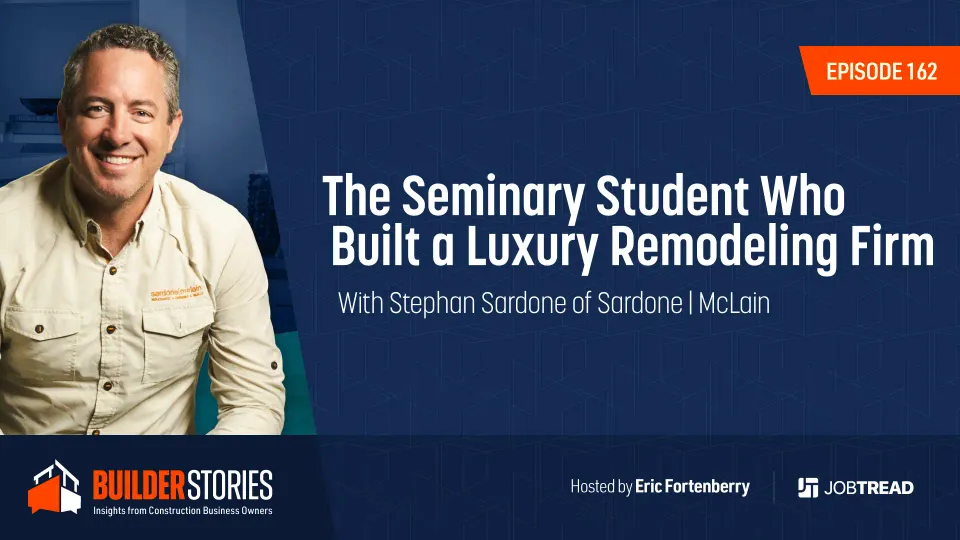

Stephan Sardone was planning to move to Papua New Guinea when he started doing tile work to get through seminary. He had no business training and wasn’t worried about making money. Then his company grew 10X in a single year and he admits he had no idea what he was doing. Hear what he wishes he’d known before the business outgrew what he could keep in his head.
In this episode you will learn:
- The one move that finally gave him a real business education
- The goal he keeps front and center
- The surprising advice he gives prospects who are weighing his competition
- The contract habit that had him eating change orders for years
- How he supports his team’s mental health with a benefit few contractors offer
Resources:
Hear the full conversation on Builder Stories. Learn more about Sardone | McLain here.
Eric Fortenberry: [00:00:00] Welcome to the podcast where we take a deep dive into the stories behind construction business leaders. We will share how they got started, how they found success, and the lessons learned along the way. I’m your host, Eric Fortenberry. Welcome to Builder Stories All right, how’s it going? Welcome back, everybody.
Eric Fortenberry: Today, I’m so excited. I have got a good friend of mine, Steven Sardone, in our office in Dallas, Texas. Very excited to have you, sir. Appreciate you coming out for a live Builder Stories. These are always my favorite. Uh, so Steven is with, uh, Sardone McClain. He has been with this company, started a long time ago.
Eric Fortenberry: He’s gonna give us the full story. Welcome to Builder Stories. So why don’t you give us, uh, you know, I, I like to open up, like to start off just a little bit of background. How did you get into construction? What led you to start your own business? When was that? All that type stuff.
Stephan Sardone: Um, it, it’s inter- the, the what led you to start your own business is an interesting question because I don’t think it ever occurred to me that that was any different than h- being an employee.[00:01:00]
Stephan Sardone: Uh, my mom was a entrepreneur growing up. My dad was a cop, and so just kind of it... having your own business was just kind of the norm. Um, when I went to college, I started a business and I, it was a job, uh, at a ca- I had a job at a coffee shop. Before that, you know, like every guy in Texas, I mowed lawns, but I also worked at her company in the summers.
Stephan Sardone: Um, in 2001, the school wanted to remodel a building, and they wanted to do it, like, on a hilarious budget, and they had professors doing, like, the electrical work. Um, but they were gonna turn it into a coffee shop, which was my expertise at the time. And so they asked me to come along and kind of help them set it up.
Stephan Sardone: And so I said, “I will, but I also want to do part of the construction, and I want you to hire my friends and let us have room and board over the summer and eight bucks an hour.” And they said yes, and I’m like, “We are so rich.” Eight bucks an hour. Yeah. It was pretty exciting. Um, and so I did that all summer, and then I set up the coffee [00:02:00] shop.
Stephan Sardone: And then I, uh, ended up going and working for one of the contractors, who was a very, very good dude, a very good craftsman, and the worst businessperson ever. Uh, and I would go, and we would work till late every night. And like I said, it was fun working with my hands. It was a, it was neat to learn things.
Stephan Sardone: Uh, but I’m like, “This is the worst company in the world.” Like, why would anybody be in construction? It clearly is terrible. Um, I finished college. I came back here to go to, to Dallas Seminary, actually, and I started my construction company. Um, and I didn’t need a lot of work, and I didn’t really care to make a lot of money because I was on the seminary track.
Stephan Sardone: I wanted to go move to Papua New Guinea. Um, along that way, I worked at another church, and I met a guy who later became an employee named Brian McLean. Um, and after seminary, I decided I really loved this, and so [00:03:00] we started working with designers and architects, and I eventually asked Brian to come on and be an employee.
Stephan Sardone: I asked him lots of times, actually. Uh, and 18 months of that, he eventually gave in. Um, he grew up building cabinets. He grew up, uh, doing all the things. And on week one, uh, we were a lead carpenter-based company, so that means the, the project manager’s actually self-performing a lot of the work. And, uh, week one I’m like, “Here’s your job.
Stephan Sardone: Here’s, here’s the first project.” And I hand him a binder and I left. And then, uh, two weeks later I hand ... I said, “Signed another job. Here’s the binder.” I left. And then two weeks after that I said, “The other project manager quit, so you have to take all his jobs.” And he handled it all. Brian is the sort of, uh, personality that people want in their project manager.
Stephan Sardone: He’s calm, he’s steady, he’s thoughtful. His degree’s in philosophy. Ugh. [00:04:00] Um, and then, uh, after six years I was just trying to figure out, like, we’re doing well, but it’s very stressful. I have to do a lot of things I’m really, really great at, and I have to do a lot of things I’m really, really, really struggling with.
Stephan Sardone: And those things are sucking the life out of me, and they’re making me less great at these other things. And I thought, “Should I switch careers?” And I met with some of our past clients, and I’m like, “Hey, what do you think about this?” ’Cause they would have us consult when they were thinking about stuff. Uh, I looked at purchasing a franchise, because the franchise promised that they would have all the systems and, and books and everything worked out.
Stephan Sardone: All I have to do is build and sell. I was like, “Oh, I can do that.” Um And then I decided, “Well, Brian’s already here, and he’s already doing a lot of these things. If I just bring him up, uh, to this position, then I can focus on what I love, and he can focus on what he loves, and together we can make this.” And so [00:05:00] we hired a coach to kinda help us through, I call it marriage counseling.
Stephan Sardone: And so for six months, he walked us through this journey of coming to terms with the agreement and how this is gonna work out, and just answering all these questions that were helpful. Um, I have, uh... When, when I got married to my wife, Katie, we went through a book together called 101 Questions to Ask Before You Get Engaged, and that was a very helpful exercise because I don’t, I don’t know what questions I don’t know, right?
Stephan Sardone: I don’t know what I need to know. So at question 55, I was finally ready to get engaged. We did finish the book, but that has become my process for big decisions. Write down as many questions as I can, and start getting working through those, and then write down all the additional ones that come up. And so that’s what we did, and that was about six years ago when Brian and I inked that, and now we are partners.
Stephan Sardone: Uh, and I would say my, my stress has gone down, [00:06:00] and what I get to focus on has gone up. My creativity has gone up, and the things I really get to think through and pay attention to is really through the roof, and my quality of life and time with my family is in- incredible, so I’m very happy with this. I would say I don’t think it’s very common in our industry for guys to take on business partners ’cause it’s just such a very old, old worldview of business.
Stephan Sardone: Yeah. And like I know everything, I have to keep all the money, and, uh, and for a lot of years, that was what I was thinking, and I was just like, “Well, I can have a little bit more money and a lot more stress, or maybe a lot more money and a lot less stress.” Mm-hmm. And so that’s how I kinda got there. Anyway, I think that was a long way to answer that question.
Eric Fortenberry: It’s, that’s awesome. So, so how many years did you go at it running the business alone?
Stephan Sardone: So I went out on my own in 2007. Um, I- And then up until six years ago.[00:07:00]
Stephan Sardone: What is this? ’26 or 2020... Oh, yeah, so minutes before COVID we signed it. Right. Which was real scary in, in Dallas for three whole months, and then we were hanging on for dear life. Yeah.
Eric Fortenberry: So have you always done the, the design build remodels? ’Cause I mean, I know now you’re doing, you know, very high-end, very luxury, you know, r- really impressive work.
Eric Fortenberry: What, what did it look like when you first started the business?
Stephan Sardone: So I started out with the company, my company was called Tile Fast, and our slogan was, “We do our business in your bathroom.” Ooh.
Eric Fortenberry: Yeah,
Stephan Sardone: pretty classy. Pretty clever. Uh, and, uh, that evolved into remodeling the whole bathroom, which revol- evolved into remodeling the whole kitchen.
Stephan Sardone: Uh, and it’s silly, but I was, I was doing... You know, I would come in, I would do all the shower work and all the tile work, and then people would be like, “Well, who’s gonna finish this?” I’m like, “Well, I don’t know. Let someone else.” And then I’m like, [00:08:00] “Well, I’ll find a guy who can do that, and I’ll find someone who can do that, and I’ll find someone to do that.”
Stephan Sardone: And eventually it added up to the whole bathroom. And then I said, like, “A bathroom and a kitchen, the only difference is appliances, right?” Like, there’s still cabinets and counters and everything. So started doing that, and I remember the very first bath- uh, kitchen I took on, um- It was, I charged the client $22,000.
Stephan Sardone: It was, uh, amazing. He was a cop, uh, in Highland Park, and his, uh, his mom was the president of Dallas Baptist University. And, uh, he was very, very nice, and like, I was like, “Hey, I’ve never done a kitchen before, but I can, so we’ll kind of go all, buy, buy everything together. We’ll do kind of a cost plus 15% or whatever.”
Stephan Sardone: I didn’t even care about making money. I was so excited- Yeah ... to take on the first one. Uh, I’m sure I didn’t make money, but I convinced him to let me like do the tile work at a fun angle and everything. Um, what was the question? [00:09:00]
Eric Fortenberry: Yeah, so, uh, what was it like, you know, what were your first jobs, and how did you sort of- Oh
Eric Fortenberry: grow from, but it sounds like, you know, kind of small. So I started networking. I had no marketing budget, but in, uh, back
Stephan Sardone: then, so this was all like, uh, around the recession, so there was lots of efforts in Dallas in the small business community to create opportunities and do networking. And so if I had enough money for a cup of coffee, I could go meet 100 people, and that’s what I did.
Stephan Sardone: Um, and along the way, I got to meet more architects and more designers and then found architect happy hours and ASID and all these other things. And so, and as I, you know, ’cause I wasn’t focused on the business or like the high-end design, I was just focused on like I need enough money to go to, to class.
Stephan Sardone: Um, but as I started seeing all this other work, I was really interested in it. And people would ask me for help with design. I would say, “I’m not a designer.” Then one day someone as- asked for help, and [00:10:00] I s- I assured them I wasn’t, and they insisted, and then I designed it, and I was like, “That was ugly.” So I’m like, “I’m never doing that again.”
Stephan Sardone: Um, and I noticed that these other people’s projects looked awesome, and I’m like, “I would like that.” And also, their projects were bigger. I was like, “Well, I need that.” And their projects were more guaranteed. And I’m like, “Well, I would like some of that in my life as well instead of running around giving free estimates out of my van,”
Eric Fortenberry: which is what I was doing
Eric Fortenberry: Um, what, what do you th- you know, when you think back about those early days, and I mean, again, it kind of sounds like you, like a lot of people end up kind of reaching that point where you’re feeling super overwhelmed, super burned out, like, you know, you’re feeling the weight of the sh- you know, the world on your shoulders.
Eric Fortenberry: Like, what, what was it in particular that you think kind of led you to, to just kind of start down that path of like, you know, questioning is this the right thing for me? Should I keep running this business? Like, h- how did, how do you sort of feel like your mental health, you know, was affected as, as you [00:11:00] were going at it alone for, for many, many years?
Stephan Sardone: I think like I didn’t have a plan, so it wasn’t not meeting goals, right? Uh, I, I wasn’t, uh, concerned about making a lot of money, so I, I wasn’t very stressed. We, uh, I- We got married in, we got married 14 years ago. So at that time, I still wasn’t very concerned about making a lot of money, and if I had work, I was happy.
Stephan Sardone: Yeah. Uh, and we did everything. Um, do you remember in, in Lakewood we had the, this hailstorm and, like, grapefruit size hail, and we lived above, Katie and I lived above, um, uh, the, a real estate office that had over 300 units. Mm. And I had already done a little work at some of his units, and I went downstairs.
Stephan Sardone: I said, “What do you need?” And he handed me a stack of work. And so I got all of my guys and we went everywhere, and we just repaired everything, roofs or [00:12:00] windows and siding. Um, and I think I was just so happy to have work and have a buck. I, I remember the first year I made $61,000. I was like, “This is unbelievable amount of money.”
Stephan Sardone: Um, and so I think, like, I did it, and I was working 80 to 100 hours a week, but so was Katie, and we didn’t have kids, so I was like, “Who cares?” Yeah. Um, I think after I bought my, our first house and I remodeled it, and then the Dallas Morning News put us on the front cover of, like, the Arts and Life section.
Stephan Sardone: And they said, you know, “This guy, they built their own h- they found their house, they remodeled it. They did all this. It’s really cool.” Then I got overwhelmed. Uh, I remember I had signed three deals one week, and I called a friend who was really good at business, which is something I wasn’t. And I was like, I started crying.
Stephan Sardone: I was like, “I don’t know what I’m gonna do. I don’t know how I’m gonna do this. I’ve never had this much work, this, this many big jobs.” Like, I could run 100 small jobs, but running half a dozen... And I was still a one-person [00:13:00] company with an assistant. Mm-hmm. Um, and so he kinda just kind of talked me through that, and, you know, I think we were still doing handshakes 10 years ago, like no contracts.
Stephan Sardone: Yeah. So a lot of things... I, I came to a point where things no longer could all fit in my head. Uh, and I needed spreadsheets and systems and processes, and quite frankly, while we have great ones today, those were the hardest things for me to kind of come up with and
Eric Fortenberry: utilize and follow. Yeah. So it’s, so it’s interesting though, I mean, you were...
Eric Fortenberry: You found it, I guess, easier to manage a bunch of jobs when they were much smaller jobs, but when you started kind of taking that step into much larger jobs, did... Was it just, like, feeling like, you know, even those, you know, just, just a few is, is, you know, smaller volume, but it was just, like, a lot more responsibility, it was a lot more pressure financially?
Eric Fortenberry: Like, you know, ’cause l- ’cause a lot of people always... You know, [00:14:00] I, I see the same path a lot of times where you s- you know, starting on whatever job you can get. You’ll, you know, handyman, you’ll take it any- an- anything that comes in, but, like, they do wanna make that, that walk up and increase the size of their jobs, take on those larger, you know, more exciting, you know, more, more profitable jobs.
Eric Fortenberry: But, like, what, what was it, what was it, like, that made that more stressful for you? Yeah.
Stephan Sardone: So, you know, you said profitable. That was also a word I wasn’t really familiar with. Like, I knew I was supposed to mark stuff up, but it was whatever the clients assumed I was supposed to mark it up. Yeah. Um, the jobs got bigger, and the client’s expectation changed, and the details got bigger, and so that happened overnight.
Stephan Sardone: So I went from designing my own small jobs to being s- handed a set of plans, and I’ve never-
Eric Fortenberry: Yeah ...
Stephan Sardone: ha- been handed a set of plans. And, um, and then I think also insecurity at that point in my life, like, I feel like I should know how to read these, but I don’t, and so I can’t ask questions. [00:15:00] So I just have to figure out everything, everything, everything and, and go through everything and use everything I can.
Stephan Sardone: And, um, but I think all those, when the, when the jobs got bigger, they got more complex. And, and I... A conversation I would have a lot of times with clients is they would say, “No, we talked about doing this, too.” And I’m sure everybody, pe- we have that conversation now, but it goes differently now. Yeah. Now it says, “We did talk about it, but this is what was included in the contract.”
Stephan Sardone: Yeah. Or, “This was included, and we wrote here that this is not included. You value engineered it out,” this, that, or the other. And back then, I would write a generic contract, and if they, they would say, “We talked about it,” and I would say, “We did. I forgot about that.” And I didn’t know that I was allowed to say, “But it’s not in the contract,” so I just ate it.
Stephan Sardone: Mm. So I ate a lot of change orders. A lot, a lot of change orders.
Eric Fortenberry: Yeah, all the time.
Stephan Sardone: Uh, ’cause I didn’t know. And then we’re doing it at the, I won’t say what the markup was, [00:16:00] but the subpar markup that everyone thinks you’re supposed to work at that’s not profitable. And, uh, um- And I grew 10X one year, and I was like, “I don’t know what I’m doing.”
Stephan Sardone: And then I went-- So I joined the Home Builders Association ’cause I had no education in my life for what I did for a living. Lots of theology Not a lot of business. And I went to, I, I went to the HBA ’cause I didn’t know about NARI, and I barely knew about that, and it was in Plano and I lived in Dallas.
Stephan Sardone: I’m like, “Why is this called the Home Builders Association of Dallas?” And so I went once, and two ladies from Remodelers Advantage were there talking, Rose and Victoria. And they’re like, “This is what we have.” And I’m like, “I’m signing up. I’m going to Baltimore or wherever it is, Maryland.” And I went up there for their conference and they said, “This is what you should be charging, and we exist to help you have a good business and a good life.
Stephan Sardone: Um, and this is how we [00:17:00] do it.” And I’m like, “Okay, I’m signing up.” Actually, I didn’t sign up because they said, um, “You have to have a certain amount of money, revenue.” Mm-hmm. Um, and so I thought, “Hmm, we’ll see where we are next year.” So next year I had went from-- So I went from, I did 10X that year, and then I increased it by 70% the next year.
Stephan Sardone: And I called and I said, “This is where I’m at. Based on the last two years, I think I’ll hit the goal. Can I just start now?” And they’re like, “Yeah.” So I joined. That, you know, you build really great friendships, relationships. You get to normalize a lot of your crazy life. Uh, and then you can get a lot of very specific feedback.
Stephan Sardone: Uh, things like, “We use this tool. This is how we handle these contract objections. This is how we review a punch list with the client.” And so lots and lots of experience in the room to share, um, and to, to do with it whatever you want with. So [00:18:00] that was a really important seven years of my life with them.
Eric Fortenberry: Was that, was that like the first time you had really been able to kind of meet and network with other people that you were in a similar situation like- In,
Stephan Sardone: in my experience at that time and in Dallas, even while after a few years of joining that, everybody was really cagey. Like they, like had all the secrets to the universe, and if they shared them, it would destroy them.
Eric Fortenberry: Yeah.
Stephan Sardone: Um, one thing I took away from... So they, they, they separate you into groups where you’re not gonna have, be in the same room with your, quote-unquote, “competition,” right? I took that mentality and I took it back to NARI and I said, “We need to have a contractors roundtable, and we’re just gonna be like gloves off, open books, everything.”
Stephan Sardone: And so I ran the contractors roundtable in Dallas for three years, and I modeled that, and I would open up, uh, the CRM I used to use. Subpar CRM for sure. And I would say, “This is what we’re doing,” and I would open up my contracts. And when I had a really icky situation [00:19:00] with a client, I invited everybody to the office.
Stephan Sardone: I said, “We’re gonna have a closed session, and I’m gonna tell you everything that the NDA says I can’t in the-- just to help and share.” And I would- Uh, a- and, and I don’t know what it’s like in Madison, but here we have a great group of remodelers who are very open with not, not just sharing like subcontractors, but also information, uh, about contracts and clients and what to do.
Stephan Sardone: And one of the presidents of NARI used to pull up his CRM, and he would compare who’s talking to who to see if they’re talking the same. That might be a little too far. Um, one startup a long time ago, I wanna say it’s called the Good Contractors List, they approached us, and we gave them some money, but we didn’t end up staying with them.
Stephan Sardone: And what they wanted to do was create a place for clients to go and, and search only for the good contractors. But also on the back end, you were allowed to, uh, talk about which client never to work with again. So everyone [00:20:00] could have that information, which was very interesting. Did you... So like were your competitors in the, in the room with you?
Stephan Sardone: Like, was this like- Not at Remodelers, but now, yes. Yeah. So there’s a guy in Dallas, Chris Black with Black Line Renovation. They do great work, and I go up against him all the time, more than any other remodeler. I met with a client this, uh, last week, and I always ask, “How did you hear about us, and who else are you talking to?”
Stephan Sardone: Uh, and he said, uh, AI, and then AI took him to this other remodeler’s website, and this remodeler likes to write, uh, review, uh, blogs about the top five bath remodelers in Dallas or Frisco or DeSoto. Do you know who I’m talking about? And he’ll, he’ll say number one is him, and here’s why. And then he’ll say the other four, and he’ll say, “Here’s their pros, here’s their cons.”
Stephan Sardone: They’re not all accurate, but it’s very compelling. And that guy had that printed off. Hmm. And, uh, he had [00:21:00] Chris at number three and me, I barely made the list at number five.
Eric Fortenberry: Hey, s- still got an at bat. I mean, yeah, that’s all that matters. You know, it’s, it’s interesting, though, h- how do you view... You know, ’cause I hear this all the time.
Eric Fortenberry: People feel like they can’t, you know, even talk to their competition. They can’t, you know, network with them. They can’t, you know, work together. Like, I mean, do you see there as an opportunity for, you know, similar size, similar type companies in the same area to, to be in the same type of group?
Stephan Sardone: Absolutely.
Stephan Sardone: Think about how many permits are pulled for construction in Dallas every year. Um, I bet 10,000 a year. And if I’m lucky, I’m gonna do 20 jobs this year. Yeah. And my seven friends aren’t even gonna do 20 jobs this year. So no one has a piece of the market that’s, that matters. On occasion, we will go up against each other, and it, I think it’s probably gonna come down to, uh, if it’s really apples to apples, right?
Stephan Sardone: Are they both this type of GC or this type of [00:22:00] design build? Um- Who’s gonna do a better job of closing the client? Who’s gonna be a better fit? Personality is, uh, uh, is what, as important as everything else. So you might... I used to go up against, uh, Chad Hatfield all the time. He’s with Alair now. Me and Chad could not be more opposite human beings.
Stephan Sardone: And whenever I would say that, w- whenever I would find out, like, “Oh, we’re talking to Hatfield Builders,” I’d say, “Well, where are you, what are you thinking?” And they’re like, “Well, he’s got this, this, and this.” I say, “You know, I think, like, if you go with Chad or Chris Black, you’re gonna have a great experience.
Stephan Sardone: If you go with us, you’re gonna have a great experience. I think it, the decision is quite easy for you. It’s the opposite of what they said in The Godfather. It’s not business, it’s now personal. Who do you like? Who do you want to spend the next year of your life talking with? Because we’re all gonna do a great job.
Stephan Sardone: One of us you’re gonna have more fun with, and you should choose that one.” There’s no reason for people to get uptight about sharing and working together and creating a collaborative community to [00:23:00] raise the standard of the industry.
Eric Fortenberry: No, I wholeheartedly believe in that, and I totally agree. There is more demand than there is supply, and we can all work together.
Eric Fortenberry: And when everybody, and when all contractors can elevate their, their, their, theirselves, their builds, the, the quality, you know, the experience they provide, like, that helps the industry as a whole. Yeah. You know, I think so many homeowners out there are just fearful because they’ve heard those horror stories of those, you know, and they’re the outliers, but those contractors who will, you know, come and take the money and run, and, like, that, like, gives the industry a bad rap, and that is what makes people more fearful of moving forward with a project that, in reality, should be the most exciting project they’ve ever done.
Eric Fortenberry: This is their most valuable asset that they will ever own. Yeah. And they are making a huge investment into that. Like, this should be a fun experience. This should be exciting, you know, but it, it gets kind of, you know, overshadowed by, like, oh, well, what if this, you know, contractor is gonna just, you know, provide a terrible experience or rob me, you know.
Eric Fortenberry: And I think we need everybody to elevate, and so that’s why I agree with you. I think it’s important [00:24:00] that people recognize we can work with our competition. We can come together. You know, I tell, I tell people all the time, like when I had someone ask me if, you know, if, if I could, you know, wave a magic wand and our, you know, biggest competitor would just be gone, I said, “No.”
Eric Fortenberry: I actually think it’s better for somebody to be trying to decide, do I go with, you know, JobTread or this other company versus do I go with JobTread or nothing? You know, do I hire this contractor or, or this contractor? Like, the, n- now we’ve already progressed. We’re not like, “Should I do it or not?” It’s, “Which one should I go with?”
Eric Fortenberry: And I think that just, again, is, is far more, you know, uh, likely to lead to a deal getting done than for these people to just waffle and not, not be able to make a decision. Like, it gives them that, that comparison and that decision point.
Stephan Sardone: A, a better educated client is a better client. When, when we interview people and they are loosey-goosey with their Their decision-making process and their budget and everything, and things aren’t thoughtful, it feels [00:25:00] like this is a, this, this, this relationship is very tenuous.
Eric Fortenberry: So I wanna go back for a second to when you decided to, uh, essentially kind of take Brian, who was an employee, and elevate him and make him a partner in the business. Like, what, what was that like? I mean, how, how did you actually sort of figure out, like, what, what is this, you know, what, what does that process look like and, and why, you know, why did you decide to do that ultimately?
Eric Fortenberry: Because, you know, I see people all the time. They, again, they’re going at it alone, they’re getting burned out. You know, they’re, they’re thinking more like, “Do I, do I shut the business down or not?” Right. You know, you had this other creative idea of like, “Well, maybe I just need to, like, find a partner and, and, and, and, and be able to divide and conquer instead of, you know, just continuing to go at it alone.”
Eric Fortenberry: So like, kind of h- how did you ultimately structure that and, and then how did you all decide, you know, who was gonna do what? Like, how did you, how did you divide up the responsibilities? You know, what do you do? What does he do? And- Yeah ... you know, what’s that look like?
Stephan Sardone: I told him, “I need you to do everything,” and I...[00:26:00]
Stephan Sardone: Uh, you know, I think I, I, I wanna say I got lucky because he was an employee there, but I think a lot of people in our industry probably have a good project manager who if they want to be more, might be the right person. Mm. I think a lot of project managers don’t wanna be more. Like, it’s, there’s, uh, personality profiles are so interesting in our industry so specifically because they’re like, “This is what I wanna do.
Stephan Sardone: I wanna wake up and I wanna build from 8:00 to 5:00, and I wanna go home.” Yeah. And like, “Well, do you want more?” “No.” I’m like, “Oh, well, I guess you’ll be a great employee.” Um, I think, so sometimes you might find someone there who maybe they’re a project manager, but they have much more in them, or maybe they, it’s not the project manager, maybe it’s a designer who, who has that, or an office manager who has that capacity to become a general manager.
Stephan Sardone: Or maybe it’s one of your competitors, and they’re great at one thing, and you’re great at the other, and y’all need to just merge your companies [00:27:00] and come up with a plan that way. Or maybe you need to go look outside and see about if there’s a third. But I think, like, there’s so much more opportunity, I think, if you’re open.
Stephan Sardone: It’s like, uh, uh, it’s like therapy. The more the more you share, the more you know. Um- The question was, uh-
Eric Fortenberry: So, so how did you, like, realistically structure this where, you know, h- like h- h- kinda who, who... What are, what are the lanes here? Who’s responsible for what? Like, how is that handled? And then when you guys maybe have a dispute or disagreement, like how does that- Yeah
Eric Fortenberry: how does that get settled?
Stephan Sardone: So that was n- not as hard. I think it, uh, uh... And I don’t know if I mentioned it before we started uh, the camera or not, but we hired a coach to kind of walk us through six months of like, uh, I call it marriage counseling, but like leading us up to that. Uh, while, uh... Because roles are important because, not, not because of, of who has to do them, but because they have to be done, so they have to be [00:28:00] assigned.
Stephan Sardone: They have to be owned. It was very simple, like sales and marketing was gonna be me. I manage the designers in the office, and he manages production, and his goal was for him to slowly kind of take over everything as a GM. So there hasn’t been a lot of like, “That’s my lane. That’s your lane.” Now, he might say something different.
Stephan Sardone: I bet he would say I’m always in his lane. Because my, because... I th- yeah, right. So, uh, but I’m like, “That’s fine.” Uh, but yeah, I come onto the job sites, and I don’t look to look, look for compliments. I look for problems. I say, “Where’s the checklist? Who’s using this? Are we following the process? This, this, this.”
Stephan Sardone: And so yeah, I’m just naturally just gonna bitch about everything. Um, so I think he would feel a little different, but I think I s- you know, he’s, he’s calm and so we can take this. But I’m also pushing things, like I’m saying, “This is what we need to do with the company. I wanna go faster. I don’t wanna lose anything, but I wanna go faster, and this is how we need to do it.”
Stephan Sardone: And so I think like, like right [00:29:00] now him and I are, are at odds, and I’ll tell you exactly what it is. Uh, I... We do bidding the way we’ve always done bidding Uh, we get the plans, go write the scopes. We schedule a bid day. We meet with every single sub. We get them to adjust the scopes for, to be more accurate.
Stephan Sardone: We get their bids back. They’re all wrong. We go back and forth with them, and then we have our number. And I’m like, “If you don’t start AI-ing this shit, I’m gonna lose my fucking mind.” Could I say fucking on a podcast?
Eric Fortenberry: Probably not.
Stephan Sardone: And so I’ll say that again. I said, “We need to AI this. We need to figure out a way to put it together and just have a little, uh, proof of life check with our trades- Sure
Stephan Sardone: and move forward. This needs to be a, a days process, not a weeks process.” Um, so, so [00:30:00] there’s that, and then there’s also, like, well, if we move everything through the pipeline faster, we have to build
Eric Fortenberry: it. I’m like, “So, so find more trades. Get another framer. You know, whatever it is, so- So you’re charging ahead, and he’s, and he’s the actual grounded one saying, “Well, how am I actually gonna deliver and not sacrifice quality?”
Eric Fortenberry: That’s right. Yeah. And I’m like, “I don’t wanna sacrifice quality, but we still need to charge ahead.” Yeah. No,
Stephan Sardone: good.
Eric Fortenberry: So, so that is our, and always has been me and Brian’s, whatever. And I, and, and so, like- Well- ... I think that’s very natural too, with the visionary, with the, you know, that, that, that, that CEO-type mindset.
Eric Fortenberry: Like, the goal is to grow and to, to just keep- Yeah ... keep charging ahead at all costs, no matter what. You know, we’re, we’re up in the, up in the clouds, and, you know, you gotta have all the people behind you sorta holding you down and keeping at least one foot on the ground. Yeah.
Stephan Sardone: And we’ve-- I don’t wanna, I don’t wanna go backwards.
Stephan Sardone: I don’t wanna
Eric Fortenberry: suck. I don’t want projects to go poorly. I only want clients to have the five-star experience. But, um- Well, how, so how do you [00:31:00] handle, though, like, let’s, let’s say there is, like, you know, heated debate or disagreement. Like, how do you handle those situations? Because again, I’ve seen so many partnerships that, that end up in this, you know, moment where it just blows up and everyone is pissed off, walks away.
Eric Fortenberry: The whole thing shutters. Like, how, how have you not let that happen with you and Brian?
Stephan Sardone: Brian and I have been friends for 20 years. Uh, and I, you know, to be honest, when you become business partner, the friendship looks different. Yeah. Right? We’re not getting beers on Friday nights anymore. But we might do it at the office, but it’s at 10:00 AM, not at night.
Stephan Sardone: Um, I think, um, so the respect can’t go away Number two, the communication. So, uh, again, I’m not trying to be weird. Date nights are important, right? Uh, so we have, every Tuesday we have lunch together. Well, it’s in the calendar. We, we hit it t-t-twice a month, which is pretty good. A-and that is just like, are we [00:32:00] on the same page?
Stephan Sardone: It’s, it’s, it’s what am I doing that’s bothering you? What is... What did you say is gonna happen that’s not gonna happen, and I need to know about it so I don’t freaking lose it later? Um, and so we do that, and then, uh, I think-- But we both have a mutual respect for our, our lanes and our space, and he knows I’m not going anywhere.
Stephan Sardone: Like, I’m just gonna keep pushing and pushing and pushing until he and we find a way forward. But I’m not gonna be like, “Oh, you know what? You’re right. Let’s just stay here forever and die a slow, painful death.” I’m gonna be very happy with that decision. Um, but I think that, and then I’ll give you a very specific Texting is a terrible medium for him and I when I’m pissed off.
Stephan Sardone: And I write whatever I write, but the way he writes back, I only read into it as he’s being an a-hole. And so I just learn, like, uh, we have to get on the phone. It’s completely different. So, like, his, [00:33:00] his, uh, his text tone doesn’t work for me- Yeah ...
Eric Fortenberry: when I’m
Stephan Sardone: upset. Yeah. Do you, uh, apply that with customers as well?
Stephan Sardone: So, um, always. So I’ve always been really insecure about my grammar- Yeah ... so I’m always wanting to hop on the phone, if anything. Because, yeah, ’cause people read a email based on their stuff usually, and when they’re upset or when it’s something’s tense, 10 times so. Almost nothing should be in writing. Uh, and yes, I, like everybody else, have tried to use ChatGPT to help me, but I’m still extremely sensitive to how someone might read something and, like, the last thing we need is some- something making a, a tense situation messier.
Eric Fortenberry: Yeah.
Stephan Sardone: So.
Eric Fortenberry: It always feels like that, that in-person or at least on the, you know, on the phone, face-to-face, whatever it is conversation is almost always [00:34:00] gonna result in a better outcome when, when people hear and can see and read the body language and it’s not just this kind of, you know, text that, you know, we know there’s a lot of keyboard warriors out there and sometimes, “Oh crap, I wish I wouldn’t have said it like that,” and, “I was just heated and I went too qui- too fast.”
Stephan Sardone: We train our guys how to communicate and it’s mostly in bullet point to, to kind of eliminate, uh, any, any semblance of emotion.
Eric Fortenberry: Yeah. You know, it’s interesting though, I, I, I really like how, and you know, and called it date night, it’s kind of interesting that, you know, but like you, you have very intentional time set aside for just those partner discussions.
Eric Fortenberry: It’s, it’s that time to if there is something that, you know, you guys are getting frustrated with, it can, you know, has that opportunity to come out instead of going weeks or months. And you know, again, I see a lot of people who just, they, they, they don’t take that time to communicate, you know, what they’re feeling and what they’re frustrated with.
Eric Fortenberry: And like, if you don’t communicate, you know, people can’t read each other’s minds. That’s right. You know? And then you get two people who’ve got this like, you know, this sort of pissed off aura around them, and like you don’t know what’s going on and, [00:35:00] you know, I think that’s, uh, it’s, it’s a really, it’s, it’s, that’s awesome.
Eric Fortenberry: Now my, uh, Alex, my, my COO here, and he’s, you know, again, my best friend. Like we, we, we meet every Monday night, you know, so maybe it resembles even more of a date. I’ve never thought about it like that or called it that. We’ll call it a work night or work session, but You know, I, I, I think though that is so helpful for us in the same regard because, like, you know, a- a- again, during the day, super busy, got a million things going on.
Eric Fortenberry: Sometimes we can have varying opinions, and sometimes we even go at it, and it’s like, man, like, you know, we need that time for us to just come back and say, “Hey, like, let’s talk through this. Like, let’s brainstorm this. Like, let’s, you know, if, if we got some words to say to each other, we can do it in private, not in front of other people.”
Eric Fortenberry: Yeah. You know? And so I do think that that’s, like, a really great strategy, you know, especially for, for partners to be able to, to stay on the same page. Because I, you know, again, I... A lot of people do hear that, you know, having a business partner can be very hard.
Stephan Sardone: Mm-hmm. You know, one other thing we did, so we designed our office so him and I have, uh, we have separate offices and shared.
Stephan Sardone: So we [00:36:00] each have our own door, but then I put two glass doors in frosted, and they stay open most of the time. They only close when, like, we need to. So that was an attempt at, like, we’ve never done a partnership. I’ve never had to tell anybody anything, right? I’ve just kept it all up here, so a bit of osmosis.
Stephan Sardone: So he hears a million of my phone calls. I hear the meetings he’s having with the guys or whatever, and so ... And it’s common for us. One will be doing, uh, on a call or on a Zoom, and the other will just come in and sit and listen just to know what’s going on. So I think, like, that’s been helpful too, having just kind of a, a pseudo shared office- Yeah
Stephan Sardone: in a weird way. It, it, the, it, it can’t be all there is, but it’s some. Sure. It’s more. He knows what I’m communicating to potential clients up front. He hears the expectations I’m setting, and so that continues to build confidence that I didn’t bring in some lunatic client that he has to deal with, which is what every project manager’s afraid of.[00:37:00]
Eric Fortenberry: We’ve talked a lot about, you know, again, I’ve, I’ve really been digging into kind of your, sort of your mindset on, on all of this, and kind of how, how, how you’ve continued to lead the business forward, you know, through these, these challenges as a business owner. But, like, you know, again, we, we, we, we know that, you know, for, for the general stats, you know, construction is, is really a very tough, you know, mentally tough, uh, industry for, for people to work in.
Eric Fortenberry: There’s a lot of mental health issues. I mean, suicide is, is, is, is very high in this, this industry. Like, what are, what are your thoughts on that, and, and what have you all done, you know, to try to make sure that you keep a very positive environment and help your people to, to not succumb to those, those stressors and those feelings?
Stephan Sardone: Yeah. Obviously, I’m not
Eric Fortenberry: a licensed anything therapist, so I can’t speak a lot about that. You’re married to an incredible one.
Stephan Sardone: I am married to one. Um, that, you know, a lot of people do who do follow through with something like that have other issues, and they’re compounded by, uh, what else is going on in their life that were unchecked.[00:38:00]
Stephan Sardone: Um, and so for me, I do have a bit of seasonal depression. It doesn’t go on for months and months, but it’s pretty common for me to have a couple weeks, uh, every, every year where things are very down. Or when the business is down, to be feeling like nothing is working and I’m failing everywhere. Yeah. Right?
Stephan Sardone: So I think, like, that’s common. Um, something we do, it do- people don’t take us u-up on it. We, uh, so UT Southwestern, when they’re, uh, psychiatrists and psychologists are in training, they have a program, and it, they do therapy for, like, 25 bucks an hour. Mm. But ... And they’re very good therapists. I know because I saw them back then.
Stephan Sardone: Um, we connected with that program, and we offer, uh, to pay for that weekly, uh, appointment w- for any employee- Wow ... for as long as they work there, [00:39:00] and some have taken us up. And I, by us, I mean, I’m like, “Everyone has a company credit card. Pay for it. You don’t need to turn in an invoice. You don’t need to talk about it.
Stephan Sardone: It, it’s none of my business,” but that’s there.
Eric Fortenberry: That’s
Stephan Sardone: awesome. So that is, I would say, where we ... That’s important. Everybody knows that I’m in therapy. I go to a, a therapist. Um, I encourage people to if they’re, um ... I think, like- In our industry, obviously lots of dudes, uh, and with that a lot of just kind of macho-ismo and the idea that no one needs to talk about anything, and that’s not really working out well for the world.
Stephan Sardone: Um, I had my wife come and talk at one of our contractor round tables, um, and I think that was helpful. Um, I think like I, I, I, I don’t know the answer to your question. I think a business owner has to create a culture and has to pay attention to their employees. If they see something, [00:40:00] they need to do something.
Stephan Sardone: Uh, if they see an employee acting different, they need to go and check in and s- and as much as they can and still respect that person’s, uh, privacy, say, “Is everything okay? Uh, do you need help? Do you need community?” Is... You know, they can say no. They can not tell you that something’s going on at home, or they’re feeling like a failure at work, or, or, or they’re stressed about this, that, the other.
Stephan Sardone: But I think, uh, us as, as managers and owners, we have the ability to kind of see that there’s a lot going on. It’s just a lot of times that we’re not really looking out for that. Yeah. And then I think the other thing is you have to create a culture where people know you care, because then either they will come to you or somebody else will.
Stephan Sardone: So bef- before I came here, I had an employee come to me about another employee and say... actually about two other employees and say, [00:41:00] “They’re both very stressed for this, this, and this.” And they did it, uh, knowing that I would never out them and knowing that I would go and connect with these people and check in and see if there’s anything we can do.
Stephan Sardone: So I think like as the owner sets the culture. Uh, now at our company, me and Brian set the culture, but the culture’s defined by the employees, if that makes sense. So the people I bring in, every single one will change the culture. And so I pay attention to who I bring in. Are they going to change us for the better?
Stephan Sardone: ’Cause if they’re not, I don’t want them. Um, but ultimately, the owner sets the culture, so if you’re gonna act like a weirdo about therapy, then everyone’s gonna keep their cards pretty close.
Eric Fortenberry: Yeah. That’s awesome. I, I love that you actually provide that as a benefit, and just the fact that they can go and, and, and, and talk to someone and company pays for it and no questions asked, doesn’t even, doesn’t even come up.
Eric Fortenberry: I mean, like, that, that’s incredible. I’ve, I’ve, I’ve never [00:42:00] heard of another construction business doing that for their employees, and I think that’s awesome. They’re, uh- They do it on Billions, so I figured we could do- ... kind of go there. Yeah, I mean, well, are you gonna bring Katie on staff? Is that a-
Stephan Sardone: Well, I can afford her.
Eric Fortenberry: Yeah. No, that’s, that really is so important though, and, and, and again, I, I think you’re so right that, like, as, as managers and, and, and as people that, you know, are continuing to, to grow our teams and, and, and, and understanding the dynamics that as more people come in, like, e- everyone has their own life and their own journey that they’re on, and their own challenges and stressors, and, like, just being in tune to how somebody is, is, is, is feeling or being able to just, like, you know, have that empathy and recognize that hey, maybe something’s going on, and just showing that you care.
Eric Fortenberry: Just even that check-in. Not asking the details, but just, “Hey,” you know, “Is everything all right?” Like, I mean, I- who knows? May- maybe they’re feeling like nobody cares about them, and you were that one person that came and, and, and reached out and, you know, i- like, I think that is so important that everyone needs to remember [00:43:00] that, like, you know, everyone has their, their own feelings and, and, and lives and, you know, it’s, it’s not always about work, you know?
Eric Fortenberry: Might not even be anything about work that’s, that’s causing this anxiety for them, but, like, for them to feel like you care and that they’re surrounded by people that care, you know, that, that does create, you know, an outlet for them when they need it.
Stephan Sardone: Yeah. I think, uh... I... You reminded me of two things I was thinking.
Stephan Sardone: You know, something we, um, at work, one of the, the things that we really try to help our clients, our... I was about to say patients. Our employees think though is taking an empathetic approach to the clients. It’s really easy to say, “Oh, they’re just being whatever.” And I think kind of modeling that is really helpful, um, so that, you know, we can also be empathetic with one another.
Stephan Sardone: Um, gosh, there was something else I was thinking while you were saying that.
Eric Fortenberry: You know, it is, it is, uh, interesting though how, you know, when you, when you think [00:44:00] about it, uh, clients are also on that same journey where you, you’ve intertwined yourself in their lives for this, you know, few months, and it’s like, you know, making sure though that like, I mean, the, the worst thing that can happen is if a client is frustrated with something and they never say anything, and you never know it, you know?
Eric Fortenberry: And like, that’s, that’s why it is so important to have those check-ins and to keep trying to, to, to watch over and make sure, you know, not just the construction’s going well, but like how are they feeling, you know? At the end of the day, like they’re not gonna remember all the intricate details of how the build went, but they’re gonna remember how they felt along the way.
Eric Fortenberry: And when you’re there and you’re, you know, trying to make it a great experience, you’re trying to make it fun, you’re trying to, you know, address any challenges or issues or stressors that they have, but, you know, if, if you’re not showing up on the job site every once in a while, if you’re not having those check-ins, like, you know, again, a lot of people don’t ever know until it’s too late, and then they just, they can’t-- You can’t repair how they felt.
Eric Fortenberry: You can fix any punch list items and things that didn’t go well, but like it’s, it’s that emotional, you know, state that like you have to stay in tune with along the way.
Stephan Sardone: Yeah. Something I-- [00:45:00] So I, I go through the contract with everybody in person. Like we separate it. We do a legal meeting, and then later we do the rest of the contract.
Stephan Sardone: And so I go spend an hour with the clients talking through that and just kind of giving them a lot of context, because it’s hard for people to appreciate because we’re not, we’re not occupying the same role in the contract. I’m the contractor, I’m a guest at your house, and this is your home Um, but this is your home, and this is a luxury service, and this is our, this is our livelihood also.
Stephan Sardone: Um, and one of the things I say is, like, if you, um, if you’re feeling something, you need to say it right away. Like, let’s not let it fester. I said, “It’s ... We have the JobTread app for a reason, and one of it is you can pop it in at 3:00 in the morning if you’re thinking about it. Pop the message in. W- when we wake up, we’ll see it.
Stephan Sardone: Don’t worry about it. Like, don’t stress about it. Just pop it in or say we need to have a meeting or whatever.” And we really try to communicate, like, we want to hear what’s going on. [00:46:00] We want to hear if you’re bothered or concerned about something. We don’t wanna just save it for the end, and like you said, it becomes a punch list problem that can’t be dealt with.
Eric Fortenberry: Yeah. Yeah. So, you know, a- as, as we kind of wrap up here, I, I think one of the most interesting things that, that I’ve sort of heard throughout and, and you even were sharing with me before, like, I, I can tell that you got into this because you’re really passionate. You really love the build. You love helping people.
Eric Fortenberry: You love, like, just, you know, seeing that, that impact that you’re making on these people’s lives, and that’s, that’s exciting to you. I can tell you’ve got that passion in you, and that’s, that’s probably your... one of your top drivers here. So I’m curious, like, how do you, how do you think about the future, and how do you think about where do you wanna take the business over the next five, 10 years?
Eric Fortenberry: Like, is there some longer, you know, term goal or, or exit strategy or... Like, what, where do you... Like, where do you wanna be, you know, in, in the future here, and h- how do you sort of see the, the business continuing to evolve?
Stephan Sardone: [00:47:00] Um, I don’t want... The first thing I, I say, I don’t want it to be a cop-out, and I say that out loud because I don’t want it to be a cop-out, right?
Stephan Sardone: I’m trying to be honest. I could do what I’m doing till I die. I really like it. I really love it. I love meeting people. I love hearing what’s bothering them. I love helping them organize their thoughts and getting very specific and focused on what we can do, what the nice-to-haves, the have-to-haves. I love kind of this evolution I get to, this journey I get to go on with these people, and I love what, how they feel w- when they see their first couple options, and I love the construction process, and I love the end.
Stephan Sardone: And I, and w- and I go and meet with everybody afterwards, and I bring a huge box of toys. That sounds weird. I have a whole huge box of stuff with alcohol. And they tell me how it went and how they love the project manager and how the communication with this and... And so, like, I, I like, I really love working with our employees.
Stephan Sardone: I, I, I love a lot of [00:48:00] it. I, I don’t have a strategy to exit. I should. I need one, right? Like, just to be a good businessperson. I wanna do more of this. I don’t know. You know, Dallas has separated by 75, and I work primarily on the east side. Working on the west side is a different group of folk, as you know.
Stephan Sardone: And so we’re starting to do more and more over there, and I think for years I was really scared about that. I would, I would meet these people and they would intimidate me. Um, and, you know, maybe rightfully so ’cause I didn’t have everything buttoned up for what the expectation was. Um, but I, I wanna keep growing.
Stephan Sardone: I wanna grow aggressively. We are not a $50 million company. We are not a $10 million company. But I don’t know what it would take to become a $50 million company, but I would like us to aim between 30 and 50, but doing the exact same thing we’re doing. I don’t feel like I wanna start a handyman service and, and a concierge service and all these things.
Stephan Sardone: And no shade for those that do. I [00:49:00] just don’t wanna do it that way. I just wanna do more of this. Uh, Dallas will never run out of opportunities for what we do exactly. It’s a lot of fun. It is really hard work. Like, it is hard work. It takes 10 months to make a buck. So, um, I, I, I want Brian to do more and me to do less, you know?
Stephan Sardone: But he knows that. Um, yeah, I, I think, like, you can get caught up in kind of the celebrity of our business. I don’t really... I think, like, it’s exciting, like, to be on the cover of this magazine or that magazine, but I really don’t. I just want, like, a million five-star reviews. And because they’re real, and when I go out in public, I get to introduce my family to different clients I get to help, which we do now.
Stephan Sardone: Yeah. They see... ’Cause I, you know, my fam- my, you know, it’s not like my wife is the secretary, like in a lot of businesses where they know all of your business. Nobody knows any of my business. [00:50:00] So, but when we do go out, they, uh, they see the girls, and I introduce my wife, and it’s fun. And, you know, I think I, I just wanna keep doing this and have quality of life, provide a nice, uh, nice life for my family.
Stephan Sardone: 20-car garage.
Eric Fortenberry: I love that, man. I mean, you know, and again, I, I think that is... that really is a, the, the thing that I see different here in you than I see in a lot of people is your mindset. And you have a very good understanding of, like, the importance of appreciating the moments and recognizing that this is your life, this is your career, this is your journey.
Eric Fortenberry: And, you know, you, you can choose to allow things to stress you, to overwhelm you, to, to make business fun or not fun, to make this, like, you know, uh, just seeing the appreciation that you have for great jobs completed, for the impact that you’re making. Like, you’re recognizing this. Like, you’re, you’re, you’re allowing that to fuel you.
Eric Fortenberry: And the things that come up that are tough and they’re hard [00:51:00] and situations you gotta deal with, well, you know, that’s why you got a partner. That’s why you got, you know, a, a team around you to help you work through those. And, and so I, I just, I, I love your, your mindset and your attitude and approach to, “Let’s just keep this fun.
Eric Fortenberry: Let’s keep making a big impact. Let’s keep growing.” I mean, growth is exciting, you know, but it’s, it, there doesn’t have to be some end goal or some end date or, or whatever. It’s like, you know, a- as long as we can keep having a good time and we keep making a big impact on others, like, I think that’s what this is all about.
Eric Fortenberry: Like, that is the ultimate, you know, entrepreneurial success story. It’s, it’s not about, you know, this big exit and all this money. Like, I, you know, I can tell you, you can have all the money in the world and it does not make you happy. You know, you have to be able to have that. Yeah, it’s, it’s certainly, you know, in my opinion, better to have money than not, but, you know, it, it, it is though, there, there is a lot more to life than, than just that you know, focusing on every little dollar and every profit and, and every single thing.
Eric Fortenberry: Like, it’s, you know, seeing those, those greater, you know, intrinsic, you know, rewarding, you know, opportunities that, that I think you do a really good job of [00:52:00] seeing and, and, and, and hopefully your team also, you know, sees and recognizes that. And it sounds like you guys have a lot of fun and probably celebrate, uh, you know, just like we like to celebrate our wins, but- I
Stephan Sardone: don’t think we celebrate as much as JobTread celebrates.
Stephan Sardone: Well, you know, but we could. Let- these are stretch goals for
Eric Fortenberry: us. All right, I love it, I love it, man. Well, look, as, as, as, as we wrap, I got one final question for you. Like, what, what advice, you know, if, if you had to pick, you know, one or two things, like, what advice would you give others out there who are earlier on in their career, you know, maybe they’re, you know, they’re, they’re just getting started or may- or maybe they’re at a, a point where they’re feeling, you know, the, the, uh, everything’s compounding and, and, and they’re, and they’re just feeling super stressed and overall.
Eric Fortenberry: Like, what do you wish you would’ve known back then when that first happened to you that, that you know now that, that, that you might be able to share with our audience? Run. Uh, you know, I think the first
Stephan Sardone: thing other than run that came to mind was, um, and this isn’t exactly what you’re saying, but I think I can turn it into what I’m, I, I think I’m trying to get at.
Stephan Sardone: Me [00:53:00] and Katie, uh, started our careers right in Dallas. She was finishing her postdoc at UT Southwestern, and I was leaving, or graduated seminary and, like, deciding to go from a practice to a, a different practice, a business, right? And, and we both thought, like, “We have to stay in Dallas. Our whole network is here.”
Stephan Sardone: And, uh, and it, it’s true, our whole network was here, but our whole network was this big, but because it was our whole world, we thought it was this big. And so don’t let, uh, your whole world hold you back from the whole world of the opportunity you actually have. Uh, you know, i- i- in hindsight, I would, we would, I would say let’s go to Austin.
Stephan Sardone: Let’s call it a day. Like, w- yeah, we’re gonna s- start back a little, but we’d be ba- you know, we’d be doing just fine, and we’d be in [00:54:00] a, a different town. And, and that’s nothing against Dallas. I just think, like, that’s an example of sometimes we’re so consumed with, uh, of everything we know, we don’t think about that there’s so much more that we don’t.
Stephan Sardone: And so whether that is get a partner early on, that would be another thing I would’ve done differently. Um, I think, uh, I would join an organization. I didn’t... It just- You know, earlier. So I joined the, the HBA, but I didn’t, I didn’t participate, right? I joined Remodelers Advantage, and that I participated in, right?
Stephan Sardone: But I would, uh, I would, I would think outside of your own bubble and box and, and, uh, so I’m gonna, I’m gonna use a theologian. Um, uh, the Anselm. So the three great fathers are Augustus, Anselm, and Aquinas. Anselm, they were trying to figure out how to talk about God, and he said, “God is that which is greater than you could conceive.”
Stephan Sardone: And, [00:55:00] uh, you don’t have to run with that, but I think what you could, should imagine is that there is something greater than you could conceive, and you need to explore that before you land.
Eric Fortenberry: Awesome, man. Look, I, I really appreciate you coming in, sharing your insights, your journey. It’s been really fun to watch.
Eric Fortenberry: You know, I would encourage anyone else in the, in the Dallas area to find a way to, to, to get to meet you, spend some time with you. You’re, you’re definitely a great, uh, great person to hang out with and, uh, you know, grab a beer with. But, you know, m- more importantly, a- again, like, you’ve got a plethora of knowledge to share, your experience and your willingness to share with others.
Eric Fortenberry: You know, I think, what, you’re vice president of, uh, of s- of, of the, the local NARI chapter. Is that right? You know, again, great opportunity to get involved, get to meet Steven and, and everyone else in this community. But, you know, just again, it’s, it’s, it’s been awesome getting to watch you and your, your company continue to grow, and, you know, appreciate the opportunity just to be a fly on the wall and be, be your new, uh, you know, CRM software provider.
Eric Fortenberry: But it’s, uh, it, it really is, is awesome that, you know, you’re, you’re, you’re really trying to help other people, your employees, your clients, [00:56:00] but even the greater, the greater market, the greater industry. It, it’s, it’s, it’s really awesome. So thank you for what you do for everyone else, and, uh, can’t wait to see where you take the business.
Eric Fortenberry: Thank you. Awesome. Thanks for joining us for this episode of Builder Stories. We hope you enjoyed the conversation and gained valuable insights that can help you in your journey along the way. Don’t forget to subscribe to the show and leave us a review. And as always, if you or someone you know has a story to share, please contact us at builderstories.com.
Eric Fortenberry: We’d love to hear from you. I’m Eric Fortenberry, and remember, every builder has a unique story. Keep building yours.