Plug the Profit Leaks in Your Remodeling BusinessWith Megan Curry of Revelare Kitchens
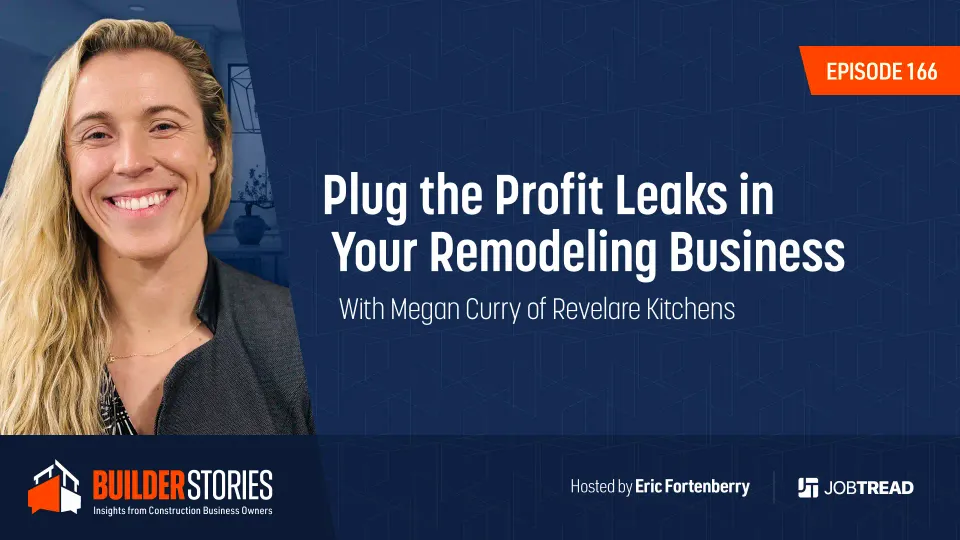

Megan Curry jokes that she’s the “general janitor” of Revelare Kitchens, where she leads about 150 employees across 11 states. She breaks down the seven operations KPIs she relies on to keep her installs on schedule and cash flowing. She also reveals the simple equation that fuels a high-energy culture, where wins get celebrated and rising stars get an early shot at leadership. And finally, Megan gets candid about a software launch that fell flat on its face and what was done right the second time.
In this episode you will learn:
- The money leak hiding in your project manager’s schedule
- Why she’d rather compete in a make market than a take market
- Her 60 to 80% rule for promoting people into leadership
- The single practice that got subcontractors to work inside her software
- How she turned a failed software rollout into full team buy-in
Resources:
Hear the full conversation on Builder Stories. Learn more about Megan and Revelare Kitchens here.
Eric Fortenberry: [00:00:00] Welcome to the podcast where we take a deep dive into the stories behind construction business leaders. We will share how they got started, how they found success, and the lessons learned along the way. I’m your host, Eric Fortenberry. Welcome to Builder Stories
Eric Fortenberry: Welcome back everybody. Today I’ve got a very special guest with one of the fastest growing companies. We’ve got Megan Curry. She is the general manager of Revelaire Kitchens. They are based in York, Pennsylvania. Really excited to have you on the show, Megan. Welcome to Builder Stories.
Megan Curry: Thank you, Eric. I’m happy to be here.
Eric Fortenberry: Well, why don’t you open us up, give us a little bit of background on, on who you are, how you got into construction. You know, what, what does, what does your business do?
Megan Curry: Yeah, no, thank you. So, um- Reveler Kitchens, myself, um, I am third generation, uh, in the home improvement industry. So, uh, o- I’ll say I stumbled into it.
Megan Curry: I think a lot of people, um, always say there’s, like, three paths to get into home improvements. In my experience, you are either really good [00:01:00] at sales, uh, selling for somebody else, decided to open your own business, uh, really good at installing the product, so wanted to work for yourself, or you got sucked in by family.
Megan Curry: So I f- I fall into the third category. Uh, tried to escape it. Um, I have worked with, um, my father for about 17 years. 17 very long years. Um, we’ve had some on and off. Uh, my background’s in accounting. Um, so I went and did that for a while. Um, but home improvement is hard to get out of. It’s a, it’s, it’s a really, really unique, fun industry.
Megan Curry: It’s like, uh, it’s one of the, in my opinion, one of the best-kept secrets in terms of success and wealth management out there. Um, so happy to always talk about that. But, um, we started Reveler Kitchens almost 20 years ago, um, be 20 years in, in February, and, uh, started as a small in-home sales company in South Central Pennsylvania.
Megan Curry: Um, think like Amish country. Um, so nothing fancy about it, [00:02:00] uh, going door to door, selling different kinds of products. So we’ve done everything from roofing, windows, siding, bathrooms, um, and then somehow stumbled into kitchens, um, about 17 years ago, and we’ve done that ever since. It’s been our core competency.
Megan Curry: Um, we’ve been able to grow the business, um, throughout the Northeast. We cover 11 states today, um, from Virginia all the way up to Maine. Um, have about six, seven different branch offices. And, um, and so I’ve done everything from start to finish. I’ve cut my teeth in the call center, scheduling appointments, talking to homeowners and running leads, selling the product, um, installing it, and, um, and a lot of my background has been in the operations side of the business.
Megan Curry: It’s where I, I enjoy, um, working through problem resolution, uh, learning all... everything I’ve learned the hard way, um, over the years. Uh, hopefully sometimes I learn it through other people’s hard ways and not my own, [00:03:00] um, but certainly stumbled through a lot of my own mistakes to get so-- to where we are today.
Megan Curry: Um, so a lot of project management, um, operations management, director of operations, and, um, and today I sit in the general manager seat, and depending on, on what day it is, I call myself the general janitor ’cause there’s, there’s always a lot of stuff to clean up, um, with what we do in this industry. But it’s, it’s fun.
Megan Curry: Um, it’s, it’s been a wild ride and, um, and like I said, I just l- love the home improvement industry and what we do and, um, keep on doing it.
Eric Fortenberry: That’s awesome. What a, what a, what a great story there. I mean, you know, third, third generation. So, you know, I, I gotta say, I, I feel like a lot of times, you know, the, those, those future generations, they kinda come in and they, and they look back and think, “Man, like, they were doing it all wrong,” wanting to-
Eric Fortenberry: reinvent the wheel. You know, so, so what’s it been like for, for you? I mean, you, you know, you’ve been working alongside your dad now for a while. Yeah. You know, how, how has that been, just you, you and your father being able to work together?
Megan Curry: Yeah, so it’s, it’s funny, um, that you say that because I would say, um [00:04:00] I definitely was full of a lot of, um, oh, we’ll call it, to, to keep it kosher, like idealism, um, when I first started working with him, and like, “We should be doing this, and we should be doing that, and you’re doing it all wrong.”
Megan Curry: And, um, he would just kinda shake his head at me and like, “You, you don’t know anything, kid.” Um, but he, he always gave me a lot of grace to, uh, to go fail, and I always call it, like failing forward. Um, and there’s been a lot of evolution, right, um, in, in terms of the industry, um, specifically just over the last 10 years, uh, with technology and, uh, with what we do.
Megan Curry: But, um, I will tell you, I’ve always come back, I c- come back full circle. Um, I think I have a very old-school way of, um, I’ve leaned into that, um, where there’s a lot of value to just getting back to basics. Um, you always wanna have your unique selling propositions and your advantages over your competitors.
Megan Curry: Um, I think that’s a, a big miss for a lot of contractors. They get stuck in just kind of the ebbs and flows of [00:05:00] doing the work, and it’s just the next job and day over day, and, and how do we make ourselves more unique? So I think always trying to evolve into that. Um, and then, and, and that component is, is just being really creative and really unique on, on a couple different fronts because we all have a product, right?
Megan Curry: We all ... You, if you sell roofs, there’s, there’s a few colors, uh, there’s a few different variations of it, so how do you make yourself more unique than, than the other chuck in a truck kinda contractor out there? Um, but there’s so much to get back to basics. Um, so being third generation has been interesting.
Megan Curry: We’ve, we’ve tussled with one another plenty over the years. We still do. Yeah. Um, but, but I think it all comes back to, um, I’ll admit it that he w- he’s right most of the time. Um, so I just try to, I try to be a really good, um, I’ll call it just like ... I n- I never wanna invent a good, reinvent a good wheel, and I think there’s a lot of really good wheels out there.
Megan Curry: I think there’s a lot of really good people, like even on, on this show, um, that, that pop in with just different [00:06:00] ideas that can kinda stimulate our thinking, um, to, to how do we not all necessarily do the same thing, but how do we go above and beyond and, and grow our businesses by delivering excellent experiences?
Megan Curry: Um, but it really does come back to the basics, and then- Yeah ... um, continuing to adapt with, like an ever-changing technological environment, um, as well as the consumers and how they adapt and respond to all of those things as well.
Eric Fortenberry: Yeah. Well, it’s, uh, you know, so, so my dad is, he was, he’s been the first, he’s the first person I hired at my last company and one of the first people here.
Eric Fortenberry: He was, he’s my CFO. He’s, he’s no longer, uh, we, we, we had a, our controller kinda came in and ended up, you know, promoting him into the CFO role. So we, we don’t know what to call my dad now. We call him maybe CFO Emeritus or- ... or our senior advisor. I mean, he, he’s still, he’s, he’s on the leadership team, and he comes in every once in a while to our leadership meetings.
Eric Fortenberry: But, you know, I, I do, I do know from, you know, again, the past, like 20 years You know, it’s, it’s such a blessing being able to- Mm-hmm ... to work with my dad and to have been able to build that professional relationship with him. Yeah. And, you know, I know when, when, when you can [00:07:00] make it work, it’s, it really is just- It’s a lot of fun
Eric Fortenberry: such s- Yeah ... such a great, great thing. Yeah. And, you know, to, to have... You know, I think him and I have done a really good job bringing that family culture feel- Mm-hmm ... to, to the company too. So- Yeah ... it’s, uh, you know, it’s, it’s something that just, you know... Pe- people used to ask me, “What’s it like?” And it’s like, “Well, 80% of the time it’s great.
Eric Fortenberry: 20% of the time- ... we’re, we’re going at each other’s jugulars.” Like-
Megan Curry: Yeah ... it’s, it’s, it’s- Yeah, Thanksgiving is always really interesting, but ... but other than that, it’s, it’s fun. Yeah. And it’s fun when... I get that question a lot, Eric, um, where people are like, “I have a, a daughter or a son that I really want to work in the business.
Megan Curry: How do I, how do I get them interested?” And it’s interesting, maybe you can relate to it too, that- You don’t, just don’t push it. Yeah. Um, because the second you force it, then it’s not an 80/20. Um, but when, when it just happens naturally and you’re both passionate about what you do, and you want, you want the same thing at the end of the day- Yeah
Megan Curry: um, it’s a really fun environment, um, to, to be successful together and to have that, that relationship that, um, just [00:08:00] results in, in actionable items. It’s, it’s really- Yeah ... a, a cool thing.
Eric Fortenberry: How, how do you think... Like, how have you been able to build your own credibility with the team sort of separate from him?
Eric Fortenberry: Because I know a lot of times, you know, your, your parents there, they can sort of overshadow, you know, a, a, a child. So like how- Yeah ... how have you been able to kind of create your own, your, your own, uh, you know, credibility there?
Megan Curry: Yeah. Um, it’s been unique. Um, you know, I d- don’t often talk about it, but I’m actually one of six, and none of my siblings work in the family business.
Megan Curry: Um, I don’t know, they don’t even know what we do, um, I’m pretty sure. Um, but we, um, we try to keep it really, um, on a level where people, especially new people coming in, don’t even know that we’re related. Um, so one of the things that very early on in my career, just a lot of pride, a lot of ego like, like we all have in this industry.
Megan Curry: Um, and I never wanted it to look like I got handed something. Yeah. So I just, um, my way of managing it, um, and leading is just to b- be [00:09:00] by example. Um, so I’m always gonna roll up my sleeves and get in with the team. Um, you know, I’m not afraid to, to get into the call center and schedule an appointment with, with a call center rep, um, and make a connection with them or deal with a problem customer, um, with some of my project managers if, if they need help with it.
Megan Curry: And my job at this point is to support them, but I can only support them by making sure that I also know how to do their job. Um, and I think that was always really, really valuable to me in terms of... And I think that’s for any leader, um, whether or not like you’re related to ownership or not, is when you’re leading and building teams, you can’t do that effectively unless they respect you, and the only way they’re going to respect you is if you do it with them.
Megan Curry: Um, they can’t feel like they’re alone in it, you know? So that’s the way that I’ve, you know, tried to navigate it over the years. It’s worked for me. Um, I have a really strict policy that if somebody says, “Your dad-“ I just give him a head shake and absolutely not. His name is Mark. And that, and that’s what we’re gonna [00:10:00] call him so, um.
Megan Curry: So yeah, just try to get in and work along. And
Eric Fortenberry: people have, I, I’ve always, uh, referred to my dad as Don as well, and, uh- Yeah ... you know, it’s, I, I don’t know, it always felt weird to introduce someone as, “Oh, yeah, it’s my dad.” Like, no, you know- Yeah, yeah ... it’s Don. Uh, we, we do have the same last name in case you’re wondering.
Eric Fortenberry: But, you know, uh, you know, I, I, I think though I’ve, I’ve certainly seen that, that trend and, you know, it seems to be, you know, the, the most successful leaders that I’ve talked to are the ones who, they, they roll up their sleeves. They, they want to be down there alongside their team- Yeah ... you know, willing to do anything that, that, that you would ask them to do, you’ve already done.
Eric Fortenberry: You know- Mm-hmm ... might, might not be the best use of, of our time- Yeah ... as, as leaders, but, you know, I think that is, is a great way to earn our team’s respect is when they see that, you know, again, n- nothing- Yeah ... you know, is, is, is, is above us. You know, we, we are willing to, to do the work just like everybody else.
Eric Fortenberry: And, and, and- Yeah ... so it sounds like you’ve, you’ve embodied that as well.
Megan Curry: Yeah. Yeah, never ask them to do something you wouldn’t do yourself, you know? Yeah. Um, and, uh, if it, and if, if you ask yourself that question, “Am I asking them to do something that I [00:11:00] wouldn’t do?” Then you’re probably asking them the wrong thing, or-
Eric Fortenberry: Yeah
Megan Curry: you need to get in and do it and lean into that discomfort.
Eric Fortenberry: Yeah. So I’m curious, you know, R- Revelere, you, you guys cover a lot of geographic territory. I mean, you said, like, 11 states. I mean, that’s- Mm-hmm ... that’s, that’s extremely impressive. H- how do you think about growth? I mean, you know, are, are you, are you focused on, you know, continuing to add, you know, new markets?
Eric Fortenberry: I mean, you know, o- obviously, the, you know, the k- the, the name is, you know, Revelere Kitchens, but I, I know you do more than just kitchens. Like, when, when do you look at adding, you know, new, new products and services? Like, h- h- how do you, how do you sort of navigate that?
Megan Curry: It’s a good question. Um, I like to fish where the fish are.
Megan Curry: Um, so I’m ve- very predictable with that kind of stuff. Um- With my background in accounting, I tend to be a little, um, I love, like, a fin-op plan. Um, I love to just take a look at a market and see, like, hey, what does, uh ... Let me, let me run through the, the advertising. What does it look like in terms of, um, of lead flow?
Megan Curry: Um, talent pool is a [00:12:00] huge, huge thing. Uh, we operate in a lot of very tertiary markets as well, so that can be difficult. Um, you know, like, I always say, like, in Vermont there’s, there’s a lot more, like, Maine, New Hampshire, there’s more moose than people it feels like sometimes. So, um, so we always take a look at what does that marketing flow look like and what’s the competition in that area look like?
Megan Curry: Um, and, um, so when we’re expanding into an, a new territory, um, that’s the first thing is marketing and lead flow. And then, and quite simply then the second t- thing is to make the investment, not just with the marketing, it’s with the people. So on the back end of things, uh, before I even hire a sales manager, I might hire a few salespeople, um, but I’m gonna hire a project manager, and I’m gonna get them onboarded and make sure that they’re comfortable with all of our systems and, and processes, and then can service the customers that we have there.
Megan Curry: Um, I don’t wanna go into a market and just go sell the crap out of a new product and then not be able to service it, right? So, um, so we’re always looking at that kind of [00:13:00] model in summary. But we- we’ve been able to develop a good, like, branch in a box kind of model. Um, so we have, like, what we, we define as, like, an A, A branch, a B branch, a C branch.
Megan Curry: Um, there’s different P&L models, uh, that go along with that, so we’re looking at different, different, um, profitability metrics. Um, I’m not a believer that you have to go in as a loss leader and not make any money. You might make a little bit less money than, than what you’re expecting in, uh, in some of your more mature markets, but, um, but how do we go in and, and dedicate to that success?
Megan Curry: Um, the products is, uh, that’s an interesting line too, you know I’ll go back to kind of what I said earlier. Um, I don’t-- I just never wanna be a dime a dozen in a market. So we, we do a lot of bathroom remodeling. Um, there’s, there’s not a lot of kitchen companies that operate the way that we do, um, which has been a big part of our success.
Megan Curry: Uh, there’s not a lot of in-home sales kitchen companies. There’s a lot of showrooms. They wait for the customers c- to come to them. Um, I always call that like a take [00:14:00] market. I wanna be in a make market. I wanna be able to go, um, make my success somewhere, and, uh, I’ll wake up and, and bet on myself any day.
Megan Curry: And I know, again, just a lot of contractors are like that. Um, but being able to identify, hey, if I’m gonna go in, especially like with, uh, with bathrooms or, um, a lot of window contractors deal with the same thing. Um, there’s three dozen other window companies in this market. How do, how do I differentiate myself from the rest of them?
Megan Curry: Um, and it’s, it’s all fun and games. I like to network, I like to be social about it and, and see what everybody else is doing, but I also always wanna have that competitive edge. And a lot of that just has to do with, with handling customers and customer service. You know, one of the things that we’ve been really big on when we’re, um, either growing an existing market of ours right now or we’re looking to get into another market, um, is first of all, AI is like at our fingertips, right?
Megan Curry: So just like doing market research on that, uh, one of the things that we’ll do is like what is [00:15:00] the biggest pain point for consumers in this area? Um, and I always encourage anybody to just do this on, on their own business, evaluate it, because what, what we get back from that research, which is more accessible to us today than it ever has been before, um, is not what sometimes we’re, we’re sitting in our little offices and meeting rooms talking about, right?
Megan Curry: We’re like, “Well, what if we added this color? Or what if we changed our warranty?” Or, um, anything like that, right? Customers care about disruption in, in construction. They don’t wanna be, um, without whatever you’re selling them for an extended period of time. They want it fast. Um, and they just want a, a good, comfortable, confident decision.
Megan Curry: I think most of us think that, oh, we need to be cheap, um, and we need to have like a cooler warranty or, or something that can kill our competition with, uh, with the product itself. Customers and consumers are less concerned about the product and the price. They’re more concerned [00:16:00] about how do you make me feel, um, today more than ever before, which is, is really unique.
Megan Curry: Um, and I think a lot of times we’re getting that wrong, where we’re trying to like cut the competition with price, cut them with warranties. Um, but look, like w- we sell windows, for example. Somebody else’s window, it, it goes up and down. You know? It opens and closes. It cleans the same way. So how can I be different in terms of appealing to the, to the emotional side of, um, of this construction project that I’m doing?
Megan Curry: So we do a lot of that, which is, uh, I, I don’t think is as common as it should be, um, currently. So, um, so just looking at, at some of those kind of ancillary little items that, um We forget about, ’cause it’s not necessarily on our P&L, but that’s what the customer con-con- is concerned about, and that’s where their buying patterns are coming from as well.
Eric Fortenberry: Sure. I mean, you know, again, y-y-you’re, you all are able to deliver these, these quick turn projects. I mean, what, what do you think, you know, what, what are the most, you know, important, [00:17:00] you know, factors at, at play here that have enabled you to do that so successfully and, and, and especially in new markets where you may not have an established, you know- Yeah
Eric Fortenberry: bench of, of, of, of trades and subcontractors. I mean, how, how- Yeah ... how have you been able to maintain that, that high quality and, and, and the customer service, you know, when, when, when you, you know, you may not have been there for a while- Yeah ... and you might not even have a home base there?
Megan Curry: Yeah, um, and that’s the challenge.
Megan Curry: I think that, that, that gives a lot of people cold feet when they’re looking to expand their business and to, um, look, like even if, if you’re in a market where you’re like, “Hey, there’s a, there’s a, a good city or a good town, like an hour and a half, 90 minutes away, two hours away, but I can’t service that super well.”
Megan Curry: Um, and I’m gonna go back to people. People and technology are, are my two things. Um, even though we’re all construction companies, um, I often talk to my team. I’ll, I’ll just like walk around the office and be like, “What are we in the business of? What are we in the business of?” And they’re like, “Well, construction, Megan.”
Megan Curry: And I’m like, “Wrong. We’re in the people business, and it’s [00:18:00] external and it’s internal.” And, um, so I spend a lot of time on how can I service externally my customers to be happy, and I find that it’s making sure that my people internally are also happy. Um, so I can do that through a couple different mediums.
Megan Curry: Uh, one is making sure that they have all of the tools and the resources available to them, so all of the technology to make their job easier, um, organized, more structured, um, more process-driven. Instead of ve- being a little, uh, reactive, I, I always wanna be proactive. Um, the second thing is I think that, uh, we don’t spend enough time in this industry being really good at recruiting, so that’s where I, I always say, like, “We’re a talent company.”
Megan Curry: So we’re a training organization every day. Um, so internally, I wanna go and I wanna find really good people. Um, I want my managers to be really good interviewers. I want them to, to find people that, that also wanna deliver really excellent services. Um, and then just validating that internally as well, making sure that they’re, they’re [00:19:00] growing, they’re being rewarded.
Megan Curry: We’re, we’re high-fiving on the successes. We’re making sure the KPIs are really, really clearly communicated, and when they’re not hitting them, we’re working with them, um, and that they feel that they can also be a part of that growth. Um, there were, a couple years ago, um, you know, I, I worked with some of our team internally because it just felt like we had plateaued to a point where we were doing fine, um, sales weren’t going backwards, but they n- weren’t necessarily growing at a rate that, that we were happy with.
Megan Curry: And what we identified was that we were just Really, really kind of incompetent, quite frankly, at, at developing mid-level managers and mid-level leadership. I was like, “There’s just no way that on our team nobody exists, um, that we can promote.” And what I found was that some of my leaders at the time were like, “Yeah, well, this, this, this guy is good,” or, “This girl is good, but they’re, but they’re not there yet,” you know?
Megan Curry: And I was like, “Forget about it. Just give them the opportunity.” Um, so I always try to [00:20:00] follow, like, the, like, 60 to 80% rule with, with promoting people. Um, just give them an opportunity. And, um, worst that could happen, and again, I said it earlier, we fail forward a little bit. Um, but if, if you can promote people, it’s amazing what they do with just that additional responsibility, that pride in what they do, um, and then being able to back them up and support them.
Megan Curry: Um, it buys us time as, as executive leaders to then find the real estate and reinvest in the marketing and, and go through that. So I was really amazed when we, we grew into a couple different markets, Eric, um, a, a few years ago, and We just relocated some people temporarily. It was like, “You know what? Are, are you willing to go and, like, live in an Airbnb for like three months and jumpstart this market?”
Megan Curry: And people were like, “Yeah, I’d love to do that. I wanna grow my career.” And, um, instead of me going to try to find a new person that didn’t really know the business, didn’t know the industry, um, and, and you might think like, “Oh, well, that- that’s expensive, right?” Well, so is hiring somebody [00:21:00] and h- keeping them around for 90 days, and then they don’t last.
Megan Curry: You take that money, you reinvest it into an Airbnb and getting this person into the market and giving them an opportunity, and it, it’s been really amazing to see how, um, how willing and able, um, people are to do that. I also find with people, I could talk about this forever, but, um, especially in the construction industry, it’s so much fun because you don’t need any crazy qualifications to be good at this.
Megan Curry: Um, there’s... It’s just people with grit and, and gut-wrenching determination. I’ll take that over, you know, 30 years of, of management experience, you know, sitting behind a desk. So I think it’s identifying people that you’d otherwise look past, um, and just saying, “Hey, I have this opportunity. What do you, what do you think about it?”
Megan Curry: And their response will tell you everything, you know. Sometimes they’ll say no, they’re not interested, and then you, you have all you need to know. But if they’re willing to bet on themselves, then you should bet on them, too.
Eric Fortenberry: Yeah. No, that’s, uh, that’s absolutely, uh, our, our belief as well is you gotta find the right people who, you know, [00:22:00] truly have the potential to be great.
Eric Fortenberry: You know, that, that, that drive, determination- Yeah ... I mean, really smart, hardworking. You know, that can, can, can often be more valuable than, you know, decades of experience.
Megan Curry: Yes.
Eric Fortenberry: You know? It’s, it’s- Yeah ... it’s, it’s, it’s so important to find those right people. I’m curious, so, you know, I, I gotta believe and, and, and my, my guess would be that you’re, you’re leveraging a lot of, you know, trade partners, subcontractors.
Eric Fortenberry: I mean, how, how, how many, you know, employees do y’all have, and how do you sort of... You know, what, what are their roles, and then what do you, what do you sub out?
Megan Curry: Yeah. So we, um... I’ll, I’ll st- I’ll kind of reverse the, the answer a little bit. We sub out all of our, our work, um, the, the installation components.
Megan Curry: Um, so we are, um, I think like a lot of contractors, home improvement contractors, I think there’s a good blend of, um, who uses contractors versus employees. We sub out 100% of it. Um, but when we do that, um, we don’t just work with random subs. They, they go through the same kind of interview process and, um- [00:23:00] We really, really vet them, and then they go through a certification program with us.
Megan Curry: Um, so we spent the time, um, I pulled myself out of, like, working in the business, and I wanted to work on it and say, “How do I make sure that my subs are an extension of me,” um, in a sense. So we, we put them through a certification program, um, where they become Revelaire certified, and then they have to keep up with those certifications.
Megan Curry: There are certain, um, level of, of craftsmanship and cleanliness and communication and professionalism standards that we uphold them to, and they, they hold themselves to, um, to continue to, to get work with us and through us. So, um, today we’ve got probably, I’m gonna say about 50 or 60, um, subs that we use on a, on a, a good regular basis that work with us and partner with us there.
Megan Curry: Um, and then the rest of our staff, all of our marketing staff, uh, sales designers, um, admin, project managers, they’re all employees, and we’ve got probably close to [00:24:00] 150 of them, um, at this point. So- Wow ... taking care of, of all of them constantly as well.
Eric Fortenberry: That’s, uh, that’s, that’s quite the team. I mean, it’s, uh, I gotta imagine that’s gotta be difficult to keep up with that, that large of a team that’s, that’s also spread out.
Eric Fortenberry: I mean, I assume- Mm-hmm ... you know, the, a lot of them are kind of in the individual markets- Yeah ... versus-
Megan Curry: Yes ...
Eric Fortenberry: you know, in your, in your back office- Yeah ... or kind of your home office in Pennsylvania. H- what, what have you centralized, you know, in York versus what is out in the, in, in the, in the local markets?
Megan Curry: Yeah. Good question. So, um- We centralize all of our, um, marketing, um, all of our call center scheduling. We centralize all of our, like, administration, finance, um, bookkeeping, human resources, um, all of that. And then what’s decentralized is, um, the boots on the ground, um, our, our sales designers that are gonna be in homes, our measure technicians that are gonna be in homes, our installers [00:25:00] that are gonna be in the homes, and then our project management staff, super important to be face to face with the customers as well.
Megan Curry: So, um, job coordinators in our warehouses. So when we go into a new market, so like the-- with those B and C branches, you know, a lot of times we’ll go in, and we’ll just u-utilize lease, like a 3PL, third-party logistics company space for warehousing. Um, then we might like graduate up to like a small warehouse, small office.
Megan Curry: We, we have a thing internally where we’ll just like go get that warehouse space, and we’ll just like build this shoddy office that’s just enough to like get together, meet, you know, um, weekly with our, our local sales team or something. Um, but it-- there’s nothing glamorous about it. Um, it just gets the job done.
Megan Curry: And, um, and what’s important to us then is that we bring everybody together a few times a year. So we try to, um, as an entire organization, we will centralize everybody, usually regularly twice a year, bring them all together and celebrate them, um, in different kinda ways. We’ll take them to baseball games.
Megan Curry: We’ll do a big holiday banquet, do a big [00:26:00] company picnic. Um, but then throughout the rest of the year, it’s so important because we cover all of these different markets to make sure that they feel a part of us. So we’re constantly running, you know, like up in New England, it’s too easy for them with all the New England Patriots fans, right?
Megan Curry: So it’s just running promotions where they can... if they, if they perform at a certain level, they get to go to a Patriots game with, with the branch sales manager or something. Um, so doing that type of stuff and investing into the culture, um, is super important, especially in today’s day and age. Um, there’s a lot of jobs out there, and, and you have to, to dance that, that fine line between the Where technology can disconnect us a little bit.
Megan Curry: It’s so great and useful that we can, you know, talk to each other over different CRM systems or Slack or anything like that, Microsoft Teams. But to, to really, like, spend time with one another, um, I make it a point with all my executive leadership too, that we have to go out to those branches, we have to meet with them, take them to dinner, hang out with them.
Megan Curry: Yeah. That is, uh... it sounds like [00:27:00] sometimes, “Oh, that’s, like, a waste of my time,” right? Uh, I didn’t work on the business. But when you work on your people, you work on the business. Um, so it’s, it’s all that, those soft touches involved there. Yeah.
Eric Fortenberry: No, I, I lo- I love that. I love the, uh, the incentive to, to get to go to the Patriots game.
Eric Fortenberry: We- ... we actually just got a, uh... when, when we, we, we were ranked, uh, 155th on the Inc. 5000, and kind of as a reward to the team, we, we got a suite, um, where we have season tickets to the, to the Mavericks and the Stars. That’s
Megan Curry: awesome.
Eric Fortenberry: Yeah. And so, you know, it’s, it’s my, my goal, and, and this is kind of our first season doing it, but my goal is to get, kind of get everyone out there at least once.
Eric Fortenberry: Yeah. And then we want to be able to use it to, like, you know, let people kind of invite their families- Yeah. It’s huge ... so we can get to know them as well. You know, as well as, like, an incentive, you know- Yeah ... the top performers, you know, get, get more games, things like that. But, you know, I, I, I, I couldn’t agree more.
Eric Fortenberry: I mean, I think it’s so important that you invest in the culture and- Mm-hmm ... and, and sometimes that is just spending time with your team. You know, it’s- Yeah ... it’s easy to... everybody’s kind of running a million miles an hour, and we get really laser focused on our, our day-to-day- Yep ... but it’s like you gotta take that, that step back and just remember we’re all here, we’re all a team.
Eric Fortenberry: Let’s, [00:28:00] let’s, let’s- Yeah ... let’s build that relationship and that camaraderie, ’cause ultimately it’s, it’s your people that will, will drive your success.
Megan Curry: Yeah. A happy team creates happy customers. It’s- Yeah ... it’s a very simple math equation.
Eric Fortenberry: Yeah. So I wanna, I wanna... I’m curious to, to, to talk about, you know, again, your, your, your systems, your software.
Eric Fortenberry: I mean, to, to, to be managing this business across, you know, s- so much, you know, area and so many states here. I mean, like, what, what, you know, what, what brought you all to, to JobTread, and, and how did you start, you know, using JobTread? What, what was it, you know, what was it like when- Yeah ... when, when you first launched it?
Megan Curry: We have a, a great story, um, with that. So, um, and I’ll tell you, I was, uh... I threw a fit. Um- And I’ve... I’m a convert now, obviously, as I sit here. But, um, what happened was I had, um... obviously operating through a lot of different markets, our, our systems are super important. Um, so one of the things that’s centralized is our customer care.
Megan Curry: So super important that if they’re getting a call in Pennsylvania from somebody in [00:29:00] Albany, New York, they need to be able to pull up that customer and figure out exactly where somebody left off with them. When were they last contacted? What, what’s going on with this? Um, making sure that, that everything’s there.
Megan Curry: Um, so what had happened, uh, with us was that the previous, uh, CRM system that we were using, um, it wasn’t bad, you know, um, but it, um- It was a little too messy and chaotic, I would say. Um, so I had an operations manager that came in. He had been here for just about like six months, and he was like, “I found this really cool system, JobTread, and it’s gonna, it’s gonna clean everything up for us and, um, hit on a lot of the pain points that, you know, when, when a customer calls in, we don’t know when somebody talked to them last, or the notes aren’t updated or anything like that.
Megan Curry: Um, it’s, it’s gonna fix everything.” And I said, “All right, cool. Uh, go do it, you know. If as long as the team is bought in, let’s, let’s go get it done.” So we make this transition to, to JobTread, um, and we [00:30:00] fell flat on our face, uh, for a couple reasons. One, uh, it was my mistake as, as the leader. Um, I did not clearly communicate when you do transition systems, what optics I do have, you need to make sure that I continue to have in the new software.
Megan Curry: That was the number one thing. The second was the team buy-in. So what our ops manager did at the time was he loved JobTread. He had done the demos, he had met with the team, he believed in it. But he didn’t necessarily, uh, convey all of that and get the buy-in from the rest of our team. So like overnight, they just flip a switch.
Megan Curry: And it, it didn’t-- it wasn’t-- it’s not that it’s JobTread. It could’ve been any system, um, where if, if you don’t transition that, you don’t get that team support, that team buy-in, then it’s like the natives become restless, you know? And then the, the in- the inmates start running the insane asylum. So what happened is everybody just revolted and, um, and then we had less visibility and less optics.
Megan Curry: And, um, as we dug through [00:31:00] it, we had to roll it back and then relaunch it. Um, so as we relaunched it, which is super important, I think, in any organization. From a leadership level, we wanna make sure that, um, that we have what we need, but we sometimes don’t consider what does our team need to be successful.
Megan Curry: And one of the big components when we’re t-- when anybody’s transitioning software, um, that I think always needs to be thought of is, how do I make this disruption as little as possible, so it doesn’t feel like a disruption to my team and to my customers? And, um, so what we did, um, as we rolled it back Is just got in, what w- met with everybody.
Megan Curry: What is it that you want? What is it that you need to be successful? And then get the whole team’s buy-in on, all right, here’s what they want. Now let’s show them this system, have them play with it a little bit. Have them just, you know, absolutely tear it apart and say, “Well, what about this, and what about that?”
Megan Curry: And, uh, put it through the ringer. And what was really cool about working with JobTread, we, we had a, a really, really supportive account manager, [00:32:00] bless her heart, I think we drove her nuts, um, but answered everything. It was like, “Well, yeah, we have, we have something for that too.” Or, “Well, yeah, this is right here.”
Megan Curry: Um, you know, and, and instead of just pointing us to, like, another video and take a look at this, it was very hands-on, uh, because we were clearly struggling with being able to, to launch it and implement it. Um, and so, you know, in, in hindsight, there’s like a list of dos and don’ts, uh, when we’re launching something.
Megan Curry: And, and here’s what I don’t regret about it though. I think a lot of times companies, and, and we’re the same way, the-- they won’t take action on transitioning to that new software, that new technology because it is such a task. Um, and it, it looks really daunting. Um, and again, to, to JobTread’s credit, one of the things that you guys do so well is we’ll, we’ll work with you to make it as seamless as possible or not as daunting as possible.
Megan Curry: And, and once you get everything in here, all of the integrations that come from it that can connect to your other systems, your other software, um, we’ve [00:33:00] built out dashboards and command centers and customer portals and, and all of that stuff, um, that has made it, um, vastly ... We were able to basically cut out like three or four other systems that we ended up having, um, that we didn’t plan on cutting out, but because JobTread does have all of these other factors that, um, make all of that other stuff really obsolete for us.
Megan Curry: Um, so it took us, it took us a while. It took us probably, I would tell you in all transparency, six months, but very self-inflicted. Um it did not have to take that long, um, to just get everybody up and running on the system. And now it’s been It’s been so cool because we’ve been able to, to, um, bring our, our subs into it.
Megan Curry: We’ve been able to bring our vendors into it. Um, it’s so easy to just tag the next person in it, um, and, and keep that ball moving. Um, the customers love it because they can easily log in and have access to all of their information, communicate through, you know, like a customer portal right back at us, um, and just [00:34:00] have everything in one place.
Megan Curry: And I will tell you, I worked in this industry for a very long time, so I do not say this lightly. There are not a lot of CRMs that, um, offer all of those things in one place, um, right off, off the shelf, kind of. Um, so it’s, it’s... We’re in a good spot with it now. We do have all of our visibility and our KPIs in, in place, and, and most importantly, the staff is happy with it and the customers are happy with it.
Eric Fortenberry: That’s awesome. Lo- love, love hearing that. I’m curious, you know, uh, obviously it’s, it’s sometimes can be a lot easier to, to get it implemented with your, your internal teams.
Megan Curry: Mm-hmm.
Eric Fortenberry: You know, what did you do with, you know, to, to get your, to get your subcontractors, your vendors? I mean, like, w- was there anything special that you did to get them launched and kinda get them up to speed?
Megan Curry: Yeah, so that’s a, that’s a fun topic because, um, anybody that works in this industry knows that, um, those subcontractors, those vendors, they, they have a lot of pride. Um- ... it’s, they’re their own companies, and they don’t, you know, they’re not always the most [00:35:00] technologically friendly. Um, you know, sometimes I look at, like, before and after pictures of a job and I’m like, “What, when, what’s the latest iPhone that you have?”
Megan Curry: You know? Yeah. Like, does, does it have a camera? ’Cause that is crazy. So, um, so one of the things that we did is, um, we needed to, to sell the benefits to them. And, um- I always go straight for the pocket. Um, I... People are money motivated, right? So, um, so one of the big benefits for us was that instead of having to do all of this additional work, emailing in, you know, invoices or completion paperwork or photos, we can get you access to this system where you just, instead of going through your seven different steps that I know that you’ve been doing for 30 years and you’re very, very comfortable with it, but now I can just have one step for you.
Megan Curry: And, um, so it was very [00:36:00] hands-on. A lot of our project managers had to, you know, really sit down, quite frankly, one on one with some of our installers and, and vendors to, to go through it. But the pitch to them was, “We can get you paid faster.” Um, as, as partnering with us, we are very proud that, you know, we can turn your pay quick anyway, but I can get you paid even faster because the system is so seamless.
Megan Curry: So, um, so we gave them a little bit of a grace period. Um, but then I tend to be a little ruthless with it, where it’s like, “I’m no longer accepting, you know, invoices or pictures or completion paperwork in this form anymore. It needs to be in here.” And, um, I will tell you they all love it now because it’s so easy for them to just communicate back, report, and they have visibility and access to information that instead of going to call somebody and wait for them to have time to send it to them, they can just log in and, and take a look at it.
Megan Curry: Yeah. So it was really how to h- what are the benefits to them. Um, and I am really big on that with, uh, instead of just coming across with a hammer and saying, “This is how we do things now. If you wanna [00:37:00] work with us, this is the way it’s going to be,” give them the reason, give them the why, give them the benefits.
Megan Curry: Yeah. And, um, and the reality is, um, they, they probably made a better transition than, than our internal team did- ... to be honest, once they, they just understood, um, the mechanism behind it all.
Eric Fortenberry: Yeah. No, I think all, all that makes total sense. And, you know, again, I’ve, I’ve kind of heard similar stories before, and it’s, you know, it’s, it’s really about making sure everybody’s on the same page.
Megan Curry: Mm-hmm.
Eric Fortenberry: You know, you kind of go, you know, as, as a unit and as a team-
Megan Curry: Yeah ...
Eric Fortenberry: you know, implement, you know, uh, you know. Yeah, there’s, there’s always gonna be those people that you gotta sit down with, hold their hand. But, like- Yeah ... once you show them, you know... And, and, and I think again, when people really understand the why, they’re much more willing to, to, to learn something new- Mm-hmm
Eric Fortenberry: and to try doing something, you know, a little bit different than, than what they’ve been used to. And, and, and I think that can really- Yeah ... make, make a big impact.
Megan Curry: Yeah.
Eric Fortenberry: You know, you- For sure ... you, you mentioned, you know, KPIs and, you know, again, I, I gotta i- I gotta imagine, you know, managing this size, scale, you know, company, what, you know, what, what are, what are the key numbers that, that you follow and, [00:38:00] and use to, to, to take the temperature of the business?
Eric Fortenberry: And, and how often, how often are you tracking and, and checking your KPIs?
Megan Curry: Yeah. Um, every day is when I’m checking them. But, uh, what I really want is always my team. I wanna be a very predictable leader and a very predictable manager. Um, so If they, to make, to make it predictable, I need to define what those KPIs are for them, and then make sure that they have access to them, um, so that they know that I’m looking at them every day, which means they have to be looking at them every day so that they’re coming to me before I’m coming to them.
Megan Curry: And, um, some of those KPIs, I’ll talk just mostly on the, on the operations side. Um, I wanna know what, what our install projections are. I wanna know what that schedule looks like. What’s our capacity with all of our vendors currently in the system? Um, are we over capacity, or are we under capacity? Do we need to go find more people?
Megan Curry: And then how are we loading up that capacity? What, what’s our scheduled percentage? Um, I wanna turn jobs quickly, um, in [00:39:00] construction. When it’s sitting in our warehouses, it’s just money that has been paid out to vendors that we need to go collect on. So we’re always looking at, you know, our, our warehouse cycle times.
Megan Curry: How long is stuff sitting there before we’re getting back out to the customer? Um You know, our installs drive our cash flow in this business. Um, so, you know, on the front end of the business, a lot of the KPIs with our, our gross sales and our net sales and our marketing percent, super important. But at the end of the day, in operations, um, what we install is what we earn, and that’s what hits the bank and keeps the, the lights on this place, right?
Megan Curry: So, um, so we’re looking at installed revenue. We’re making sure our capacity can, can sustain, uh, what’s coming down the pipeline at us, looking at that pipeline constantly. Um, uh, we’re looking at the cycle times of how long has a customer, you know, been in this process with us. Um, I want to follow like a FIFO inventory system.
Megan Curry: If they’ve been in the pipeline for longer, first in, first out, let’s get them installed and get them taken care of. And then we look at our, our done [00:40:00] right the first time percentages. Um, you know, in our, our businesses, whether you do a lot of referral word of mouth marketing, or you do a lot of online social media marketing, um, your reputation is super key, and getting a job done correctly and quickly is, um, is vital.
Megan Curry: When we don’t get it done right the first time, it better get done right the second time, and it better get done right fast. So we’re looking- Yeah ... at all of those percentages and metrics, um, on a day-to-day basis. Um, kitchens are interesting because it’s about a three to five installation timeframe, three to five days.
Megan Curry: Um, so we’re not necessarily looking at that daily, more like on a weekly basis. But I think for a lot of contractors, you can look at that what’s hitting every single day, and I’m looking constantly at, at the next few days or the next few weeks, um, because if I’ve got a, a, a lull, a dead spot that’s coming up two or three weeks from now, that’s, that’s my cash flow.
Megan Curry: That’s how I’m, I’m paying everybody. So, um, so I always want to make sure that we are booking our, our schedule at, at a [00:41:00] close to 100%, um, and getting those customers taken care of and, and getting paid.
Eric Fortenberry: Yeah. That’s awesome. I’m curious when, when you think kind of just generally about, you know, remodelers, where, where do you think that a lot of them may be losing money without realizing it?
Megan Curry: There’s so many, so many, so many places. Um- In, in construction, um, there’s a lot of leaks, um, that could happen. So if we just, again, stay on, on the operations side of the business, um, I’ll go back to that kind of booked percentage with your schedule. The longer ... Or, or there’s, there’s certain days where you’re losing money and you don’t even realize it because your project manager is in charge of scheduling, and he or she does not know, um, or doesn’t have a defined key performance indicator or metric that they need to hit every single day, and they just got busy.
Megan Curry: You know, they got busy with something else, and [00:42:00] they ... Tomorrow’s not booked up. It’s no skin off their back, um, but it’s lost money for, for us as a business. So that’s one area, um, that I think leaks very easily. Um, and then remodeling’s crazy. Um, I always ... It’s Murphy’s Law, right? Whatever can happen, will happen, so a lot goes wrong.
Megan Curry: That’s why I like that done right the first time percentage, because when it’s not, it’s costing somebody money. And it’s, it’s usually us as businesses in some capacity, whether, um, say, say it was out of our control. The manufacturer sent something incorrectly. We weren’t able to get it done right the first time.
Megan Curry: But that customer doesn’t care that it was the manufacturer that-
Eric Fortenberry: Yeah ...
Megan Curry: messed up. Their contract’s with you. Um, and so we have to be really, really good at, at holding our vendors accountable, our subs accountable, um, because that customer’s not coming back and, and looking at the manufacturer and saying, “You know what?
Megan Curry: I think I should have a 10% discount.” They’re coming back to us and saying, “Hey, for this inconvenience, I’d like a discount for it.” So we leak money in, in remakes and reorders [00:43:00] and, and that done right the first time percentage all the time as construction companies. And, um, and the reality is that they’re pretty easy fixes.
Megan Curry: Um, it’s, it’s way easier, in my opinion, to fix that, um, because it’s quite literally just managing a, a relationship or, or getting better at, at accurate measurements, um, than trying to go fix a sales rep’s messed up head to- ... motivate them to sell some more business. Yeah. You know? So, um, so that’s a, a second area.
Megan Curry: Um, I’ll talk about this too in terms of leaking money. I don’t think everybody always charges enough. Um, maybe not what, what some consumers wanna hear, but, um, there’s always ... Having a really good dedicated pricing system that you’re just unrelenting in, um, and, and you offer that, that price because you know that the service that you offer is worth it.
Megan Curry: Um, I’m always really big on protecting our margins as an organization, um, with your cost of goods sold and, and charging, charging that price that you’re confident in. Yeah. Don’t undercut yourself, [00:44:00] uh, selves and, and sell yourself short with that at all. Um, and then, you know, some of the other areas in terms of, of just leaking money, um, is process.
Megan Curry: So, um, I always say that, that- A fail point stems from either a lack of an execution of a process, um, which is a people thing, or a lack of a well-defined process. Um, and so taking a look at our businesses and making sure that every area is kind of worked out like a machine. And I don’t-- I, I think that’s missed a lot of times because, again, we get in the weeds of just going to sell the next job, going to measure the next job, and, and just installing it.
Megan Curry: Yeah. But if you pull back the lens and say, “Okay, if I’m a customer, what would I want my customer journey to look like?” And you can just flowchart that out on a, on a whiteboard, for crying out loud, or the back of a, a bar napkin. Um, and you just define that process, and then you put fail-safes in it. You know, for example, one of the things that we do with kitchens, um, we send a measure tech out every single time, [00:45:00] um, not to just measure the job.
Megan Curry: That, that is a component. I love my sales reps. I don’t trust them down to the 32nd of an inch. But what my measure techs do that’s really important is they sit down with the customer, and they review the contract. We call it, like, a rental car agreement, and they have to initial everything all over again and say, “All right, this is the door I picked.
Megan Curry: I’m looking at it right now. This is the color I picked. I’m looking at it right now.” Uh, we have a line on there that’s like, “No other verbal representations will be accepted, you know, at this point in time.” So we, we talk, “Is there anything else that I didn’t cover with you? Did my salesperson say that I’m gonna, you know, install a birdhouse while I’m out here?”
Megan Curry: Any-anything crazy, um, to try to avoid any, um, I call them GOK factors. God only knows when we get out there, um- ... what that customer’s gonna say to us. So, so those processes, I think, are, are a- Yeah ... super important area to just tighten up and, and not leak money.
Eric Fortenberry: Yeah. No, I think, I think you’ve nailed it. Uh, you know, ano-another kind of, uh, interesting thing I’d, I’d love to get your perspective on, I mean, you know, the, the, the, the home improvement industry, you know, we’ve seen a lot [00:46:00] of private equity, you know, companies coming in.
Eric Fortenberry: These, these big PE firms are, are buying up, you know- Yeah ... family-owned businesses. You know, that it’s, it’s really happened a lot on the, on the exterior side. I mean, do, do you You know, d- it, it seems like though there’s, there hasn’t been as many acquisitions, you know, with, with the quick turn kitchens, bath businesses.
Eric Fortenberry: Like, why do you, why do you think that ha- w- why do you think that’s, that’s, that’s the case?
Megan Curry: I’ve got a rather hot take on private equity. Um, I think they got really interested in the industry as a whole because, um, the secret got out a little bit that this can be a very profitable and lucrative industry.
Megan Curry: I think they’re afraid of interiors over exteriors for two reasons. Uh, there’s a lot of moving parts, so there’s a, a lot more opportunity to maybe leak money on a job. Um, and it’s complex to sell because of that sometimes. Um, you can make it super simple. Uh, we do. The list of things that we don’t do is way, way longer than the list of things that we do.
Megan Curry: We’re just dedicated to [00:47:00] that. But I think that spooks PE on, on the bathroom and, and kitchen side a little bit. The real other reason though is, um, you go from selling... You know, nobody gets their roof replaced because they just woke up and said, “Hey, honey, let’s get a new roof. Um, it’d make the house look cooler,” right?
Megan Curry: Yeah. They get it replaced because it’s leaking. Same thing with windows and, and you know. I just got a new front door. Why? Because my handle busted, you know, not because I was like, “Oh, this would look really cool.” Um, so I think in the exteriors, there’s more of a like, okay, we need to replace this, where, um, on the interiors, it’s really amazing what people will live with, um, in their, their kitchen and bathroom space.
Megan Curry: Um, and so I think private equity thinks that, you know, it’s, it’s easier to go sell, um, the needs over the wants. The reality is there’s, um, there’s so much, so much untapped potential in the interior space because of that. Um, I think private equity is learning the hard way that this industry, while it’s very lucrative, um, it’s [00:48:00] not meant for Wall Street.
Megan Curry: Um, there’s been a couple very big companies that have folded and, and given our, uh, industry an e- an even worse name than sometimes we, we get anyway. Um- Yeah ... and so that’s been really unfortunate and sad. But, um, but we’ll see. I, uh, I think they’ll be done with our industry for a little bit after some of the, the tanks that they’ve had recently.
Megan Curry: And honestly, my, my hot take on it too is, while I think from an owner perspective, it’s, it’s nice, it’s fun, get like a big payday, um, we’ve had plenty of private equity call us and knock on our door and- I just wouldn’t be willing to do it to my people, to be quite blunt. I’ve interviewed a ton of people-
Megan Curry: that, that have come back from private equity, and they’re just like battered soldiers Yeah ... from the battlefield, so.
Eric Fortenberry: Yeah. Well, I, I, I won’t, I won’t name names and oust anyone and, uh, but, uh, I’ve had, I’ve had one of those people on, uh, on the podcast, and he- ... he, he shared some of those, uh, those, those stories there.
Eric Fortenberry: Yeah. So it’s, it’s definitely, uh, there’s, it’s, [00:49:00] it’s, it’s two, two-headed monster, so.
Megan Curry: Yeah,
Eric Fortenberry: yeah. You got, gotta, gotta, gotta really understand what you’re going into.
Megan Curry: Yeah.
Eric Fortenberry: You know, look, uh, you know, you, Megan, you, you’ve shared just so much tremendous insight here, and, and I, and I really appreciate it. You know, I’m, I’m curious, you know, what, what would you share with, with others out there listening?
Eric Fortenberry: Like, what, what do you think... What’s some of the best advice that, that you’ve gotten, you know, over the years that, that you think might help, you know, other contractors out there listening today?
Megan Curry: It’s a great question. Um, no, there’s, there’s so, so much. Um- One, I would say to always keep learning. Obviously, if you’re listening to this podcast, you’re, you’re curious, you’re, you’re learning, you’re working on honing your skill set and, and developing your, your skills further and your knowledge base, um, to be successful in this industry.
Megan Curry: And the one thing I would say with that is just don’t stop. Um, there’s, there’s a lot of great podcasts out here. Um, this is one of them. There’s a lot of great events that a lot of our vendors put on. JobTread puts one on. [00:50:00] Um, and, and just push yourself outside of your comfort zone by, by going to those things, um, because it’s a nice break.
Megan Curry: The most inspired that I get ever, um, is when I take a break from working in and on the business, and I go to a conference and I network, or I listen to, to a podcast on my way into work. And, um, you know, for those of you familiar with, like, EOS, it’s, it’s like a clarity break. Um, and it-- and you’re, you’re taking time aside from that, um, and, and just really pulling back the lens, um, further on the business and, and seeing it for what it is.
Megan Curry: Um, and, and the other component, uh, the other piece of advice I’d give is, um, is when, when it gets hard, ’cause it always is hard, this is such a grind. Where I always say we’re out of business every single day in this industry. You gotta start over every single day. You gotta go sell another contract. You gotta go install another contract.
Megan Curry: Um, you start at ground zero, and you climb that mountain every single day. Um, most people can’t [00:51:00] do what everybody listening to this podcast is doing. Um, and don’t lose sight of that, and surround yourself with, um, with other people who also do it. I’m, I’m really big on I wanna be surrounded by people way smarter than me.
Megan Curry: I wanna be the, the dumbest one at any table that I, I sit at. Um, so it’s, it’s just similar to the, the first point, really, Eric, is pushing yourself to, to constantly learn. There’s a lot of, uh... I always say, like, we could start, like, a group therapy session, um, to make each other feel better, because we all deal with it.
Megan Curry: You know? Like, my business is full of, of total imperfections constantly, and that’s what makes up a lot of my job is just fixing, fixing, fixing. And, um, so when you feel like You’re stuck in that. Um, pull back from it. Call one of your colleagues, call one of your friends, listen to builder stories, um, go to a conference and, and get that fresh perspective and get inspired and just be a constant learner.
Megan Curry: Don’t, don’t let that pride and ego get in the way of, um, of [00:52:00] learning, um, from other people. I think this industry offers-- I think that one of the most beautiful things is that everybody’s always willing to give advice and to help and to just talk things through. Um, and that’s a really cool thing, um, that a lot of other industries don’t necessarily have access to.
Eric Fortenberry: Yeah. I, I couldn’t agree more. I, I, I love your advice. You know, and for, for everyone out there listening, I, I’m sure they have gotten, you know, several, several nuggets of, of knowledge that they’ve, they’ve, they’ve been able to take away just from this brief, you know, interview here. But, you know, I, if, if, if anyone would like to learn, you know, more from, from Megan, she is, uh, one of our moderators at the Women’s Summit, uh, that we’ve got this year.
Eric Fortenberry: It’s, uh, or in, in January, so it’s the day before, uh, JobTread Connect. So on January 12th is the Women’s Summit, and then JobTread Connect is our, is our annual user conference. You know, that’s the, uh, 13th to the 15th there. You know, it’ll be a great opportunity just to, again, be in the room with Megan and, and, and all of these other, you know, really powerful leaders who are, are opening up and just continuing to share.
Eric Fortenberry: You know, it, it’s, it, it is... You, you are not [00:53:00] alone. Like, and, and so many entrepreneurs out there feel like, you know, they, they are alone and, and, and nobody understands what they’re going through. You know, you, you don’t have to feel that way. Like, this, this, this JobTread community, the, the, the construction community, I mean, there is an incredible, you know, group of so many people out there who are going through the same things.
Eric Fortenberry: You know, just, just like, just like Megan shared here, like, you know, put yourself in the room, put yourself at the table, work together, learn from each other. I mean, like, that is how you can continue to build a great business. And, and just, just like you shared, I mean, this, this is not easy. You know, if, if it was easy, everybody would be doing it.
Eric Fortenberry: Everybody’d do it. And, and it’s not. And, and, and it’s not for the faint of heart. But, like, that doesn’t mean that you can’t be extremely successful. And, and, and again, look at, look at what Megan and, and her family has built over the years. Like, they have built a very successful, very scalable, you know, incredible business.
Eric Fortenberry: And It, it just takes a little bit of time, you know, to, to invest in your own personal, your own professional growth. You know, build the right team, invest [00:54:00] in your team, and, and help them to also learn and grow and become, you know, the, the best that they can be, and that’s, that’s how you can, you can build a really great business in, in, in construction.
Eric Fortenberry: So, you know, I, I really appreciate you, Megan, for coming on, for sharing this insight. What you all have built is, is incredible. I’m so excited to, to see where you continue growing the business. I have no doubt you will, you will be, uh, wildly successful in, in, in the, in the coming years. I mean, just g- given the success you’ve already had, it’s, it’s real exciting.
Eric Fortenberry: It’s very motivating and inspiring to, to our team. So, you know, thank you for, for being a great leader, a great role model for everyone else out there. You know, you, you truly represent that new standard that this, this whole industry needs to, needs to, to, to, to follow and, and employ the same strategies because that’s, that’s what we all need.
Eric Fortenberry: This, this should be an exciting time for, for homeowners, you know, to, to be able to invest in their most e- you know, their most valuable asset that they’re ever gonna own. And so- Mm-hmm ... you know, choosing a contractor, it, it shouldn’t be this, this fear and this worry. It should be an exciting time and, and when, when you [00:55:00] build a great business that delivers exceptional customer experiences time and time again, then you will have customers lining up waiting to get, you know, g- get you to come in and do their job.
Eric Fortenberry: So again, thank you for, for everything that you’ve done, you know, and for building such a great business and, and also for being willing to, to share and help others. It means a lot. Really, really appreciate it.
Megan Curry: Thank you for having me. I really appreciate it, Eric.
Eric Fortenberry: Absolutely. Well, have a good one. Can’t wait to see you in, uh, in, in, in January in Dallas, Texas, at JobTread Connect.
Megan Curry: Sounds good.
Eric Fortenberry: See ya.
Megan Curry: See ya.
Eric Fortenberry: Thanks for joining us for this episode of Builder Stories. We hope you enjoyed the conversation and gained valuable insights that can help you in your journey along the way. Don’t forget to subscribe to the show and leave us a review. And as always, if you or someone you know has a story to share, please contact us at builderstories.com.
Eric Fortenberry: We’d love to hear from you. I’m Eric Fortenberry. And remember, every builder has a unique story. Keep building yours