
Where Americans Are Moving and the Homes They Want to BuildWith Jared Davis of Architectural Designs
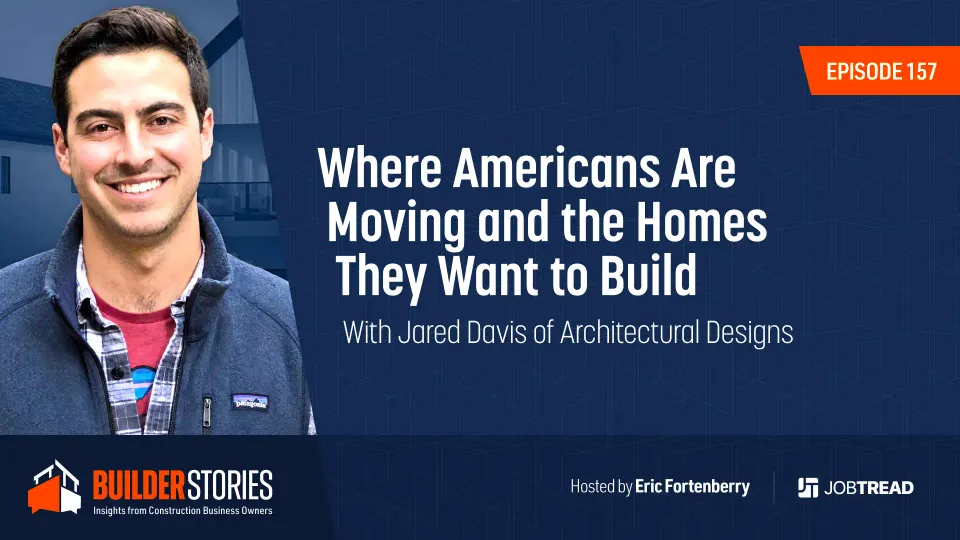

Jared Davis left Stripe to take over a family business that sells house plans to builders across the US and Canada. Today Architectural Designs represents 28,000 plans from around 200 designers and sells to tens of thousands of builders every year. In this conversation he shares what that buying data reveals about regional growth and shifting design tastes. He also makes the case that a stock plan can get a builder to a custom design faster than starting from scratch.
In this episode you will learn:
- Why the “pre-drawn” stigma is costing builders time in preconstruction
- The question to ask before hiring an in-house designer
- The home style that dominated the last decade and what’s replacing it
- The regions where home building growth is spiking, according to what people are buying
- What a life-size floor plan walkthrough revealed about how buyers decide
Resources:
Hear the full conversation on Builder Stories. Learn more about Architectural Designs here.
Eric Fortenberry: [00:00:00] Welcome to the podcast where we take a deep dive into the stories behind construction business leaders. We will share how they got started, how they found success, and the lessons learned along the way. I’m your host, Eric Fortenberry. Welcome to Builder Stories.
Eric Fortenberry: Welcome back, everybody. Today, I got a very special guest. We got Jared Davis, who is the CEO of Architectural Designs. They’re located in Fairfield, Connecticut. Real excited to have you on the show. He is also one of our marketplace partners and has been a long time, uh, friend of the company and, and, and really we’ve just seen lots of great work coming out of these guys.
Eric Fortenberry: So I’m excited to have you on the show. Welcome to Builder Stories, Jared.
Jared Davis: Thanks so much, Eric, for having me. Excited to be here.
Eric Fortenberry: Well, why don’t you kick us off with a little bit of background, you know, who you are, how’d you get into it, because I know you got a really unique story here.
Jared Davis: Yeah, absolutely.
Jared Davis: Thank you so much. So Architectural Designs is the leading stock plan marketplace in the United States. We’ve been around for [00:01:00] forty-three years. We are proudly one hundred percent family-owned, uh, by my family. My grandfather ran this business when it was a magazine, and people would buy their residential house plan designs via a magazine that they picked up at a newsstand.
Jared Davis: Uh, my uncle John took over the business and digitized it about twenty-one years ago before e-commerce platforms were ubiquitous. We were one of the first, uh, online businesses that made the jump from magazine to, uh, online storefront. Uh, and I took over from him a-about a year and a half ago. I’ve been with Architectural Designs about eighteen months.
Jared Davis: Uh, we have a really unique role, uh, in the home building ecosystem. So we operate a two-sided marketplace. Uh, we can get into the details later, but briefly, we work with about two hundred design firms, architects, designers, draftspeople all across the US and Canada, and we represent and sell their twenty-eight thousand residential house plans on our site. We’re very proud [00:02:00] to put money in the pockets of those folks, uh, and many of whom, uh, have been partners of AD for forty-plus years and have worked with all generations of my family.
Jared Davis: Um, on the demand side, we work with both retail customers, so that’d be a, you know, husband, wife, family looking to build their first home. We are typically one of the earliest partners that they might identify and select in their home building journey. Uh, and then I think what brings us here today is that a big part of our business is B2B.
Jared Davis: We work with, uh, tens of thousands of builders, general contractors, uh, and firms that are associated with h-house building across America and Canada, uh, every year, um, many of whom are also JobTread customers. A-and so we thank those folks that already are partnered with us today, but we hope that we can, um, talk to, uh, you about how we offer value to your builders generally.
Jared Davis: Uh, that’s the story of the business. Uh, and then I found my way here about a year and a half ago, where I was working, uh, [00:03:00] in, in large technology companies. Uh, most recently I was at Stripe, and I had both the good fortune and the good luck of getting to partner with JobTread in my past role. So I’m actually familiar with your business, uh, in a totally different part of my career as well, uh, and it’s really cool to get to partner with you in this capacity, um, now.
Eric Fortenberry: Yeah, that’s, uh, it’s, it’s pretty, uh, p-pretty ironic. Uh, you know, s-small world here, right?
Jared Davis: Very small world. Yeah. Really cool to build relationships, uh, from, from job to job, and, uh, so glad to get to talk to you again, Eric.
Eric Fortenberry: Yeah, man. That’s, uh, that, that’s really cool. And, you know, again, I, I, I think, you know, even before that, you were at Facebook, which is, which is neat.
Eric Fortenberry: Um, you know, we’ve... You know, Facebook, I, I’ve told people I really think has, has been one of the MVPs here at, here at JobTread. You know, we, uh, we, we, we, we... I, I joined all the, the Facebook groups early on, every contracting group out there, and, uh, you know, for a while, it was just like a fly on the wall answering questions and things.
Eric Fortenberry: But, you know, honestly, it was, it was huge for us to, to get that traction early on, and, uh, s-super cool that, that, that you were there. And yeah, Stripe, you know, has been a partner [00:04:00] with us from, from the very beginning, uh, you know, both running kind of our own internal payment processing for our subscriptions and then also providing that as an offering to our, to our clients has, has been really beneficial as well.
Jared Davis: Really cool. Yeah. And now that I’ve joined the JobTread Facebook groups as a marketing partner of yours, uh, it is very cool to see what your builders and customers are posting about on a near daily basis. And many of them talk about collecting money through your platform, and so it’s very cool and satisfying to see work that I’ve maybe played a very small role in supporting your business’s growth, but hearing people post about it, uh, day in and day out now as your partner, that, that is a very cool full circle kinda moment.
Eric Fortenberry: Yeah. That’s, that’s what I was thinking too. You know, gotta be, gotta be quite the full circle there for you to sorta see the, uh, see the whole thing play out from, from, from another perspective.
Jared Davis: For sure.
Eric Fortenberry: So I’m, I’m curious, you know, I mean, a, a, a lot of our listeners, you know, they’re, they’re running, you know, their own family businesses, either as, as the founder or, you know, maybe they were, they were the child of, of, of the [00:05:00] founder. You know, what, what would you say? Like, what, what did your uncle do right in that transition, and, and what advice might you give to others who are, who are working through those, those similar dynamics?
Jared Davis: Yeah. Well, the first thing I would say is now that I’m, uh, a relative newcomer to the home building ecosystem, there are so many family-run businesses in our space. We see it on the design side. Uh, we certainly see it on the builder side. I think that’s just a very cool aspect that is very present in this journey.
Jared Davis: Perhaps it is intrinsically tied to the product that our shared customers are building, which is a family home to go raise your children in or place your parents or grow as a family, um, that it makes sense to be selling to kind of a family-owned business, but of course not always. Um, I would say the, uh, the things that my Uncle John got right start with the people and the culture.
Jared Davis: Uh, you know, he built the team from scratch. I think the team was a pretty tight crew back in the day. He, uh, he grew our team. We, we are 13 [00:06:00] folks, uh, in Connecticut and a few remote, uh, with about another dozen or so, uh, supporting us, uh, i- in a contractor capacity, and that team and culture are the strongest, um, the strongest asset that we have.
Jared Davis: It’s definitely been my goal to maintain and preserve the culture and the things that work, and then of course, grow and invest in the areas that, um, that, that maybe we could do, could do more and do better in. Um, but that’s pretty important. Uh, taking care of, of our team is the most important aspect, and of course, that filters through to, um, all of our customers, uh, how they perceive our brand, our team, our culture.
Jared Davis: Uh, we hear about it every day. Earlier this year, we hit, um, 5,000 five-star reviews, uh, from customers who have happily bought our plans and ideally converted them into, uh, full homes. And as we’ve talked about as a team many times, that is not something that you can engineer or conjure out of thin air.
Jared Davis: That is, uh, showing up to work [00:07:00] every day for years at a time. Uh, and so that speaks volumes to the team that he assembled and, and almost nothing, uh, about what the last 18 months have, uh, have yielded.
Eric Fortenberry: Yeah, that’s, that’s incredible, man. 5,000, uh, five-star reviews is- that’s, that’s no small feat. That, that takes a long time to acquire.
Jared Davis: Yeah. Means a lot of things are working well, and we got the right people.
Eric Fortenberry: Yeah. Was there, uh, w- was there anything that you’ve changed since you took over?
Jared Davis: Yes. Uh, a lot, uh, and, and, uh, I’m happy to speak to some of the highlights. Um, I think there’s a few fun ways that I can answer this. I think the first is, um, is the technology.
Jared Davis: Uh, we are an online marketplace. I think it’d be, uh, it’d be silly to not start there. Um, we, we have found product market fit. We are a business that’s, uh, durable and sustainable, and by evidence of the fact that I’m the third member of my family to join, clearly, you know, we found our target customer. But it doesn’t mean that we’ve been able to use the latest and greatest tools to meet their [00:08:00] needs or improve their experience, and we’ve invested quite a bit across our stack.
Jared Davis: Um, the first note I’ll say on this is we, we put together a presentation at the end of 2025 looking back on all the changes that we made last year. We had one slide that showed all the new tools and logos that we added. There were maybe 15 screenshots of logos that the team had added and incorporated into the product.
Jared Davis: And I think looking back at that window really spoke volumes about all the new things that we’ve, we’ve brought on. And, you know, it’s more than one a month. That, that’s a lot of change in the span of one year. But, uh, it, it runs the gamut. We added Stripe as our payment processor, and among many other changes, we saw, uh, almost a three or four X lift in our conversion rate.
Eric Fortenberry: That’s awesome.
Jared Davis: Uh, I don’t think our customers really care that much. They just wanna get in and out of our checkout process and start their home building.
Eric Fortenberry: Yep.
Jared Davis: Um, but that really matters to builders who might have a multi, um, year relationship with us, uh, and need to buy quickly. They might be on a job [00:09:00] site texting our team, uh, from their phones like, “Hey, I’m, I’m on a job site.
Jared Davis: I’m meeting a prospective customer in my office in twenty minutes. I need this plan. Uh, how can you help me look good for my prospect?” Uh, and so, you know, both a faster checkout and a better, um, text and phone system that we’ve brought in, those are really useful and directly affect builders, um, who are mobile by default.
Eric Fortenberry: Yeah, that’s great.
Jared Davis: Yeah.
Eric Fortenberry: So from a home builder’s perspective, I mean, let’s say they’ve never bought, you know, pre-drawn plans. You know, walk us through what, what does that, what does that experience look like? You know, what’s included in that plan set? What isn’t included, if, if anything?
Jared Davis: Yeah, for sure. So I think the, um, I think the first thing that I was, uh, informed when I started getting closer to this business and joined was that the stock plan marketplace or a stock house plan design comes with certain, um, uh, stigmas or expectations of like, “Oh, this is pre-drawn.
Jared Davis: It’s not custom.” And I think that myth [00:10:00] can be totally debunked. What we talk about all the time, uh, on our team and with builders is you actually can get to a custom house plan design faster in many cases using a, a starting point like ours, um, than you can with, with many in-house resources. And that’s not to knock the in-house resource.
Jared Davis: We work with plenty of builders who have drafts people or design functions in-house. We just think that we can deliver that faster and give your time back to, uh, higher value activities. So the first is, uh, if you’re a builder and you’re looking to cut down on the time you spend in the pre-construction phase, uh, we think that we can offer tremendous value to you.
Jared Davis: So the first is, uh, if you know the types of plans, either by total living area, style, features that you want included in the plan, if you’re multifamily and you wanna get started with, uh, designs there that can work within your zone, uh, or local zoning restrictions, w-we are a fantastic starting point. [00:11:00] Uh, you can go have those discussions, of course, with your local zoning board or, uh, you know, your, your local jurisdiction.
Jared Davis: But, uh, certainly you don’t need to start from scratch, and I think that’s really where we, um, offer a lot of time savings to our builders. And the second would be anything value add on top of the plan. So most builders, uh, would be happy to offer their prospects, or if you’re a spec home builder, um, you’d love to add all the bells and whistles to a home to attract the widest diversity, uh, of customer profile, as well as increase the value, uh, at sale.
Jared Davis: And that’s where we think we can offer value to builders through our modification service, which is happens to be a free quote. But where I think that really offers value to builders is you don’t need to have that function in-house. So again, free up your payroll, free up your personal time to being on site or to attracting customers, and, uh, and look to partners like us that can offer you a pre-baked design and then the customization work that you need, uh, [00:12:00] directly thereafter, um, beyond.
Eric Fortenberry: So, so wait. As far as design, you’re, you’re, you’re saying that a builder can buy a set of plans and then work directly with your team to customize those plans for, for their client?
Jared Davis: That’s exactly right.
Eric Fortenberry: I mean, that you know, again, that, that, that sounds huge. I see so many people who, you know, they’re, they’re kind of in this like position of like, man, like, you know, we, we’ve been outsourcing the design work, but it’s not fast enough or, you know, they, they kinda just don’t, don’t, don’t always, you know- Enjoy their partner, whatever it may be.
Eric Fortenberry: You know, and they’re like: “Well, should we hire a full-time person? Should we bring the design in-house?” They feel like that’ll get them a lot more control. You know, it’s likely gonna cost them a whole lot more, and, and sometimes there’s kind of that capacity concern. Well, am I gonna really be able to keep that designer busy enough, you know?
Eric Fortenberry: And so it sounds like this is a great option here where, you know, you’re, you’re- you’ve got the pre, pre-set up plan, so you’re- you’ve already cut out the majority of that upfront, like, but then if they wanted to tweak it, they just get to hire you guys. And, and how does that, how does [00:13:00] that work? Is that like, you know, is it, is it one turn, or is there an ongoing meetings?
Eric Fortenberry: Or like how are, you know, is the client getting involved with this as well? What- Tell us a little bit more about that.
Jared Davis: Yeah, absolutely. Uh, and, and we agree with you, Eric. We think that it’s a really compelling offer to builders, starting with the fact that they don’t necessarily need to go hire an expensive design resource who might have a low utilization rate and carry a, an ongoing cost to the builder.
Jared Davis: Starting there, I think is, is already, uh, putting the builder one step ahead. Uh, but then getting into the, the per project work, builders can spend as much time as they’d like browsing our site and finding the right plan that, that matters once they decide to pull the trigger or pull the trigger along with their client who has identified, “Yep, these plans work, and my HOA will approve them,” or, you know, “My spouse will like this design feature.
Jared Davis: We’re good to go.” The modification service, um, is pretty straightforward. So we offer a, a service on our site that is self-serve. You can submit [00:14:00] any number of requests, um, around the plan. You can submit those before you’ve bought the plan, but typically it helps if you’ve already bought the plan. You know you’re pot committed to building this design, and maybe you know a little bit more about your particular lot or the town jurisdiction restrictions you may have, et cetera.
Jared Davis: Um, a-and then we’ll route you to either the original designer of that plan, which is really fantastic. The builder gets to work with, uh, an architect or a design firm who stands behind that plan and can maybe speak to, uh, you know, past customers that have worked with similar questions or, or modifications, uh, or a network of third parties that we work with who do this, uh, all, all day long.
Jared Davis: Um, and from there, the conversation can run from an initial set of maybe seven requests all the way down to, you know, a months’ long engagement process. Either way, w-we’re pretty confident that that’s a really attractive path forward rather than having to bring that function in-house and work through utilization [00:15:00] rates, times, calendar alignment, all of that stuff.
Eric Fortenberry: Yeah. And, and so are, are you seeing that people are coming to you guys, like, you know, before they’ve, they’ve met with the client, where they wanna maybe provide them a couple different options and give them some, some ideas? Or is it typically they-they’ve, they’ve already engaged the client, you know, maybe got them into, in even on, you know, some sort of a, a initial contract there, and then they’re coming and they’re, like, picking it out together?
Jared Davis: It’s a great question. I think that starts with the business model that your builder would have. And I know that JobTread supports a number of, of builder business models, so I don’t want to assume anything. But I’d say there’s kind of two main profiles that we see the most frequently. The first would be like a classic design build business.
Jared Davis: Um, if you are a design build contractor, you might offer in your marketing materials or website a, a set of plans, uh, or a set of homes that you definitely can build. That is [00:16:00] certainly an area where we can offer value. Uh, not only can you just copy the plans that you want from our site and list them on yours, but you also could browse, uh, our styles or collections, uh, and, and give a more bespoke view to, um To your prospects, uh, as they come in.
Jared Davis: The second would be a custom builder, and I think that’s much more, um, bespoke, white glove. Maybe you’re sitting down for a few meetings with the, the party to identify their real needs, and then you might be searching for that perfect design together. Um, we’ve captured a number of, uh, case studies, uh, from our builders, many of which we have on our website, um, that show that exact model where, uh, you know, a couple comes in to sit with the builder and they look together, uh, you know, in the builder’s conference room, uh, at plans on our site that maybe fit the bill for what that customer is looking for, that might fit, uh, their budget, but that their builder certainly would be comfortable moving forward with and building and, and giving a real estimate.
Jared Davis: So that is a huge [00:17:00] part of, of the partnership that we know your customers and, and our shared customer wants to deliver to their end prospect.
Eric Fortenberry: Yeah. You know, I think what, what’s, what’s interesting too, like I, I see on the site, I mean, you, you’ve got, what, 20 something thousand, uh, plans from a couple of hundred designers.
Eric Fortenberry: Is, is, is that right?
Jared Davis: That’s right. Yeah.
Eric Fortenberry: Yeah. So, so how, h-how do, how does a builder narrow down, you know, kind of what, what they’re looking for? I mean, like I, you know, I feel like I could go spend like, you know, hours or days just perusing this, this massive data set. Like, how do you, you know, how, how do you recommend people kind of like try to narrow it down?
Jared Davis: Yeah. We, we frequently hear that a lot. Um, I, I think discoverability is definitely a problem that we have, but I would describe that as a good problem. Um, so first, uh, f- any of the plans that hit our site, um, are coming from a professional architect, designer, design firm. They get vetted through a three-person committee.
Jared Davis: They meet certain minimum requirements for what is included [00:18:00] in the full construction documents and construction set that a customer will, will get post-purchase. Um, and, uh, we ensure that there’s a, a minimum quality there. I know this is not exactly your question, but just for the builders out there who might be thinking, “Gosh, is this, you know, is this low quality, uh, material that we’re looking at?”
Jared Davis: No. It’s a- it’s actually all been, been vetted. There’s a professional behind it, and we reject about 90% of applicants who come to our site looking to sell.
Eric Fortenberry: Wow.
Jared Davis: So we, we have a high bounce rate from people that don’t quite meet that bar. Um- Getting to, uh, the discoverability piece, builders can take a number of approaches when looking for plans.
Jared Davis: And of course, I would also say this goes back to like, well, what is their business model? Are they looking for plans to market on their website, or are they looking hand-in-hand with a prospect who has signed a letter of intent or a, a contract to move forward? Um, I’d say the most common areas to start would be styles.
Jared Davis: Um, depending on what style you, um, [00:19:00] you have, uh, preference or skill set in building, you know, great. Um, depending on the part of the country that you live in, you might be, uh, more likely to wanna invest in, uh, you know. For example, uh, our company is in Connecticut. We have a lot of New England style, um, and Cape Cod-style type homes in, in the area, along with modern farmhouses, colonials, things like that.
Jared Davis: That would be, like very typical for our region. We know that changes, uh, as you move around the country and, um, that’s clearly a-an area that we have to meet. We’ve a lot of builders that need to operate in certain, um, square footage or total living area bounds, and so you can narrow your search based on that.
Jared Davis: And then, of course, finally, bedroom, bathroom count, uh, and then special features. I think that’s really the most fun part of our website is when you can search for plans that carry, um, certain attributes, uh, for different rooms or, you know, first floor primary bedroom, second floor laundry, things like that, where you might really be tailoring a very specific vision for what you’re hoping to build, uh, and can [00:20:00] narrow plans down that way.
Eric Fortenberry: Yeah, it seems like there’s a, there’s an extensive set of filters, uh, when, when you’re, when you’re browsing through there that looks like, looks really, really happy. I even like the, kind of the lot size, you know? Is it a narrow lot?
Jared Davis: Totally.
Eric Fortenberry: Is it a wide lot? I mean, like, seems, seems like that would be really, really helpful.
Jared Davis: Sloped lot is a common one that we get from builders as well. Um, and we’ve got plans for that. And then of course there’s, um, there’s a, a very different use case which would be, uh, a developer, uh, who’s got a large subdivision and needs to fill multiple lots. You know, that would be another key use case that, again, differs by business model.
Jared Davis: But certainly we’d be a one-stop shop for profiles, uh, like that.
Eric Fortenberry: Yeah. Well, that’s great. And, and I really like how you can, you can click on, you know, one of these plans. It actually kind of has like a full profile where you can see like some design renderings. You get kind of a, you know, sort of some of the s- the stats, the measurement data.
Eric Fortenberry: You know, you can actually see even a sample of the, of the plans right there, which, you know, all, all of that seems really helpful for people to be able to get the confidence, you know, [00:21:00] before they buy it that, that that’s what they’re looking for and that this is gonna meet their needs. So I, I love that.
Jared Davis: You said it, Eric. We, we are definitely trying to establish trust with, uh, with any of our customers, but certainly with builders, uh, for whom time is money, and they need to know, uh, unequivocally that they’re gonna get a high quality set of construction documents and designs that they can then immediately run with, uh, to go get permitting, to go get approval from their customer, to go plug into their organization.
Jared Davis: W- we need to demonstrate to those folks, uh, that our, our plans are high quality, high fidelity, can definitely work for their region. Um, so 100%. And I think we’re constantly looking at ways for how to establish trust, uh, demonstrate social proof that this plan worked for, you know, Eric in Dallas, and how do we, how do we apply that and extend that trust to you, uh, in whatever part of the country you live in.
Eric Fortenberry: Sure. And kind of just sort of browsing, it kind of, it looks like, you know, this, this could be anywhere from, you know, a couple hundred bucks up to maybe a couple thousand bucks. [00:22:00] Is that, is that kind of like a general range that, that someone might expect for a, for a full, full set of house plans?
Jared Davis: Yeah.
Jared Davis: That, that’s exactly right. I’d say we describe it in, in identical terms. Uh, depending on how, uh, on how you wanna configure your plan set, that can affect the ultimate price that you pay at checkout. Um, we offer single use and multi-use licenses. We offer different plan sets. Uh, we offer printed sets. Um, we offer a ton of optional add-ons.
Jared Davis: So we can reverse plans. We can add or change the foundation type, the basement type, um, the, um- Framing considerations, uh, two by six, for example. All of those would be customizations that each designer would offer along with his or her portfolio, and that we would, of course, support for whatever needs the builder has.
Jared Davis: Uh, and then that’s the plan. Then we offer some other services that might help the builder get closer to that permit ready or, um, uh, you know, [00:23:00] foundation, uh, pouring moment, uh, along with the build. And that ranges from the modification service which we talked about, which could also run them a few hundred or a few thousand dollars depending on the scope of those mods.
Jared Davis: Um, for builders specifically, we also offer, um, a custom list of materials that they might find useful. That would be like a, a takeoff, uh, solution. Again, helpful if that saves you time during the build. Uh, but we’ve heard that from our builders for many years that that’s a really useful asset that we can offer them.
Jared Davis: Um, and then we’re hoping to introduce some additional services as well, which I’m, I’m happy to talk through.
Eric Fortenberry: Yeah, I, I saw the, uh, you can get the, the cost to build report as well as even the cost to furnish. I mean, that’s, that’s pretty interesting. Yeah. Uh, gi- give, give the homeowner a little ballpark on, uh, “Hey, you know, you, you chose this, this five-bedroom house.
Eric Fortenberry: Here’s, here’s what you should, uh, you know, expect to, to cost to furnish it.”
Jared Davis: Yeah. Those, those are fun. So the cost to build report has been something that we’ve offered going all the way back to the magazine days. I think that’s a pretty logical, uh, [00:24:00] asset that a customer might, might wanna have. Uh, I think it’s a better fit for retail customers who might be going through their first and only new construction journey. Um, and builders might, might, um, want to go through the cost estimate process themselves. So we know that there’s a fit for some but not all builders, and we hear that feedback every week. But that’s a pretty common one, right? Like, don’t you wanna know what your house might cost to build before you pull the trigger on this plan?
Jared Davis: Like, that makes a lot of sense to us. The cost to furnish, uh, exercise is a pretty fun one too. In surveying our customers, we heard time and again that they really value transparency, uh, and, uh, visibility into their downstream costs, and furnishing is very quietly a large expense for any home. And so we thought that that was a really slick way to give customers just a little bit more insight and data into their, uh, home-building journey.
Eric Fortenberry: I love it. That’s awesome.
Jared Davis: Yeah.
Eric Fortenberry: Uh, you, you alluded to maybe some additional services, uh, co- coming, coming down the road here. I’m curious if [00:25:00] what, what you might be able to share.
Jared Davis: Yeah, for sure. So these are the fun ones. Uh, last month, we formally introduced on our site a structural engineering partnership, so we can stamp your plans in all 50 states and most provinces in Canada. I think seven provinces, uh, in Canada. And that has been consistently a huge ask from our builders who routinely will ask us, “Hey, this plan is great. I plan to buy it, but do you offer permitting, uh, or stamps?” Uh, we do not, but we have a firm that does. Uh, the time savings on getting your plan from us and then immediately flipping that stock or customized plan right over to our partner is huge.
Jared Davis: The last month has blown away our expectations in terms of, uh, leads submitted and, um, interest in this service. Many of whom are coming from our professional builder population, so we, we feel really confident that that met the mark for what our builders asked us to introduce. Uh, and then we’re hoping in the next few weeks [00:26:00] to offer a builders-only service for, uh, custom renderings, uh, if they need help marketing the final asset.
Jared Davis: Um- Uh, we, we’ve been told, uh, in many surveys and conversations with builders that selling the finished product is a huge challenge that they face. Uh, and we think that this is one small but very meaningful step that we can offer, uh, to help builders to ultimately sell the finished home.
Eric Fortenberry: That’s awesome.
Jared Davis: Yeah, we’re proud to introduce those two services.
Eric Fortenberry: You know, and I, I, I’ve, I’ve heard you kind of say a couple times, like you survey your customers, you hear your customers. I mean, I, I, I really love that about, you know, what you guys are doing. I think that probably makes us such good, good partners is like we’re also very big on, you know, you, you gotta always listen to your customers and take their feedback, you know, into account when thinking how can we better meet their needs?
Eric Fortenberry: What else could we do?
Jared Davis: Totally.
Eric Fortenberry: You know, I just, I, I, I love that, man. That’s awesome.
Jared Davis: Totally. Uh, I mean, one thing that I will say, uh, to speak to the, the broader team at JobTread, uh, we met, uh, [00:27:00] your team at a large industry conference back in February. And, uh, we learned that many of your builders were looking for a, a design partner that could offer plans like the ones we support, uh, and had trouble finding that.
Jared Davis: And so that was really compelling to hear from you guys, who are so close to your builders. Yeah. Uh, and you build software and tools for them to run their whole business. Uh, but interestingly, bringing the design to JobTread’s portal and overall experience is potentially a gap that we can help to close.
Jared Davis: Uh, and so that was a really meaningful point of feedback that we heard from your team. Uh, and then of course, when we factored in our own surveys with our, our builders saying, “Yes, JobTread’s a tool that we use frequently,” and, uh, uh, that came up in, in a lot of our surveys. It was clear hearing it from you all, that can kind of centralize, uh, feedback across the industry and across geographies, and then directly from our shared customers.
Jared Davis: Yeah, it was very compelling, um, for, for why we should partner with you.
Eric Fortenberry: Yep. No, man, it was a total, total no-brainer. So that’s, that’s, that’s [00:28:00] awesome. Cool. Now, tell me, you guys have, uh, y- I think you call it the Trends Report, um, that, that you publish like twice a year, I, I believe. And, you know, it’s, it’s built off what your customers are buying. I mean, what, what have you noticed is, is happening, you know, now in, in home design?
Jared Davis: Yeah. So, uh, the trends report, as you noted, is a tool, um, that is aimed directly at builders or the professional profile, uh, of, of anyone using our site. We publish it around two times a year.
Jared Davis: It is tied directly to, um, what plans are being submitted to AD and what plans are people actually buying and building. Uh, and so trends change, uh, you know, throughout the course of the year. I don’t think we need to be publishing this month in and month out, but every six months it’s good to get a snapshot of what are Americans and Canadians building.
Jared Davis: Um, I’d say there’s a few things. Uh, the average new construction, uh, size in America has trended down over the last few years. I’d say pretty consistently we’re in that fifteen [00:29:00] hundred to two thousand square foot range generally. Um, that has been consistent across architectural designs. I think many of our designers are getting clever about how can we put more value into smaller footprint homes.
Jared Davis: Uh, I’d say secondary trends along that are how can we open, uh, open up the first floor and create open concept homes that give, um, residents more bang for their buck. Uh, i.e., how do we open up the kitchen to the living room and maybe to a den or living area all downstairs without loading up the home with additional, um, uh, walls or breaks, uh, in that flow.
Jared Davis: Lastly, a, a lot of people, uh, over the last few years have been working from home, and I think that has, uh, filtered its way into the design world with, uh, additional bedrooms, certainly with bedrooms that, uh, that are on different floors from where the majority of folks, uh, eat and cook. Uh, I am working from home today.
Jared Davis: That’s a great example that I’m sure many of your [00:30:00] builders customers will ask about is like, how do I, how do I work from home or how do I extract more value out of the bedrooms, uh, in my home? Uh, and then maybe the last one that I don’t think is quite, uh, as evident in the builder trends report but would definitely be a factor would be, as I build a home, how do I think about the needs of my family over the course of five to twenty years?
Jared Davis: And is the home that I’m selecting now from a website like Architectural Designs future-proofing my needs as a family? Maybe I have more kids. Uh, maybe I need to make a home office. Maybe I need a home gym. Am I being thoughtful about my design selection now to account for my changing needs down the road?
Eric Fortenberry: Yeah, that’s, uh, that’s, that’s awesome. I can see certainly, you know, kind of that work from home, the whole COVID era that, you know, put a lot of people spending more time at their houses has definitely changed, changed their thoughts around how they structure, structure their homes and, you know, again, even, even the inside, the outside.
Eric Fortenberry: It’s a lot more time is being spent there.
Jared Davis: Totally.
Eric Fortenberry: I-I’m curious about the, you know, so, so the, the regional preference data is something [00:31:00] that most builders never really see. You know, what are, what are some of the key regional differences that, that you’re noticing?
Jared Davis: Yeah. Uh, I think, uh, stylistically that would definitely be one of the broader, um, broader and like most obvious differences that our builders see.
Jared Davis: Historically, we, we used to ask builders to tell us what part of the country they lived in, and we would give them data around their part of the country. Increasingly, we have found that that distinction doesn’t really matter, and if anything, builders are hungry for more data about what trends are working in, say, the Midwest that they can apply to the Southeast and, and vice versa.
Jared Davis: Um, I’d say one of the themes that we talk about internally a lot Is that the modern farmhouse design has been really popular over the last, say, ten years. And increasingly we’re seeing, uh, less of that, uh, in favor of traditional and colonial designs as well as kind of modern mountain designs. Uh, and so that I think matters a ton for our design community.
Jared Davis: Like, what new designs can [00:32:00] our population of firms put forth that we know our customers are, um, are consuming and voting with their feet by buying and building. But more importantly, I think it speaks to, like, where are Americans moving to? And I think this is a more interesting topic, uh, around, like, what are the trends nationwide for where we see home building and population growth spiking?
Jared Davis: And so pretty consistently, we see Texas as a key leader. Um, right there are many hubs in Texas that I’m sure you and your team know well, but we’re seeing that sprawl kind of expanding to the suburban areas around, uh, Texas, um, and that ranch style, uh, in Texas, super, super popular. Uh, for us, um, Georgia, North Carolina, South Carolina, and Florida are huge drivers of growth, huge drivers of builder customers finding us in those regions.
Jared Davis: Uh, and again, expanding kind of beyond those urban centers, but increasingly attracting people to parts of the country where cost of living [00:33:00] is more affordable. Um, restrictions on building are less, uh, which is huge for our shared customer, uh, and the a- the average contractor using JobTread. Uh, and also maybe where the weather’s better.
Jared Davis: So tho- those are generally what we’re seeing. Uh, and I’d say increasingly, but to a lesser extent, I’d say kind of the Rocky Mountain region, Colorado, Montana, Idaho, those population centers, and the modern mountain style, those are increasingly becoming popular. And we’re seeing that style, um, uh, spread to other parts of the country that maybe you would not necessarily associate with being a mountainous, uh, state.
Eric Fortenberry: Yeah. No, that’s, uh, it’s interesting to think about how you, you could almost kind of see, you know, and, and this is really like a, a leading indicator of where people are moving to, is where you start seeing more and more, you know, plans getting, getting purchased, you know. And so are, are you looking at, like, are you asking them where this will be built?
Eric Fortenberry: Like, do you actually get, like, the, the location or just ask kind of general stuff? Or are you just looking at where the, you know, where the billing address is? Ho- [00:34:00] how much, how much detail do you collect there?
Jared Davis: Yeah. Um, we do not force customers to give us their, uh, their site location for where they plan to build.
Jared Davis: That’s a topic of huge debate internally. Uh, I think we’d love to know that data. Uh, importantly, not every customer who buys a plan knows exactly where they’re gonna build. So not- We don’t have a 100% case or instance of somebody who has acquired land and knows the plan they’ll build on top. That was a huge myth that we had to debunk.
Jared Davis: Um, it would lo- it would make sense that you have your land and then you figure out the plan that fits, you know, the style, the size, the restrictions, but that is not always true. Um Increasingly, we’re asking for site locations as we look to offer and introduce more and more services. In order to provide you with a structural engineering stamp, for example, we do need to know where you’re building.
Jared Davis: Um, in order to introduce higher, uh, h- higher value services, we’re, we’re gonna need that. We tend to look at the billing location. For builders [00:35:00] especially, wh- where we have a multi-year and importantly a multi-order relationship, uh, it’s a lot easier for us to understand, Eric, where, where are you based? Uh, where does your team build?
Jared Davis: How many teams do you work with? In some cases it, you know, it’s up to 15. Um, so great. What geographies do you cover? Uh, there’ve been a lot of interesting things that come out of that. Uh, one in particular would be a builder who’s located like on the border between two states and they build in, in both locations.
Jared Davis: Yeah. That would not be present in our data. That would only be present when we communicate and connect one-on-one with the builders. So yeah, we have a lot more work to do to better understand, uh, the needs of, of our builder customers, but hopefully they can just tell us what we need to go build on their behalf.
Eric Fortenberry: Yeah. Well, that’s awesome. And, and I, I think you guys, you just recently partnered with Walk Your Plans. Is, is that right?
Jared Davis: We did, yeah. That, that’s a really cool partnership. Are you familiar with them?
Eric Fortenberry: Yeah, so I, uh, it was, I don’t know, maybe a couple months ago, I was at the Seattle regional workshop that we did, and, uh, for the first time I got to go out there and like actually saw it and I was just like, man, like, [00:36:00] and they, they like had like kinda JobTread all hooked up to it as well, like pulling up the plans and, you know, that’s, uh, s- super neat. So, you know, tell us, you know, h- how does, how does that, how does that work and, and what problem do you see that really solving?
Jared Davis: Yeah. This is a really fun topic. Uh, I think our team is really excited about this partnership. So first of all, um, we were introduced to the Walk Your Plans team from one of our designers, uh, who used that service personally and thought of us as a key partner that would get value out of this partnership.
Jared Davis: Uh, and so right off the bat, that speaks volumes about how close we are with some of our designers and how thoughtful they are about the end customer, which is a, an aspiring homeowner who needs to get great plans at an affordable price and then visualize those plans locally. I mean, what a cool, um, uh, you know, IRL in-person experience that, that we can deliver.
Jared Davis: Uh, and so we met with the Walk Your Plans team at, at the same conference that we met your team in [00:37:00] this year, but a year ago. We piloted that experience and met the Walk Your Plans licensee, Rob, in Port Chester, New York, which is the closest location to our office. We piloted a few plans ourselves and then brought our entire team, uh, from the office to go walk and experience that plan and put ourselves in our customers’ shoes.
Jared Davis: The Walk Your Plans team met us in kind, and we’ve now launched an exclusive nationwide partnership with them.
Eric Fortenberry: Wow.
Jared Davis: To date, we’ve had over 200 Architectural Designs customers request more info in walking. Um, we’ve had dozens of people actually make that jump and take our plans, uh, and walk there. I think the most interesting thing to talk about with that partnership is, uh, is how we were proven wrong.
Jared Davis: So when we envisioned this partnership, we thought that it would logically follow that, Eric, you and your family have picked out the perfect plan. You’ve bought it, and now you can bring your spouse, your kids, [00:38:00] and maybe your builder or your interior designer, uh, or other members of your friends and family to a walk your plan site and walk the home now that you’ve bought it.
Jared Davis: We have been resoundly proven, uh, incorrect on that assumption. Most people want to walk their plans before they buy them because they wanna get the confidence of what they are buying actually will fit their family. So that’s really cool. Uh, we think it’s just such an amazing opportunity to bring our rich kind of two-dimensional experience into the real world.
Jared Davis: Um, and we’re, we’re pretty close with that team. We’re in touch probably every week. Uh, our customer success team, which is a team of four, uh, routinely talks about their service as a key value add and differentiator for why buying a plan from AD, uh, is more useful and valuable than just finding a plan elsewhere.
Jared Davis: Uh, and, and we pass leads on all the time.
Eric Fortenberry: So, so they, they are able to go and walk a set of plans, or could they- Are they able to try multiple plans before they decide which one they wanna buy? They can do that?
Jared Davis: Yeah, they can. We, we have [00:39:00] probably a, a handful of folks every month that are, uh, walking two to three plans, uh, in a one-hour session and get the confidence that like, “Okay, plan number two is the one our family’s gonna build.”
Eric Fortenberry: Wow.
Eric Fortenberry: That’s huge. Yeah. I, I love that, man. Really cool. That’s- That, that does seem like really big value add.
Jared Davis: Yeah.
Eric Fortenberry: What do you- When you think about, like, the profile of, of the builders who are, who are getting the most out of this, this relationship with you guys, like what, what does that profile look like?
Eric Fortenberry: Are, are there certain types of builders that you find, you know, are, are, are better fit or, or kind of... Yeah, what, what guidance can you give us there?
Jared Davis: Yeah, 100%. So I mentioned earlier, but we’ve captured three case studies of real builders, uh, who we went out and filmed, uh, on job sites in their office and kind of in a one-on-one interview to ask them exactly that.
Jared Davis: Like, how did you find AD originally? How do we offer value to you? In all cases, those builders have been partnered with AD for five years or more across multiple projects. Uh, and the [00:40:00] profiles that we captured, I think are the most typical. Um, two of those are single-family residential kind of design build, uh, builders, and the second would be a, um, subdivision, uh, multi-property, multi-lot developer.
Jared Davis: Uh, we think that we can offer the most value to those teams. In particular, those are not massive, sprawled, huge, publicly traded, uh, build companies. They’re obviously much smaller. Several of them are family-owned, uh, going back to what we talked about earlier. But they are, uh, you know, small, thoughtful, customer-centric and customer-oriented, and we can offer them so much value, uh, by standing behind them and offering, uh, super high quality, super affordable and a wide array of plans that a much smaller firm not partnered with a stock plan marketplace like us couldn’t really meet.
Eric Fortenberry: Yeah, that makes sense. Are, are there, uh, a-additional- like, do you, do you guys have like kind of additional services or like can, can, can a builder... You know, I, I think you have your, your, your [00:41:00] pro subscription of, of some sort. Tell, tell us a little bit about that, and like what, what are they getting with that?
Jared Davis: Yeah. So, um, we’ve talked through most of the services that we offer, but maybe to put a bow on all of those. So we think that discovery o-of plans is one of the biggest value props that we can offer in addition to high quality, low price and time to market. That is on our website. We think that that speaks directly to the needs, uh, uh, of a core builder profile.
Jared Davis: Uh, in addition to that, we offer modifications, the takeoffs and, and, uh, lists of materials. We’ve got the two cost estimates: cost to build and more recently, the cost to furnish. We’ve recently introduced Walk Your Plans as a partnership, which many builders will, um, work with and bring their, uh, their customers to as like a value add differentiated part of the build experience with, you know, davisbuildco.com and, um, structural engineering.
Jared Davis: Uh, so we actually have quite a lot that, uh, we think we can offer to builders. We want our [00:42:00] builders to tell us more. The, uh, pro subscription that you alluded to, that relates to the data trends that we publish every six months. That’s a paid service.
Eric Fortenberry: Okay.
Jared Davis: Um, I think we have to do a better job of getting that in the hands of our builders.
Jared Davis: Uh, I think builders are hungry for real world data about what people in North America are actually wanting to build. Lastly, uh, we have a free rewards program for all builders. So if you buy a plan from us, uh, we will enroll you in our, uh, builder rewards program. Uh, and really that’s just meant to convey all of the packages, uh, and services that we just talked about, but importantly, uh, lifetime, uh, compounding discounts on plans that you buy.
Jared Davis: So we start at 15% off the first plan, 18% off the sixth, 20% off the 11th, uh, and on and on. And we are actively looking to increase that value. We, uh, we just brought on a head of builder sales, Tony, about three or four months ago, who’s been actively surveying and talking to many of our builders, [00:43:00] including some who are JobTread, uh, referrals, uh, who come in through your portal every month.
Jared Davis: Um, and, um, we are actively asking them what more would they like to see from us as part of joining and enrolling in that rewards program. So I hope to have an update in a few months around additional, uh, value-added services that we can give them. But for now, um, we’re, we’re listening to what our builders want, and importantly, we’re meeting them where they’re at, which is jobtread.com.
Eric Fortenberry: Yeah. That’s awesome, man. You know, it, it’s, it’s, uh... It’s really neat to see how, how you’ve just transitioned this business from, again, being, you know, paper magazine, you know, all the way now to this, this digital e-commerce, you know, ability for, for people to go browse and, and, and buy plans, you know, just seamlessly, like instantly when, whenever they need it.
Eric Fortenberry: Where, where do you see this industry going? Like, I mean, is, uh, do, do you see kind of, you know, future kind of, you know, evolutions here? Or, you know, what’s, what, what are your thoughts on that?
Jared Davis: Oh, yeah. This is a great topic. Uh, we could do a whole other segment on this. Um, [00:44:00] I see, uh, I see a number of trends in, in our business.
Jared Davis: I mean, the first is actually, um, establishing trust with builders, and I think this really speaks to what you just said. Like, we, we were a magazine, uh, yet we’ve had durable, uh, you know, m- market sustainability for forty-three years. We’re still family-owned. We’re growing our team this year. Um, that’s a really nice place to be, but it only works because builders trust us and the product that we offer them.
Jared Davis: And so with all of the changes in technology, I think, uh, answering the question of can you deliver a product that actually works for a real builder on site, uh, is the most important and fundamental one, and that is timeless. Uh, obviously, AI is a huge new disruptive technology, and it will certainly affect the design world.
Jared Davis: Uh, where I see it most, um, directly touching our product is in, uh, both the rendering side, right? Like, how do you take a two-dimensional floor plan and bring it to life for [00:45:00] our customer who needs to really visualize just a aerial view of a 2D multi-story home into the real world, uh, you know, X square footage home that they will step foot into.
Jared Davis: I think the rendering piece online is huge. I love that we have a partnership with Block Your Plans because that’s n- a non-AI solution to this problem, but renderings is a really important one. Uh, and the second, I think, is, uh, getting customer-centric and even more personalized. So where I see our business evolving is harnessing AI to ask each individual customer about their personal needs.
Jared Davis: Mm-hmm. Tell us about your timeline, your budget, your family, your family’s preferences, what you’re looking for in a home. How can we narrow our search so perfectly for you because of all of the data that you’ve given us? When we just talked about the filters that we offer on our site, I think they’re great.
Jared Davis: They don’t ask for things about like w- well, what is your child like? Or are you gonna have a grandparent living in the house? Or do you need a gym in that flex fifth bedroom, [00:46:00] right? Like, those are really important questions that will certainly come up in the conversations you have with your builder or, if you’re a builder, with your prospect.
Jared Davis: So we know that that’s something that we can introduce, and I’m really eager to bring our team and our product in, into that world. Where I definitely have questions on are, um, can AI replace the design itself? And, uh, I would be really curious to see where the market goes in that regard. I think fundamentally, we, uh, we believe that designers and architects have a fundamental role to play in the home-building journey.
Jared Davis: I don’t see that changing. I see that as a new tool that we can equip and furnish, uh, our designer population with to improve the, the quality, uh, of their product.
Eric Fortenberry: Yeah. No, that’s, that’s, that, that’s really interesting. And, you know, who, who knows what, uh, what’s gonna happen with AI? It’s, uh, pr- pretty, pretty big mystery, I think, to all of us.
Jared Davis: Oh, who knows?
Eric Fortenberry: But, uh, yeah, I, I- man, I, I could see how it could be so beneficial though, where if you could have that chat, you know, kinda go back and forth and really, [00:47:00] like, have the, the AI sorta prompt and get more insight and more details, then it would really help them narrow down, you know, the, the maybe a, a much smaller kind of targeted set of plans that might be a good fit for them.
Eric Fortenberry: I mean, that, that’d be huge.
Jared Davis: Yeah, 100%. I mean, we think that that’s a, a really easy connection, uh, from, uh, distilling our massive portfolio down into the needs that matter for you. Uh, and that’s, you know, the for you part is the most important piece.
Eric Fortenberry: Yeah. Well, Jerry, this has, this has been super interesting, man.
Eric Fortenberry: I, I, I really appreciate you coming on. I’m, I’m curious kinda just here as, as we wrap up, like, what, what would you say, like, what, what’s the best piece of, of advice that, that you’d give to builders listening today?
Jared Davis: Yeah. Uh, the piece of advice that I would give to builders today, uh, would be, um, to look at their business and ask if there’s a role for a stock plan marketplace like Architectural Designs to play in improving their offering to customers.
Jared Davis: Um, I think if they take a customer centric view, um, that is [00:48:00] always, uh, always good advice. But really listening to the needs of the customer to inform what they need to go do, uh, internally i- is, is a great path forward. Where I think we can answer that question is meeting the needs of the customer by offering the widest array of plans that maybe they can’t meet with their current team or assembly right now.
Jared Davis: And if that’s true, then we’d love to have a conversation with them and see how we can offer that value.
Eric Fortenberry: That’s awesome. Well, look, Jared, I, I really appreciate you coming on. You know, you and your team have been great to work with. You know, for all the JobTread users out there, definitely go check these guys out.
Eric Fortenberry: They’re located right in our marketplace. You know, you can reach out to, to Jared and his team. You know, I really, really believe in what you all are doing and just appreciate all the, all the hard work that you’ve put into to, to delivering, you know, these plans because it really will make a big impact on, and, and you’ve already seen it on, you know, tons and tons of builders out there.
Eric Fortenberry: So guys, go check them out. Thanks for tuning in. Jared, appreciate you coming on.
Jared Davis: Thanks for having me, Eric.
Eric Fortenberry: Have a good one. Thanks for [00:49:00] joining us for this episode of Builder Stories. We hope you enjoyed the conversation and gained valuable insights that can help you in your journey along the way. Don’t forget to subscribe to the show and leave us a review.
Eric Fortenberry: And as always, if you or someone you know has a story to share, please contact us at builderstories.com. We’d love to hear from you. I’m Eric Fortenberry. And remember, every builder has a unique story. Keep building yours.