
Turning $100,000 in Debt Into a Thriving Remodeling BusinessWith Todd Milton of Milton Construction Company
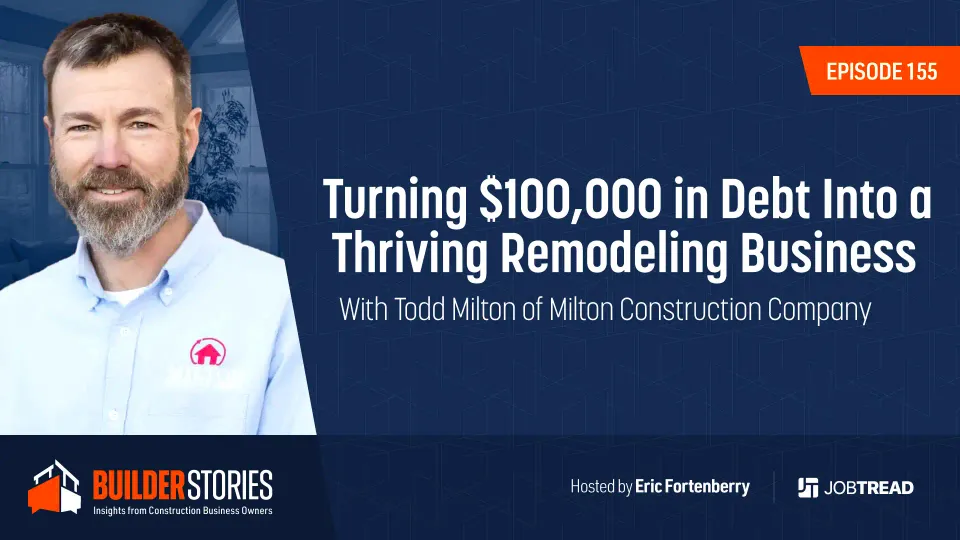

Todd Milton inherited his father’s sterling reputation as an Appomattox, Virginia home builder, then nearly ran the company into the ground. He then attended a two-day conference that exposed how badly he had been pricing jobs, and that same year he closed the books $100,000 in debt. He rebuilt his pricing, rewrote his contract into something that protected him, and slowly turned a business run off a legal pad into one with real financial software behind it. Today he’s learning when and how to step back and let his team lead.
In this episode you will learn:
- The pricing myth he believed for nearly a decade that bled his company dry
- The unconventional method he used to climb out of six figures in debt
- The formula that finally showed him what he actually needed to charge to turn a profit
- How long it really took before his marketing investment started paying off
- The advice from a client that changed the way he leads his team
Resources:
Hear the full conversation on Builder Stories. Learn more about Todd’s work here.
Eric Fortenberry: [00:00:00] Welcome to the podcast where we take a deep dive into the stories behind construction business leaders. We will share how they got started, how they found success, and the lessons learned along the way. I’m your host, Eric Fortenberry. Welcome to Builder Stories
Eric Fortenberry: Welcome back, everybody. Today, I am excited. I have got Todd Milton, who is the owner of Milton Construction Company. They’re located in Appomattox, Virginia. Really excited to have you on the show. Welcome to Builder Stories, Todd.
Todd Milton: All right. Thank you, Eric. I’m glad to be here.
Eric Fortenberry: All right. Well, why don’t you kick us off?
Eric Fortenberry: Give us, uh, you know, a little bit of background, you know, who you are, how you got into construction. You know, tell us, tell us about your career.
Todd Milton: Well, uh, first of all, I’ll, I’ll tell everyone where I am and s- the significance of that, because not everyone knows. But Appomattox is where General Lee surrendered to General Grant on April 9th, 1865, so effectively ending the, the long, brutal civil [00:01:00] war that our country endured.
Todd Milton: So that’s Appomattox’, uh, claim to fame. Um, uh, so that’s, get that out of the way so you know where we are. We are a very small town. There’s about 2,000 people that live in this town, but we’re only a half hour away from Lynchburg, Virginia, which is a larger, uh, larger city, and of course, that draws, um, that gives us most of our business.
Todd Milton: Um, so I got into this, uh, my dad, um, Ken Milton, uh, was a home builder from the late 1970s until his retirement around 2015, I guess is when he finally decided to hang it up. So I grew up working, uh, summers, uh, with Dad. I had no interest in this kind of work whatsoever. I just needed a job, I needed some money, and you’re kind of forced to do that growing up.
Todd Milton: Um, I went away to college and had another job for a [00:02:00] while, uh, but around 2006, uh, I decided I needed to-- I had an interest in this. Uh, I bought an old home, started fixing it up, and, uh, you just kind of realize, you know, you’re kind of good at this. You grew up with it and, uh, I tried to avoid it for a while, but it was no longer, uh, something I could avoid, and ended up moving back to the area in 2006 and, uh, just catching my dad there right at the end of his career before he retired, um, and was able to work Uh, with him and his company, uh, for, uh, a few years there before we actually started a different company, Milton Construction Company.
Todd Milton: And, uh, w- kind of an interesting timing is I, I got into this just slightly ahead of the 2008, 2009 recession that our country hit. Uh, and I saw my dad’s company go from about 16 [00:03:00] employees to two, he and I. And the only reason he kept me around was just out of pity, uh, to give me something to do. So my dad was financially strong enough to be able to weather that storm.
Todd Milton: Um, and so my business started right in the midst of that, and we’ve been able to emerge from that. Um, and anyway, so that’s my background. Um, started as a home builder and now do only remodeling work. Um, we have stopped building new homes.
Eric Fortenberry: That’s awesome, Todd. So sounds like your dad built a, a very successful home building company in the late 1970s, and then you ended up founding Milton Construction in 2010.
Eric Fortenberry: I’m, I’m curious, like, what did you take away from watching your father build his business? And, and was there anything, uh, that, that you wanted to make sure that, you know, you, you did the same way? And then what did you do differently?
Todd Milton: Yeah, we, um, well, first of all, my dad, [00:04:00] uh, left me with something that is, uh, almost priceless, and that’s a, a good reputation.
Todd Milton: So, you know, someone starting from scratch doesn’t have-- They have to earn that reputation. But I was able to come in on, right on his, his heels, uh, of just having such a stellar reputation in the area, um, and the same name, uh, with our business. Um, and so even to this day, we encounter folks that he built homes for, um, that still call us f- with questions or even with remodel jobs.
Todd Milton: Um, so that in and of itself was, uh, you know, is worth a million bucks. Um, my dad, uh, just left me with a lot of good skills on how to talk with people, how to deal with people, how to get along with people. Um, and something that, uh, is, is somewhat of a joke, but there’s a [00:05:00] lot of seriousness to it. He, he used to joke that he went to college at a place called UDH, and people would always say, “Well, where is that?”
Todd Milton: And he said, “Under the damn house.” So he has sort of this, uh, street smarts, uh, this blue-collar work ethic that, uh, you just can’t learn from a book. And so we, we continue to joke about UDH to this day, um, uh, with all the guys that work for us, that they’re getting some certification, uh, uh, along those lines.
Todd Milton: So, uh, Dad left me with a lot of great things, um, that, uh, you know... He, he passed away, uh, two years ago, uh, at the age of eighty-two. Um, uh, but he was able to see basically the, the way our business has ended up, and he was just so very proud, uh, of the way things have evolved over the years.
Eric Fortenberry: Man, that’s awesome.
Eric Fortenberry: I’m, I’m s- sorry to hear about your, your loss there, but man, I, yeah, I could, I could imagine nothing else that would make him more [00:06:00] proud to see his son, uh, be able to, to continue on in his footsteps and to, to be able to build a successful business just like he has.
Todd Milton: That’s right. Yeah.
Eric Fortenberry: So, so were there any things, though, that you, you know, you felt like now that you take-- took the reins, like, that you would, uh, want to do a little bit differently?
Todd Milton: You know, there’s a lot of things, um, and you know, it’s not just at our business. There’s a few other, uh, businesses in our community, um, where I’m in good relationship with their current, uh, leadership. But when we reminisce back to the day to when, you know, the previous generation was leading these companies, um, uh, for example, there’s a local building supply here, um, I’m good friends with, uh, he’s about my age of the guy who runs the building supply.
Todd Milton: But when we look back to the founder of that building supply or, or to my dad’s generation, it’s really hard to put your finger on him, but it was almost a different world that these people lived in. The way that they were able to build [00:07:00] jobs, price jobs, run their businesses, um, uh, just the things that my dad, the simplicity with which he ran his business, um, just would not work nowadays.
Todd Milton: Um, for example, he, he built homes, uh, well, even the price, the, the homes that he built for maybe one or $200,000 would cost close to a million dollars now. Um, the work that he did with a one or two-page contract, um, you would never get by with that nowadays. Um, and, uh, even hand-drawn blueprints, uh, with folks, um, very patiently, hardly anyone can do that.
Todd Milton: Uh, hardly anyone knows how to do that, number one, but you know, folks nowadays are just looking for s- design and computer renderings and all these things. So it was almost a different world, although human beings have not changed. And so that way to deal with people and communicate with [00:08:00] people is still the same
Eric Fortenberry: Sure.
Eric Fortenberry: So take us to 2015. That, that was, uh, that was an important year in your business. Can, can you tell us what, uh, what happened to you then?
Todd Milton: Yeah. Uh, long about 2015, um, we-- At that time, my company was, uh, there was four of us, not counting my dad. It was me and, and three other carpenters. Uh, and back then I’m still out on the job sites doing everything, uh, and then I’m back in the office, you know, writing the checks and estimating the jobs.
Todd Milton: We had a lot of work on the books. We had one of the biggest homes that we have ever built, uh, under process. And, um, on the surface, uh, you know, I had other builders even tell me that they were jealous of us because of how busy we looked. Long about that time, I got invited by another contractor to go to a conference, uh, that was being put on in a, a city [00:09:00] not too far away in Roanoke, um, being put on by this guy, Michael Stone, who wrote a book called Markup and the Profit.
Todd Milton: I didn’t wanna go, um, but I really-- It was one of these situations where you just couldn’t see a polite way out of it. Uh, this guy was a family friend. Our, our kids were in school together. Uh, and so I reluctantly paid $500 to go to this two-day conference. When I showed up at this conference, um, I, I don’t know how else to put it, uh, other than using religious terminology, but it was as if I saw the light, as if I had heard the gospel for a contractor, uh, being presented to us.
Todd Milton: And the material that Michael Stone presented at this conference, uh, was revolutionary to my thinking as a contractor. Um- So all the work that we had, we ended up that year being over $100,000 in debt [00:10:00] after the dust settled. So this big home that I built, uh, I lost, oh, so much money on that job because I didn’t estimate it right.
Todd Milton: I was not getting along with the homeowners who were refusing to pay a final payment. We had a cost plus job, uh, locally that just went very sideways, uh, over, uh, the extras that got incurred during that job. So basically everything that I heard at that conference, I was ripe for learning because of my experience.
Todd Milton: And, um, so in addition to my dad, I owe an enormous debt of gratitude to Michael Stone. I’m still in contact with Michael to this day. I think he’s around 82 years old now. Um, and, uh, so we just very, very slowly started to shift and transform how we, how we worked, um, starting with charging for estimating, uh, to lengthening our contract, uh, from one page to 20 [00:11:00] pages or more depending on the job, um, all the way up to the present moment where, you know, we continue to learn new things and encounter new things like JobTread, for example, something that we didn’t have back in the day.
Todd Milton: Um, so 2015 was a game changer, uh, for us and, uh, I don’t know where we would be, uh, without that opportunity to learn from Michael Stone.
Eric Fortenberry: Yeah, I mean that, uh, s- sounds like that was a, uh, pivotal moment for you. I mean, to, to end the year with over 100,000 in debt, I mean, uh, that had to be, uh, quite, quite stressful.
Eric Fortenberry: I mean, did- Yes. ... did the thought of, uh, you know, e- ever just throwing in the towel and quit, you know, did, did that ever come to mind? Or like h- how did you, how did you, you know, kind of rationalize like, okay, like, you know, what I’m doing is not working. We’re just, you know, accumulating debt. How are we gonna change and get out of it?
Eric Fortenberry: I mean, do, do you think if it wasn’t for that conference, like would you have not continued on? Or what, what do you think?
Todd Milton: I don’t know. That’s a very good question. [00:12:00] I’ve never thought about it that way. But, um- I think at that time what I really knew is because of what I had just learned, I knew it was possible to turn it around.
Todd Milton: Because one of the things Michael would tell you is that a lot of the people who end up coming to his classes or coming to him for some help were in the same predicament or worse that we were in. Um, there’s an enormous failure rate in construction work. Um, I, I forget the exact numbers, but almost of any other industry, um, this is a tough way to make a living.
Todd Milton: Um, primarily because people just don’t know how to price their jobs correctly or don’t know how to use contracts. But if you’re willing to learn and willing to stick with it, it’s a very rewarding career. Um, so yeah, if, if I had not encountered Michael, I really don’t know what, what we would have done.
Todd Milton: Um, but because all of a sudden I knew how to do it, I knew that as work picked up, I would get rid of [00:13:00] the debt and, and start seeing a profit. Um, and so that’s what we did. And I would venture to say that within a year the debt was gone, um, and we were, you know, starting to kind of move things in the, in the right direction.
Eric Fortenberry: That’s great. I mean, w- you know, when you, when you, when you think about, like, what, what was it specifically that, you know, got you into those situations where, you know, again, now you’re losing money. I mean, you know, you, you mentioned pricing your jobs, you know, and, and, and you said, you know, you, you started charging for estimates.
Eric Fortenberry: Like, you know, was it, you know, you... Did you just not know your numbers? Did you not manage the job costs? Like, what kind of... What, what specifically led to, you know, these, these losses?
Todd Milton: Well, one thing was, uh, I think probably the biggest thing was just, you know, I, I was just... I inherited, uh, like so many people do, just a, a myth that a contractor should only charge, uh, 10% for his profit, 10% [00:14:00] for his overhead, without actually giving that any more thought than just taking kind of the, kind of the, whatever’s blowing around in the wind here.
Todd Milton: Um, and one of the things Michael shows you is that, you know, you need to figure out your exact markup based on your sales and your overhead and the profit that you feel like you want. Um, and when he shows you that, it’s just as clear as day how you should price your jobs and what markup you should end up using, but I didn’t know that.
Todd Milton: So again, it was just such basic knowledge, but until you encounter that knowledge, you’re, you’re very handicapped and you’re at the mercy of just common, uh, the common myth. So-
Eric Fortenberry: Yeah. No, I mean, I, I- Yeah ... I see people all the, the time who just think they gotta just price their job based on, you know, what everyone else is pricing their job at in the, in, in their, in their market.
Eric Fortenberry: And, you know, they just don’t wanna lose the job, even if it means they’re gonna lose money. They don’t realize the, the full impact of that. And, you know, [00:15:00] e- each, each contractor has their own cost, their own overhead. Like, you know, you have to figure out what is the right, you know, price and, and how much do you need to make to keep the lights on, to keep growing the business.
Eric Fortenberry: And so it sounds like that was a huge, you know, huge turning point for you to, to really start to kind of see how the profits truly flow throughout.
Todd Milton: Yeah. Michael really emphasizes being profitable instead of being competitive. I’m not competing against the other builders, uh, out there. They have a different business, and we’re...
Todd Milton: really, we should view one another as colleagues. Uh- And, and one of the things he says that was just so memorable, he’s like, “You’d be better off to go fishing than to take a job and lose money on it.” Uh, and so I kinda took that to heart. And, uh, I haven’t been fishing yet, uh, but or at least in a while, but, you know-
Todd Milton: we, we just... Basically, in 2015, uh, we made the decision to stop being a nonprofit construction company. So
Eric Fortenberry: Love it. So [00:16:00] y- you mentioned, though, that, I, I guess you had a one-page contract. Did, did, did... Kind of maybe alluding to, so did you get into some situations where, you know, you basically just weren’t protected legally and kinda got- Yes
Eric Fortenberry: into to, to... Customer just decided they didn’t wanna pay you and you didn’t have a choice but to write it off?
Todd Milton: That’s exactly right. Um, I got into a situation with some folks who, uh, just were pretty aggressive. Uh, they wanted what they wanted, and they, um, basically with this one-page contract, uh... Basically, I went to an attorney halfway through this job just to get some advice, and he, he basically laughed at me.
Todd Milton: He said, “This is not even a contract.” He said, “This is a list, a list of things that you’re doing.” Um, and, uh, long story short, yeah, we get to the end of the job and, and, and, uh, they just make punch list after punch list and r- stop and refuse to make a final payment. [00:17:00] And I had a choice as to whether or not to, uh, sue the folks, um, and try to get that money or just let it go and chalk it up to a very expensive lesson and move on, and that’s what I chose.
Todd Milton: Um, uh, just trying to leave the stress behind and, um, you know, it, it was, uh... I, I look back and, and wouldn’t trade that experience for anything, even though it wasn’t enjoyable to go through at the time.
Eric Fortenberry: Man, that is such an important lesson for, for everyone out there listening because, you know, again, I, I, I see so many people who think that, “Oh, I don’t need a contract,” or, you know, “We’re, you know, we’re, we’re gonna, you know, just do it, do it right and we’ll get it done.
Eric Fortenberry: It’ll be good.” You know, and it’s like, man, you’re like, you’re just waiting for that one time when it doesn’t work out and when something doesn’t go right. You know, and I mean, like, you know, again, like I- I’ve seen that one time put people under, you know? That’s right. Yeah. And so it’s like, it’s, it’s so important.
Eric Fortenberry: You know, what, what have you learned and, and like what do you think a [00:18:00] real contract needs to include in order to protect the contractor? Like, what, what specifically have you added to yours that you didn’t have back then that you would recommend to others to, to make sure is included in their contract?
Todd Milton: Yeah, that’s a great question. Um, and y- you know, I look back and the folks that I was working for on this particular job basically would not have... I would not have ever worked for them because they never would’ve gotten past our preliminary design agreement. They would not have agreed to pay for an estimate.
Todd Milton: Uh, so, but as far as the contract itself, you know, I kind of joke on, jokingly, you know, when you open a new book and it often has a dedication page, you know, to, uh, this book is dedicated to mom or whatever. Well, I often wanna put these folks’ name at the beginning of my contract that I dedicated to them because you know, almost everything in there was pertinent to that situation.
Todd Milton: I, I think every state’s probably the same, but in Virginia there are legally [00:19:00] about 10 things that are required to be in a written contract. And they’re basic things like, you know, the cost of the job, how the payments will be made, uh, that you’re gonna use change work orders that are, that are written. Um, uh, what things could delay the job that are beyond the contractor’s control.
Todd Milton: So there’s a list of these things that just have to be in the contract. Well, in addition to those basic things, you know, we’ve added all kinds of other things, and to this day, I continue to add to the contract. Um, every time I encounter a new situation that sort of, you know, we, we weren’t anticipating, we just add a little bit of language to the contract to cover that And, uh, I mean, it’s everything from, you know, of course, it’s a scope of work.
Todd Milton: It’s, uh, what we’re doing for them. Um, you can never put too much information in a contract, but you can always leave a lot of stuff out that you wish. Um, you know, when the job’s gonna start and complete, um, how the [00:20:00] payments are gonna be made, what happens if they miss a payment, um, what happens, uh, if they have a dog, uh, or, or a pet of some sort that they don’t wanna get out of the house, um, what time you’re gonna get there, how you’re gonna clean up.
Todd Milton: I mean, there’s just all these... You know, our contract now is at least 15 pages standard up to 30 pages on a more complicated job, but the, the main language in it is the same. And it’s written in such a way that it not only protects us as a contractor, but it truly protects a homeowner because they are very-- they know what to expect.
Todd Milton: Uh, they know what’s coming. Uh, there’s not gonna be any curve balls or anything. So it’s, uh... Our contract over the years has been reviewed by not only our attorney but by the homeowner’s attorney in some situations, and we’ll take their advice and, and work different things in it. So it-- I truly believe it’s a win-win document.
Todd Milton: And a contract is the sort of thing that you should sign [00:21:00] one time and really never even have to look at ever again. Um, most people are like that. They-- You get along with them fine. Um, uh, but if someone ever wants to argue, then you don’t want them arguing with you. You want them to argue with the contract that they signed
Eric Fortenberry: Yeah, I think that’s a really great way to look at it.
Eric Fortenberry: I mean, like, you know, again, most people think, oh, a contract is, is just, you know, there to get me. You know, it’s like, no, it’s, it’s, it’s a great framework for how this relationship is gonna work and how we’re going to manage this project and what you should expect. And, you know, I, I agree with you. I mean, the, the more, you know, thoughtful you can be and, and, and if, and if a situation has come up that’s gotten you, I mean, yeah, go incorporate that into the contract, even if maybe it won’t happen, you know, in the next five jobs, but that one job when that same situation comes up, you’ve already dealt with that.
Eric Fortenberry: You already have the experience. You already know how that situation should be handled. And so providing that, you know, that guidance and that written documentation, I mean, that, that, that, I think it is a win [00:22:00] for everyone to have that common, you know, place. They’re on the same page about how we’re going to govern, you know, this, this relationship and this project.
Todd Milton: That’s right. And Eric, a interesting thing happened last year. We, we had a major renovation that we worked on. The couple had paid for the design. We spent a few months with them, uh, designing. It was a over a $200,000 renovation. Um, we get to the part where we’re going through the contract, and this, uh, the homeowner, uh, wanted to add all of these different things to our contract and change all of these various things.
Todd Milton: And we met with them and listened to their ideas and, and, and tweaked a few things just to show them that we were willing to listen to them. But we ultimately declined the job because we were not gonna change our contract that had stood for many, many years now, reviewed by both the homeowners’ attorneys and our attorney.
Todd Milton: We were-- we’re very confident in what it says, and we [00:23:00] ultimately tur- we turned the job down, because if this guy was being this This much of a, a nuisance just before signing the contract. What’s he gonna be like when major money starts changing hands, and his house is full of, uh, people and full of dust?
Todd Milton: Uh, so we let that one go.
Eric Fortenberry: No, that sounds like you dodged a bullet there. I mean, it’s a great, great way to, to, to make sure that this customer is gonna be a good fit is seeing how they’re gonna handle, you know, that type of, uh, negotiation.
Todd Milton: That’s right.
Eric Fortenberry: So, you know, um, and, you know, and, and, and one other thing I wanna point out too, I, I, I see a lot of people who don’t realize that, you know, a- again, and I’m, I’m not a lawyer, I’m, I, I’m not an attorney, I, I can’t, uh, give legal advice.
Eric Fortenberry: But, you know, what, what I do know is it’s very important that you have certain clauses, like what happens if the client doesn’t make a payment? You know- Right ... in some states, you may not have the right to stop work unless you have explicitly given yourself [00:24:00] that right in the contract. And so that’s where, you know, again, a lot of contractors can get in trouble because they think that because they didn’t make a payment, they can just stop right then and there, and a, a judge may see it differently.
Eric Fortenberry: And so I think, like, that’s a great example of, like, you have to be very detailed about defining what will happen when certain things, you know, happen or don’t happen, so that you can make sure that you are in the right to stop work, wait for the payment, and then continue on. Or if you never get the payment, to have that option to, to, to basically walk away.
Eric Fortenberry: But, you know, that’s, that’s just one of many examples of how important it is that you do spend a little bit of time and a little bit of money to consult with an attorney who is very familiar with construction, construction law, and how that needs to be written up for you, your business, your state. You know, so I could not advise any more that, you know, people need to make sure that they have got that in place before they, they, they go into construction.
Eric Fortenberry: It’s, it’s just so important to, to, to protect [00:25:00] yourself.
Todd Milton: That’s right. And, you know, one of the recent things we added to our contract, just because this is, again, so different from my dad’s age, my dad never advertised or did anything other than the Yellow Pages. Uh, but, you know, we’re, we place a real heavy investment into marketing, and so I’ve added a section at the end of our contract letting our customers know that, you know, it’s our ultimate desire that at the end of this job, you’re gonna be so, uh, enamored with our work that you’re gonna let us take all these pictures and, uh, videos of the project and post them all over our website and social media.
Todd Milton: But so we give them that forewarning in our contract that we, we fully intend to take pictures and, and take videos throughout the job, unless they explicitly tell us otherwise that they don’t want us to. Hardly no one ever does that. But we just felt obligated to put that notice out there that, that we’re gonna be taking pictures and using the work that we’re doing, uh, you know, [00:26:00] to help promote future work, so.
Eric Fortenberry: Yeah, that’s, that’s smart. And again, if I’m the, if I’m the customer, yeah, I, absolutely, I want you to make this the best project you’ve ever done, and you wanna showcase it. Like, that’s how I know that you’re gonna do your best work.
Todd Milton: That’s right. Yeah.
Eric Fortenberry: So I’m, I’m curious again, you, you ended the year, you know, with, with, with $100,000 in debt.
Eric Fortenberry: Like, w- what did it look like to actually create a plan to figure out how are you gonna build yourself out of this hole? How are you gonna get, you know, back on top? Like, what, what was that recovery like? And, and, and, and again, how, how did you go about sort of planning and then executing this?
Todd Milton: Well, number one, you know, make sure that the jobs you were doing from that point forward, you priced them correctly and they were profitable.
Todd Milton: So there’s, there’s the income. And number two, I just used the old Dave Ramsey snowball, um, to just get out, uh, of debt. So, um, I had a few people like subcontractors, my [00:27:00] electrician and my plumber, that I just sat down and looked them right in the eye and told them the situation. They knew the situation ’cause they had worked on the job and they knew these people.
Todd Milton: And they just were gracious enough to say, you know, “You take your time and, and, and pay us when you can.” Um, and I just took the smallest one first and paid that off, and then went to the next one and paid it off, and just kept snowballing it until... And that, and so, you know, Dave Ramsey, he, he knows what he’s talking about, uh, even for a business.
Todd Milton: Uh, so we snowballed our way out of it and, uh, and just started doing, started pricing our jobs correctly. Um, and it’s amazing when you price your job correctly, you have money.
Eric Fortenberry: Yep. So tell us a little bit about from a marketing standpoint, I mean, as I understand, kind of the first decade, I mean, you, you basically just had a very basic website, no social media, you know, your, your business was, was primarily built with word of mouth, [00:28:00] you know.
Eric Fortenberry: Uh, when did you realize that you needed to do more and you needed to invest in marketing? Was it, was it kind of when, when you knew you needed to, you know, get, get a lot more deals and start building yourself out of this hole, or was it before that, after that? Kinda, kinda what, what brought you around to, to investing in marketing?
Todd Milton: Well, again, it was that connection to Michael Stone, ’cause Michael Stone, uh, was the person who introduced us to Brian Javelin, uh, the owner of My Online Toolbox. So I didn’t jump on that right away, but it was about a couple years later that I decided, again, baby steps, you know. So s- learn how to price your jobs, write your contract correctly.
Todd Milton: And then I kept reading Michael’s books over and over again. And so if you do that, you’re gonna eventually... Of course, he wants you to do some very essential things with marketing. You know, your, your business cards, your, your, uh, your, your shirts, your job signs, your trucks. Um, but then the website this day and age is basically, it’s replaced and [00:29:00] superseded Yellow Pages, what they were in, in the old, old days.
Todd Milton: And some of the folks listening to this may not even know what the Yellow Pages are. Um, but anyway, uh, when I first contacted, uh, My Online Toolbox- I was immediately struck by their personal response. So Brian basically called me and talked on the phone with me even though everything that we were doing was focused on digital marketing, uh, that personal touch.
Todd Milton: So I, I was very impressed with his, uh... I’m very impressed with the relationship, uh, that we’ve established with them over the years in addition to, um, just the great knowledge that he brings to our online marketing. And so we began working with him, and it’s not an immediate magic wand that you just cast over, uh, your website and all of a sudden it’s, it’s perfect.
Todd Milton: Uh, one of the things I’ve learned is you need to be [00:30:00] consistent over time, and that consistency over time, just like a savings account or a money market account or an investment of some sort, it- the interest on that will eventually, eventually start to compound. Uh, so nowadays we, you know, we’re very highly ranked online when people search for a remodeler in our area, uh, including using the, the AI search that is all of a sudden, uh, taking, uh, place of the other older ways of doing it.
Todd Milton: And so Brian has basically built our online platform and our brand in such a way that, um, so consistently over time that, uh, you know, uh, eight, nine, 10 years down the road after starting with him, we have a very solid foundation for our, our marketing.
Eric Fortenberry: Yeah. That’s great. H- how long would you say that it took to start seeing results?
Todd Milton: Probably at least a year, maybe two. [00:31:00]
Eric Fortenberry: Yeah.
Todd Milton: Um, and again, it- it’s, it’s not this instant thing. Um, but most of our leads nowadays are coming from people searching for us and finding us online. Um- Yeah ... whereas, you know- And I- Yeah.
Eric Fortenberry: You know, I, I, I see so many people who, who, who don’t really understand, you know, the difference between sales and marketing and, and, and, and, and, and unfortunately, you know, when they get a deal and, and sometimes even a bigger deal, like, you know, they, they wanna go and they, and they just focus all their efforts and attention on that.
Eric Fortenberry: And then, you know, a couple months later when they’ve wrapped up that project, they, they realize, “Oh, no, I don’t have anything else in the pipeline.” And now they have to go right back to ground zero to start the whole marketing process and start calling and trying to find, you know, where’s that next deal gonna come from.
Eric Fortenberry: And, like, that’s, you know, again, like, the, the, the nature of marketing is something that you need to be continually investing in, even when you’re busy, even when you can’t take on more projects, you know? So, so what has been, like, your content strategy [00:32:00] and, and, and how much do you do, like, you know, adding to your website or doing social media or running ads?
Eric Fortenberry: Like, how, how are you kinda thinking about continually building that awareness and, and, and trying to get, you know, the AIs and the search engines and all that to, to keep recommending you?
Todd Milton: You made a very good point, Eric, in that even while you’re still busy, you need to be focused on marketing. The time to focus is not when the phone stops ringing.
Todd Milton: That’s too late. Um, so there’s that consistency. So yeah, so we are constantly adding new material to the website. Every time we finish a, a nice project, um, we, you know, we sort of have a procedure where we contact the folks, we try to, uh, take photos, we try, try to get a video if at all possible with them speaking in the video.
Todd Milton: We try to, you know, get the Google review and testimonials and all this sort of stuff. Uh, so Brian helps us put all of that together, uh, and it-- which will eventually become a new feature on the website. So adding [00:33:00] fresh content to your website, from what I understand, from my limited, uh, knowledge, uh, helps keep your website alive online.
Todd Milton: Uh, it’s not a dead website. Uh, in addition to that, you know, the social posts are also consistent and regular, always pointing back to these featured projects on the website. Um, we just recently hired, uh, someone to s-focus exclusively on marketing for us. So this is a young lady, uh, the emphasis on the young because someone my age, fifty-two years old, uh, you know, I’m more comfortable with a piece of paper and a pencil than I am with a phone, uh, or a computer.
Todd Milton: Um, but she works for us part-time, and, and her exclusive focus is to keep all of this stuff, uh, just hopping right along. Whereas for me or for my executive assistant, it was always something in addition to [00:34:00] everything else that we were doing, we also had to focus on marketing. So, uh, Madeline, who just started working with us, is her-- that’s her only responsibility, uh, is to go out and, and get fresh footage and, and, and just work with us to keep that stuff active and, and new and consistent.
Eric Fortenberry: That’s awesome. And, and, and, you know, again, I, I think that’s such a great move. But, you know, what, what I heard too is that i- again, it, it took you many, many, many years to be able to get to the point where you could hire a full-time person to just focus on marketing. A- and I think that’s where, you know, again, Brian and his team, you know, i- i- finding a marketing agency early on and investing in it from day one is so important because if you think that you’re just gonna wait until you’re big enough to afford to hire a marketing person, like, the reality is, like, if you wanted to be great at marketing, you know, there’s not just, like, one person who is gonna be, you know, this, this, this magic unicorn that can come in and, [00:35:00] you know, get you, you know, a website, get you designs, get you some content, you know, go build out the website, you know, run ads, run social ca- Like, that’s where when you can partner with a company who this is what they do, they have a lot of people who have that expertise.
Eric Fortenberry: And so instead of having to pay each one of those people full time, you get the benefit of working with a company who can deliver the right people at the right time that have that experience so that you can be great at all those facets. And, and it sounds like you made a really good move, you know, a long time ago to, to invest in that.
Eric Fortenberry: And, and, and I just... I, I think that’s so important for all of our listeners out there. Like, it is never too early to invest in marketing because at the end of the day, like, if you’re not getting leads, if people aren’t finding out about you, like, you know, th- this could be all for nothing.
Todd Milton: That’s right.
Todd Milton: You’re exactly right. Yeah. In this day and age, if you’re not Online, if you don’t have a consistent brand, uh, that’s marketed online very well, um, your phone won’t ring, I don’t think, unless it’s just [00:36:00] from referrals. And referrals are great sometimes, but referrals can also be bum deals. Uh, you know, so you wanna attract the right kind of customers to call your business.
Eric Fortenberry: Yeah. And, and, and you also... You don’t wanna sit back on your heels and wait for those referrals to come in. Like, you gotta be proactive in doing things that are going to bring people to you instead of just waiting for, for someone to call someone, “Hey, you ought to... You know, if you got a need, go, go call this guy.”
Eric Fortenberry: You know, I think it’s just a much better, you know, approach to try to get as many... You know, you, you just gotta... You know, it’s, it’s a numbers game, right? We gotta spread the seeds, get as many, you know, things out there that will help bring people to us.
Todd Milton: That’s right. That’s right. And you know, we see a lot of folks in our community, I’m not sure if it’s this way across the board, um, there’s a lot of advertising on the local radio, there’s a lot of advertising on billboards, and my hunch has always been that that will do nothing but just get your phone to ring and ring and ring with everybody.
Todd Milton: Now, I don’t want everybody calling Milton Construction Company. [00:37:00] I want the right people calling. Yeah. The people who have looked at our website and have just seen that this is the company that I wanna work for. Number one, look at these people. They’re very expensive. I’m only gonna call them if I’ve got some money.
Todd Milton: And then number two, look at the quality of work that they do and their team and their core values, and these are the sort of things. Uh, so they’ve already investigated us, and, uh, and have, you know, intentionally called us and, uh, versus just having the phone ringing off the hook and h- us having to say no to so many people.
Eric Fortenberry: Yeah. Well, and, and, and I like too how, a- again, on your website, you know, you, you’re, you’re not just uploading a bunch of photos. I mean, photos are great, and, and, and videos are great, but, like, you’re telling the story. And I think that those- Right ... stories are very important because it can relate to that next person who is thinking about, you know, doing a remodel.
Eric Fortenberry: Like, they can read, well, oh, that, you know, that, that person was in a similar situation [00:38:00] as me, and here’s how they went about it, and here’s why they chose, you know, Todd and, and, and what the experience is like. You know, the, the story and the context is also very important to relate to people and to make them feel like, you know, this is, this is a good fit for them because, like, hey, someone else who was in that same boat, you know, they, they made this choice, and they’re very happy, so, you know, maybe, maybe I should.
Todd Milton: That’s right. That’s right.
Eric Fortenberry: So I, I’m curious, kind of b- beyond marketing, like, y- you know, you, you, you ran the company on spreadsheets for, I don’t know, 10, 15 years, something like that. Like, what, what helped you to sort of systematize, you know, and, and, and, and put systems and processes in place that could help you to scale the business?
Eric Fortenberry: Like, kind of when, when did that come about and, and, and sort of what, what challenges did you have with, with learning to, you know, to, to do it with technology instead of kind of the, the way that you’d been doing it for a long time?
Todd Milton: Yeah, that, that, that’s tough because I, I’m someone who doesn’t like change.
Todd Milton: Uh, I don’t like, uh, [00:39:00] you know, uh... I get s- I get set in my ways and very comfortable with that. Um, I guess the first step is, you know, uh, uh, I was talking with an attorney, and this attorney, uh, just kind of caught wind of how I was running things, you know, write- hand writing checks, um, and just keeping a, a handwritten, uh, check register, and I entered it into Excel.
Todd Milton: Um, and all of my estimating and files and everything were just on a legal pad. Um, and she’s like, her first suggestion is, “You really ought to get something like QuickBooks, because something happens to you, it has- somebody else has to be able to step in and, and pick this up, and they won’t be able to do it with your, you know, your Flintstone, Fred Flintstone kind of system there.”
Todd Milton: Um, so our first step was, you know, to get a financial software. Um, and from there, um, I personally, uh... Well, one of the things, again, I got from Michael Stone is this constant [00:40:00] push for further education. So always be reading, always be learning and attending conferences and different things. And so Uh, I reached out for some, uh, coaching for our business, for me personally as the business owner, and that’s really how I ended up with JobTread, uh, is it became highly recommended through these consultants that I was working with.
Todd Milton: Um, so as we started to look into that... And, and part of it too, Eric, really was getting me out of the way. Um, we have added a few key people to our team over the years, and it’s letting them have the vision for something like JobTread and letting them run with it. Uh, seeing the need for it, seeing the, the, the helpfulness of it, but even if I personally was resistant to it, just realizing for the greater good of the whole company and the team, I need to get out of the way.
Todd Milton: So here I sit in my office with my pencil and my piece of paper, [00:41:00] but the company itself, everybody on their phones and recording their hours, is using something like JobTread, uh, pushing over to QuickBooks. And so I see the value of it, and I, as a leader, I think sometimes we have to get out of our own way.
Eric Fortenberry: Yeah, no, uh, 100%, you know? And, and, and I think it’s, uh, it can be a challenge, right? I mean, you know, we, we, we’ve done this for so long. This is what’s worked. You know, like, I, I think learning to delegate as, as leaders who are, you know, just meticulously tuned into the details and, you know, we, we all believe that we can do it the best, and it’s, you know, it’s, it’s like, well, you know, I want to do it all, but at the end of the day, like, we, we can’t do it all.
Eric Fortenberry: You know, in order for our businesses to, to grow and to scale, you know, we have to be able to trust the people that we have put in place. And, you know, what, what I’ve learned is that it is so important that, you know, in- instead of me going and, and, and telling my team e- exactly what they have to do, like, the [00:42:00] more that I can make it a collaborative process and, and, and help them to sort of, you know, come to me with potential solutions to problems that they see, like, they really take ownership over it.
Eric Fortenberry: And then they have a sense of pride in wanting to go and to implement and to learn and to, you know, set things up and to run them, you know, where it, it wasn’t ... They’re not doing it because, like, they feel like they had to because their boss told them to. It’s because, like, they see an opportunity to, to come in and to, to make an improvement and, and to play a meaningful role in, in growing the business.
Eric Fortenberry: And like, I think when, when you can get your team’s buy-in, you know... And, and, and I tell people all the time, like, if you’re thinking about, you know, implementing some software, like, get your team on the demo. You know, let your team see it. You know, have those real conversations about, “Okay, like, guys, like, what is this gonna be like if we implement this?
Eric Fortenberry: Like, who is going to be the owner? Who is going to take charge of this? Who is gonna go do the training? Who’s gonna be the admin, do the setup? And how are we all gonna work together to [00:43:00] adjust our processes?” That’s right. And then, like, documenting, you know, those processes. Like- You know, so many times people kind of get things and they set it up, and then, you know, they’re like, “All right, great, now we’re gonna hire someone,” and, like, that person doesn’t have any set of instructions or know how to do it, and, like, you gotta sit there and, you know, train them.
Eric Fortenberry: Like, I think it’s so important that, like, you document, you know, your SOP so that, like, you can hand that to a new person, and they can understand how to use it. Or when they get to a situation like, “How do I do this?” Like, there is that, you know, ability to, to go and understand how your system, you know, manages these, these processes.
Eric Fortenberry: And I mean, o- obviously now, you know, with AI and Claude and Chat, you know, and cool thing, you can connect your, your AI to JobTread. You can just ask it questions and have that back and forth. But, like, I, I think, you know, the, the point is that it’s important that, you know, as, as business owners, we don’t get too stuck in our ways that we can’t see good opportunities to, to improve.
Eric Fortenberry: Because- That’s right ... you know, again, technology, you know, the, the economy, like [00:44:00] everything that’s going on around us, you know, it, it, it can be, it can be very easy to, to kind of just be heads down, laser focused and, and not, you know, see these greater opportunities to improve the business, improve our team, improve our culture, improve, you know, our processes.
Eric Fortenberry: Like, you know, you, you gotta set those things up so that you are ready to scale and grow, and that you don’t get into situations where people get burned out. If, if they don’t have good systems and processes and you keep bringing in more jobs and, you know, stacking it on their plate, and they’re, like, feeling overwhelmed, you know, like, that, that again, that’s gonna lead to burnout and could ultimately, you know, cost you those profit margins on those jobs.
Eric Fortenberry: And so, you know, I, I, I do think it’s important that, you know, people realize that, like, you know, again, e- even if you feel like you’re not the best one for the technology, you know, having someone or recruiting someone on your team who can bring that skill set, you know, you can still have that big win. And it sounds like, you know, you, you’ve got some, some great people on your team who can help, you know, get those things [00:45:00] figured out and implemented and, and, and the whole company is better for it.
Todd Milton: That’s right. You know, and something I was thinking about this morning, uh, thinking about this podcast that we were gonna do today is just our company, um, well, like many companies, you know, s- 10 years ago that I, as the business owner, was doing almost everything. I was working on the jobs with my hands. I was, uh, out there digging in the, in the dirt.
Todd Milton: Um, but then I was back in the office looking at new jobs, estimating, preparing contracts. I was in here writing the payroll checks. It’s just kind of a, a, a one-man shop with a few carpenters to help that one man. So I, I started this morning to really think of our business like, you know, as we grow up as people, you know, we go through our childhood and then a, a really awkward period of adolescence, and then we emerge from that and become a young adult.
Todd Milton: So our company over the last three or four years, you know, when you’re 18 years old, uh, [00:46:00] and you’re still in your adolescent age, uh, people don’t normally grow, you know, two feet tall, uh, in the course of a few years. Maybe some people do. Um, but your, your body and your mind and everything just fundamentally changes during those years.
Todd Milton: And so our company has gone from about eight people to 10 people in the last three years. So again, we haven’t grown. We’re not a 50-person company. We’re 10 people still. But there were some fun- very fundamental changes. I stepped out of the role of a bookkeeper and hired an executive assistant. Our lead carpenter stepped off of the field and started to sell jobs and put jobs together, and one of our carpenters stepped into the role of actually being a production manager, so he’s in charge of building.
Todd Milton: So these, as these roles change, our need for what you’re talking about, how are we gonna do this? Because when it was just me, it’s all in my head. I know how I’m gonna do it. [00:47:00] But when all of a sudden people change roles, we grow up as a business, even if we don’t increase by a lot of people, we have changed our roles, and we need to have an organized way as to how we’re gonna do sales and how we’re gonna do our finances and how we’re gonna, uh, do everything.
Todd Milton: And so we’re still in that growing up process of trying to figure these systems and processes out One at a time. You know, we can’t do them all at the same time. So last year we really worked on nailing down our sales process. And, uh, you know, one thing as you were talking, Eric, uh, we learn from everybody in life.
Todd Milton: We learn from so many people. We had a customer a few years ago, we did a very large renovation for this guy. He was a very successful businessman. Um, and he gave me some advice and, and I think it’s some of the most profound advice I’ve ever heard. He said to hire people that are smarter than you, give them the tools that [00:48:00] they need to do their job, and then get the hell out of their way.
Eric Fortenberry: Yep. That’s, uh, that, that is, that is phenomenal advice. And, you know, I, I, I want to thank you for, for sharing, you know, really your, your entire experience here because I, I think that there’s a lot that people can learn. And, and, and I think, you know, one of the biggest takeaways that, that, that I’m walking away with is, is, is again, like, it was unfortunate that, that you ended up with, you know, that, that debt.
Eric Fortenberry: But at the same time, like what I saw you do is surround yourself with other people who are great resources that could help show you a better way. You know, Michael Stone, you know, Brian Joblin, like, you know, all, all of these, these coaches that, that you’ve worked with over the years, like, you know, being able to, to surround yourself with others who have been there, they have done that, and to have the open mind that- Something needs to change, and then [00:49:00] to go implement.
Eric Fortenberry: You know, w- without implementation, you know, you, you just got a bunch of ideas, but, like, you know, it’s so important that, like, you can go and focus and get the right systems implemented, get the right processes, get the right people, you know, price your jobs correctly, protect yourself. Like, all of these lessons that, you know, have taken you, you know, a long time to learn, like, these are the things that other contractors I hope will hear from this and will be able to implement much sooner and much earlier on in their careers and in their business.
Eric Fortenberry: And, and regardless how long you’ve been in business, if you don’t have these things in place, like, again, take it from, from, from Todd here and, and, and make those changes, because it can make a huge impact, and it will set yourself up for success moving forward. So I, I just... I, I really appreciate, you know, you taking the time to, to share your experience and to share these lessons.
Eric Fortenberry: You know, I, I, it’s, it’s not easy building a business. And, you know, if, if it was easy, everybody would do it, you know? That’s right. Yeah. But, but, but [00:50:00] sometimes it takes, you know, a lot of hard lessons along the way, and, you know, all we can do at this point is, is try to share with others, you know. And I just, again, I, I appreciate you being, you know, a good role model and willing to, to open up and, and share the challenges that you’ve had because, you know, that, the, it, it, it’s a messy journey, you know?
Eric Fortenberry: It- But at the end of the day, like, you can build a very successful business as, as you are and, you know, as, as many others are. So I, I just, I’m, I’m, I’m excited to see people making the changes and being very intentional about how they’re going about running their companies so that they can deliver those great experiences, they can earn those five-star reviews, earn those testimonials.
Eric Fortenberry: Like, that’s what it’s all about is, is, is being able to have those successful outcomes for not just you and your company, but also your clients. And, uh, you know, I, I, I truly believe that we can all win by working together and by making the right moves. And, you know, I just, uh, you know, it’s, it’s exciting to see you making all these, these right moves.
Todd Milton: Yeah. And you’re right, Eric. This, and, and the nature of your podcast I think is right up this [00:51:00] alley. But getting together with other construction business owners, other contractors, and just talking shop is one of the most valuable things that we can do for each other. Again, we’re not competing against, against each other.
Todd Milton: We’re helping each other. It is a tough industry, but it’s very rewarding. And as the more that we talk amongst one another and share our, our, our stories, uh, the more, uh, help we’re gonna receive from each other.
Eric Fortenberry: Absolutely. Well, appreciate you coming on, Todd. It’s, it’s been, been awesome getting to, getting to hear your story.
Eric Fortenberry: And, uh, yeah, I can’t wait to see what the future holds for you.
Todd Milton: Well, thank you for having me, Eric. I really appreciate it. Absolutely. Have a good one. You too.
Eric Fortenberry: Thanks for joining us for this episode of Builder Stories. We hope you enjoyed the conversation and gained valuable insights that can help you in your journey along the way.
Eric Fortenberry: Don’t forget to subscribe to the show and leave us a review. And as always, if you or someone you know has a story to share, please contact us at builderstories.com. [00:52:00] We’d love to hear from you. I’m Eric Fortenberry, and remember, every builder has a unique story. Keep building yours