
Turn Your Craft Into ContentWith Mike Coffey of Coffey Custom Builds
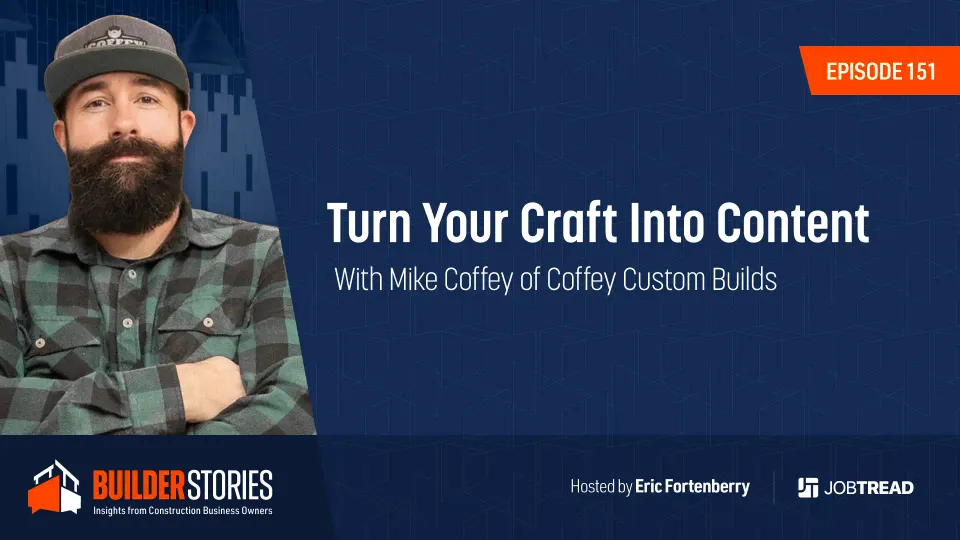

Mike Coffey grew his social media audience from nothing to more than 120,000 Instagram followers. Here, he reveals how contractors can use social platforms to build trust, show their humanity, and turn finished-project beauty shots into real sales opportunities. He also shares how suffering a stroke last year changed his priorities. Instead of feeling consumed by the less inspiring parts of his business, he is now focused on building a life around the things he loves most: producing excellent work and the creation of meaningful content he can share with others.
In this episode you will learn:
- How much social growth your business really needs
- The difference between personal branding and company branding
- How Mike learned the best times to post
- Common social media mistakes contractors should avoid
- What to know before working with sponsors and brands
Listen to the episode to learn more.
Resources:
Learn more about Coffey Custom Builds here.
Eric Fortenberry: [00:00:00] Welcome to the podcast where we take a deep dive into the stories behind construction business leaders. We will share how they got started, how they found success, and the lessons learned along the way. I’m your host, Eric Fortenberry. Welcome to Builder Stories
Eric Fortenberry: Welcome back, everybody. I have got a very special guest today. We’ve got Mike Coffey, who is the owner of Coffey Custom Builds. They’re located in El Dorado, California. Really excited to have you on the podcast, Mike. Welcome to Builder Stories.
Mike Coffey: Thanks for having me.
Eric Fortenberry: All right. Well, why don’t you kick us off with, uh, kind of the, the usual, give us a little bit of background, who you are, how you got into construction, you know, what led you to start, uh, Coffey Custom Builds?
Mike Coffey: Yeah, I actually, before this, was working at my family’s metal stud framing and drywall subcontract shop. We were a union shop, and I was working there for about six years, I think, and then I got into woodworking as a [00:01:00] hobby when my son was born, and I would do that every waking hour that I could. I would woodwork all the time.
Mike Coffey: I got into that, and I started falling in love with it, and then I started selling some pieces, and then I started making more money at that than I was at my family’s business. And after a couple of years of that, I had to make kind of the tough choice of what do I want to do here? And, like, I loved working for my family.
Mike Coffey: Um, it had its stresses, but it was, it was a good gig. We-- It was a good company. I was really proud to work there, but, um, I wanted to do my own thing. Drywall and metal stud framing wasn’t my thing, um, and woodworking was. So I started doing custom furniture. I got really heavy into traditional joinery, um, traditional woodworking, making bespoke pieces of furniture, and as that started getting busier, I brought on an employee, who was my cousin, and I had bought an, a CNC machine, and he started operating that on the weekends for me while we were building custom pieces, and we started doing some commercial work and residential work and [00:02:00] custom pieces all over the place in California.
Mike Coffey: And, um, I started getting more employees, and, um, I left my family business, took this thing full time, full time as a custom furniture and cabinetry shop, trying to lean mostly into furniture because that was my passion. But as the company grew, I n- I noticed that we needed to get more into cabinetry because that was more, um, sustainable, and we could control margins more, and we can control a lot of the outcomes there a lot better than with furniture.
Mike Coffey: Um, and the margins were just great. So we, we were leaning more into that, and then Uh, several life changes through that period of time, personal changes and life things going on. Um, last year, early in the year, I started thinking, “You know, I need to get my contractor’s license.” And I started asking friends and family members and people who I respected, and all of them were like, “You need to get your license.”
Mike Coffey: So I got my license last year and, um, I mean, it’s just taken off since then. So, uh, we just haven’t looked back. Everything’s been changed. So now we are primarily [00:03:00] a commercial cabinetry and millwork subcontractor, and that’s what the company is now. So I’ve got four people in the shop. I’ve got a VA. We’ve got all of our support staff, and we need more.
Mike Coffey: We’re constantly scaling it feels like. That’s the most exhausting thing in the world is feeling like I’m having to constantly scale. Um, I’m in the middle of buying a large building right now so we can move our operation to that and, um, just lots of constant changes. Feels like we’re just constantly growing.
Mike Coffey: So that’s kind of my, uh, quick elevator pitch of how I got into the contractor world.
Eric Fortenberry: Yeah. That’s, that’s great. You know, I think, uh, another really, uh, interesting and, and, and unique, uh, you know, thing about you is you’ve got over 120,000 followers on Instagram, and I believe it’s something like 40,000 on, uh, YouTube.
Eric Fortenberry: Yeah. Is, uh... Tell us a little bit about that. I mean, how did you, how did you get into to social media, creating content, kind of how did you build that, that, that presence and, and what’s your goal?
Mike Coffey: So when I first started woodworking, I didn’t take very many, [00:04:00] like, traditional woodworking classes. I took a few just to get going.
Mike Coffey: A lot of what I learned was from social media, and I thought it was such a cool platform to be able to learn so much. There’s a lot of misinformation out there, but there’s a lot of really good information out there. And as I was starting to learn woodworking, I wanted to also teach people, even though I had no business doing that
Mike Coffey: But I, I wanted to teach people, uh, what I had learned. So I-- my-- originally, my content was just a guy in his garage learning how to do woodworking, and there was something for people to learn from that who knew less than me. Um, but I think it was just kinda fun watching a guy figure it out. And, uh, that really was what I was doing, was just figuring it out.
Mike Coffey: And then over time, as I got more into custom furniture and I really started to learn what I was doing, um, I started to lean into teaching, like, as part of my platform. That was my platform. And I, I would go to different events across the country and teach various things, whether it was woodworking itself or how to grow social media, things like that.
Mike Coffey: Um, that just became a part of my-- uh, I mean, a large part of my [00:05:00] brand. Content was a large part of my brand. It was, it was... It was a solid 60/40 or 70/30 split leaning towards content, um, especially when it was mostly custom furniture. Anymore, it’s not really that much. Uh, as I’ve been growing the business, it’s been really hard to focus a lot of energy onto content.
Mike Coffey: But, um, it is not something I ever wanna let go of, and it’s definitely something that I want to be able to lean, lean into more again in the future as soon as possible. My goal right now with the company is to get everything set up so I’m not nearly as hands-on with the day-to-day operations. Um, I don’t wanna be an employee at my company.
Mike Coffey: I wanna own the company, and I wanna run the company. I don’t wanna be the guy-- I’m, I’m just, my hands are in too many things, and I need to hire the right people for that, and that’s the process that we’re in right now, so that I can get back to telling my story on social media and what we’re doing here.
Mike Coffey: So for me, I think the thing that lands the most with people is the real gritty honesty of whatever it is you’re doing. Uh, [00:06:00] if you’re doing construction or making pottery or whatever it is, people like to see the human aspect of it. Some people wanna see the craft behind it, for sure. There’s a value in that for people.
Mike Coffey: But people wanna see how that trade, craft, hobby, activity, whatever it is you’re doing, affects the human being and how that human is affect-- how they’re affected by that and how they affect what they’re doing. Yeah. So, um, I think that’s the big thing. Like, it’s the relatable human story that is the most important thing, and that’s what’s really important in content, is seeing the human.
Mike Coffey: And that’s-- As far as my goal with content right now, I think right now with the position I’m in it’s f- the, the goal right now is for me to share with other people who own businesses or people who are trying to run a business the things that find them value in their business. Like for me, I try to share the things that are bringing me value in my business and the processes, procedures, software, uh, whatever I’m doing that I’m [00:07:00] finding that is like a life hack for, you know, lack of better phrases, I guess.
Mike Coffey: But I mean, that stuff really helps. Um I can’t really do the same content anymore because by and large we’re not-- I’m not making custom chairs or custom tables or stuff. Um, we’re making a lot of cabinets, a lot of them, and it’s frankly uninteresting. Uh, watching the same, like, laminate cabinetry being produced en masse isn’t very exciting.
Mike Coffey: But seeing someone run a business can be exciting, especially if that’s something you’re trying to do. Uh, so that’s gonna be more of what the content becomes in the future, I think. But I also don’t really know what’s gonna land in the future. Sure. And the social mediascape is, changes so quickly, and it’s so hard to keep your hand on the pulse of things without just being full-time dedicated to it to really know what’s gonna land.
Mike Coffey: So you might-- I might go into it being like, “We’re gonna talk about the business side of, of, uh, the business.” It might be some other thing that lands with people, and I have to pull on that thread as soon as I figure out what [00:08:00] that is. So we’ll see. It’ll be a refocus here. I know 2027’s gonna be a much bigger content strategy for me.
Mike Coffey: Um, this year is more of a getting the business grounded in a place that is sustainable for long-term future. So that’s kind of-
Eric Fortenberry: So how, how long have you been, like, posting content like this regularly? ’Cause s-
Mike Coffey: Nine years.
Eric Fortenberry: Nine years,
Mike Coffey: okay. I mean, it’s, it’s been-- I mean, it’s since I started- Yeah ... this, uh, from the be- almost-- I guess it’d be about eight years, actually.
Mike Coffey: So I guess probably 2018. Um, and I used to post, I mean, I would never miss a day. There was a point where, um, during the pandemic, content was just, really woodworking content was just on fire at that point in time. Um, I think a lot of craft trade, crafts and trades were really big in the scape. I was posting twice a day religiously for a solid two years.
Mike Coffey: I mean, I would not miss. If I was on vacation, I had content ready to go. I had everything. It was really important to me to never miss that. And I mean, that would pay off. I mean, it really did. Was it worth it? I don’t know. But it did see growth. I mean, it really [00:09:00] did see growth, and, like, the payoff was there in certain places.
Mike Coffey: Um, I guess it’s just really hard to 100% with my heart feel like it was aligned with what I really needed out of my life. But I was doing it. I mean, there was success found in social media and content. I was working hard getting content growth and s- I mean, there was good income coming from it. Um, there was good brand deals.
Mike Coffey: There was good things going on, and it was putting us in front of-- It was putting my company in front of people that I never would’ve been put in front of before. We were getting clients across the country, really, uh, that we never would’ve seen without a real proper marketing campaign. It was our marketing campaign.
Mike Coffey: Sure. We’d get things in front of people, and we’d get high-end clients on the other side of the country who would order really cool projects from us, and we’d be shipping them across the country, and we never would’ve had that opportunity otherwise. So, um- I think, well, uh, you’re probably gonna ask me, like, where do people screw up on [00:10:00] social media, so I’ll wait till you get to that.
Mike Coffey: But, so I’ll- Well- But I think, I think people use it wrong for sure.
Eric Fortenberry: You know, I, I, uh, just the fact that, I mean, again, you, you, you have put such a focus on making sure that you’re extremely consistent. Like, I mean, m- maybe c- can you, like, walk us through, like, what, what is your content process? Like, how do you come up with th- the ideas?
Eric Fortenberry: Like, how do you keep track of, you know, what you’ve recorded, what you’ve done? Like, when do you film it? How long does it take you, you know, to, to actually produce it? You know, who does that work? Sure. Are you doing it? Do you have a team of people? Like-
Mike Coffey: Yeah ...
Eric Fortenberry: like, I mean, like, uh, the, the, the amount of effort that, that you must be putting in to actually deliver consistently for year after year after year, I mean, like, that’s, that’s, that’s incredible, Mike.
Eric Fortenberry: Like, te- tell us- It’s a lot of time ... like, how do you go about that?
Mike Coffey: Yeah, I mean, honestly, the most successful stuff- I, I mean, I’m talking from an ant- from a dated, uh, v- understanding of what content is. I really haven’t been aggressive in content in the last year and a half like I’ve been in the [00:11:00] past. But when it was going really well, my best successes were for content that I didn’t really plan out that much.
Mike Coffey: And it was always frustrating ’cause you’d put all this energy into this thought process, and you’d be like, it was good content. You’d put out solid content that you were proud of, but, uh, it wouldn’t land. Whereas, like, something I-- we had one post one time where one of my employees was just hammering in a, a piece, uh, an inlay into a piece of wood, and it got like 40 million views or some bogus sum.
Mike Coffey: It was an insane amount of views. It got, like, 15,000 followers. For such a dumb thing that I was just filming him really quick as, off, like, almost a joke, almost making fun of him. Um, put some weird trending audio on there, and it just blew up. And I’m like, “What is happening?” Like, I don’t even... Like, you’re like, “Oh, I spent all this time feeling like I understand content,” and then something like that takes off, and you’re like, “Nope, I don’t know how any of this works.”
Mike Coffey: Like, it’s just like, it’s just like you’re just throwing stuff at the wall. But, um, I mean, the, the honest answer is, in terms of the time investment, it was significant. I mean, I would, I would be-- [00:12:00] Whatever we were doing in the shop, I would film for short form, uh, like the, uh, the portrait formats like Instagram, TikTok, and for Facebook.
Mike Coffey: And if you’re making content to make content, don’t sleep on Facebook. Uh, there’s a lot of important stuff going on over at Facebook. There’s a lot of people who have a lot of time on their hands viewing a lot of Facebook content, and it’s a good place to put energy, believe it or not. But, um, my, my, my daily routine would be wake up, I’d be editing the post or posts from the day before that I would have-- Or I’m sorry, I’d be posting the post from the day before that I had edited late into the night.
Mike Coffey: So wake up in the morning, get posts ready. I always posted at the same time, which was for me, I found the best time to be 9:00 a.m. every single day. Um, when I was on a two-post period where I’d feel like two po- posting twice a day was worth it, I would post again at, like, 4:00 p.m. Pacific Time. Um, and that’s really different for every account because everyone has a different audience.
Mike Coffey: So anyone who’s like, “You [00:13:00] need to post at this time,” they don’t know what they’re talking about. They’re wrong. They don’t know. ’Cause everyone, every single account has a different audience, and you don’t know when the best time that that audience is. There’s just no metric that’s 100% accurate. You have to figure that out through posting and testing and figuring it out on your own.
Mike Coffey: Um- Just quick side note, I will say that I feel like most people who say they know what they’re talking about with social media are lying. They don’t know what the-- There’s just no way to tell. It’s just so hard to, like, know these things, like, for reals. Everyone really has to understand their specific audience, which is really important.
Mike Coffey: Um, but I would, I’d spend the morning doing that, get my son to school, come back, work, film the whole day. A lot of the time it was just the camera was running with whatever operations and, and processes we were doing. Uh, because for me, on my page, what did best was process shots. Usually, like, two to three really sexy, quick, uh, shots of us doing some joinery or some whatever method or process that we were doing for some cool piece would do [00:14:00] really well.
Mike Coffey: The other things that would do really well is beauty shots. Um, so beauty shots and processes did really well for my channel. Everything else just kinda wouldn’t land. Um, though, though on YouTube, the things that did land was instructional. How to build a thing, you know, ’cause people are searching, “How do I build a table?”
Mike Coffey: or whatever all the time. That stuff would land. Uh, for YouTube, I did have a videographer for about a year and a half. Um, he would film and edit everything, and we were a partner in that. Um, but his production company took off, and we went separate ways, and then it was me filming and editing everything, and that was so much time to make a long-form video together.
Mike Coffey: Um, it would take me-- I’d-- It’d probably be six to eight weeks between putting videos out because that’s just how much time it took while running a business. It was just almost impossible. It was killing me. Um, it’s a huge investment. Like, a huge investment. Um, if you really wanna see Success in the content space, be prepared to invest a [00:15:00] lot of time.
Mike Coffey: And, um, the only way around it is to have videos go viral, and you don’t really want videos to go viral. You want slow, steady growth in the content space because if you have a video go viral, you now have a bunch of people... You get a bunch of followers, um, your numbers spike, and then when your next video doesn’t do the same thing or the next few videos don’t do the same thing, the algorithms see your videos as less valuable than that last, than that one that did really well, and it will stop feeding you to people.
Mike Coffey: Mm. So the best thing you can do is have consistent, uh, uh, content creation, putting out consistent content of the same type so that your audience grows, and it’s so the platforms can put you in front of people that are more like that audience to help you grow more.
Eric Fortenberry: Yeah.
Mike Coffey: So
Eric Fortenberry: that’s- That’s great. I- I’m curious.
Eric Fortenberry: H- how do you... I mean, you, you talked about kind of you have to sort of figure out when is the right time for your audience, your location. Like, h- how would you gauge, you know, is it better to post at 8 or 9 or 10? Like, h- how do you- Yeah ... [00:16:00] how do you measure that? Like, what, what is the, what is the metric or, or, or metrics that kind of, like, can help tell you when is the right time?
Mike Coffey: The thing I would do, because the times would change, is put together m- a few weeks worth of s- very similar content and release them in two-hour increments. Like, on a Monday, drop it at 8:00, on a Tuesday, drop it at 10:00, and then space these things out and see where you’re seeing the most success. Also, days matter, too.
Mike Coffey: I mean, there’s some days that are just garbage. Monday gets a lot of, would used to get a lot of views for me. Tuesdays would get nothing. Yeah. Wednesdays would be fine. Thursdays would do nothing. Friday would be great. Uh, it was all these different weird things. And you can go online and Google why does this day do better, and there’s all these made-up reasons.
Mike Coffey: But, uh, no one really knows. I mean, people are really ti- are, are back at work on a Monday, and they’re, uh, they’re tired of being at their desk, so they start opening up browsers and looking at st- uh, at content or whatever. Um, who knows how true that is. Just those numbers would change. But I would do tests [00:17:00] really, ’cause on short form content platforms, Instagram doesn’t offer it.
Mike Coffey: TikTok, they actually might. I don’t know. I’m so out of touch with TikTok now. I think I’ve got, like, 40,000 over there, but I, I haven’t posted in years over there, uh, because it’s just been so volatile. Who-- I don’t even know who owns it now. Um, but it’s just all over the place. But there’s... YouTube has the ability to tell you when your audience is viewing the most.
Mike Coffey: Hmm. Um, you can look directly in their stats, and YouTube is, like, incredible about Data. I mean, it’s a data company. They’re an advertising company. It’s Google. That’s, they know when people are online. They’re tracking that religiously, you know? Yeah. So you can go into Google and look in your dashboard and see exactly when your viewers are online.
Mike Coffey: But with Instagram, TikTok, Facebook, you really have to just run tests, run similar content at different times, and see what hits when.
Eric Fortenberry: That
Mike Coffey: makes sense. And keep a notebook. Like, that’s what I would do, is I would keep a log. I would keep a log of when stuff was hitting. I mean, sometimes-- I used to get, I, I’d get so upset when I’d miss a time.
Mike Coffey: Like, I’d just get caught up with something in the shop, and I’d be like, “Oh, man, I missed posting [00:18:00] by 40 minutes.” And it would matter. It made a difference. Hmm. Um, and it would affect posts for the next few days. So, like Find a time, figure out the time that works, and stick to it
Eric Fortenberry: Do you think that, I mean, like, for, for the majority of, you know, contractors out there, I mean, like, i- is, is their, is their social media strategy, is it, is it likely to try to drive inbound leads and create awareness?
Mike Coffey: So with what we’re doing now with general contractors and commercial work, it does nothing for us. Uh, we do have architects go and look at our stuff, but they care more about our website. Um, I think if you’re a residential contractor, a general, um, beauty shops will-- beauty shots will help you get client confidence.
Mike Coffey: Um, when we were doing custom furniture, I mean, my page would just... As soon as I would link our page, the Instagram page, we would get a sale. Hmm. ’Cause they would see the shots and be like, “Yes,” immediately, whatever the price is, “We’ll pay it,” you know. And it worked for that. [00:19:00] Um, I think as you deal with more professionals in the field, they don’t care about social media, so you’re selling to the wrong audience.
Mike Coffey: So you, as a general contractor, in my opinion, you need to have a portfolio for your beautiful shots, which you can point them to your website, or you can use Instagram to grow a platform there with your beautiful shots too, ’cause people will see it and like it. Um, so I would say if you’re a GC doing residential work, um, put your beauty shops up, shots up there.
Mike Coffey: But if you’re trying to grow an Instagram page to grow an Instagram page, ask yourself why. Like, why are you doing that? Why do you need to do that? Um, I don’t think that... I think if you got, like, 150 followers on Instagram, a residential client might go, “That’s kinda weird.” Uh, but if you have, like, 100,000 followers on Instagram as a general contractor, that could help you land some sales, but I think you might get the same conversion rate at, like, 2,000 followers as a general contractor- Hmm
Mike Coffey: showing it to a residential. They just wanna see the end results. I don’t think that someone’s gonna decide to [00:20:00] drop $200,000 on a remodel based on how big your Instagram page is. Um, so I think you need to ask yourself, like, what do you wanna do with Instagram? And I think a lot of times there is value in building a community.
Mike Coffey: Uh, you can meet other trade professionals through the, through that f- uh, space, through social media. You can, um, grow your general contractor buddy list or whatever. You can, you can make and create a really good community out there. So I’m not sure how much for general contractors a social media page is going to help other than your beauty, your beauty shots.
Mike Coffey: I do think if you’re doing, uh, like, specialty trades, I think the specialty trades can see a lot of value in it, ’cause you can see, like, this person takes a lot of c- care with their craft. I think that helps with the specialty trades. Um, but I think, I think it’s tough. It’s a tough sell with general contractors unless you have those beauty shots.
Mike Coffey: I’ve got a few buddies of mine who are general contractors. They do all residential. They put their most beautiful stuff up there, and that’s it. [00:21:00] That also I think is not a good idea. I think you should also put some of the other stuff up there of you being a human, running a business, showing the struggles and wins of what that looks like.
Mike Coffey: I think that’s helpful as much as putting the beauty shots up. But I think ultimately, if I’m gonna be paying a guy X amount of dollars to remodel my home, I wanna see that he can do good work. Sure. Not that he’s silly on the internet, you know? Yeah. Uh, or, or he’s a goofball.
Eric Fortenberry: You
Mike Coffey: know- I do wanna, I do wanna know they’re a human,
Eric Fortenberry: you know?
Eric Fortenberry: Yeah. I’ve, I’ve, I’ve seen a lot of, you know, especially the educational posts where it’s like, you know, for people who are, are targeting, you know, residential, you know, uh, they, they ... You know, a lot of times the end consumer doesn’t understand, you know, what it’s like to go through a large scale renovation.
Eric Fortenberry: Yeah. That’s a solid point. And so when, when they can see those behind the scenes, like, kind of get a little bit more understanding of the process, you know, what challenges might come up, how are you gonna address them, you know, what works, what doesn’t work. I mean, it seems like those, that educational content [00:22:00] can really help to, to warm up the lead so that when you do- That’s solid
Eric Fortenberry: have that first conversation, like, they’re not just totally cold coming in blind. Like, you can point back to, “Oh, well, did you see, you know, when I, you know, talked about this or how we, you know, overcame that challenge?” Like, kind of a, uh, I think it can be used as a great tool to, to warm and, and, and nurture those, those, those prospects before they’ve actually become your customers.
Mike Coffey: No, that’s a solid point, 100%. There’s a lot of ... I have a lot of my interior design clients and other GCs that are doing the same thing. They’re, they’ll do, like, an infographic, um, s- set of slide photos of like, “This is what’s gonna happen when you, uh, agree to our quote. This is what’s the next...” And what they’re doing is creating, uh, safety and confidence with their potential clients.
Mike Coffey: ’Cause a client Most of the time you’re dealing with a residential client, they probably are only gonna do this one or two times in their whole life, and it’s a huge investment for them, so it’s very scary. Yeah. So they’re very afraid to invest this money. That’s why I got out of residential. Um, but they’re, they’re, they’re, they’re afraid to...
Mike Coffey: And understandably, like, [00:23:00] it’s a completely human, natural response. I’ve gotta drop 200,000 or 100,000 or 60, 30, 40, whatever this large amount of money is. It’s hard-earned money that they’re about to spend on a thing. They wanna make sure that the person taking them to the finish line knows what they’re doing and is gonna treat them right through the whole process.
Mike Coffey: And you’re 100% right. I mean, utilizing the platform to convey your knowledge and to make yourself the expert and the person who successfully landed these projects in the past is absolutely a great way to do that. Yeah. In the same way that beauty, beauty shots do. That’s a, that’s a great point.
Eric Fortenberry: So if we look at the flip side, like, are there, you know, are, are there, are there things that you’ve seen people do where they’re posting online where, you know, maybe that was, uh, not a good piece of content?
Eric Fortenberry: Or, like, I mean- Yeah ... are there... You know, you, you alluded to it earlier, like what, kind of what, what mistakes do you see people making with their content that, you know, you would, you would advise against for contractors?
Mike Coffey: Well, it’s tough ’cause, like, I mean, spec- the real honest answer is you see these, these general contractors posting, disparaging clients, talking [00:24:00] about money troubles, these things that would make me uncomfortable to give them my money.
Mike Coffey: Now-
Eric Fortenberry: Hmm ...
Mike Coffey: what they’re doing is kind of funny. Uh, so I think they’re trying to, like, elicit a response from a larger audience that isn’t their client, and some of these ones that I see are not even really general contractors. I think they’re just parody accounts for the most part making jokes. Um, but I do see, um, general contractors posting about, like- J- problems in their business, all kinds of things that were incredibly avoidable.
Mike Coffey: And they’re, they’re talking about their frustrations with these things, and things that they just didn’t plan around that they should’ve planned around. Don’t do that. Uh, I’m not saying try to hide those things, but don’t go forward with that message to your clients. It’s not a, it’s not a great thing. I mean, you really wanna own your mistakes with clients, and you really wanna figure out the best solution moving forward, and whatever you’ve done wrong, you need to make it right.
Mike Coffey: Um, but maybe don’t tell those stories [00:25:00] often. Uh, I would keep that to yourself. So when you’re
Eric Fortenberry: blaming others for, uh, you know- Right ... blaming the customer, blaming the-
Mike Coffey: Yeah ...
Eric Fortenberry: you know, the trade partner, blaming the, the weather, but just kinda that sort
Mike Coffey: of that- Anyone but yourself. Yeah. It’s just like you don’t, you’re not gonna own anything that goes wrong in this project.
Mike Coffey: No one wants to work with that. So, um, I think, I, I really think that it’s tough ’cause the reason I bring up those, like, parody accounts that almost seem like they’re, um... Those accounts do really well in the social media scape, but I don’t know how they’re actually doing as a business. So, uh, they... You almost have to p- like, make a decision, and it’s like, do I want to be a highly successful content creator, or do I wanna be highly successful at my business?
Mike Coffey: Yeah. ’Cause it’s really hard to give The right amount of energy to both as a single person or as a, even as a handful of people running a page or a thing. You really need to understand, like, what is the point of our social media page right now? Well, realistically, I really care more about growing my business, [00:26:00] um, so I’m gonna utilize my social media page to convey safety and confidence to my clients and to talk with other business professionals and contractors about how we can, um, do better in our crafts.
Mike Coffey: Um, that’s how I utilize it. Um, I think I see other people out there making the mistakes I said earlier of blaming others, complaining, making this thing like a nightmare. Like, they just hate their life it seems like, and they’re just using their social media platform as a therapist. Um, I think no one wants to see that, you know?
Mike Coffey: And I’ve made the mistakes, like, in my stories. I’m like, “Ah, I was dealing with this stuff,” and I’m like, “I gotta take this down. This is not gonna work.” Like, I, I cannot keep this live for everyone because this is not professional. It just becomes unprofessional, so.
Eric Fortenberry: You know, I think a lot of people, though, they, you know, oftentimes they, they don’t feel comfortable putting themselves out there and they, you know, that, that, that leads them to not do anything with social.
Eric Fortenberry: Yeah. And, you know, I think and, and a- and again, in today’s age, like, it is so important that you, you do have a profile and you [00:27:00] have a presence. You know, how active you are, if you got, you know, probably not gonna get, you know, the, the, the same level of followers and engagement that, that, that you’ve gotten over several years.
Eric Fortenberry: But, like, where would you recommend, you know, for, for contractors out there who are listening, like, they, they, they, they know they need to do something, but they don’t know where to start and they keep telling themselves that they don’t have the time, you know, that this, this isn’t a priority. Like, kinda how, how do you sorta help them figure out, like, you know, where do you, where do you go to, to start?
Mike Coffey: For, for me, it is so... When I first started it, it was so weird to be in front of a camera. Um, talking to people is so-- I mean, for now I don’t care. I love it. I love being in front of the camera now. Um, you know, at, but at the beginning I was like, I wasn’t really big on social media kind of in general. Um, I felt like it was doing more harm than good, which I don’t, I still kind of feel that way in a lot of ways.
Mike Coffey: But, um, but it kinda is how you use it and what you make of it, you know? So the thing that helped [00:28:00] me the absolute most was just doing stories on Instagram. Uh, it gets you comfortable seeing your silly, stupid face, like saying some stuff to people, but it, you know, and you’re not putting it out, you’re not putting it out to such a large audience potentially.
Mike Coffey: You’re really only putting it in front of y- whoever’s following you at the time. Um, so it’s a real, for me, it was a very easy way to get comfortable talking to people through a camera. Um, that helped me out. It, it really is weird going from not utilizing social media in any way to leaning heavily on it for your business or whatever you’re trying to accomplish.
Mike Coffey: Um, it’s weird. It’s really weird going from not doing it to doing it, to being, to putting yourself out there, m- uh, feeling like people are judging you, and you will feel that way, I mean, ’cause people are probably judging you. You just have to, like, learn to not care, which is really hard to do. Um, and but you gotta figure it out.
Mike Coffey: You’ve gotta be like, “You know what? I don’t really care,” ’cause I’m me and they’re them, and it just doesn’t matter what I’m doing. Like, it’s not their... I don’t care. I just don’t [00:29:00] care. Um, and that’s a hard thing to figure out, and you gotta work through that however you can. But I really like doing stories.
Mike Coffey: Um, at first, um, there’s a lot of pages that, I mean, kinda rule of thumb is if, like, you’re gonna put content out there, put your face out there. And I think the faster you pull that Band-Aid off, the quicker you’re just gonna... You just have to do it. You just gotta get yourself out there and be yourself. Be a human, be a relatable person, and when you start getting the positive responses, you’ll be like, “This ain’t so bad.
Mike Coffey: It’s actually pretty nice.” You know? It’s a little validating, and it feels pretty good when you’re getting the, like, the thumbs up and the high fives from people. And I think when you’re a smaller account, you’re gonna see way, way, way, way more of the positive, upbeat high fives than you’re gonna see- Yeah
Mike Coffey: the people coming out of the woodwork who are hating. You really don’t see that until you start getting a lot more followers. Um- And then at a certain point, you just start to love the criticism, and you just start trolling them back, and it’s super fun. It’s-- I’ve turned it into a game now. Like, I just...
Mike Coffey: I’ll just go ba- I’ll try to keep, like, a long thread of, like, a troll going as long as I [00:30:00] possibly can, just as calm as I possibly can, and I’m just laughing, making them more mad. It makes me so funny, and then I just block them, and it’s great because I have full control. So, so it’s... But, but for real, it’s, get, just make yourself do it.
Mike Coffey: Just get out there. Love it. Put yourself on camera, and, um, you’re gonna start feeling more confident about yourself when you do it for some weird reason. Uh, and you’re just gonna keep doing it, and then you’re gonna become-- who you are is going to start shining through naturally as you do more and more of that, and it’s gonna feel really good, and you’ll be like- Yeah
Mike Coffey: this is not a problem. Just do it. You
Eric Fortenberry: know, it’s, it’s, it’s interesting, and, uh, you know, our marketing team would, would, would tell you the same here, too. Like, the more I think about recording something or recording content, the more preparation I put into, you know, trying to, you know, have a full script and follow the script and say it exactly right, you know, the more it leads me to like, “Oh, okay, no, no, let’s, let’s redo it.
Eric Fortenberry: Let’s redo it. No, I don’t like that.” I go and I watch and I overanalyze and like- ’Cause it’s not you ... it’s gotten to the point where it’s like, you know, I, I’d rather just kind of do it off the cuff. Mm-hmm. And a, a lot of times I don’t even go back and watch it. It’s [00:31:00] like, look, even if I made a blunder, even if I misspoke, even if I did, you know, said something that, you know, ma- made a mistake or whatever, like that’s just being real.
Eric Fortenberry: It’s- Yeah ... it’s, it’s who I am. It’s creating natural content. It doesn’t, you know, you, you know it wasn’t some fake, you know, AI generated content, ’cause yeah, look, I, I stuttered. I made a, you know- Yeah ... said something, you know, whatever. Like it just like, I think that real, you know, raw content is so valuable and like it doesn’t have to be perfect.
Eric Fortenberry: Like nobody expects- It shouldn’t be ... every conversation they have with someone else to be perfect. Like this is life. This is who we are. And I think that that- Yeah ... like, you know, getting comfortable just, look, let’s just click record and see what happens and put it out there and, you know, like people aren’t gonna like judge you for that.
Eric Fortenberry: Like they’re gonna like appreciate that, you know, you’re being, you know, open and vulnerable and transparent and just sharing and like- Yep ... I think that’s what creates that like, you know, that, that natural following of people who genuinely wanna follow along and are interested in seeing what you’re doing, learning from you.
Eric Fortenberry: Like, you know, but, but I agree with you, like it, it’s a hard thing to kind of [00:32:00] get over, especially at first when like you’re just, you’re just so self-conscious about everything and like, you know, “Oh, am I gonna look good? Is, am I gonna say the right thing?” Like, if I record with someone else, are they gonna like get upset or whatever?
Eric Fortenberry: It’s like, look, just, just try it, you know? Yeah. Like you, you just gotta pick up your phone or pick up your camera, click record, and just get comfortable doing it. And eventually- Yeah ... yeah, it’s second nature. Like I’ll step behind any camera and don’t even think twice about it, and you have fun.
Mike Coffey: Yeah. If you’re, you’re worrying about something that hasn’t happened, make something happen and worry about that.
Mike Coffey: That’s more important to worry about something that has happened than something that hasn’t. I mean, just, just do it. I mean, it’s just... And you’re 100% right. You just gotta be... I mean, whenever I write a script for content, I don’t read it. It’s just my wr- it’s just my ideas that I... It’s more of like a, a brain dump of what I want to say.
Mike Coffey: I’ll memorize that whole brain dump And then I kind of reset. It’s all fresh in my mind, and I say it how I want to say it off the cuff because it-- you can tell when someone’s reading something, their eyes dart around . And you can tell when they’re, like, looking up into their [00:33:00] head, they’re remembering what they had written down exactly.
Mike Coffey: You don’t want that. You just want to be yourself. No one cares enough. I mean, no one cares as much as you think they care, honestly. Like, no one cares enough. Unless you say something heinous or horrible, uh, no one’s gonna really, like, care that much. They’re gonna be like, “Oh, that was kind of a human, um, misspeak.”
Mike Coffey: But it’s not that big of a deal. I mean, it’s fine. It’s gonna be fine. You’re gonna recover .
Eric Fortenberry: You know, and so, so again, like for, for the people who, let’s say, they’ve, they’ve kind of gotten past that, they’ve gotten to the point where, like, they’re creating a ton of valuable content. They’re getting, you know, the, the engagement, like, you know, and then you start to get the, the attention of, of, of some of the larger brands.
Eric Fortenberry: You know, tell us, like, what, what is it like, you know, when, when, when a builder or contractor starts to, you know, get interest from sponsors? And, and how does that, how does that come to fruition?
Mike Coffey: Oh man, that’s a-- that is one where if I could go back and talk to myself when I was starting, I would say, “Talk to your peers.
Mike Coffey: Uh, don’t try to figure it out on your own,” ’cause it’s just, uh, you’re gonna get taken [00:34:00] advantage of and you’re gonna do it wrong. Bottom line. Uh, brands start reaching out for different things. You just-- It’s so hard to understand your worth and, um, as brands start reaching out, like when the numbers started being there-- And how should, how should I word this?
Mike Coffey: When, when the views were there and I, I could, I had very strong analytics, the value that I could command from brands was shocking sometimes. I’d be like, “What? Holy cow.” And eventually it got to be there was so much of it going on, I did have a company managing that for me. I had a, I had a management team, uh, and I had an agent, and they were handling all that stuff for me, um, honestly up until I had my stroke last year.
Mike Coffey: Uh, and that’s where I kinda had to like rejigger my life and refocus everything in my life and kind of get a lot of things dialed and changed. Um, but as it come, as these brands come in, they start asking a lot of you for nothing, um, and you’re like, “I’ll just do it for the exposure.” And it’s like, [00:35:00] yeah, at a certain point you do need to learn how to do things.
Mike Coffey: Like you have to walk before you can run, um, that’s very true. But at a certain point you need to like, you start doing things for nothing, and you start getting taken advantage of, and you’re like, “This isn’t even worth it.” Well, I’ll tell you, if you get paid the right amount, things are worth it. So it sounds, it sounds gross, but it’s true.
Mike Coffey: I mean, you, you’re, you’re putting in an ener-energy into something, something that takes a month to make a video for, something that takes weeks to make videos for, um, it’s a day’s work some-sometimes, you know, a couple of days work for some of these things. Um, it’s a lot. I mean, I can get into the real nitty-gritty of these different things.
Mike Coffey: Like I would do, um, content for companies that would never even go on my page. I would do basically ad reads or an ad advertisement for a company, um, and the money was nuts. Like it would pay my mortgage for several months, you know? Um, and I’d never even, uh, put the content on my page. Uh, you know, we’d do these like a couple of different ads for lo-local power utility.
Mike Coffey: We did that like three [00:36:00] times. We did the power utility like over a period of a year and a half. Every six months we were running an ad for them as a local small business owner, you know? Um, and it was great. I would lose a whole weekend of filming. I would work with my editor for a solid week and a half.
Mike Coffey: We would go back and forth on edits, and it was well worth it, you know? Um, as I started getting into more, um- As we started needing more tooling and to tool up the shop, uh, some of the brands would reach out and be like, “Hey, we’ll send you this for this.” And I’d be like, “Mm, I need this tool and you’re gonna pay me.”
Mike Coffey: And that was the hard part. They’d be like, “Wow.” I’d be like, “I know you’re doing it. Like I know you’re paying people to do this stuff. Like I’m... I mean, you can act like you’re not, but we both-- We’re all friends. Like all of us content creator people, we all talk.” I’m like, “Okay, fine.” So then, uh, you just have to get past that hump, and then when they’d pay you, we’d get the tools in and we’d have a tooled out shop.
Mike Coffey: You know, there was a lot of tools in here. There’s a few large, uh, power tool companies that I’ve worked [00:37:00] with over the years. One has been very, very good to me over the years. Um, unfortunately, we’ve kind of outgrown what they can offer for our production needs. Uh, but they were great for, for years for me.
Mike Coffey: Uh, they took good care of us. Uh, we had great tools, either very, very, very discounted or completely free and, uh, it worked out really well as a person growing a furniture or cabinetry company. Um, and you know, it-- Go ahead.
Eric Fortenberry: You know, I mean, it, uh... What, what I’m hearing is, I mean, again, like you, you got really into this, got really good, I mean, to the point where like you created, you know, a, a separate business here.
Eric Fortenberry: Oh, yeah. That now you’re trying to run, you know, you got, you got the contracting, you know, carpentry side, and now you got the, you know, the, the social, the content. You know, like, I mean, I can only imagine that’s, that’s, that’s... You’re, you’re, you know, you’re, you’re working, you know, both ends of the, of the candle there and like just kind of probably burning yourself really thin.
Eric Fortenberry: Like at, at what point- Yeah ... like does it make sense? Like i- is there, is there a point like if you really wanna [00:38:00] focus on growing your construction business, like I’m a big believer in like you gotta focus and you gotta be all in- Yeah ... on one thing. If you wanna do that, really, really great. You know, like does it get to the point where it does become a distraction or where like you’re spending more time, you know, you’re losing focus on, you know, your core business because, you know, you see all the likes and the engagement and it’s like, you know, like it’s real exciting, it’s fun.
Eric Fortenberry: Yeah. Like we love when we get a bunch of people commenting and liking, but like how do you balance that- It’s still the foundation ... like, you know, when does it become a distraction and, and something that’s actually taking you away from what, you know, your, your core focus should be?
Mike Coffey: Yeah. That’s a s- I mean, honestly, that’s been the whole last couple of years for me is coming to terms with the fact that Mike Coffey is not really Coffey Custom Builds anymore.
Mike Coffey: Um, and that was the big thing. Like when it was-- When the content was doing the best, it was like I was this guy making stuff. I learned a talent, I learned a trade, I learned a craft, and I was a goofy guy. I’d have fun on the camera. I’d have a good time. It was great. It was Mike Coffey. That was Coffey Custom Builds.
Mike Coffey: I’m [00:39:00] not Coffey Custom Builds anymore. I haven’t even made anything in my own shop in almost a year now, you know? Um, it’s like this... It’s like a whole different thing. Like I just run a business now. I’m this guy who runs a business. And, um- You know, it was, the writing was on the wall like a couple years ago.
Mike Coffey: It was like, oh man, this is, this, this change is coming, and I need to figure out what even is content gonna be for Coffee Custom Builds? What is my coffee gonna be with Coffee... I mean, all these different things, and it’s so weird to say, but it is, it was the reality. Uh, like I had to make that decision.
Mike Coffey: And like I mentioned earlier, I had a stroke last year. That was where I was like, everything had to, um, change. It was a huge change. I almost died. It was really s- it was a real scary thing, and it, and it’s not to be dramatic, but like it took that because I’m so hard-headed and so stubborn, and it was so hard to let go of a thing I’ve spent so many years building.
Mike Coffey: Um, and not that I’ve let it go, but we’re having to like just completely change what it is now. Like I’m trying to
Mike Coffey: [00:40:00] Almost I’m trying to create Coffee Custom Builds as this company completely separate from me so that I can go back to making content again, making custom furniture, and, uh, separate these things enough to where the company’s running itself. I put in 20 to 30 hours a week into this thing instead of 60 or 70 hours a week into this thing, um, so that I can go back to doing that thing I love, which is why I started this.
Mike Coffey: I started this because I love making custom furniture, like I love woodworking. I truly to my core love it, and I haven’t done any of it, you know? Yeah. Because I’m fortunate enough to have a company that is succeeding, and we are doing well. Um, but it’s to the detriment of some of the things that I love and that I’m passionate about.
Mike Coffey: I don’t have the ability to do both. Yeah. It’s not possible. I just can’t. I almost died. And it’s not-- It wasn’t a stress thing. I had a heart f- I had a heart defect that I was born with. N- I-- None of us knew about it. Um, and I, I [00:41:00] almost died. Um, and that, that was like a plug got pulled, and I was like, “Okay, I have to focus on the thing that...”
Mike Coffey: I have employees that I’m responsible for. I have a son. I, I have all these things that I’m responsible for. Um, if I die, n- a lot of what they need is gone now, and content will not provide that for them. So content is a thing that’s entirely for Mike Coffee. Uh, I think, I don’t know that with where we’re at as a company, I can point people to our Instagram page and say, “Hey, look, this is the quality of work you’re gonna get from us,” and it will land us jobs.
Mike Coffey: But with the commercial cabinetry, content doesn’t really bring us more work, so I’m trying to bring myself away from my business as a person to get back to content so that I can focus my energy back there and do the thing I love with it, because I cannot do both successfully. No. Something will suffer.
Mike Coffey: So for right now, I’ve made the conscious decision to put my energy into this [00:42:00] business so that I can get the right people in the right places to run this thing for me, uh, while I-- I mean, I will run the company, but they will manage the day-to-day stuff, so that I can get myself back to doing what I love doing, which is making custom furniture and doing social media again.
Eric Fortenberry: Yeah. No, that
Mike Coffey: makes sense. Like, I really enjoy it, and I miss doing it, and I don’t wanna have a big production team. I don’t want to have a a social media page that is representing a brand. I want a social media page that represents my coffee.
Eric Fortenberry: Yeah.
Mike Coffey: I miss that. Not from an egomaniacal standpoint, but from a, it, it’s just much more fun to not...
Mike Coffey: It’s much more fun to be building stuff and content around the fun stuff I’m doing than it is to be about talking about, I don’t know, how to balance books. It’s just not as fun. It’s just not as fun, so, um,
Eric Fortenberry: anyway. Well, you know, it’s, it’s, it’s interesting because, you know, and what, and what we’ve found, again, with kind of, with, with, with JobTread social media versus, you know, using my page and, [00:43:00] and, and kind of the, you know, Eric Fortenberry, like, the algorithms and, and, and, and the social media sites, they seem to really prefer, you know, the, the people, you know?
Eric Fortenberry: Yeah. The, the businesses, the, the company pages, the brands, like, they just don’t seem to, to, to push that out as much as, you know- Yeah, it’s tough ... you could post the same piece of content on- They want you to pay ... on a personal page versus a company page, and, like, you get, like- Yeah ... 10X the engagement- Yeah
Eric Fortenberry: from, from the personal page. And so, like, I do think it’s important that, you know, contractors really think about how are they building their brand and their presence and their awareness because, like, at the end of the day, like, people, they, they, they buy from people. You know, they wanna know who the people are that they’re going to buy from and who they’re going to work for, and so, like, can you kinda talk a little bit about, like, you know, the difference between, like, you know, that, that kind of like, h- how should people be thinking about the, the, the company versus, you know, the person and, and kind of building those two brands?
Mike Coffey: Yeah, I think it’s really important. I mean- At some point, we’re gonna have to make a Coffee Cust- I [00:44:00] don’t even know how to do it. Like, I don’t even know what the approach is gonna be yet, because Coffee Custom Builds is my company name, but it’s also my online identity, and we’ve, we’ve rebranded my website in the last year.
Mike Coffey: Um, my social media branding doesn’t look like my company branding. It’s a completely different branding package- Mm ... from two different graphic designers, you know? Um, when people from social media go to my website, right now they’re very confused because it’s geared towards commercial GCs. Uh, there’s no more stuff for people who are, like, hobbyist makers in their garage trying to figure stuff out.
Mike Coffey: I used to sell a ton of digital files, lots and lots. We’d sell all kinds of stuff, different files I’ve made over the years, uh, plans for different builds. Um, I don’t know how I’m gonna utilize that moving forward, but w- I have to figure that out, and so do other, uh, gen- general contractors, contractors, business owners.
Mike Coffey: You need to figure out how to delineate these things. So you can have your company page, which will be your portfolio of finished pieces or whatever cool stuff you wanna share, the infographics, what our process is. You’re sharing your branding [00:45:00] mission, mission goals, and accomplishments and stuff like that.
Mike Coffey: Who you are as a company is there. It’s important to have that. It’s good. Um, but as the owner of this thing, you can have much more fun with the content and your business... You still need to be professional, but your business might not suffer from s- from a more, uh, like loosey-goosey post where you’re having more fun.
Mike Coffey: I mean, you, Eric, can post different things to Eric Fortenberry than you can post to JobTread. Yeah. It’s just a bottom line. Like you, you’re selling a, a, a piece of software to general contractors. They wanna go to the JobTread, uh, Instagram page and be given confidence in what they’re about to invest in for their company, especially in an industry where, uh, it’s people who hate change.
Mike Coffey: It’s people who are afraid of change, are afraid of computers and software, and I mean, honestly, I mean, not to like blow smoke, but, like, you guys are leading the f- cutting edge of what construction con- uh, software can be and what it can do. Um, that’s really scary, and you guys are trying to [00:46:00] figure out a way to demystify that process and get that more com- get that in the hands of people who really, I mean, all of us need it as contractors.
Mike Coffey: We need this stuff to work well. Um, you, as a human being and the owner of a company, um, can go on Instagram and have a lot more fun with it than the JobTread page can. You can talk about your guys’ company meetings or a get-together you guys had, uh, some fun stuff, some cul- uh, whatever’s going on in your life, these different things.
Mike Coffey: You can have much more human conversations and interactions with people than the JobTread page really should. I mean, it really- Yeah ... should be two different delineated, like, things.
Eric Fortenberry: Do you think as you’ve continued to build your, your social presence, like Has that, has that enabled you to, to change how you, you know, price your jobs, h- how you kind of value, you know, the, the, the, the services, like, given, you know, again, you, you’ve got a bigger audience, you’ve got more interest, you’re creating, [00:47:00] you know, more, more awareness for your business?
Eric Fortenberry: Like, h- h- has this in any way led to you being able to charge more or, you know, even just value your time more, so that ultimately led you to, to, to charge more and make more?
Mike Coffey: Yeah. I mean, prices have just continually gone up. I, I mean, a lot of it is the learning curve, uh, of just screwing up on your pricing early on, but prices are just constantly going up.
Mike Coffey: Um, everything’s get- nothing’s getting cheaper. I mean, we’re g- we see these different economic changes and, um- The cost of gas isn’t gonna go back down much. I mean, the, the cost of cars isn’t gonna go down. Like, we’re not gonna see these things go down in price much. Everything’s just gonna continue to get more expensive.
Mike Coffey: That’s just the reality, until there’s some massive crash. So that’s how we have to run our businesses. Um, if you, you know... You really have to learn how to attract the right clients. Uh, for me, we were making expensive stuff that starts at a [00:48:00] bottom. Uh, like the, our lowest end price point is a lot higher than a lot of people can afford, so we had to find the right customers for that.
Mike Coffey: Uh, you have to learn how to filter those things out quickly. You have to learn how to not waste everyone’s time, yours and theirs, uh, ’cause there probably is someone who will make the thing they’re looking for at a different quality than we can produce, uh, at their price point. Um, we’re not that person.
Mike Coffey: We make a different price point. We have a different experience. And when I would show people our work, it would lock up a sale at the price point that I would give them. Uh, so it did help ’cause they could see that. And then you ha- you know, we, we can show our operation a bit more too. We would show what we’re doing.
Mike Coffey: Um, we can show them-- They can go to a, some dude in his garage messing around on his table saw and making, he’ll make them a table for sure. We, they will be able to eat food on that table just as much as they’ll be able, be able to eat food on my table, but my table will be [00:49:00] able to go to their grandkids.
Mike Coffey: That dude’s table will not make it through four summers. So there, there’s a difference. Yeah. So, uh, the, the quality is there, but social media has helped us be able to, uh, clearly tell that story that we have a better product- Yeah ... uh, in what we’re doing. So it definitely has helped. Um-
Eric Fortenberry: So, uh, I, I wanna shift just for a second here, kind of as, as we get into our tail end.
Eric Fortenberry: I mean, like, a-again, like, w- I, I’ve been following you for a long time. I’ve, I’ve, I’ve seen how great, you know, your work is. I’ve seen your social. Like, I mean, you’re, you’re clearly, you’re, you’re working more than the, the, the typical, uh, you know, nine-to-fiver here. Right. How important is it, like, for you to have, like, systems and processes?
Eric Fortenberry: Because, like, again, like, the amount of output that you are delivering every single day is, is, is, is really unheard of, Mike. You know, h- c-can you kind of, like, just... W-what is your superpower? Like, how are you doing this? How are you doing so much so efficiently? Like, I’ve, I’ve seen you leveraging systems, technology, AI.
Eric Fortenberry: Like, you know, again, like, a lot [00:50:00] of these things, like, it just... C-can you talk to us about, like, what, what is it that helps you to just be able to just crank so much out so quickly?
Mike Coffey: I’m not afraid to try new things, and I don’t think I have the best methods. Um, I haven’t been doing this long enough to have a, a big, huge ego about what we’re doing. I-- like, as related to JobTread, I mean, we, we jumped from a different platform back in December, moved to JobTread. It’s been a h-huge win for us.
Mike Coffey: Um, I talk to a lot of business owners that are like... I’m like: “Who’s your CPA?” They’re like: “Oh, we do all that.” I’m like: “Do you run a CPA business, or are you a contractor?” They’re like: “No.” “Then why are you doing a CPA’s job? You don’t know how to do that. It’s a C- hire a CPA.” You gotta find ways to stop holding onto things.
Mike Coffey: Like, just don’t hold onto things. If there’s someone who does the job that you’re trying to do, pay them to do it because it’s gonna be worth it. Uh, it’s going to be worth it. Um, I’m in the [00:51:00] process of figuring out how-- like I’m, in the last five, six months, I’m like: “Oh, man, I am doing a ton of administrative work.”
Mike Coffey: I didn’t start making custom pieces to do administrative work. I need an ad-administrative person bad. So I had a-- I hired a virtual assistant, and I’m leaning into Claude heavily. I have multiple agents, like I-- wow, right before we got on this call, uh, you know, I had Claude pulling in all my bills for one of my vendors for the last month and putting them in JobTread and then, uh, pushing them over to my payment software, which I use Trust.
Mike Coffey: You know, so all these things, like use systems, put software, put processes in place, lean on things that exist. Keep your head or keep your ear open and open mind and listen to what other people are doing and see what’s bringing them value in their businesses, and use every hack you can. I mean, um- You know, we, we produce a lot of stuff.
Mike Coffey: We, we have-- I mean, I got four people in the shop. For how many people we have in the shop, we make a lot of things. Uh, we produce a lot of product. We do a lot of things. I do too much. I [00:52:00] fully recognize that I’m not living a maintainable lifestyle right now, but it’s... You know, I’m in the process of fixing it.
Mike Coffey: I’m working on it, you know? Uh, I’m gonna-- Once we get it w- I’m in the process right now of buying a building. Uh, we’re looking at building, bl- buying a very large commercial space right now to move the whole operation to. Once that’s done, I’ll be hiring a full-time office manager to handle a lot of this stuff, to take a lot of things off my plate, ’cause I don’t-- This isn’t what I wanna do.
Mike Coffey: I don’t wanna do this. Um, being open to new ideas, trying new things, listening to people who have positive-- If somebody-- If, if there’s a large group of people in your trade talking, uh, really highly of a specific thing, listen to it. At least listen to it. Don’t be a fool. You’re foolish if you don’t wanna even tr- like listen to what they’re saying.
Mike Coffey: Um, try it. See if it works. Give it a little try. Try it for a month. Do something for different for a little bit. Uh, if you’re drowning in a thing and you put it out there to your audience on social media, that’s the other thing that social media is great for. You can poll, uh, other [00:53:00] people, you know? Um, we had an issue we ran into, uh, uh, this, earlier this week.
Mike Coffey: I put it out in my stories, “Hey, other cabinet shops, what are you doing?” Now you get a lot of people who are like, “Why don’t you try this?” And it’s like a person who’s never built a cabinet, completely unuseful information. But they just wanna interact with you, which there’s nothing wrong with that.
Mike Coffey: They’re just like trying to be like helpful, and they wanna be like-- they wanna be a part of the conversation, which is a cool thing about social media. But you can poll a very large audience. I have 120,000 whatever plus followers. How many of those people are cabinet shop owners? I mean, probably a solid 20,000 of them.
Mike Coffey: You know what I mean? Like I can reach out to-- How q- how quickly can I get those responses, you know? Yeah. And that story saw like 30,000 people, and, uh, I got like 200 responses of what they’re doing in these shops, um, which is incredible. So, um, listen to people around you, be open-minded and, um Just because you’ve done something one way doesn’t mean you should always do it that way.
Mike Coffey: ’Cause-
Eric Fortenberry: Yeah ...
Mike Coffey: humanity is always innovating.
Eric Fortenberry: No, that’s-
Mike Coffey: That’s why we’re humans. [00:54:00]
Eric Fortenberry: That’s, that’s great advice, Mike. I, I see, again, a lot of people kind of get sort of stuck in their ways and they, and they- Yeah ... they don’t realize how fast technology, how fast, you know, things are evolving around them because they’ve just been so heads down, so laser focused on just- Mm-hmm
Eric Fortenberry: doing the same thing that they’ve always done that they don’t realize there is a better way, or there may be a different way. Yeah. And- Yeah ... you know, it sounds like, you know, you’ve done a really good job just kind of like being open-minded, exploring new things, trying new things, like not being scared to get out of your comfort zone and, and, and explore, you know?
Eric Fortenberry: I mean, like, that is like you have to continually, you know, evolve and, and keep up with what is happening in the world around you. And like, you know, by, by, by, by doing that, like, it, it, it helps you to find those new methods, those new things that you might not have done otherwise. And, you know, it sounds like also, I mean, like networking.
Eric Fortenberry: I mean, just like talking to- Huge ... other people who have been there, who are going- Mm ... through the same thing. They’ve, they’ve already overcome those things. Like, you can learn so much from other people. And, you know, again, having that i- [00:55:00] incredible, you know, social, uh, you know, f- following and presence, I mean, you know, we’re, we’re, we’re just kind of down at, you know, a little measly 10,000 people in JobTread Pros.
Eric Fortenberry: But like, you know, being able to have that community of people where when you need help, when you need to throw an idea out there and get real feedback, like you instantly get it because you’ve got so many people. And like, you know, again, I think that’s another kind of side benefit of building this, this online presence around- Yeah
Eric Fortenberry: around, you know, social. But like, you know, just again, like I, I think it’s about being open-minded and, and it sounds like you’ve done a really good job and can, can point to many instances where, like, that’s helped you find new ideas.
Mike Coffey: Yeah, I mean, w- I was using a different... Like, I mean, I’m related back to JobTread here, but like I was using a different piece of software for a while, and I wasn’t looking for something else.
Mike Coffey: Um, I didn’t... I was dialed. For what we were doing at the time, it was fine. Uh, and it was getting us-- It was what we needed it to be. It wasn’t until last year that I was like, “This isn’t working. Uh, this isn’t doing what we need.” We had made our own, like, spreadsheets and dumps and s- just stuff that just [00:56:00] felt so clunky and silly.
Mike Coffey: And, um- I knew it wasn’t working. I, I think if you try something and you screw up, you’re not a fool, you’re kind of brave. If you don’t listen to other people’s advice, then you’re a fool. Uh, that’s when you’re a fool. Um, i- it-- just li- at least listen to people. Uh, not everything is applicable to everyone, but I mean, I was at an event, and I heard three different trades talking about JobTread.
Mike Coffey: I’m like, “What the... What is this?” Uh, and then I did a dive that weekend, and then that’s when I was like, “Okay, we’re changing.” Um, and then not to like keep going on the JobTread long smoke, but when the AI thing has been massive for us. The integration with AI is, is huge. I have like nine agents or something like that, that do things that I am going to pay a human to do.
Mike Coffey: Well, we’ll probably still have AI do that, but they will be ma- monitoring it and managing it, uh, just because it is so ridiculously fast with an AI to do it. But them to make sure, uh, quality testing everything, um, really I want a person who I can hold accountable for it. It’s really [00:57:00] hard to hold AI accountable for things.
Mike Coffey: Yep. But, um, but trying new things is huge. I mean, it takes so much time off my plate, and at a time when I need as much off my plate as humanly possible. Um, just doing new things is so... I, I like trying new stuff. I think it’s cool. Like you g- if you try a new thing and it works great, I’m just like y- “Yes.”
Mike Coffey: Like, “Let’s do this.” And as many times as I can have those aha moments, I’m stoked on it, so that’s always fun for me. That’s awesome. Yeah.
Eric Fortenberry: Well, I would definitely love to hear more about, uh, these, these different agents. May- maybe you can create, uh, create some content for everyone to- Yes, I need to do that
Eric Fortenberry: to really understand how, you know, you- Yeah ... you’ve leveraged AI, because I mean, again, I, I, I know it’s been huge, you know, for you and for many others. You know, I, I, I wanted to kind of as, as we wrap up here, like what advice would you give to, to other builders, to, to contractors, people out there who, who are listening?
Eric Fortenberry: You know, they could be at any stage in their journey. Like what do you wish you would have known, you know, when you first started that, that, that you know now that may be able to help somebody else kind of skip over a couple of those hard knocks, those, those [00:58:00] lessons you learned the hard way? Like what, what, what were a couple just piece of advice you’d give other contractors today?
Mike Coffey: So the-- this may seem obvious, but creating a very clear, what’s the word for this? Um, like operation plan for every single project and following it to the T. Uh, the times that only t- the times we’ve had projects bite us in the butt are when we didn’t follow our task lists perfectly. Um, I know this sounds real like lame, but like I-- it’s so important to have processes in place and a very clear line.
Mike Coffey: Like if you create your schedule for your job, I mean, in, you know, back to JobTread, we, we do it in JobTread. Every time we get a new job created, it has this long list of tasks, and the only time we’ve had jobs bite us in the butt is when someone, myself, someone in the shop, uh, project management missed one of those tasks.
Mike Coffey: Um, it’s our own fault. Dot your [00:59:00] I’s and cross your T’s. Uh, I think what you should do is if you’re in a specialty trade or a general contractor, ask other shops what they’re doing Again, this goes back to not being afraid to ask other people for advice. Ask them what they’re doing. Uh, I think you’ll find that any business owner worth anything will want to see you succeed, and the ones that don’t, avoid them 100%.
Mike Coffey: Just stay away from them. They are poison. Uh, you don’t need that type of people in your life. If they don’t wanna tell you or help you with helping you succeed, they’re not the kind of business owner you wanna be friends with. You wanna be friends with other business owners. If you’re a real business owner and you know the struggle of it, and you’ve actually put the blood and sweat into it, you wanna see the next guy succeed or the next gal succeed.
Mike Coffey: You want to see them succeed. And make friends with those people, and don’t be afraid to ask them questions because I know when I got people asking me for help, I’m, one, honored that they want my help, but two, I love to help them avoid mistakes that we’ve made. [01:00:00] So I don’t have one piece other than set yourself up with a system that you can trust and lean on so that when you start that system going, you know that if you do every single step in that system, you’re gonna have success.
Mike Coffey: I know that’s kind of generic, but, uh-
Eric Fortenberry: No ...
Mike Coffey: that’s the best I got.
Eric Fortenberry: That’s, that’s great, man. Look, I, I really appreciate you coming on, Mike, kind of just sharing a little bit more about your story, your journey. You know, obviously, it’s, uh, pretty incredible what you’ve been able to build, uh, build on, on social.
Eric Fortenberry: But, you know, I also just so happen to know you, you do great work as well, uh- Thanks ... with all the furniture, with all the work and, and, and building the business that you have. I mean, it’s, it’s, it’s very impressive, Mike. So, you know- Thank you ... again, just I, I, I wanna thank you for being a great leader, a great role model, you know, contributing all of that content, that education that has undoubtedly inspired so many others out there.
Eric Fortenberry: Like, it makes a big impact, and I, and I’m just grateful that this world’s got people like you that are, that are doing that and that take the time to create as much as, as, as you do. Uh, so, so thank you. You know, thank you [01:01:00] from, from, from the JobTread community for all of the, the content, the education, the c- you know, kind of the, the knowledge that you’ve shared.
Eric Fortenberry: It’s, it’s... it really is cool, man, and, and, and I very much- Thanks, man ... appreciate it.
Mike Coffey: Thank you.
Eric Fortenberry: All righty. Have a good one, man.
Mike Coffey: You too, brother.
Eric Fortenberry: Thanks for joining us for this episode of Builder Stories. We hope you enjoyed the conversation and gained valuable insights that can help you in your journey along the way.
Eric Fortenberry: Don’t forget to subscribe to the show and leave us a review. And as always, if you or someone you know has a story to share, please contact us at builderstories.com. We’d love to hear from you. I’m Eric Fortenberry, and remember, every builder has a unique story. Keep building yours