
Running a Company You Grew Up InWith Kelly Kirk of Greymark Design + Build
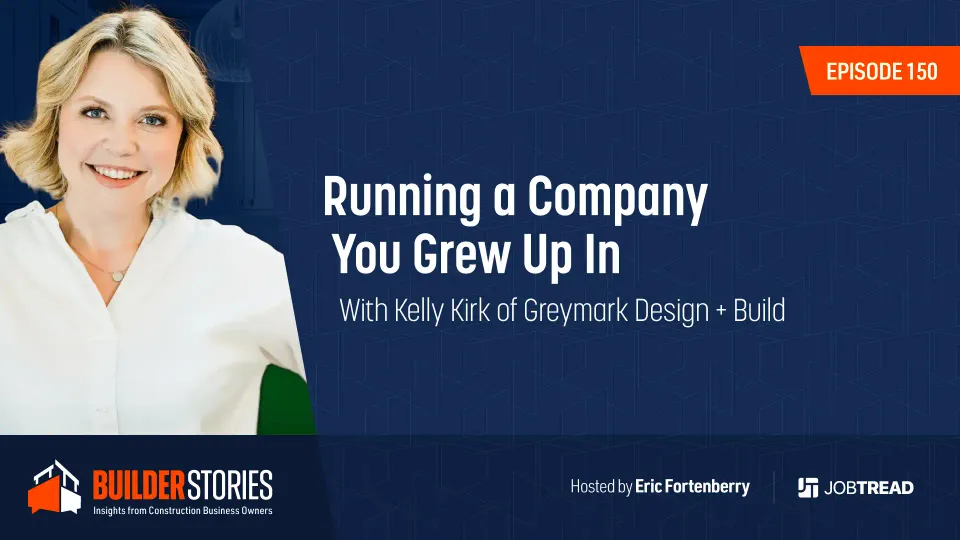

Kelly Kirk took over Greymark Design + Build a few weeks after her mother, who founded the company, passed away. Leslie King was a larger-than-life figure and a well-known industry leader. Kelly chose to honor that legacy while also finding her own voice as a leader and bringing in fresh processes and a new approach. The journey wasn’t easy, but today Kelly heads up a thriving company with a strong, aligned, and high performing team.
In this episode you will learn:
- Why Kelly could not lead the way her mother did, and what she built in its place
- The single email that changed how Kelly’s team saw her, and how long the effect took to compound
- What her business coach used to pull the company through its worst stretch, and why it was far simpler than she expected
- The client comment that revealed a blind spot only someone outside the industry could see
- How she plans in one, three, five, seven, and ten year increments without losing focus on the current month
Listen to the episode to learn more.
Resources:
Learn more about Greymark Design + Build here.
Eric Fortenberry: [00:00:00] Welcome to the podcast where we take a deep dive into the stories behind construction business leaders. We will share how they got started, how they found success, and the lessons learned along the way. I’m your host, Eric Fortenberry. Welcome to Builder Stories
Eric Fortenberry: Welcome back everybody. Today, I’m excited. I’ve got a fellow Texan with me. Kelly Kirk is the president of Graymark Design Build. They’re located in Houston, Texas. Very excited to have you on Builder Stories. Welcome to the show.
Kelly Kirk: Thank you. Thanks for having me.
Eric Fortenberry: Yeah, it’s my pleasure. So why don’t you kick us off as usual.
Eric Fortenberry: Give us a little bit of background, who you are, how’d you get into construction, you know, what led you to, to Graymark?
Kelly Kirk: Sure. So, um, we’re Graymark Design Build. We were Graymark Construction Company when we first started. So a little atypical, especially in Texas. Um, the company actually started in like 1995 with my mom.
Kelly Kirk: [00:01:00] So my mom actually started it. I was very young. Uh, she was between the names Watermark and Graystone. She liked those two, and she wanted to combine them. And so it was, um- Gray Mark were Waterstone, and we thought Waterstone sounded like a development. So we, my sister and I next to that. I have a younger sister who’s two and a half years younger.
Kelly Kirk: Uh, so she started the business when we were really young, and she started at Swinging Hammers. There’s a historic neighborhood not too far called The Heights, and that’s where she started out working on houses from the ’20s, ’30s. And then I grew up in the industry, going to job sites, sitting for inspectors.
Kelly Kirk: Uh, fun fact, they oftentimes won’t red tag if a child is the one waiting for the inspector. They feel a little bad. So that was her little, her little trick to, to have that done. I would clean up job sites. Uh, so that’s [00:02:00] kind of how I got started. When I was in high school, she actually had me run payroll.
Kelly Kirk: So she would take me out of school on Fridays when class was over, and I would actually start doing her payroll for her as a teenager. Uh, so it’s pretty wild. I would-- I can’t believe in hindsight that she would do that, but it was so fun. It was really fun to be able to do that. Uh, so then I went to college, and her theory on it was that she wanted me to be able to spread my wings.
Kelly Kirk: So during all of this time, she’s working, she’s growing the business. She’s, you know, establishing everything. I’m going to college, and I get a degree in finance, financial consulting with a minor in economics, so like super business. End up getting my master’s in accounting, take the CPA exam, uh, so like super business, not construction.
Kelly Kirk: Still relevant. [00:03:00] Uh, so I do accounting for a few years. She’s asking me questions about things. It was kind of fun to get to talk about the business in a way where we were more equals. And then when, in about 2017, I approached her and said I was interested in coming on board. And so In 2017 was Hurricane Harvey, which, uh, was a lot more traumatic for us, but I think the rest of the country probably knows about it.
Kelly Kirk: But we got 52 inches of rain in, like, three days. It was insane. So, so much of the city flooded. She was inundated with work and with calls, and so I started helping out with her. Even though I had a full-time job, I started helping out with her, and then I came on board in April of 2018 full time. Uh, during Hurricane Harvey, she was diagnosed with her cancer had come back.[00:04:00]
Kelly Kirk: So it had started in 2015, but it’d come back in 2017. Uh, and she ended up passing away in 2019, August 2019, so that’s when I took over full time. Um- I’m sorry to hear that ... since then, it’s just been me and my team, and we’ve been, you know, going ever since. And despite the fact that this is not what I went to school for, it’s always been a passion of mine, and I’ve always loved doing this.
Eric Fortenberry: Yeah. Well, I’m really sorry to hear about your mother. That’s, it’s, it’s tragic. Um, very, very interesting, though, that you, you, you literally grew up on the job site from a very young age. Uh, I, I love the, uh, I love the inspector story. That’s, uh, that’s, that’s pretty awesome. I could see, uh, I could see some others maybe, uh, trying to plant their kid there waiting for the, uh, waiting, waiting for the green tag as well.
Eric Fortenberry: Um-
Kelly Kirk: Yes. Despite the fact that my sister does not work with me, she is also [00:05:00] an architect in Dallas, so she is still... It, it’s in our blood. My dad flips houses, uh, for a living out in, uh, like Lake Sam Rayburn area, so kind of far away from where I am and where my sister is. But, uh, it’s, it’s... I had no other choice.
Kelly Kirk: With my mom, my dad, my sister, all of us are in the same industry, so...
Eric Fortenberry: That, that’s, that’s, that’s awesome. I mean, I, you know, I love hearing the stories of people who have actually grown up, you know, in the trades, on the job site. Like, you, you really understand what it’s like, you know, to, to, to run and be part of a construction business, which I think it gives you tremendous advantage versus someone who’s just kind of getting into it later in their career and sort of, “Hey, I’ll start a construction business” but, like, they, they haven’t, you know, actually gone and done, you know, decades of, of, of hands-on experience to, to know what it’s like.
Eric Fortenberry: Um, so, so, so very neat that, that you’ve got that, and I’m sure you’ll always cherish those memories.
Kelly Kirk: Mm-hmm. Yeah. It was... It’s a really different way of getting to know [00:06:00] your parents when you’re actually going to work with them and helping them out with their job. It’s- It’s pretty fun and builds your relationship in a, a completely different facet.
Kelly Kirk: It’s-
Eric Fortenberry: Yeah. I mean, running, running payroll, uh, as, as a teenager’s gotta be, uh, pretty, pretty interesting seeing all of the, you know, the, the, the salaries and the pay and, you know, just, like, kind of being exposed to that at a young age. I mean, what a valuable, you know, opportunity for you, and I mean, you know, ultimately that kinda doesn’t make me surprised that you end up going into the accounting route and, and, and, you know, going, going down that path when you, when you saw, you know, what it took to, to actually, you know, do that back office, you know, administrative type work to, to help make sure people got paid.
Kelly Kirk: Will say I have never been the one to, like, prepare the financial statements, do the AP, do the AR. That’s never been... Outside of when I was in high school, that’s never been something that I’ve really done, and I think part of it is [00:07:00] because I realized from 16 that, uh, maybe that path wasn’t for me. But I did still enjoy, like, the business aspects of it.
Kelly Kirk: So even when I was a CPA, I was an auditor, so very, like, high level flux analysis, looking at, you know, changes between financial statements, trying to figure out where, where are things that Are kind of hiding in the numbers. You know, numbers can tell you a lot, and I think we as business owners understand that if you don’t know your numbers, then you’re flying blind.
Kelly Kirk: And so having that experience from a young age, I think also helped me understand why I wanted to go into finance and accounting, and that is still something that I really enjoy is the numbers. That’s kind of how I approach sales as well.
Eric Fortenberry: Yeah, absolutely. You know, that, that’s, uh, that’s actually my background as well.
Eric Fortenberry: I did, uh, finance and accounting undergrad and ended up going to investment banking for all of nine months before I quit to start my first business. But, you know, I, I feel like having that, you know, that, that background and that experience, you know, understanding numbers and [00:08:00] financials and cash flow, you know, that definitely is, is a very great skill set for, for any business owner or business leader to, to have and to understand, even if you’re not doing the day-to-day accounting and, you know, all, all, all of that, it’s, it’s, it’s, it’s so important.
Eric Fortenberry: I feel like a lot of business owners, they, they really, they struggle, you know, to, to understand how all the financials come into play, and they think, “Oh, you know, we had a great month, and we got, you know, $100,000 in the bank, and we’re, we’re doing so good.” And it’s like, “Well, actually, hold on. We better go look at those liabilities and how much do you owe to other people before we, we declare victory here.”
Kelly Kirk: Absolutely. I remember when I was, when I was first kind of getting out of school and, and working on things, my mom actually at one point asked me why... Because in the peer group that we’re part of, the statement of cash flows is not something that you review as part of your packet. And so she’d never really put a whole lot of stock into that specific report.
Kelly Kirk: And so she asked me, “Why does my bank balance not tie [00:09:00] to my net profit?” So it was kind of fun to, like, have that conversation with her and try to explain, “Hey, that’s not, that is not the way that it works. There are non-cash transactions, there are cash transactions, and these can show up here,” and kind of teach her a little bit about that.
Kelly Kirk: It was-- And the fact that she listened to me, frankly, shocking, but- ... she respected me enough and my education enough to, to actually listen to what I was saying and see me as a, an equal in that regard. Obviously, she’s still my parent, but, uh, it was... I don’t know, it was just really, really fun to, to have that experience and to have that respect from her.
Eric Fortenberry: Yeah, that’s awesome. So I’m, I’m curious, I mean, you know, you, you had been obviously kind of part of the business for, for many years on and off, kind of, you know, before school, after school, you know, part-time, full-time. And then, you know, ultimately af- after your mother’s, uh, passing, you, you ended up taking over the business.
Eric Fortenberry: Can you, can you tell us a little bit more about that transition and, and what was it like, you know, having to, to [00:10:00] step into that, you know, that leadership role and, and, and take the reins? I mean, how, how, how were you able to sort of come, come to terms with all that and, yeah, what, what, what, what was, what was it like being at the, at the helm?
Kelly Kirk: Well, Eric, that’s a great question. Uh, I-- What I neglected to mention, uh, about August 2019 is that I was also super pregnant. I was about 28 weeks, I think. So, uh, not only was I suddenly taking over my mom’s business that she had grown from scratch, and now I was entrusted with this, her baby, her-- my, my third sibling, uh, but I also was growing a small human.
Kelly Kirk: And so that was, that was pretty wild. And my husband did work with me at the time. So it was, it was a whole family affair. Uh, I-- when it happened, I leaned heavily on my team. So a lot of people have-- a lot of business owners [00:11:00] Have the theory that they know all of the things and they have to tell their team what to do and how to do it.
Kelly Kirk: And there’s actually a book that I read early on, and it’s called Turn the Ship Around, and it’s really about bottom-up leadership, not just top-down. And so that really had an impact on me in empowering my team to be able to make decisions because I don’t think I would’ve been able to survive without them, especially when I ended up
Kelly Kirk: We were planning a company outing for a Friday just as a way for us all to get together and bond. This was a few weeks after my mom died. Uh, everyone in the company was reeling. We have a lot of people that have been with the company for a very long time, so this was, wasn’t just affecting me, it was affecting the entire team.
Kelly Kirk: The entire team was grieving and mourning. Uh, and so I, I was... I had a bunch of beer from a baby shower, and so I was [00:12:00] loading a cooler with beer, put it into my car, and they... You know, I was in my head thinking, “Oh, you’re not supposed to lift heavy things when you’re pregnant.” And at that moment I thought my water had broken.
Kelly Kirk: Turns out it was blood. So I ended up having an emergency C-section, uh, that day instead of going to the company outing.
Eric Fortenberry: Gosh.
Kelly Kirk: So, um, yeah, it was quite an adventure. And so I was, uh, I hadn’t signed checks. It was a Friday, and we sign checks every Friday, so I had to have somebody bring me the checks to the hospital- Okay
Kelly Kirk: where I had a baby come out of me, they are sewing me up, and somebody’s bringing me checks to my hospital room like an hour postpartum, just signing checks. Oh
Eric Fortenberry: my gosh. Wow,
Kelly Kirk: Kelly. I, this was a Friday. I got discharged on a Monday, my birthday actually. I got discharged on my birthday, and I was back at work on Tuesday.
Eric Fortenberry: Wow.
Kelly Kirk: Yeah. Wow. Then I was in the hospital again Tuesday night and discharged [00:13:00] again on Wednesday, and they told me that if I went back to work on Thursday, that I was gonna be back in the hospital and it was gonna be worse. So they made me stay home, so I finished out that week at home, and then I went back to work the following Monday.
Eric Fortenberry: Holy cow.
Kelly Kirk: I don’t recommend it.
Eric Fortenberry: Yeah, that’s, that is, uh... Wow, I’m, I’m, I’m shocked. That’s, man, g- V- very, uh, very impressive that you had the, uh, the ability to, to pull yourself to, to, to just do whatever it took that you had to do. I mean, I, you know, I certainly hope that others, uh, m- maybe can figure out a way to not have to push themselves so hard, but you know, I- Mm-hmm
Eric Fortenberry: I can only imagine your, your mindset and what you had gone through and just felt like your back was against the wall and you had no choice.
Kelly Kirk: I, I had no choice. I, I- In my head, failure wasn’t an option. So to me, it was never are we gonna make it, it was always how are we gonna make it? [00:14:00] How do I survive this?
Kelly Kirk: How do we get through it? Not are we going to. Uh, to my benefit, my mother did have some life insurance policies, and they were actually like a year shy of running out. So for anyone that does not have life insurance, key man policies, anything like that, that is what allowed us to keep the doors open, was the ability for me to draw on that money.
Kelly Kirk: We had also ... This was, um, quite the perfect storm. We’d also just built our building, and so we had zero cash because all of it had gone into building a building. So it was quite the perfect storm. And this was, again, 2019, so we all know what happened in 2020. Uh, it was quite the adventure. But I, I was also part of a peer roundtable group, and one of my peers actually flew in and came to sit with my [00:15:00] team and had me, had our office manager print off our financials, and he went through our financials and said, “Cut this, reduce that, do this.”
Kelly Kirk: I mean, he was even like, “Fire people. I’m gonna fire people. Like, if you want me to fire them for you, just send them right in. I’ll do it.” He’s like, “You can’t, you can’t afford all of this.” And so it was, it was pretty wild. I am so appreciative of the fact that somebody ... That he did not have to do that. He, he did not have to fly to my city and do this, but he did because he’s one of the kindest people ever.
Kelly Kirk: Um, and unfortunately for us, Houston’s infrastructure is also terrible, and we had a boil notice during the same time that he was here, so he couldn’t actually get water from anywhere, and all the restaurants were shut down. It was-
Eric Fortenberry: My gosh. It just doesn’t stop, does it?
Kelly Kirk: I think I’m ... Maybe I’m cursed, and I refuse to acknowledge it.
Kelly Kirk: I don’t know. I don’t [00:16:00] know. But, uh, maybe, maybe that’s it, ’cause yeah, it’s Therapy is a really great thing. It’s a O-
Eric Fortenberry: o- obviously you’ve, uh, y- you’ve come out stronger on the other side, so you know, it, it, it must have all ended up working out for you. I mean, uh, it’s, you know, life, life is very unpredictable.
Eric Fortenberry: It’s, uh, you know, who, who knows what you’re gonna get thrown. You know, being a business leader is extremely unpredictable, you know, constant, constant challenges, fires, you know, and just having to deal with all the hardest problems that sort of bubble up to the top. And, you know, at the end of the day, I, I think that it’s, it’s important that, you know, we, we, we do our best and, and, you know, leave it all out there on the field.
Eric Fortenberry: But, you know, at the end of the day, there’s only so much that we can do, and we gotta be able to go to bed and say, “Man, I, I did my best today. I’m gonna get some rest, and we’re gonna wake up, and we’re gonna do it all over again, and tomorrow’s gonna be a great day.” And, you know, it’s, it’s, it’s, it’s one day after another sometimes, and sounds like you- Mm-hmm
Eric Fortenberry: uh, you, you had quite the, quite the ordeal for a while there.
Kelly Kirk: Yep. It was, [00:17:00] um, 2019 through 2023 into 2024, I think, were our, our hardest years, and then things really started to click. It was a lot of, a lot of lessons that I had to learn, and despite the fact that I did go to college for five years, the best education that I got was still doing the, the things, making those wrong decisions and then figuring out what I can do to fix it.
Kelly Kirk: ’Cause I, I mean, as a business owner, you, you make tons of bad decisions. You, you do the wrong thing, and then you figure out, okay, well, that didn’t work. Let’s try it this way this time, and learning from it and, you know, listening to other people and learning from their mistakes is also super important, so that way I made my own mistakes.
Kelly Kirk: I didn’t make theirs, but I also learned from them as well. I heard this thing the other day, and it was, as a business owner, you’re either having your best year ever or you’re about to go out of business, and [00:18:00] oftentimes that’s in the same day. And I feel that deeply sometimes. But, uh, it’s, it’s, it’s really highs and lows, and it’s about being able to manage that and work through it and not have that anxiety kind of haunt you and being able to regulate your nervous system despite the fact that it’s, it, it can be pretty chaotic.
Kelly Kirk: I mean, thankfully now I’m at a point where it, it isn’t chaotic, and that’s something that I’ve had to work through is the fact that under-- for those many years, I was under such intense stress that I had-- I-- it was pretty clear what I was supposed to be doing and how to do it, and I had to just do the things that I knew I needed to do.
Kelly Kirk: And then you reach a point where it’s calm, and then that’s also hard to do as well, especially when you’re used to firefighting. Um, I know you had Doug [00:19:00] Howard on the podcast, but, uh, he was my business coach for a while. And I remember one of the things he said is, “Just because the walls aren’t on fire doesn’t mean that everything is bad.”
Kelly Kirk: So he’s, he was with me through all the firefighting years, but- Sure ... it was... Yeah,
Eric Fortenberry: I- So is that- Go ahead. So, so you said you’re, you’re part of a peer group. You- Mm-hmm ... sounds like you had a business coach, Doug. I mean, like, it... Would, would you credit those to kind of where you, you sort of learned how to lead and, you know, kind of how to, how to build your- yourself out of this, you know, this, this situation?
Eric Fortenberry: I mean, is it anything else that, that you think about, like, that made a huge impact on, on you as, as, as a leader and really h- helped you grow into your role?
Kelly Kirk: Absolutely. I am a huge believer in support networks and peer networks, so yes, I am part of a peer roundtable group, Remodelers Advantage. I heavily leaned on that group.
Kelly Kirk: [00:20:00] They are fantastic, wonderful human beings that I, I... I’m in a different group right now, but I talk to the other people and see them and I’m... They are a large reason why I’m standing here. I’m also part of the Greater Houston Builders Association, so it’s our local association that’s part of Texas Association of Builders and NAHB.
Kelly Kirk: So in, in Houston specifically, we don’t have any other large chapters like NARI or anything. We only have GHBA. It’s really the only one that can survive in our city because it’s such a, a large chapter. And so that is another one, is having peers in my city that I can ask questions of too, and that’s been very important for me being able to survive this.
Kelly Kirk: Um, Doug Howard really, really helped me at the absolute worst times. He was really fantastic, and it was funny because it... Sometimes when you’re in [00:21:00] those moments where everything feels the darkest, you think that there must be some sort of, like, complicated answer that you need to do. Like, sometimes you overcomplicate it, and it was so funny.
Kelly Kirk: One of the most powerful things that he and I did was just a revenue worksheet, just the most simple tool imaginable. And I as a CPA am huge on spreadsheets, and so I would do all of these crazy calculations and formulas, and really the thing I think that was most impactful for me in that moment was just that revenue spreadsheet, which was literally the most simple thing created.
Kelly Kirk: But it’s so- Was this like- ... powerful because it’s simple.
Eric Fortenberry: Was this like to m- to model out your growth and what you needed to make every month and...
Kelly Kirk: Mm-hmm. Yep. ’Cause I would get either too far in the weeds of this week, or I would get too far down the line into next year, and I couldn’t keep the focus in the right- Area, and so he was, I mean, he, he worked with me in [00:22:00] one-month and three-month increments.
Kelly Kirk: What’s happening this one month? What do we need to do for next month? And how are we doing for the month after that? I mean, it was really just like keeping a really short and tight window is kind of what got us through some of those w- worst times. Um, and then interestingly, I did Action Coach for six months before Doug Howard.
Kelly Kirk: Um- Action Coach wasn’t for me, but I learned a lot of really interesting things that ended up working out really well from that. And so despite the fact that something isn’t for me necessarily, there’s still absolutely things to learn. So I learned a lot about changing your mindset about things. So instead of
Kelly Kirk: Like mantras, it sounds so cheesy when you talk about it, but like mantras and like writing a letter to yourself for the future of, you know, what, what does your life look like [00:23:00] in three months or six months or something, and, and writing that letter of, you know, this is who I am now And then actually watching it play out because you’ve changed your mindset into this is what is gonna happen, and then you kind of just make it happen.
Kelly Kirk: It’s crazy the way that the mind works like that. I
Eric Fortenberry: mean, I feel like it’s the same way with setting, setting goals. You know, if, if you don’t set a goal, you’re, you’re never gonna hit it ’cause you don’t have one. But, you know, when you set that goal, it’s like, you know, uh, like I, I know, you know, here at JobTread every year, you know, we look at next year’s monthly goals and we’re like, “How in the world are we gonna hit that?”
Eric Fortenberry: You know, but then somehow you get into it and it’s like you set your sight on that goal, and lo and behold, like you somehow just, it just sorta seems to work itself out when, when you’ve got that vision and you’ve got that, you know, desire to, to reach that point. You know, that next step, whatever it is.
Eric Fortenberry: Like, I think having that mindset that, you know, you’re, you’re gonna do whatever it takes, but, like, knowing where you’re going is so important because so many people don’t... You know, they’re [00:24:00] just kind of doing the same thing over and over, but they don’t really have this, like, destination or this, this, this place that they’re trying to work towards.
Eric Fortenberry: And so, like, having that and giving that, like, a solid anchor, you know, in, in, in, in, in your direction and, you know, h- how will we know when we’re successful? Well, let’s hit that goal. You know, that is a great way to, to, to get a team motivated, to get yourself motivated, to, you know, kind of rally around that and, um, you know, it’s, it’s something that you can also fall back on.
Eric Fortenberry: And, and look, when you don’t hit it, okay, well, let’s, let’s look at why we didn’t hit it. What assumptions did we make? You know, how did... Like, what should we have done, or what are we gonna do differently next month to make sure we do hit it? Like, I think so many teams, you know, they, they don’t take the time to really plan out, you know, their, their growth and plan out, you know, their, their year and what do we need to do.
Eric Fortenberry: Let’s, let’s break it down monthly. Like, how many customers do we need to win? How many jobs? What’s the average price point? Is that enough? Are we charging enough? Like, do we have the team to go win those jobs, to go deliver on those jobs? You know, I think, like, going through that exercise, you know, is, is so important and, and I feel like a lot of people they, they, they try to sorta do it when it’s too late, you know?
Eric Fortenberry: They’ve... They’re, they’re already in [00:25:00] hot water wondering how we got here, and now you’re trying to work backwards instead of, you know, preventing yourself from, from getting into that position.
Kelly Kirk: Mm-hmm. Absolutely. I agree with that fully. I see that a lot in my roundtable group, uh, just over time. Not one company in particular, but I see that a lot, especially when people are thinking about transitioning out.
Kelly Kirk: They’ll say, “You know, I’m gonna... I wanna be out in, you know, three to five years,” but they haven’t even begun anything related to that transition. And it’s like, whoa, you, you really should have planned this out a while ago. I mean, for me, I’m, I’m... Oh, God, how old am I? 37? I’ll be 38 this year. I... One of those weird years where I, I don’t really know how old I am.
Kelly Kirk: I’m between 35 and 40. I don’t know. You,
Eric Fortenberry: you quit counting after a while, and it’s all good. Yeah.
Kelly Kirk: Yeah. I’m not quite to 40 yet, but I’m, I’m not 35 anymore. I’m in that, like, late 30s era. So I don’t really know what the future has for me, but what I do know is that in the short term, I know [00:26:00] where I’m going.
Kelly Kirk: So I actually have a one, three, five, seven, and 10-year. That’s a little bit more than most people would probably prepare. For me, it makes sense because I really think that it’s, it needs to be broken up into those littler chunks for me, the way that my mind works. Because I need to know where I’m going in 10 years, but I also need to know what I need to do in between to get there and how to make sure that I’m on track.
Kelly Kirk: And so with each of that, I have an org chart, I have assumptions that I’m making. So, you know, what can a salesperson sell? What can a project manager do? What can design produce? Things like that. And then I also have a budget associated with it, with salaries laid out for all of the team members, just to make sure that I’m tracking where I need to be.
Kelly Kirk: And then I also do, to your point about, you know, job size and number of jobs, where does our current job size average, where does it need to be, and how many projects does that mean that we’re doing? Just to make sure that all of that makes sense [00:27:00] together. ’Cause otherwise, I mean, anyone can set a goal and say, “You know, I’m gonna be a $20 million company.”
Kelly Kirk: It’s okay, but how? How are you gonna do it? I mean, you can set a goal, but you gotta have steps that you need to do to, to get there. So that’s, that’s been really helpful. And it is kind of funny to see it working its way out, ’cause I started this back in 2022, I think is when I started it. And yeah, we’ve been, we’ve been tracking where we need to be.
Eric Fortenberry: That’s awesome.
Kelly Kirk: Mm-hmm.
Eric Fortenberry: Are there, are there any other, you know, kind of ... It sounds like maybe this is something kind of new that you had implemented with the business. Are there any other, you know, kind of s- systems or processes that, you know, that, that you have implemented since taking over the business that you feel like have, have made a big, you know, impact on the, on the company and sort of helped you to, to take the helm and steer it?
Kelly Kirk: Absolutely. Um, so first of all, people [00:28:00] always talk about hiring and how important it is and- I had never hired anybody before, and I’d never fired anybody before. And firing was terrifying, but really it is like ripping a Band-Aid. Um, I’ve since had to fire a couple of people, not too many, but enough to have ex- uh, some experience.
Kelly Kirk: But hiring, I think, is really the most important thing, and I think having the right team around me has been one of the hardest things that I had to learn, was how to build the right team and how to manage them appropriately. So in my first beginning years, I didn’t understand how to really have a backbone, to be perfectly candid.
Kelly Kirk: I, I didn’t know how to stand up for myself in a [00:29:00] way that would be both strong and respectful at the same time. And so that was something I had to learn. Um, in terms of like processes, I-- we didn’t really have any when I started. We didn’t-- Nothing was really a process, and so we had to have more defined proce- My mom was, oh God, such a force of nature.
Kelly Kirk: Just-- She was shorter than me, but her shoes were so big to fill. I mean, just an incredible person. So I think a lot of the reason why we were so successful before is because of just who she was. But unfortunately, Leslie King is not a process, and so I had to figure out how to make the processes to follow.
Kelly Kirk: So, um Just learning from other people. I went and visited a lot of different companies, saw the way that they did things, and, and [00:30:00] took a lot of information from them to try to build things that made sense for our company. Um, ask clients a lot for feedback to be able to refine our processes that make sense for our specific demographic.
Kelly Kirk: What do they wanna see? For example, we used to do appliance shopping before the clients had even seen a floor plan. And we finally got some feedback that we implemented of, “Hey, I have a really hard time picking out my appliances when I don’t even know how it’s gonna lay out.” And for me, as somebody in the industry, I’m like, “Well, of course you can pick out appliances without knowing the lor- the layout.
Kelly Kirk: You build the layout around the appliances.” That’s not how people that don’t do this for a living think. So it was really helpful for us to hear that feedback and build it in. And so that’s a constant part of what we do, is the continuous improvements, one of our core values. Uh, another thing that I thought was a really interesting lesson to learn, [00:31:00] um, in terms of processes is I don’t have to do all of the jobs, and in fact, other people can do them better than me.
Kelly Kirk: Um, at one point, I had to fire myself as estimator because I did such a bad job. I was-- I forgot stairs in an estimate one time, and I had relied on the team around me to catch things. But the problem is that if you’re not the one preparing it, sometimes it’s really difficult to be able to catch things in a review.
Kelly Kirk: You can catch a lot of things, but sometimes if it’s something as basic as stairs, in your head, you’re just like, “Well, surely the stairs are in there.” They weren’t. They weren’t. So one of my project managers was
Kelly Kirk: Project management wasn’t what he should be doing with his life. And I liked him, and I knew that he was still a good fit for the company, but I knew that he wasn’t a good fit for that role. And so [00:32:00] we ended up moving him into estimating because he knew all of the things from project management, and oh my goodness, he has been thriving in that role.
Kelly Kirk: And another interesting thing is he was having some health issues during that time, and I really tried hard to get him to take care of his health and wasn’t penalizing him for having to take off for doctor’s appointments and things. And because his health has really improved, now he can actually give us his best self, and so that’s been a really interesting thing to learn.
Kelly Kirk: I g- it’s not really a process. I mean, I could think it’s kind of like a maybe an HR process, but, um, allowing my team to be able to take care of their health has allowed them to be able to do a better job and also enjoy working for us as much as possible. I mean, my office manager has been with us, oh my goodness, like- 18 years [00:33:00] or something, 17 years.
Kelly Kirk: Like, she’s been with us for a long time. My building designer is, like, 12 years. I mean, these people have been there for longer than I have. Um, I have a project manager who’s been with us since 2018, which in this industry you don’t have project managers stick around that long. That is a hard job, and it’s oftentimes fairly thankless.
Kelly Kirk: And so that’s been a large thing that I think has been really important to me is taking care of the team that’s- Kind of what I think of as my role
Eric Fortenberry: Yeah
Kelly Kirk: Taking care of
Eric Fortenberry: them No, I’m not-- I, I agree with you. I, I think, you know, building the right team is, is, is arguably the most important thing that any leader can do because at the end of the day, like, we’re, we’re only one person.
Eric Fortenberry: There’s only so much that we can do. And, you know, if, if, if, if we try to keep putting on every hat and do everything ourselves, I mean, that is exactly what leads to dropping balls and just not, you know, being able to, to, to execute at that high [00:34:00] level, you know, that we want. And it’s, it’s, it’s not because, you know, we’re not able to or trying to or want to, it’s just, we just physically don’t have enough time and enough ability to focus on doing everything and doing it well.
Eric Fortenberry: And so it is, it’s so important that, that, that, that we build the right team. And, you know, look, just like you said, sometimes, you know, you, you gotta get the right people on the bus, but then you, you may have to get them into a different seat. I mean, one of my favorite books, Jim Collin, you know, from, from, from Good to Great, right?
Eric Fortenberry: Like, right people on the bus, right people in the right seats on the bus, and then sometimes you gotta get, you know, the wrong people off the bus. And, you know, I, I agree. I, I think letting someone go is, is, is, is one of the hardest things, you know, that, that, that leaders have to do. But, you know, at the end of the day, like, if it’s not the right fit and, and you’ve coached them and you’ve tried and it’s still not working out, like, you, you just have to make those tough calls.
Eric Fortenberry: And I feel like a lot of people just, they, they just keep kicking that can. They, they keep saying, “Oh, may- they’re gonna change,” or, “Something will, will be different,” or, “They’re gonna show up differently tomorrow.” And it’s like, look, you know, we, we gotta, like, quit lying to ourselves, [00:35:00] and we gotta make the hard decisions.
Eric Fortenberry: And, you know, I think ultimately it’s, it’s, it’s, uh, it’s kind of the, the, the responsibility of the leaders that we just have to do what needs to be done for the interest of the business, the team, our clients, you know? And so it, it sounds like you’ve, you’ve had to, to learn that lesson, uh, as well, and it’s, uh, it’s a very important one.
Eric Fortenberry: You know, what, what I, what I’d love to dig in a little bit more to, because, like, you know, again, like, you, you, you said that you didn’t have the backbone early on and you didn’t know how to stand up for yourself. I mean, you know, again, being, being a woman in, in this male-dominated industry, I mean, you know, you, you are an outlier.
Eric Fortenberry: You know, and you, you had to, you know, learn to, to not let that affect your ability to build and lead a company in this industry. I mean, h-how do you feel like that has-- H-how has that, you know, been for you? Like, how have you overcome? Like, where did you get the confidence, you know, to stand up to anyone and everyone?
Eric Fortenberry: You know, because, like, I, I see so many, you know, opportunities that, that women could step into these, into these roles in this industry. But, like, it seems like there [00:36:00] is a little bit of fear in there. You know, it’s, it’s certainly not, you know, easy. H-how did you figure it out? And, like, where, where did that confidence come from?
Eric Fortenberry: And, like, what, what made the biggest impact for you to, to be able to lead?
Kelly Kirk: Um, so that is such a good question. Uh, I think one of the biggest things that really turned it for me is getting fed up, to be perfectly candid. I, I took a lot from other people because I didn’t have the confidence, I didn’t have the backbone, and I would-- I-- There were certain people, I just let them walk all over me, employees, trades.
Kelly Kirk: I, I am a rose-colored glasses kind of a person, and so that can be really detrimental when you’re dealing with people that are, uh, taking advantage of you, and that is exactly what happened to me. [00:37:00] Um, and so finally, I got to a point where I realized that I was gonna lose my team and I was gonna lose other things if I didn’t get this figured out.
Kelly Kirk: And I was losing so much money on projects. I was losing client trust, I was losing team trust, and I realized that there was one specific source of this. And I-- and it was somebody that had all, I thought, all of the construction knowledge. And part of the thing that was holding me back is I thought I had to have that person.
Kelly Kirk: I was so fixated on keeping the team intact and being proud of that, that I lost sight of the fact that sometimes people shouldn’t be there. They don’t have your best interests at heart, and if they aren’t there for the right reasons... So I actually, during that time, I’d also gone through Traction. I’d started reading through Traction, and it was-- there’s a, a lot about, you know, right [00:38:00] people, right seats, and looking at people and how do they compare to your core values and how do they, you know, pulling your core values from thinking about your best employees.
Kelly Kirk: And I realized that he not only didn’t fit any of my core values, that he was actively detracting from everything. Uh, and so this was a, a management position, and I ended up There was one moment where I had expected him to come through for me, and he let me down in a huge way. And instead of being fearful and hoping that he would change and making excuses and saying that it’s a one-off, I took the initiative, and I sat down, and I actually wrote him an email and put on my big girl pants and, and decided that I, I can do hard things.
Kelly Kirk: I can be brave. I mean, being brave [00:39:00] isn’t not being scared, it’s doing it even when you’re scared. Yeah. And so I was terrified. I was so scared, and then I sent that email, and of course you have that panic of like, “Oh my God, what have I done? I can’t believe I just did that.” Uh, ’cause I had tried calling, I’d tried texting.
Kelly Kirk: He didn’t answer at all, and so I finally sent the email, and by that point, there was nothing that I could... I can’t undo it at that point. I mean, it, it had started the ball rolling, and once I took that little step down that path of trying to hold him accountable, it snowballed from there. And the funny thing about confidence is that it is really baby steps, so it was...
Kelly Kirk: That was the one turning point, was just one single email, and through that one single email, I felt more proud of myself, which built into more confidence, which built into [00:40:00] more confidence, which has me now to a place where I don’t, I don’t have a problem pulling someone into my office and saying, “What are we doing here?
Kelly Kirk: Why are we, why are we doing... You know that that’s not, that’s not gonna work like that. That’s... We don’t do that here.” But it took... I mean, this was 2021, and it took probably like two or three years for me to really build confidence to the point where I felt truly confident. It also helps that, you know, you get...
Kelly Kirk: When that starts to happen, when start- people start to notice you’re building confidence, they’ll comment on it, and that is really nice to hear. So then y- it’s just these little, like this little snowball-
Eric Fortenberry: Yeah ...
Kelly Kirk: that just keeps going and gets bigger and bigger and bigger and then eventually one day you look back and you’re like, “Oh my gosh, I can’t believe, I can’t believe I used to take that.
Kelly Kirk: I can’t believe [00:41:00] that that was the way that I used to be.” I mean, really for any women that are struggling with that fear- I mean, I think just starting, just, just doing a hard thing once and realizing, “Hey, I survived that. I can do another hard thing.” I, I mean, it’s scary, and it doesn’t mean I’m not scared.
Kelly Kirk: It doesn’t mean I wasn’t then. I was terrified, but I just did it and kept going and It, it, it just I think accountability is one of those, like, biggest things that leaders can struggle with. It’s a really common struggle. And once you start it, it just works so well. And I do think that we need more women in the industry.
Kelly Kirk: I, especially doing what we do, I think a lot of times people are looking for women to work in their houses, and if you’re looking for a man, there are so many other choices. [00:42:00] There are s- and there are great choices. I love my peers. I will absolutely recommend them to anybody. But if you’re looking for me, you’re probably not looking for them.
Kelly Kirk: And so I do think that there is, there’s a shortage of women in remodeling and women in, in leadership positions. Women have a very different way of approaching things. I mean, it- it’s just kind of the way that we are. Um, and I think you really need different people with different ideas to be able to have a successful industry.
Kelly Kirk: We have to have people with different backgrounds and different ways of thinking about things. Otherwise, we, we ... I don’t know, it just doesn’t quite work right.
Eric Fortenberry: Yeah. Well, I mean, it’s, you know, and it’s, it’s challenging, you know, when, when it had to get to that breaking point for you, for you to just feel like you had no other option, you know?
Eric Fortenberry: But, like, once you went in and you started, you know, [00:43:00] holding them accountable and, you know, kind of making the tough call, you know, you, you probably felt this sense of relief and this weight that just, like, g- was off your shoulders because, like, if you’re sitting there being undermined at every single turn, you know, like that, that, that is never a good recipe for, for anyone.
Eric Fortenberry: And, you know, I, I, I think at the end of the day, like, that, that is what is so unfortunate when you see leaders who they, they, they ... And they may even know that this is happening, but they don’t take action, you know? And, and so, like, at the end of the day, though, like, it, it sounds like, I mean, you, you finally learn to, to make the tough call and to take action.
Eric Fortenberry: Like, that step, you know, a- again, it, it not only built confidence for you, but I- it sounds like it gave your team, you know, this, this, this, this rejuvenated, like, sense of like, “Okay, Kelly is our leader here, you know, she isn’t gonna let this stuff fly.” And, and, and, like, when you start getting that momentum going, you know, you’re, you’re earning respect of your peers and, and your, and your coworkers and your employees by doing the thing that a lot of people, I think, fear.
Eric Fortenberry: Like, letting someone [00:44:00] go, you’re always worried that, like, “Well, is everyone else now gonna think, are they gonna let me go?” Like, you know, is the boss the bad guy because they let someone go? And, like, you know, they, you know, m- they may have heard, you know, that other person’s side. And, and, you know, again, like, as leaders, we can’t just go around and say, “Hey,” like, “Here are all my issues with each one of these employees.”
Eric Fortenberry: Like, you know, you can’t, you can’t share that type of information, you know? But I think when they see action and, and they ... You know, again, I think a lot of people innately know, yeah, that person, you know, just, just wasn’t the right person here. You know? Like, if you leave that, that one person who is a toxic, you know, energy and attitude and You know, again, like the reality is probably a lot of people didn’t enjoy working with him.
Eric Fortenberry: You know, regardless, you know what I mean? Nobody wants to see somebody else sit there and, you know, undermine, you know, one of their, their coworkers, much less their boss, and like, you know, like that, that, that really doesn’t, you know, bode well. And some people think, “Oh, you know, that’s cool. It’s how they build relationship.
Eric Fortenberry: Let’s talk bad about, you know, someone else.” And it’s like, man, like, you know, the, the reality is they’re probably judging you just as much, if not more, for whatever you’re saying. And so, [00:45:00] you know, good, good for you for, for, for not, not letting that person continue to, to, to, to run over you. And, you know, again, I, I think, I think you’re absolutely right that this industry needs more women leaders.
Eric Fortenberry: You know, we need more people because, you know, at the end of the day, like, you know, it’s, it’s, it’s so important for, for a client to feel like they have the right contractor, and they have a good relationship where they like them, they trust them. You know, they, they are picking you as a person, you know, and they want to make sure that they believe that that person will be the best fit for them to go and, you know, rip out their house and tear out their kitchen.
Eric Fortenberry: And like, you know, like there’s a lot of trust that has to be built there. And, and, and again, I, I think that there’s such a huge opportunity in this industry, but like we need more women to hear your story and to hear the successes. I have met some of the most successful construction companies out there are run by women, and it’s incredible when they can really, truly, you know, build that team and, and, and, and they, and they lean into, “We are different.
Eric Fortenberry: We are the woman. We [00:46:00] are going to lead you and give you the best customer experience that you could ever ask for.” Like, that is exactly what has created so many successful women-led businesses here. But like, again, they, they’re not hearing those stories enough. You know, we need more people to hear those stories and to see those successes.
Eric Fortenberry: And I’m not sure if you’ve, if you’ve talked to, to Erica and Anna and Taylor. I mean, we have an incredible group of women here at JobTread, and they’re actually creating, you know, a, a women in construction, you know, event that, that’s gonna be, uh, you know, the day before JobTread Connect, which is like so exciting to bring together so many people so that they can see the successes, and they can hear the stories, and they can learn from others.
Eric Fortenberry: You know, I’m, I’m... You know, you said it earlier, like having that peer network and the support group and, you know, peer groups, like that is so important for everyone. And so like we’re, we’re excited to, to, to be spearheading this and hopefully, you know, can, can, can, can inspire more women to, to continue joining this industry and, and leading because, you know, just, just like you said, I think you can make a huge impact
Kelly Kirk: Absolutely.
Kelly Kirk: I [00:47:00] mean, I, I do think that there is kind of an untapped network there of, of women in construction that we want to get together more because our experience is a little bit different, and there aren’t as many of us. And, uh, our local GHBA chapter didn’t have a professional women in building group until, oh gosh, like 2023 or something like that.
Kelly Kirk: And right when we started it, it became one of the largest chapters in the country because it was just this like pent-up desire for like, I want to be in this group, but we just didn’t have ability to get it off the ground. So I’m so excited that y’all are doing that. That is fantastic. Also, I mean, kudos to you and to all of JobTread for an incredible connect experience.
Kelly Kirk: I mean, that is, um Last year was our first time to go, and I was blown [00:48:00] away at how amazing it was and how much I learned, and just the incredible thought and, and effort put into an event like that. I mean, it was next level. And so I have no doubt that the Women in Construction event that y’all are putting on this year is going to be just as beneficial and fruitful as the rest of the experience that I’ve had.
Eric Fortenberry: I appreciate that. Of course. We, we, we definitely, uh, have, have an incredible team, and they work very, very hard to, you know, to, to plan that event. I mean, it’s like, you know, we’re, we’re now actually... I think we’re, we’re, we’re working on securing locations, like, all the way through 20, uh, 31 now, I believe.
Eric Fortenberry: You know, and it’s like, you know, having to like, you know... The, the challenge has been, you know, with our venue, you know, we’re kind of, you know, constrained. I mean, we’ve just, like, blowing the walls off this thing and trying to figure out how do we, you know, maximize that because we sell out every year, and, like, I mean, that’s, like, the last thing we want.
Eric Fortenberry: But, like, there’s really not that many, you know, venues large enough because, like, we’re kind of, like, in this, like, you know, 1,000 to 1,500, you know, [00:49:00] people. They’re, they’re-- it’s kind of like this, like, middle spot where you got a bunch of venues for smaller groups, and then you got, you know, a bunch of venues for, for huge, you know, thousands of people.
Eric Fortenberry: But kind of like that, that middle void, you know, has been very challenging for us. But, you know, it’s, uh, it’s, it’s-- I, I’m with you. I think it’s so important that we keep bringing people together so that they can meet others, and they can network. And, you know, I, I, I think a lot of times people just, they, they feel like you’re alone, you know, at the top, and, like, we don’t have anyone else that knows what we’re going through because, you know, we’re, you know, we’re, we’re the business leaders and the owners and, like, you know, no-nobody else gets it.
Eric Fortenberry: And, and, and it’s like, man, like, that’s not the case. Like, so many people are going through the exact same thing as we are at the exact same moment, or maybe they’ve already been through it, and it’s like, you can learn so much from so many other people, and that’s... I mean, that’s why, like, I work so hard on this podcast, you know, and want to share these stories because, like, you know, a-again, like, you can’t just keep doing the same thing over and over and expecting a different outcome.
Eric Fortenberry: Like, you got to go invest in your own learning, your own development. You know, invest in your team’s professional development [00:50:00] because, like, that is ultimately what’s gonna make the biggest impact for everyone here, you know, including, you know, your, your team, your company, but also your clients and their success and being able to recruit, you know, more clients and more trade partners and, like, you know, it, it all kind of feeds into, to itself.
Eric Fortenberry: And I think once you get this, like, energy, you know, and this, like, momentum going, you know, it can keep building on itself, and yeah. So I’m, you know, I, I’m obviously a big fan of what we do with, uh, with, with Connect and, you know, really excited for the Women’s Summit this year, and it’s gonna be, uh, g-gonna be awesome.
Kelly Kirk: Fantastic. Yeah, I agree. I mean, I think I did have a-- I grew up, obviously I’m from Texas, I grew up in church, and felt a bit like church camp-ish. You know, the like, that high that you get when you’re like at the, at the church camp, you know? Ah, it was-- Hadn’t had that feeling in quite a while, so it was, it was kinda fun.
Kelly Kirk: That like just super energized feeling where you’re like, “I’m gonna go out and we’re gonna crush everything.” “Everything’s gonna be fantastic.” Yeah, and having not just me, but a team member [00:51:00] there too was also really cool. I’m so glad that it’s an event that isn’t just for business owners. ’Cause yes, being a business owner can be very lonely, but I think sometimes we do get to a place where we, we do a lot of professional development on ourselves But I think sometimes we can get too carried away on that and forget about the professional development that we need for our team members, too.
Kelly Kirk: And they need to learn that as well. I mean, it, it’s just as important for them, and having those opportunities to learn about business and understand things also empowers them to be able to treat our businesses like their own and to have that, you know, owner’s mentality, which has been really beneficial.
Kelly Kirk: And my, my employee who went with us last year, um, he’s, my goodness, head over heels for JobTread, and he has taken this, and he will just do things on his own now because he feels confident enough in both the software and [00:52:00] in my trust of him that he will just like, “All right. Hey, guys, I’m gonna have this done for your daily logs.
Kelly Kirk: You’re gonna see some changes coming in, and this is the way we’re gonna do our scheduling now.” It is the coolest thing to see this happening, and I just get to sit back and watch it, and, gosh, so beautiful.
Eric Fortenberry: Yeah. It’s, it’s awesome when you, you have a team that truly does feel empowered, and they know they have the support of the leadership and, and, and they can go, and they can take initiative.
Eric Fortenberry: They can implement change, and then they can inspire the people around them to, to also adopt and do it. And so it doesn’t feel like as leaders we’re having to just hammer all these things in. It’s like you’ve got this, you know, groundswell, and people like, you know, want to do it. They want to make the change.
Eric Fortenberry: They want to be better, and that’s, uh, that, that’s when I think you, you really know that you have unlocked the potential of your people and your team when you start seeing that stuff happen.
Kelly Kirk: You know, it’s funny. I have two small children that are four and six, and I think a large part [00:53:00] of what has developed me as a leader is also what’s developing me as a parent, where like it’s kind of the same mentality.
Kelly Kirk: Like, I’m raising two humans, two small humans, to become big humans that are successful, and I’m, you know, keeping the guardrails on them while they learn to, to become a human. But also with employees, like I, I’m entrusted with these people, and I have to keep the guardrails on them while they learn their jobs and how we do jobs together.
Kelly Kirk: And so it, it is kind of like a similar mentality, uh, between parenting and, and, you know, having employees and management where, uh, like You’re still, y- you’re still trying to guide people doing things. I don’t know. It’s just kind of funny.
Eric Fortenberry: Yeah. Well, I gotta ask, since I, since I now know you’ve got, you know, a 10-year plan there, I mean, what, what...
Eric Fortenberry: You know, what, what’s the vision here? I mean, you, you’ve obviously, you’ve got a second-generation company. You know, you’ve done a phenomenal job taking over and building out the business and [00:54:00] have, have now made your mark on it. Where do you, where do you wanna take the business over the next, you know, five, 10 years?
Eric Fortenberry: Like, what’s, what’s kind of the, the goal here? Is it to maybe hand it off to one of your children one day? Or what, what do you... You know, do, do you have thoughts on that?
Kelly Kirk: I don’t, because my children, again, even in 10 years, my oldest will only be 16, and at that point he will have no idea what he wants to do with his life, I’m sure.
Kelly Kirk: Although f- already he’s like, “I’m an engineer.” And my daughter is like, “I’m either...” She changes her mind, doctor or dentist. Four years old, she’s gonna be a dentist. Four years old. That’s crazy. Love her. She’s crazy. Yeah.
Eric Fortenberry: That’s
Kelly Kirk: awesome. Um, I don’t know where we’re ultimately headed in terms of, like, who will eventually be in charge after me, but really the vision is to grow, and to grow it to a place where the people that I have that I’m building up as team members will eventually get to have their own teams, because I think that they’re all fantastic people.
Kelly Kirk: But I [00:55:00] also wanna give them the opportunity to either grow into a new role or to stay where they are. Whatever makes the most sense for them and makes the most sense for the company, but giving them more opportunities and being able to work with more clients, because Houston’s huge, so there’s so many opportunities for both us and all of my peers to be able to thrive in this city.
Kelly Kirk: And so I think that’s really the goal, is to get to a point where we’re large enough to have- A really good amount of clients where we can help a lot of people live their best lives.
Eric Fortenberry: That’s awesome, Kelly. I, I, I, I really, I love your focus on everyone else. You know, you, you truly want everybody around you to succeed, and I can just see how you lift them up and have their best interests, from, from your team members to your clients.
Eric Fortenberry: Like, I mean, that is a, a, a very, you know, impressive sign of a great leader, and it’s, it’s just so awesome to, [00:56:00] to see you, you know, doing this.
Kelly Kirk: That’s my why. My... That’s my why. You know, the, the book, like, Find Your Why, that kind of stuff. Uh, my why is to create a, uh, safe and non-judgmental place to help others bloom.
Eric Fortenberry: That’s awesome. So look, as, as we wrap up here, um, I, I wanna give you an opportunity to, if, if you had to pick, you know, a few pieces of advice to, to share with others who may be earlier on in their career, maybe they’re trying to decide whether to go into to the industry, you know, what, what advice would you give them, you know, knowing what, what, what you’ve been through, you know, seeing the challenges that you’ve overcome.
Eric Fortenberry: You know, if, if you had to pick just a couple things, what, what would they be?
Kelly Kirk: I mean, really my, my biggest advice would absolutely be build your network and just find people that have done where, what you want to do. I mean, this is true for not just our industry, but for everybody in life. Find a mentor.
Kelly Kirk: Find somebody that you can lean on. Find, [00:57:00] find people that you trust and can ask questions and be vulnerable. I mean, find people that wanna see you succeed, but also if somebody isn’t, does not have your best interest in mind- They don’t need to be in your life. They don’t need to be there. Only surround yourself with the right people, and if you surround yourself with the right people, you’re gonna be fine.
Eric Fortenberry: That’s awesome. Well, thank you so much, Kelly, for coming on. I, I, I know this probably couldn’t be easy to, to have to, you know, talk about your transition here and taking over the business after, you know, having such a hard, you know, loss, um, in your life, and I’m, I’m so sorry for that. But I’m, I, I, I can’t tell you how impressed I am with the business that you’ve been, you know, that you’ve built.
Eric Fortenberry: I mean, it’s, it’s been awesome and an honor just to be, just to be a vendor of yours and just, you know, your software provider. But, like, seeing your success is... It, it really is. This is what motivates us. You know, it’s such an inspiration to so many others out there, and I just... I, I really appreciate you sharing your story so that we can help spread the word and, and, and hopefully it’ll be an inspiration to [00:58:00] many other women who are thinking about entering the industry or have already entered it but may be struggling.
Eric Fortenberry: You have done a phenomenal job, and we are just so honored to have you part of our JobTread family here.
Kelly Kirk: Thank you. It was an honor to be on the podcast as well.
Eric Fortenberry: All righty. Have a great one.
Kelly Kirk: Thanks. You too. Bye.
Eric Fortenberry: Thanks for joining us for this episode of Builder Stories. We hope you enjoyed the conversation and gained valuable insights that can help you in your journey along the way.
Eric Fortenberry: Don’t forget to subscribe to the show and leave us a review. And as always, if you or someone you know has a story to share, please contact us at builderstories.com. We’d love to hear from you. I’m Eric Fortenberry, and remember, every builder has a unique story. Keep building yours