
How to Step Back From Your Business Without Watching It Fall ApartWith Felipe Freig of Versa Method Coaching
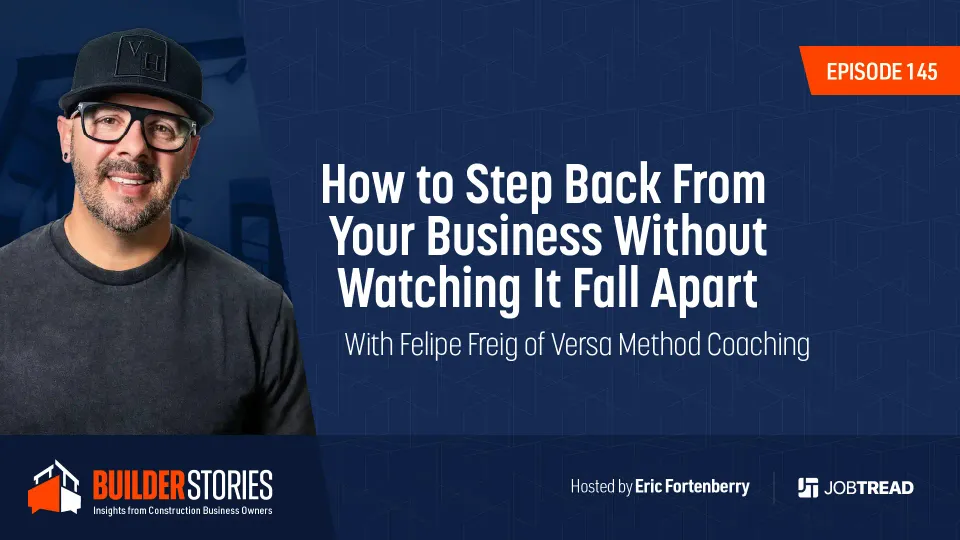

As the leader of Versa Homes, Felipe Freig builds multimillion dollar homes for executives and entrepreneurs. He dialed in the systems behind those builds so completely that he was able to step back from the daily grind. So he launched Versa Method Coaching to hand that same playbook to other contractors. In this episode he gets specific about what actually keeps a building business profitable.
In this episode you will learn:
- Why Felipe calls "transparency" a "crock" in the construction industry
- Why Felipe commits to a fixed price on multimillion dollar custom homes when almost no luxury builder will
- What luxury clients actually want instead of a line by line breakdown
- The one number Felipe says no client should ever see, and why showing it loses you the job
- The full SOP library running Felipe's company, and how a builder could soon have it dropped straight into their own system
Listen to the episode to learn more.
Resources:
Learn more about Versa Method Coaching here.
Eric: [00:00:00] Welcome to the podcast where we take a deep dive into the stories behind construction business leaders. We will share how they got started, how they found success, and the lessons learned along the way. I’m your host, Eric Fortenberry. Welcome to Builder Stories
Eric: All right. Welcome back everybody. Today we have a very special, very unique Builder Stories episode. I’m here in Seattle, Washington with Felipe Freg. Felipe is, uh, with Versa Homes, as well as now Versa Method Coaching. Really excited to, to have you here, Felipe. We, uh, you know, we, we, we did this podcast, what, like, back in 2023.
Eric: Yeah. It’s been a few years. I think you were actually number 20- Yeah ... uh, that, that came on the podcast. So real excited to have a follow-up here, because you’ve started to do some really interesting things beyond just Versa Homes and the luxury home builds. You’re now helping contractors with their businesses.
Felipe: We are. We’re doing that. We started coaching contractors. You know, we’re doing well. [00:01:00] We, we kind of unlocked the way to do things, and we wanna share it. Wow. We wanna teach people how to do it. We wanna make sure all contractors are being profitable, running a good business, and not being stressed out. Yeah.
Eric: Well, look, let’s, uh, let’s take a little stroll while we talk. Let’s do it. So before we get into that, though, why don’t you give us... just give us a little bit of an update. I mean, you know, in the last several years, I mean, I, I, I’ve seen the work that you’ve done. I mean, it’s just outstanding, man. Like- Thanks, brother
Eric: really, really impressed. Why don’t you tell us, give, give us a little update on the business. How’s, how’s Versa Homes been? Man, Versa Homes has been crazy. It’s been growing every year. Uh, we’re building some crazy homes, and I, I don’t even know how we get to do those things, you know? I think it’s the right place and the right time.
Felipe: Uh, you know, every contractor that does well will get an opportunity to build, you know, multimillion-dollar homes like we do right now, you know? And a lot of it h- has to do with our systems. We do homes for executives and entrepreneurs. Yep. And what they want is organization. They run a business. They know how a business should be ran, [00:02:00] and when they look at our back- background and our, you know, back office, they go, “This is the guy.”
Felipe: And a lot of that has to do with JobTread. Daily logs, communication, all that cool stuff that we implemented, clients are talking about it after we’re done. They say, “Hey, those guys were really good. They, they talked to us every day. They sent us photos and pictures. Everything was clear.” And that helps your growth.
Eric: Yep. Have you- Yeah ... I mean, uh, obviously implementing, you know, and really getting software dialed in for your business, I mean, it’s... A lot of people just want that easy button, they want it, you know, just done for you overnight. Yeah. But, like, you know, you’ve spent years really refining your, your, your processes and, and you’ve got a phenomenal team in place.
Eric: Like, can you tell us a little bit and, and maybe, you know, what, what advice would you give to others, you know, as well? Like, what, what has worked for you in terms of really getting this dialed in to the point where, like, you’re now able to, to step back and, and now doing something else while your business is [00:03:00] continuing to thrive?
Felipe: Well, as you know like yourself, when you’re running a business you have to start thinking like a leader and a business owner, not a worker. Yep. And that’s just helped me huge. I’m able to spend time and implement all these things that I wanna do for my company so that we have the systems in place to satisfy the needs of a customer, right?
Felipe: So if you step back and you go, “Hey, I know I’m a drywaller, so if I start a business and I’m gonna go drywall,” you know, that’s not the right thing to do. No. I know the drywall industry. That’s great. Now I have the knowledge. Now I need to understand how to run a business and when I did that it changed everything for me.
Felipe: It started to go from, like, me being hands-on and dealing with everything to now stepping back. As you know, I’m able to coach people because I got free time. Yeah. Right? My team is all dialed up. Our SOPs are in place. Our softwares are working for us, right, which is crazy. Yep. I always say, like, [00:04:00] softwares like JobTread is like having another project manager-
Felipe: that you’re not really paying that $200,000 a year wage, right? Yep. So if you can leverage softwares like JobTread and, you know, use AI mixed with it, which I know there’s some cool things coming up with JobTread- Yeah ... with that, you know, then you have a great team. For sure. And then it frees you up to start thinking about other things that you can do with your company, like coaching or your Instagram, and going wide so that you have the opportunity to do crazy things, right?
Eric: S- so I’m curious, was there, like, a point where you knew that you needed to go help other builders? Like, did, did you see, you know, something or w- was it through, you know, a relationship with some other builder that, like, you saw them struggling that you were just like, “Man, like, there is a better way and I feel compelled to go help people”?
Felipe: So I’ve always been a bit of an innovator in my industry. I always, like, wanna push, like go above and beyond of what everybody else is doing. Yeah. What that created was everyone asking [00:05:00] me, “Hey, can I pick your brain?” I did that for years. Like, I literally went for lunch, took the guys for lunch. They asked me questions.
Felipe: We ended lunch, see you later. You don’t even know if they’re doing well or not. Yeah. Right? And every week I was getting somebody asking me for lunch. I still do. And I said, “Hey, why don’t I just start coaching?” Yeah. It really feels like people are needing help. If they’re reaching out to me to get help, there’s gotta be a way of doing this better.
Felipe: So I reached out to my coach and I said, “Hey, I wanna coach.” He goes, “Well, here’s the framework.” I started it, and so far it’s going great. That’s awesome, man. When, when you see what all these contractors are, you know, h- h- how they’re building their business, you know, what they’re using, you know, what their challenge are, like, do, do you see a lot of the same, like, similar challenges?
Eric: Or do you see very unique situations with every builder? Yeah. It’s all the same. [00:06:00] Yeah. It’s all the same. Builders keeping everything in their head and just telling people what to do instead of showing them what to do. Hmm. Right? You have to remember, and you know this ’cause you’ve built a great team, you build the people and they build your business.
Felipe: The problem that contractors are having is that they’re just- Doing everything themselves. Yeah. And they’re delegating and not teaching, right? So that keeps them stuck. They’re the go-to person for every question and answer. Hmm. So if, if they’re the go-to person for every question and answer, how can they expand and have time for their families, and have times to research a bit more about how to run your construction company better, find software that works, you know?
Felipe: Like, all these kind of things that your business needs. Yeah. You know, it’s interesting how many people I, I meet, like, literally every day, every week, like, they just... They’re, they’re, they’re, they’re working hard, they’re hustling, but they don’t realize that, like, they’re, they’re just [00:07:00] doing the same thing over and over but, like, they’re expecting one day to wake up and, like, the profit’s just gonna, like, fall out of, out of the sky into their lap because, like, they, they put in the work and...
Eric: You know, I mean, hard work is important but, like, man, you, you gotta, you gotta be smart and you, and you gotta set yourself up with the right tools. Why do you think people are saying this all the time, “Work smart, not hard”? Yeah, exactly. Tho- tho- those type of cliche type of comments are actually there for a reason.
Felipe: All these guys are hard workers. Hmm. They’re super hard workers and they- Yeah ... they work day and night, they come home, they barely have dinner, and they go into invoicing, or they go into quoting, and they’re not doing what they’re supposed to be doing, which is running a company. Yeah. Right? You gotta have your systems in place, train well, and trust your people to build your company.
Felipe: You build your people, they build your company. Yeah. You know, I, I, I know that you spend a lot of time, you know, looking at the different ways that you can price a job and, and, and, and there’s, you know, pros and cons to, to all of them. Yep, [00:08:00] 100%. You know, what... Why don’t you tell us a little bit about, you know, what, what’s your recommended method for, for selling a construction project?
Felipe: You know, a lot of people say this, transparency is such a big word in the construction industry. “I’m transparent. We are transparent.” That is the biggest crock of poop that you can tell somebody, and I’ll tell you why. People don’t really want transparency, and what I mean about that is this: when cost-plus contractors are showing all their numbers, they call that transparency.
Felipe: They don’t know that what they’re doing is they’re confusing the client. Yeah. And they’re not being transparent because a cost plus doesn’t give them an end result, so that’s not transparency. Hmm. So the way that I do things is I’m a big advocate for a fixed price. Telling the client exactly what it’s gonna cost by doing all the work up front.
Felipe: And it is hard work, but once you get there and they understand the numbers, now you’re being transparent with your client. If you say the home’s gonna cost you $3,000,452- [00:09:00] Hey, that’s what it’s gonna cost you, and you’re not gonna go over that. Hmm. That’s transparency. Not opening up the books, telling them, “Here’s your numbers,” letting them choose whoever they wanna hire, three quotes- Yeah
Felipe: and then at the end of the day, they w- had a 3,000... or a $3 million budget, and they end up at four million. How transparent is that? Yeah. So I quickly figured that out, and I said, “Hey, you know what? I- I’m gonna do fixed price.” And I know it takes a lot more work at, in the front end, but in the back end when you start building, I am at peace building.
Felipe: I’m focused on the build, and the client just gets to watch and enjoy the build. Hmm. So you’re saying that they don’t have to open up their book, they don’t have to- No ... show every single trade and every line item and all the details? Here, here it is. What did you just buy? You just told me in the car you bought something you couldn’t find, and you finally found it.
Eric: I, I got a Model S. Y- okay. 2026 brand new, uh, Model S that Tesla told me I was not gonna be able to buy. Got it. Now let me ask you a question. When you bought [00:10:00] it, did you ask them how much a technician got paid to put that engine in? Uh, no, I did not. Did you ask them how much the headlights were? No, I did not.
Felipe: What about the paint job? No, I did not ask that either. So, so you shop like this every day. Yeah. Why, as builders, are we not giving the same value to the client, where they look at the product, they go, “That’s a fair price that I wanna pay, and I’m gonna buy it”? You know, that’s a, that’s an interesting question, man.
Eric: I, I guess I, I would say that I, that I innately trust Tesla has put together a great product and- There you go ... I, I, I want it to be easy. I, I don’t, I don’t actually want to worry about all the, the, the various, you know, costs and everything that went into it. Like, I, I just want the car to show up. That’s the way it i- You don’t, do you not want your home to show up?
Felipe: That would be good. After you designed it? Yeah. It would be good. And do you wanna pay more for your home after you’ve decided, or do you wanna pay the price that it actually they told you at the beginning? I, I wanna know what it’s gonna cost going into the project. There you go. Then you can, you can [00:11:00] relax, you can- Hmm
Felipe: set your finances, and away you go. So why do you, why do you think so many builders who, you know, especially I, I see this especially for larger projects, like- Yep ... why, why are they choosing the cost plus model? It is very simple. Cost plus will give the guys, will give the client a budget. It’s not accurate, it’s a budget.
Felipe: That means whatever it costs you, plus their fees, is what the price is. “Well, I need a budget.” Sure, I’ll give you a budget, and a budget is not a price. You have to understand that. Yeah. A price is way different than a budget. So it allows the contractor to remove risk from themselves and put it all on the client.
Felipe: Now, if you hired a contractor, are they not the professionals? Yeah. Are they not the ones that build houses every single day? Yeah. Should they not know the cost? Yeah. I mean, I, I’m trusting they’re managing it. Well, so why are they putting it on you? That’s a great question. I’m telling you, it’s the same thing.
Felipe: It’s, it’s like me going, “Hey, man, how much is software?” [00:12:00] You say, “Oh, it’ll be 500 bucks a month.” Cool. Next month I get a $600 bill. What’s your customer gonna say? “Why’d you raise the price?” That’s right. “You told me the budget was 500 a month to run your software. Why is it 600?” “Well, you know, you used a little too much data.”
Felipe: You know- Yeah ... read the fine print. It’s never a good feeling, I’ll tell you that. It isn’t, and it isn’t in small items like software, and it isn’t in huge items like a custom home. Hmm. Yeah, that’s interesting. Do you think that, uh, uh, do, do you ever feel like contractors, like, just wanna come out with, like, “Hey, look, I’m only gonna make this.
Eric: Here’s my profit margin,” and they like how it kind of breaks it out or... You know, ’cause I, ’cause I know a lot of homeowners sometimes they wanna know, “Well, how much are you making?” I mean, how, how do you, how do you respond to that when you’ve got a fixed price contract? Well, I always say, “Hey, listen. We’re gonna make a profit because we’re here in business to run a business.”
Eric: Yeah. Okay? What I make is, doesn’t really matter. Just like [00:13:00] a lot of people would know what the cost of a car is, but do they go to General Motors and ask them how much money they’re making? No. No. So why do they wanna know? I mean- People wanna know, right? And if they really knew, they wouldn’t hire you.
Felipe: That’s the problem. The biggest thing with cost plus is that they’re giving you fake numbers, cost plus 10%. You run a software with how many builders in it? It’s about 12,000. Let me ask you a question and put it out there. Does 10% run a company? Does 10% run a company? No. No, not even close. No. Okay. Now, if you showed any client any more than 10%, would they start worrying about how much money you’re making?
Felipe: Of course they would. Yeah. It’s interesting that, that, that right there could make them feel like, oh, you know, it’s, it’s expensive even though it could be, you know, 50% of, you know, $2 is- Yeah ... you know, not, not expensive. But, uh- I mean, to most clients, everything is expensive, right? Yeah. They want the Taj Mahal, but they don’t want you to, you know, warranty it.
Eric: You know, and I think, too, the other thing is that, you know, we, we have to remember that, like, it’s, it’s actually in their best interest that the [00:14:00] contractors are making money and that the builder will be here when warranty issues- 100% ... come up. And, and, and again, it’s like if the con- if, if the homeowner is squeezing them on the front end, you know, and it’s like y- you know, you, you want the best deal today, right now, but what about, you know, a year from now or three years from now when something comes up?
Eric: You know, do, do you wanna be able to call your builder or not? 100%. And, and here’s the deal. The price at the end of the day is not the same. You have a fixed price guy putting it all together for you and the, at the end result price is the same as the cost plus guy. The cost plus guy is just telling you a low number percentage, but there’s a lot of hidden costs in the cost- Hmm
Felipe: that’s gonna bring that price up to the, that same end result. If that makes sense. Yeah. Yeah. I mean, it’s, uh, it’s interesting. So- Let me ask you a question. Yeah. Marked up numbers in estimate budget sheets before that percentage, how many times you see that? Oh, all the time. Okay, so is cost plus transparent?
Eric: No, because- There you go ... they’ve, they’ve, they’ve, they’ve baked in a hidden [00:15:00] profit in the cost. This i- this is a, this is a guy that- ... has 10,000 users on there, right? And he’s telling you how it works. But hey, I don’t blame them. You know why? ’Cause they have to make money. You know, the, the problem though when they do that is that now they don’t have accurate numbers to look at because they’ve gone and they’ve buried this extra, you know, profit in there- 100%
Eric: and then it makes it very hard to actually when you’re getting the bills, “Well, is that what we were expecting to pay or does that have our, you know, little, uh, you know, fluff on top?” 100%. I mean, so is that transparency? No. No. It’s, it’s convolution. So, hey, listen, they gotta make money. Yeah. They’re in business.
Felipe: But clients don’t like to s- to see that you’re making enough money to run a business. Yeah. Right? If clients see that, what happens? They don’t hire you. Yeah. So they’re saying cost plus transparency but, you know, they’re hiding things and it gets them the job. Yeah. Well, just do a fixed price. Huh? Just be, be up front.
Felipe: Here’s the price. So anything else doesn’t matter. So you’re now packaging [00:16:00] this, this, this proven method- Yep ... that, that you have, you know, again, spent a lot of time, many years flushing out. Yep. Tell us what, what is, what is this program that you’ve put together? What, what’s the opportunity for a builder to, to come and work with you and, and, and what would that be like?
Felipe: Well, listen, it’s not just me. It’s builders understanding that they need a coach. Yeah. Uh, it’s not just about me. They need to know that when it comes to building or any business you need guidance or else it’s gonna take you double the amount of time to get there. And what we offer is that guidance. So builders know, they know 70 to 80% of what they need to do, they just don’t do it.
Felipe: Right? Why? Because they just know no any better. They don’t, they don’t have anyone holding them accountable. There you go. Accountability is huge. So for example, if I am training a builder and I said, “Hey, how did you quote this thing?” “Well, you know, I, I showed my client the numbers.” And I said, “Why did you show them the numbers?”
Felipe: “We talked about this. Now look what happens.” Are you getting the job? [00:17:00] “No, they walked away.” Well, there you go. Yeah. Right? The less you show a client, the better the experience. I know that sounds odd. I mean, honestly though, I mean, you know, again, it’s, it’s keep it simple, right? It’s, it’s... If, if you give me a bunch of numbers, a bun- you know, a huge, you know, spreadsheet with all this data, like, I, I’m gonna get lost in, in one place or another.
Felipe: You’re putting, you’re, you’re putting the client to work. Yeah. How about this? “Hey, client, cost plus, you pay all the bills.” Well, you just hired yourself a new admin for your business- ... which is the client. Yeah. And then they’re looking at a bunch of numbers, a bunch of invoices they know nothing about, and they’re paying it- So now I’m-
Felipe: or they’re questioning it ... am I gonna now also go start sourcing materials and- A lot of them do ... getting them? That’s a different model. Like, where it’s like, “Hey, cost plus a fee. I charge you 80 grand. You pay the bills, you pay me 80 grand.” That means you’re looking at everything, you’re sourcing everything, you’re responsible to getting it here, which what’s crazy about that, if you let the client manage the job site, it’s gonna take three times longer.
Felipe: So that 80 grand or 100 grand management fee that you [00:18:00] charged the client- Yeah ... now comes out to, like, maybe a $30,000- ... profit on this $3 million job. Yeah. Which how the hell are you gonna warranty that job? No, you’re not. You’re not. How are you gonna stay in business? You’re not. Never, right? Because, you know, five years down the road, “Hey, my house sunk.”
Felipe: “Okay. Well, go find a builder to fix it,” ’cause that one, it’s not around anymore. Pressure to cut out all the piers. 100%, you know? And a lot of clients might be watching this video and go, “Hey, listen. Oh, yeah, that’s a lot of money you guys charge.” It’s not. It’s the money that it takes to stay afloat to make sure that that builder, builder survives- Yeah
Felipe: so that when you need help and you have to fix your home because something happened, they’re there, right? So, so again, as, as a builder, am, am I gonna have the opportunity to work directly with, with you, with your coaches? Like- I don’t let anyone coach. I do the coaching. Okay. You work directly with me. Okay.
Felipe: You have three options. You can go on a do it yourself where you can ask questions on our platform and watch videos. That’s for the [00:19:00] guy, you know, that doesn’t want to spend too much money on it and just wants to watch the videos. Option number two, you can join our group coaching, which is very engaging.
Felipe: A lot of questions get asked there. You can ask a lot of question. We solve your problems right there and then, and I teach lessons from marketing, sales, systems, and mindset. Okay. And then if you really want to step it up, we got a one-on-one with me. I don’t have many spots on that because it’s me coaching and I don’t have all day to coach people-
Felipe: because obviously I’m building homes as well. Yep. And, uh, but it’s a very intense kind of deep dive into your business, right? Okay. So is this, uh, like, i- is, is it recommended that I, that I start with the videos and work my way into the group coaching and then ultimately- No ... go to the one-on-one or is it just- I think the group coaching is the way to go.
Eric: Yeah. I think the video’s for those guys that are like, “Maybe, you know what? I don’t have $9,000 USD to spend on the group coaching.” Okay. Which is 56 lessons with me all year long, one hour a week. Yeah. You know, I only have this much money to [00:20:00] get going ’cause I just started my business. Well, then go for that.
Felipe: Do it yourself. You still get to watch the calls, you just don’t get to ask questions or be part of solving your problems. I mean, I think the other, the other thing that really can’t be, uh, you know, can’t be, uh, missed here is, like, just, like, being part of a community and, and being, you know, around others who are going through similar challenges.
Eric: They’re working through things. Like, you know, I think when you have those facilitated group meetings, like, you know, y- you get to learn from more than just, you know, you. It’s, it’s, it’s everyone who’s kinda going through that same thing and, like, being able to share these, these strategies and these tactics and what’s working, what’s not.
Eric: Like, I mean, that, that is also invaluable opportunity to, to learn and to grow. There is a huge value of being part of a community, and a lot of guys will do better when they’re sitting around people that are doing the same thing. Yeah. And it gets a little competitive, right? So imagine this. They always say you’re the average of your top 10 friends.[00:21:00]
Felipe: Right? Or top five friends sometimes they say. Yeah. Why? Because you, you’re, you’re in that circle and you wanna do what they’re doing and, you know, if they built a house, you wanna build a house. Yeah. If they opened up a business, you wanna open up a business. When you’re in a community setting talking to all these builders and trades that are doing the same thing as you, you start to engage with them, you ask questions, you help each other out, and you start to find out how they do things, you know?
Felipe: You learn from them. All of a sudden you’re doing this exactly same thing as they were doing. Yeah. And you elevate your company- ... you know, from zero to 100 in no time. 100%. Now, if you’re standing alone trying to figure it out, are you going to learn as fast? Oh, no. I mean, I, I, I see so many people who they feel like, you know, they’re, they’re the only ones that understand what they’re going through.
Eric: They’re, you know, they, they say, you know, “It’s, it’s lonely at the top,” you know, they don’t, they don’t feel like they can, they, they can confide in others and, like, ultimately they get burned out. 100%, because it’s a lonely world out there. Yeah. Nobody’s telling you what to do and when you come up with an [00:22:00] issue, you know, like, who’s gonna help you with it?
Eric: Yeah. And who’s gonna coach you through it and make sure that it doesn’t happen again? You know, I think a lot of people also end up, like, have a little bit of a sense of like, I think they know that, that, that they’re not always, you know, doing as, as, as good as they could. They, they have this kind of like this self-doubt, this, you know, they, they got some head trash that leads them to, to not, you know, price their jobs correctly, to, to not build, you know, the detailed budgets that they need, you know?
Eric: And, and I think that can in turn become a little bit of an embarrassment to them, you know, opening up and, and, and sharing and being vulnerable, you know? I mean, h- how, how do you kinda help, help break people out of their shell when they’re, when they’re kind of stuck in that rut and they just, they... It, it’s like they know- Well-
Eric: that they’re not doing it right. They wanna do it right, but they’re, they’re still scared ... because when you’re in a group setting, you see the results and you just, you, you just open up and you go, “I’m doing the same thing.” Yeah. It’s simple as that. Like, I don’t have to help them break through. It, they break through by themselves by [00:23:00] watching everyone else in their group do the thing-
Felipe: and do it so well- Yeah ... that you have no choice than to wanna make, do the same thing. Yeah. You know, I think the other day you’re, you’re showing me, you’re, you’re walking me through, like, the detailed SOPs that you have put together and, like- Yeah ... just, like, giving people these, these resources that they could spend, you know, a year or two trying to replicate and, and figure out, and even at that, like, they’re not battle tested.
Eric: They’re just, you know, coming up with, with things on the fly. Like, you know, I, I just... I see you giving so much- Well- ... to, to your clients ... we’re trying to make the industry better, right? We’re trying to make it an even playing field where everyone has to elevate to a good standard. Yeah. That way, the construction industry gets even a better name.
Felipe: Yeah. Because it is hard, but then there’s also a lot of people that don’t do a good job, right? So what I’m doing, actually, this is really cool. We spent nine months building all these SOPs, detail by [00:24:00] detail, how to use JobTread, how to put your hours in, how to look at the budget, you know, how to run an admin, how to...
Felipe: Even an EA SOP is on there. I have an EA, executive assistant. You know, all that’s there, all the playbook. My videographers right here, they know exactly what to do because they read all the SOPs. So we have that, and we bundle it all into one package, and you’re gonna have it available for download on our website soon.
Felipe: And not only that, but it comes with an implementer- Hmm ... which you don’t have to write your SOPs and put them in there into the system, and we have a software that I told you about that’s gonna be part of this, where you’re gonna have it literally bundled up in a package- Hmm ... ready to go. Man, that’s incredible.
Felipe: How long has it taken you to do SOPs? A long time. Yeah. So what, what if now a builder can come and download the SOPs, do a little bit of fine-tuning to their liking? You know, they don’t even have to do it. We have a person that does it for you, and we give you the software that you should be running. Yeah.
Eric: No, that sounds [00:25:00] incredible, man. Pretty crazy, right? So let me ask you this. Is your, uh... You know, you, you guys have been just crushing it on, on, on Instagram, on social, you know, the videos. I mean, like, is that also included in there? It’s all included. It’s the, the, the playbook of how to... what to look for, you know?
Felipe: Wow. Dave, is it included? Yep. It’s all there. It’s all the secrets are there of that. Wow. You know, we’ve grown on Instagram. We’re gonna... We’re about to hit 100,000. Actually, by the time you... we put this video, we will have 100,000- ... followers, right? And we have it all in there on how to do this. That’s incredible, man.
Felipe: Yeah. You know, like- So- ... I, I, I think one of the neatest things in, in... You know, Felipe, you and I have known each other for a long time now and- Yeah ... you know, I think we, we, we both share that passion to, to help others because, you know, again, this- ’Cause life isn’t just about us. Like, I mean, we’ve, we’ve both had very successful careers.
Eric: We’ve, we’ve got, you know, great teams in place. They’re able to, you know, to, to keep our businesses growing. But man, it’s like, what, what does somebody do in their free time? You know, h- [00:26:00] how does somebody, you know, genuinely go above and beyond to help others? That, that, that to me is so important, and I just, I, I love seeing how you have just time and time again over the years show up and, and, and you show up for your clients, you show up for the community, you show up for other builders.
Eric: You show up for strangers. I do. And you’ll give them free advice. I do, yeah. You’ll help them, and it’s... And again, it’s, it’s for the greater good. It’s for this industry. Like, we need more people like you, more role models, more people who will truly live this new standard that I, I think we all have the potential, but, you know, some people just need that extra, that extra nudge.
Eric: They, they need that guide, that person who has been in their shoes and can show them the way. And, you know, I’m just, I’m, I’m excited that, that you have created, you know, Versa Methods Coaching here to help other businesses because so many people have that potential. They just need somebody to help them unlock it.
Felipe: You know what? There’s one thing I learned. I was born naked- ... and I’m leaving naked. [00:27:00] Nothing that I’ve gained, whether it’s the Lambo, whether it’s the, you know, the home, nothing I gain I’m taking with me- No ... except for one thing Memories Yeah Memories and understanding that you made a difference before you left.
Eric: Yeah. So that is a key thing for me by doing this. I teach a lot of people, you know, I help them out for that reason. If you wanna be rich, help others be rich. Yeah. And I don’t mean by money, but I mean by, like, you know, be rich in what you provided in this world before you leave, if that makes sense. 100%.
Eric: Yeah. It’s, it’s, it’s interesting how, you know, when, when you focus on putting out, you know, great work, you know, putting out just, just good energy, good vibes, helping others, like, it’s, it’s incredible how this universe just seems to... It, it, it all comes back around, you know? It, it does. And, and I think, I think the positive energies just- Yep
Eric: it attracts others. It attracts goodness, you know. And, and you’re right, man, this, this, this life- Well- ... is too short ... [00:28:00] you, you told me your story, and then one good deed turned into this multimillion dollar software- Yeah ... which is this. You had a guy come in, they had issues with their finances. Their budgets were crap.
Felipe: They were... Some of them were doing work at your house, you know, like, “There’s gotta be a better way.” Yep. Right? And you came up with a software that was strictly focused at first with budgeting, because budget was the issue. Yeah. And then look what the universe gave you back. Yeah. Right? That’s not, “I’m, I’m smart.”
Felipe: That’s you creating good energy, putting it out there, and then you get back. 100%, man. Right? I’m a big believer in that, you know? You get what you put out. Simple as that. Well, look, this is, uh, this, this has been really exciting, man. I, I, I just, I appreciate you so much. I appreciate what you’re doing and how you’re showing up for others.
Eric: You know, really, it, it means a lot to me. It goes both ways, bro. It means a lot to this community, man. Yeah. Like, the, the JobTread community. I mean, you show up every year. You’re at, you’re at Connect. You’re, you’re here at our, our, our Seattle regional workshop. You’re [00:29:00] presenting. You’re sharing. You’re giving, you know, to others, and I just, I wanna say thank you.
Eric: No, I wanna say thank you- I really appreciate it ... because you’re, you’ve done the same for me. Without your software, without your, your creation that you’ve made, my business would have never gotten to where it is, and it’s true. Hm. You know, how many builders do you know that are thriving without softwares and things that you’ve put in place?
Eric: Yeah. Nope. Not many, right? So thank you very much, my friend. Yes, sir. Been a pleasure. All right. You too. Good
Speaker 5: Thanks for joining us for this episode of Builder Stories. We hope you enjoyed the conversation and gained valuable insights that can help you in your journey along the way. Don’t forget to subscribe to the show and leave us a review. And as always, if you or someone you know has a story to share, please contact us at builderstories.com.
Speaker 5: We’d love to hear from you. I’m Eric Fortenberry, and remember, every builder has a unique story. Keep building yours