
How to Get Better Construction Leads: 3 Qualifying Questions Every Contractor Should Ask
By Meredith Dobbs

Not every construction lead is worth pursuing. The contractors who consistently win profitable jobs aren’t the ones with the most leads; they’re the ones who know how to quickly identify which leads will actually convert. The fastest way to do that is by asking three qualifying questions early in the conversation: What’s your timeline? What’s your budget range? Who else is involved in the decision?
When Construction Leads Waste Time
Every contractor knows the feeling. The phone rings, the email comes in, and another “lead” lands on your plate. You spend an hour driving to the meeting, another hour walking the property, and a third hour putting together a proposal. Two weeks later, you hear nothing back. Or worse, the prospect uses your bid to negotiate down a cheaper competitor.
This is the reality of construction lead generation for many contractors. The leads come in, but a significant percentage of them are budget shoppers or homeowners who aren’t ready to move forward for various reasons.
The fix isn’t getting more construction leads. It’s getting better at recognizing which ones are worth your time before you invest in them.
The Difference Between an Unqualified Lead and a Qualified Lead
What is an Unqualified Lead?
An unqualified lead is anyone who has shared their contact information or shown a basic interest in your services.
- The Intent: Low or unverified. They might just be dreaming, researching, or hunting for the lowest price.
- The Risk: High chance of wasting your time on free estimates.
- Examples:
- A homeowner filling out a “Contact Us” form to ask, “How much does a kitchen cost?”
- A name and number purchased from a lead aggregator platform (like Angi).
- Someone who downloaded a free “Home Remodeling Guide” from your website.
What is a Qualified Lead?
A qualified lead is a prospect who has been vetted for specific criteria to ensure they are a good fit for your company and worth your time investment.
They pass the BANT framework:
- Budget: They have the financial means and a realistic understanding of what the project costs.
- Authority: You are talking directly to the decision-maker (e.g., both spouses, or the property owner, not a tenant).
- Need/Intent: Their project matches your specific expertise (e.g., they want a custom home, and you are a custom builder, not a handyman).
- Timeline: They have a specific, realistic date to start and finish the project.
| Criteria | Unqualified Lead | Qualified Lead |
|---|---|---|
| Budget | Unknown or unrealistic | Defined and realistic |
| Authority | May not be the decision-maker | Talking to the decision-maker |
| Intent | Researching or price shopping | Ready to hire the right fit |
| Timeline | “Whenever” or undefined | Specific start and finish dates |
The difference between these two is everything. Unqualified leads drain your sales pipeline, eat your time, and create false hope. Qualified leads close, pay, and might even become referral sources later on.
Most contractors have a strong construction sales process for delivering proposals. Far fewer have a process for deciding which prospects deserve a proposal in the first place. That’s where qualifying questions come in.
3 Qualifying Questions Every Contractor Should Ask
Before you schedule a site visit or work up an estimate, ask these three questions. Each one is designed to surface a specific buying signal that separates serious prospects from window shoppers.
Question 1: What is your budget range for this project?
This is the single most important qualifying question, and the one most contractors hesitate to ask. The fear is that asking about money will scare off the prospect. The reality is the opposite.
Pay attention to how a prospect responds when you ask about the budget. Prospects with real projects almost always have a number in mind, even if it’s a range. A flat refusal to share any range often signals that the prospect hasn’t done the financial groundwork yet, which usually means they’re earlier in the process than they let on.
An honest “I have no idea,” on the other hand, is still useful information. It tells you that you’ll need to educate them on what their project class actually costs before you can move forward, which makes this a good moment to share a rough estimate range and see if it aligns with what they had in mind.
If their budget is well below what the project requires, you save yourself the time of creating a proposal that they’ll never accept.
Question 2: What is your timeline for getting this project started and completed?
A prospect with a real project has a real timeline. They want to be in the new kitchen by Thanksgiving. They want the pool ready for summer. They want the roof replaced before winter.
Vague answers like “whenever” or “we’re just exploring options” are signals that the prospect is in the research phase, not the buying phase. That doesn’t mean they’re not worth following up with eventually, but it does mean they don’t deserve your top-priority attention right now.
A clear timeline also tells you whether your schedule can accommodate the work. There’s no point bidding on a project that needs to start in six weeks if you’re already booked through next quarter.
Question 3: Are you the sole decision-maker, or are there others involved?
Construction projects almost always involve multiple stakeholders. A spouse, a business partner, a homeowner’s association, a designer, an architect, an insurance company, or a lender may all have a say in the final decision.
The reason this question matters is twofold.
- First, it tells you who else needs to be in the room when you present your proposal. If you only convince one decision-maker, but their spouse hates the design, the deal dies.
- Second, it surfaces whether the project is real or hypothetical.
Prospects gathering numbers to share with a spouse are often months away from a decision, if they ever make one at all.
What to Do With a Qualified Lead
Once a lead passes all three qualifying questions, your job is to move them through your sales process quickly and professionally. This is where having the right tools matters.
A solid construction CRM like JobTread lets you:
- Track every qualified lead
- Follow up on time
- Send professional estimates
- Convert interest into signed contracts
Without one, qualified leads slip through the cracks just as easily as unqualified ones.
If you’re still tracking your sales pipeline in spreadsheets or sticky notes, it’s worth evaluating your construction software options. Ultimately, manual systems slow down all processes, leading to a lack of clarity and potential revenue loss.
JobTread replaces those manual systems with a connected platform built specifically for contractors. Leads flow directly into the CRM, estimates convert into budgets, and as costs come in, the budget updates automatically. Change orders, purchase orders, and invoices all stay tied to the same job, giving contractors a clear, real-time view of where every project and every dollar stands.
Speed matters when it comes to getting estimates in front of qualified leads. According to a 2026 industry benchmark report, the average B2B company takes 42 hours to respond to a new lead, and the first responder wins roughly 50% of competitive deals. Contractors who can quickly create and send estimates win more jobs, while those who lag behind risk losing them entirely. That’s one of the main reasons customers love JobTread.
Learn more about how JobTread brings the full construction workflow together in The Best Construction Management Software for 2026: Why JobTread Wins.
How JobTread Helps Contractors Manage and Qualify Leads
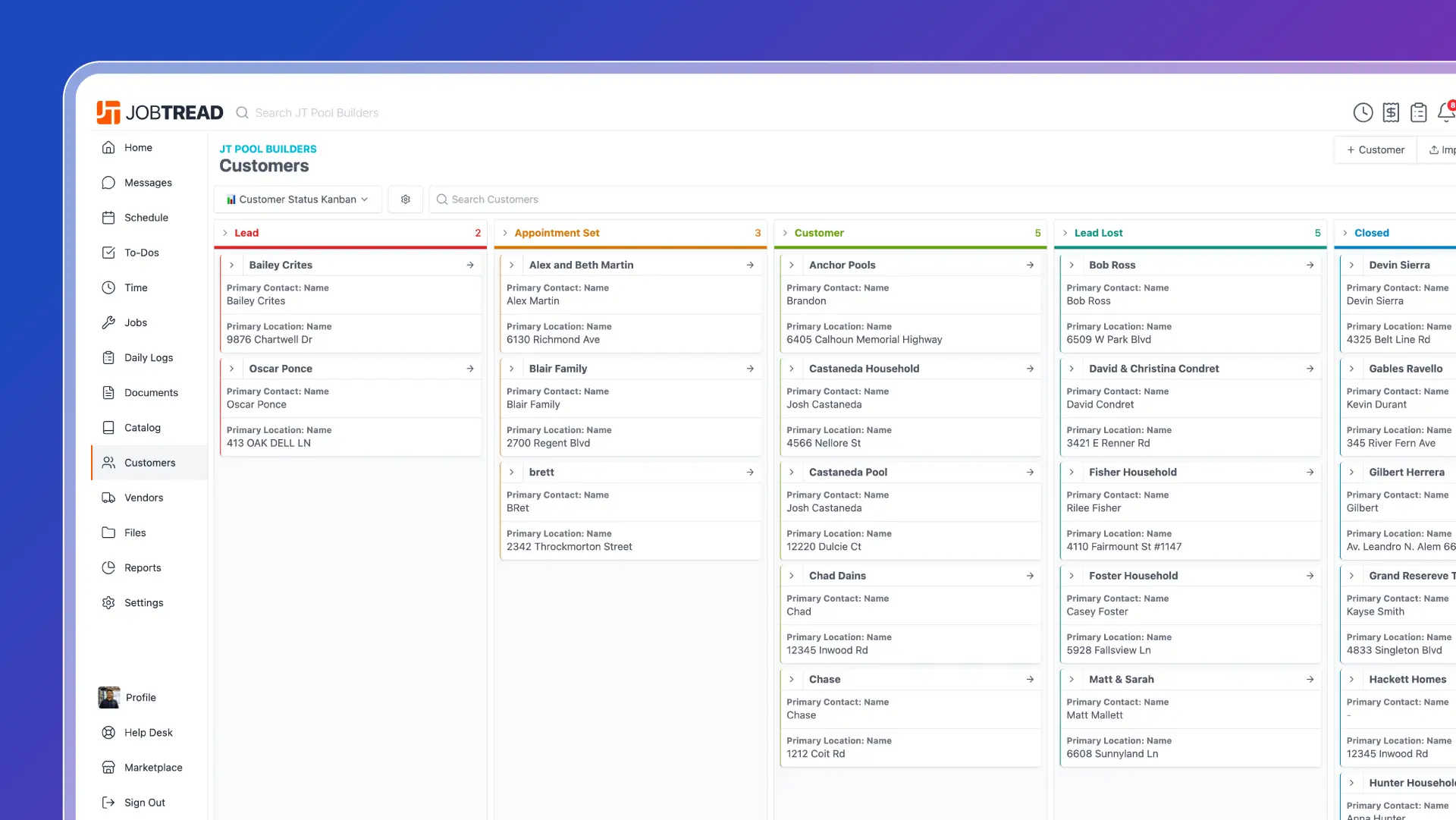
JobTread’s construction CRM is built for contractors who want to track, qualify, and convert leads without losing time to manual data entry. Every lead lives in one place with full communication history, qualification status, next steps, and proposal details.
Once a lead is qualified, JobTread helps you:
- Produce a professional estimate fast
- Send it through the platform with e-signature
- Convert the won proposal directly into a managed job with budgets, schedules, and customer portal access
The result is a faster sales cycle, a higher close rate, and fewer qualified leads slipping through the cracks.
Schedule a live demo with JobTread to see how the platform fits your sales process.
FAQ
Turn more leads into signed contracts.
Let one of our experts show you how JobTread’s construction CRM helps you qualify leads and close more business.
Book a Demo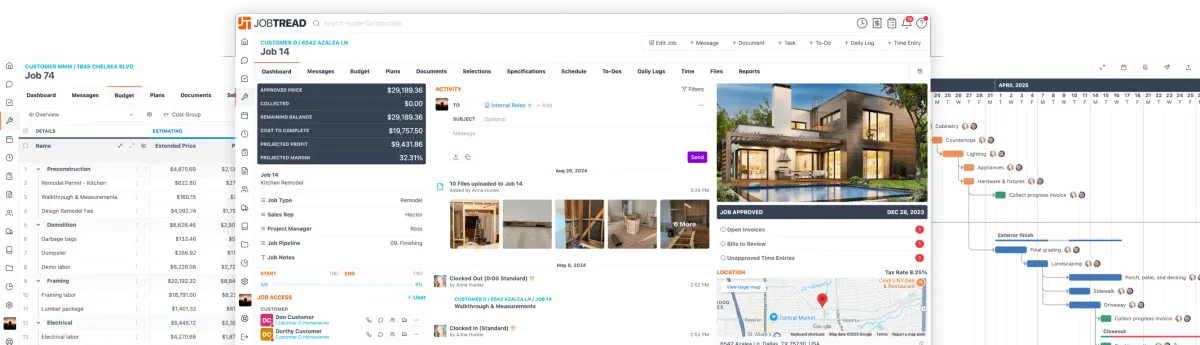

Meredith Dobbs is a Digital Marketing Specialist at JobTread with a background in education, research, and strategic communication. She specializes in creating clear, trustworthy messaging that is rooted in research, crafted for connection, and driven by a deep care for customers and their businesses.