
How to Estimate a Construction Job Faster and More Accurately: A Step-by-Step Guide for Contractors
By Meredith Dobbs

To estimate a construction job, contractors follow seven core steps: review the plans and scope, perform a quantity takeoff, price materials, calculate labor, add equipment and subcontractor costs, apply overhead and markup, and assemble the final proposal.
A construction estimate is the foundation of every profitable job. Price it too high and risk losing the job. Price it too low and win the job but lose money. Getting estimates right is one of the most important skills a contractor can develop and one of the easiest places to leave money on the table, especially when material prices shift constantly from month to month.
This guide walks through how to estimate a construction job step by step, from reviewing the plans to sending the final proposal, plus practical ways to estimate faster without sacrificing accuracy.
No matter the trade, from home building and remodeling to pools, roofing, and specialty work, the same core process applies. Here is how to do it well.
What Goes Into a Construction Estimate
Before walking through the steps, it helps to understand the parts of a construction estimate. Every accurate construction estimate is built from four cost categories, and leaving any one of them out is how contractors end up working for free.
A complete construction estimate includes:
- Direct costs: The costs tied directly to building the project, including labor, materials, equipment, and subcontractors.
- Indirect costs: The costs of running the project that are not tied to a single task, such as permits, dumpsters, temporary utilities, and site supervision.
- Overhead: The cost of running the business, including office rent, software, insurance, and administrative salaries.
- Profit: The margin added on top of all costs so that the business grows.
Every accurate estimate accounts for all four. Skipping any one of them is how contractors end up working for free.
The Step-by-Step Estimating Process
Review the Plans and Define the Scope
Every construction estimate starts with a clear understanding of what is being built. Review the plans, specifications, and scope of work in detail before pricing anything. The goal at this stage is to catch what is included and, just as important, what is not.
Unclear scope is one of the biggest causes of estimating errors. As state construction guidance puts it, the plans, specifications, and bid documents are what define the scope of the contract and the details of the work to be completed, so any gap there flows straight into the bid. If the plans leave questions open, get answers before creating the bid. A five-minute conversation at the beginning prevents a five-figure problem later.
Document any assumptions along the way. If a contractor assumes a particular grade of material or a specific access point for the crew, write it down. Those documented assumptions become the basis for change orders if the project shifts after a customer approves a bid.
Estimate the Construction Site Costs
Site costs are the expenses tied to preparing and working on the physical site, and they are among the easiest costs to underestimate because many of them never appear in the plans. Unforeseen site conditions are a well-documented risk in construction. Academic construction-contracting guidance notes that conditions discovered after work begins, such as a material in an excavation that behaves differently than expected, can materially change the cost of the work. An accurate estimate accounts for them before the bid goes out, not after.
Common site costs include:
- Clearing, grading, and excavation
- Temporary facilities such as fencing, portable toilets, and temporary power
- Dumpsters for debris removal
- Permits and inspection fees
- Equipment rental and delivery
The most reliable way to estimate site costs is to walk the site whenever possible. Photos and plans do not always reveal access challenges, drainage issues, or existing conditions that drive up costs. A site visit often surfaces expenses that would otherwise become surprises midway through the job, the kind of surprises that turn into change orders or lost margin.
A standard site cost checklist keeps the same items in front of the estimator on every bid. Building that checklist into a repeatable estimating process is the single easiest way to stop forgetting line items, which is one of the most common and most expensive estimating mistakes a contractor can make.
Estimate the Labor Costs
Labor is often the largest and least predictable part of a construction estimate, so estimating it well takes both good data and good judgment.
Estimating construction labor costs starts with the labor rate, and the rate that matters is the fully burdened labor rate, not the base hourly wage. The fully burdened rate includes:
- Payroll taxes
- Workers’ compensation insurance
- Benefits
- Supplies
The gap between the two is larger than most contractors expect. According to the U.S. Bureau of Labor Statistics, benefits and other non-wage costs make up close to 30 percent of total employer compensation costs, with wages accounting for only about 70 percent. Pricing labor off the base wage instead of the burdened rate is one of the most common ways estimates come up short.
How to Calculate the Fully Burdened Labor Rate
Step 1: Total Annual Burdened Costs ÷ Total Annual Direct Wages = Burden Multiplier
Step 2: Base Hourly Wage × Burden Multiplier = Fully Burdened Hourly Rate
With the rate set, the next step is estimating the hours. Break the project into tasks and estimate how many labor hours each task will take. This is where historical job data becomes invaluable. A contractor who has tracked how long similar tasks took on past jobs will produce far more accurate hour estimates than one working from memory, which is one reason job costing and estimating work best as a connected loop.
The final step is to multiply hours by the burdened rate and add a reasonable allowance for productivity loss. No crew works at 100 percent efficiency for an entire day. Weather, coordination, and rework all eat into productive hours, and an accurate estimate reflects that reality rather than assuming a perfect schedule.
Build Estimates Faster With JobTread.
See how JobTread helps you price jobs accurately and win more work.
Estimate the Material Costs
Material estimating is part math and part planning. It starts with a quantity takeoff, the process of measuring the plans to determine exactly how much of each material the job requires. An accurate takeoff is the foundation of the entire material estimate because every pricing decision downstream depends on getting the quantities right.
Once the quantities are set, the next step is to apply current pricing. Material prices move constantly, so pricing a job off last year’s numbers is a quick way to erode margin. The U.S. Bureau of Labor Statistics tracks these shifts through its Producer Price Index for construction materials, which measures the change over time in the prices producers receive for building materials. The practical takeaway is simple: get current quotes from suppliers for every major material category before the bid goes out.
Every material estimate also needs a waste factor because no job uses materials with zero waste. Depending on the trade and the material, waste allowances typically range from 5 to 15 percent. Leaving waste out of an estimate guarantees a shortfall.
Finally, account for delivery and handling. Freight, fuel surcharges, and restocking fees are real costs that belong in the estimate rather than quietly absorbed into margin.
Add Overhead, Markup, and Profit
Once direct and indirect costs are totaled, the next step is to add overhead and profit. This is where many contractors make a costly mistake by confusing markup and margin.
Markup is the percentage added to costs. Margin is the percentage of the final price that is profit. They are not the same number, and using them interchangeably is one of the fastest ways to underprice a job. For a full breakdown, see our guide on markup versus profit margin.
Setting the right number starts with covering overhead. The U.S. Small Business Administration advises that a sustainable price has to cover both direct and indirect costs while still delivering a profit, which is the entire purpose of this step. Calculate what percentage of annual revenue goes to running the business, then make sure every estimate carries its share. After covering overhead, add the profit margin on top.
The result is a price that covers all costs, contributes to running the business, and leaves a profit that lets the company grow.
Build and Send the Proposal
The estimate is the internal math. The proposal is what the client sees. A clear, professional proposal does two things: it wins more jobs and it sets expectations that prevent disputes later.
A strong proposal includes:
- A clear scope of work
- A breakdown of what is included
- Contractor assumptions and exclusions
- A payment schedule
- The total price
The more clearly the scope is defined in the estimate, the easier it is to manage change orders as the project evolves.
Review Plans → Takeoff → Price Labor and Materials → Add Overhead and Profit → Send Proposal
Speed matters here, too. The contractor who sends a polished proposal within a day or two often wins over the one who takes two weeks, even at a slightly higher price. The research backs this up. Harvard Business Review’s widely cited study “The Short Life of Online Sales Leads” found that the odds of winning a prospect drop sharply the longer a business waits to respond. Responsiveness signals professionalism, and managing that follow-up is exactly what a construction CRM is built to handle.
This is where quality construction management software makes a difference. Fast, efficient estimating is one of JobTread’s core strengths.
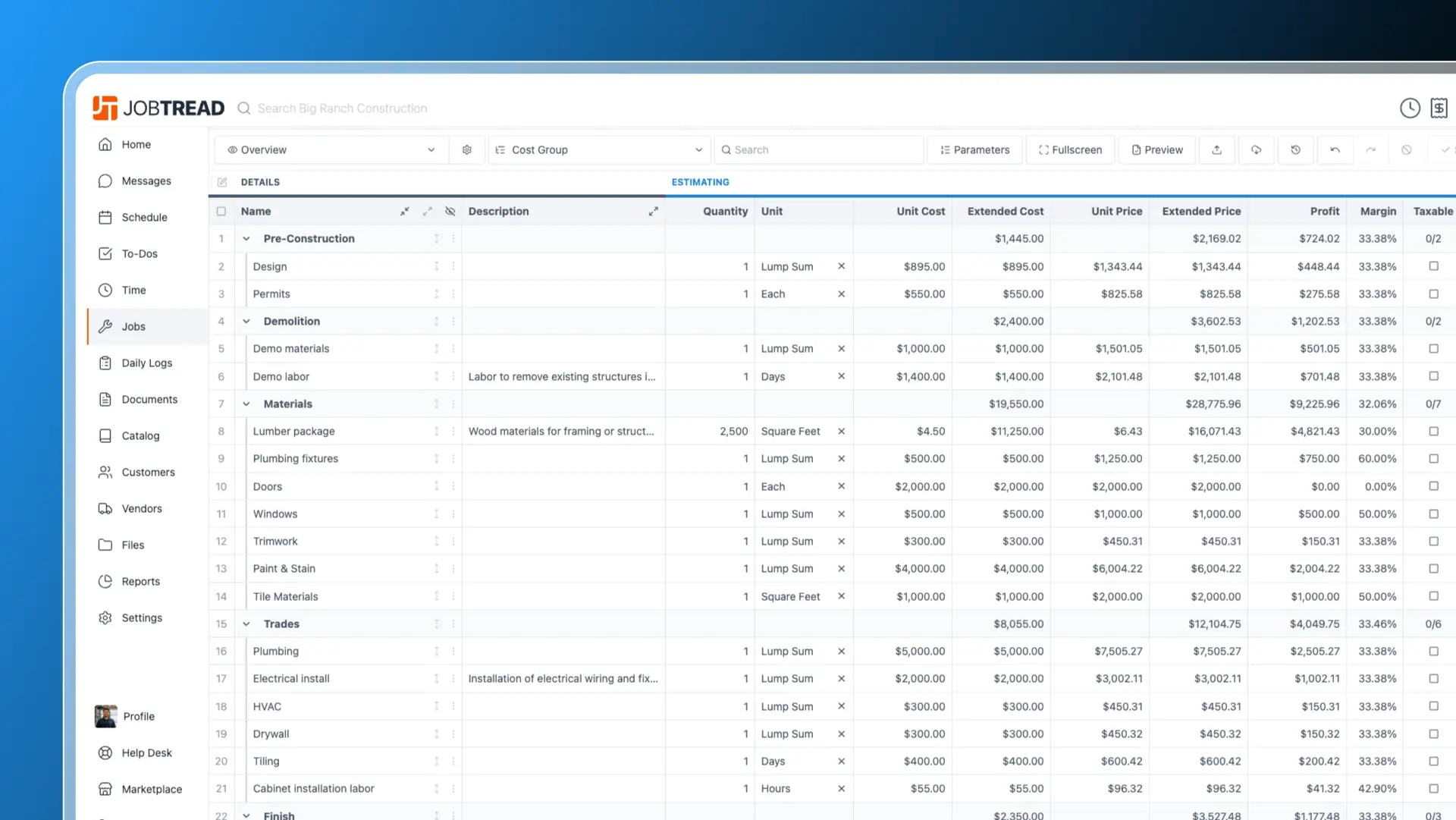
Build Estimates Faster
Most contractors would rather be on the job site than behind a keyboard. JobTread helps deliver professional estimates in record time by providing:
- Budget templates
- Onscreen takeoff
- Formulas and parameters to automate pricing
- Mass actions to make updates quickly
In addition, JobTread provides customizable document templates that help users produce proposals, change orders, invoices, and other client communications in a clean, professional, and efficient way. That means a contractor can send a proposal, collect the approval, and start invoicing in far less time.
Less time at the keyboard, and more time running the business.
Common Estimating Mistakes That Cost Contractors Money
Even experienced contractors fall into the same traps. The most common construction estimating mistakes include:
- Forgetting line items: Missing a single cost category, like dumpsters or permits, comes straight out of profit. A standardized checklist prevents this.
- Pricing with outdated costs: Material and labor costs change. Estimating with old, inaccurate numbers quietly erodes margin on every job.
- Confusing markup and margin: This single error can turn a profitable job into a break-even one.
- Underestimating labor hours: Optimism is expensive. Base hour estimates on real historical data, not best-case assumptions.
- Leaving scope vague: Unclear scope leads to disputes, unpaid work, and strained client relationships. Define it tightly up front.
- Estimating from memory: Relying on gut feel instead of documented costs and historical data leads to inconsistent, often inaccurate bids.
Most of these mistakes share a single root cause: estimating without a reliable system. The right process and tools turn each one into a step that is handled automatically, which is exactly where AI-powered estimating changes the math for contractors.
How to Estimate Faster Without Sacrificing Accuracy
Accuracy and speed are not opposites. The contractors who estimate fastest are usually the ones who estimate most accurately because they have systems that remove guesswork.
Three things make estimating both faster and more accurate:
- A cost catalog: Maintaining a database of common materials, labor rates, and assemblies prevents rebuilding every estimate from scratch.
- Historical job data: When you track actual costs against estimates on every job, future estimates become sharper. Contractors can learn where they tend to underestimate and correct for it.
- Templates and standardized processes: A repeatable estimating workflow means nothing gets forgotten, and every estimate follows the same reliable structure.
Contractors who still estimate in spreadsheets or on paper spend hours rebuilding the same numbers and still miss line items. Moving to a system that stores costs in a reusable cost catalog, pulls historical job data, and standardizes the process makes estimating faster and more accurate at the same time.
Many contractors describe exactly this shift on the Builder Stories podcast, where they talk about moving off spreadsheets and tightening their numbers as they grow.
How JobTread Helps Contractors Estimate Faster
JobTread is built to make estimating both faster and more accurate. Instead of rebuilding every bid from scratch, contractors work from a connected system where costs, history, and proposals all live together.
With JobTread, contractors can:
- Build estimates from a reusable cost catalog of materials, labor rates, and assemblies, so common items are priced in seconds.
- Pull from historical job data to sharpen hour and cost estimates based on what actually happened on past jobs.
- Generate professional proposals directly from the estimate, with clear scope, options, and pricing.
- Track estimated costs against actual costs as the job runs, so each estimate makes the next one better.
- Update pricing across the catalog when material costs change, so no estimate goes out on stale numbers.
The result is a faster path from plans to proposal with fewer errors and stronger margin protection. Estimating is just one part of what JobTread does. To see how it brings estimating, budgeting, scheduling, and job costing together in one platform, read more about why JobTread is built for contractors.
Build More Accurate Estimates and Win More Profitable Work
Estimating well is a skill, and like any skill, it gets easier with the right process and the right tools. When contractors account for every cost, base their numbers on real data, and use a repeatable system, they bid faster, win smarter, and protect their margins on every job.
If estimating in spreadsheets has become a bottleneck, it might be time to put the whole process into one connected system.
Frequently Asked Questions
Elevate your company to new levels of success!
Let one of our experts show you how JobTread will get you organized, save your time, and increase your profits.
Book a Demo

Meredith Dobbs is a Digital Marketing Specialist at JobTread with a background in education, research, and strategic communication. She specializes in creating clear, trustworthy messaging that is rooted in research, crafted for connection, and driven by a deep care for customers and their businesses.