
What Is a WIP Report in Construction? A Complete Guide for Contractors
By Meredith Dobbs

A Work in Progress (WIP) report is a financial document that tracks costs, billings, percent complete, and projected profit on every active construction job in real time.
It shows contractors which jobs are making money, which are losing it, and which are underbilled or overextended before those problems hit the bank account.
Running a construction business without a Work in Progress report is like operating a job site without a schedule. You might still get there, but you will not know what is actually happening with your money until the project is over.
What Is a WIP Report?
A Work in Progress report gives contractors a clear picture of where each project stands financially at any given point in time.
In construction accounting, a WIP report is also the foundation of percentage of completion accounting. It is how contractors recognize revenue as work gets completed, rather than only when a job is invoiced or closed out.
For most construction companies, a WIP report answers four core questions:
- How much have we spent on this job so far?
- How much have we billed the customer?
- How much of the work is actually complete?
- Are we ahead of or behind our budget and billings?
Why Construction Companies Need WIP Reports
A WIP report is more than an accounting requirement. It is a management tool that helps construction business owners catch problems early, forecast cash flow, and protect profit margins.
Here is what a strong WIP report gives you:
Financial clarity on every active job.
See costs, revenue, profit, and billing discrepancies for every open job in one place.Accurate job costing.
Compare actual costs against estimated costs in real time job costing to identify cost overruns before they get worse.Progress monitoring.
Track percent complete on each project to see how much work has been finished and how much remains.Cash flow management.
Identify which projects are overbilled or underbilled to predict future cash inflows and outflows with confidence. The Construction Financial Management Association recommends watching WIP underbillings closely to see which jobs are consuming cash.Better forecasting.
Use WIP data and your job budgets to project future revenue, profit, and project timelines based on actual performance.Compliance and lender reporting.
Provide the documentation banks, bonding companies, and CPAs need to verify financial statements, especially for construction loans, lines of credit, and surety bonds.Early problem detection.
Spot cost overruns, billing discrepancies, or schedule slippage before they damage the bottom line. Construction CPAs recommend reviewing WIP with project managers at least monthly for exactly this reason.
Without a WIP report, contractors often discover profit problems months after the fact. By then, the money is already gone.
How to Read a Construction WIP Report
The numbers on a WIP report tell a story. Here is what to look for:
Overbilled jobs
mean you’re billing ahead of the work being completed, and that’s usually where you want to be. Billing ahead keeps cash flow healthy on the project and means the customer is funding the work instead of you. Most contractors aim to stay somewhat overbilled rather than dead even or behind. The one thing to watch: when overbillings from one job start funding another job’s costs, a slowdown on either project can squeeze cash fast. Healthy overbilling means the cash stays tied to the work it came from.Underbilled jobs
usually mean work is getting done faster than the team is invoicing. That ties up working capital and forces the business to float costs the customer should be funding. Underbilling is one of the most common cash flow killers in construction.Jobs where actual costs are running higher than estimated
are profit leaks. Catching this early gives contractors a chance to adjust scope, request change orders, or tighten up labor before the job loses money.Jobs where percent complete is high but billing is low
often mean missed billing milestones. Reviewing WIP weekly helps catch these gaps before they turn into 60 or 90 day receivables.
Key Components of a WIP Report
Every WIP report should include these core line items for each active job:
Job description.
A brief overview of the project, so the reader knows which job the report covers.Contract amount.
The total contracted price for the project, including approved change orders.Costs to date.
The total costs incurred on the project up to the reporting date, including labor, materials, subcontractors, and other direct costs.Estimated final cost.
Your best estimate of what the job will cost when complete based on the original estimate and any updates.Billing to date.
The total amount invoiced to the client through the reporting date.Percent complete.
Calculated as costs to date divided by estimated final cost. This is how most construction companies measure project progress for accounting purposes.Revenue recognized.
The amount of revenue that should be recognized on the income statement based on percent complete and contract amount.Projected profit.
Calculated by subtracting estimated final cost from the contract amount. This is what the job is expected to earn when finished.Over and under billings.
The difference between revenue earned (based on percent complete) and revenue billed. If you have billed more than you have earned, the project is overbilled. If you have earned more than you have billed, it is underbilled.Gross profit to date.
The difference between revenue recognized and costs to date. This shows how much profit the job has generated so far.
How Often Should Contractors Run WIP Reports?
Most construction companies run a WIP report at least monthly, but many run them weekly during active project seasons.
The right cadence depends on the size of the business, the length of the projects, and how often financial decisions get made.
As a general guide:
- Small contractors with short projects: Monthly is usually enough.
- Mid-sized contractors with multiple active jobs: Weekly reviews catch issues sooner.
- Companies pursuing financing or bonding: Run WIP at the close of every accounting period since lenders and surety providers often require a current WIP schedule.
The key is consistency. A WIP report only works if the numbers feeding it are current and accurate.
Common WIP Report Mistakes to Avoid
Even contractors who run WIP reports regularly can fall into a few common traps:
Using outdated cost estimates.
If the estimated final cost is not updated as change orders happen or scope shifts, the percent complete calculation will be off.Forgetting committed costs.
Costs that have been ordered but not yet paid still need to be tracked. Otherwise, the report understates project costs.Skipping approved change orders.
Change orders increase the contract amount. Leaving them off the WIP report makes a profitable job look less profitable than it is.Running WIP in spreadsheets only.
Manual spreadsheets are slow, error-prone, and out of date the moment someone enters a transaction in another system. Construction accounting software that pulls live job data like JobTread is far more reliable.
How JobTread Helps With WIP Reporting
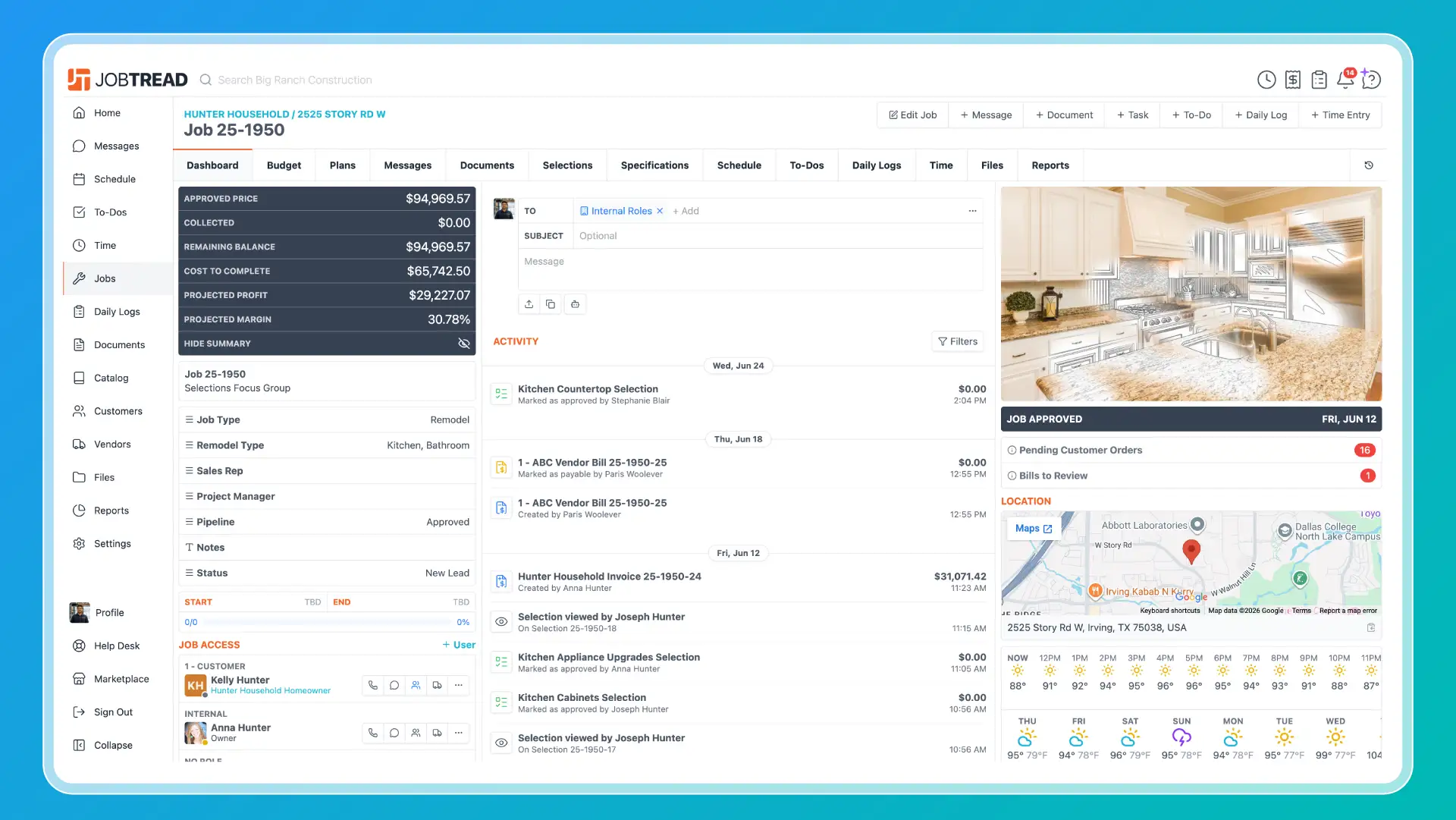
JobTread builds WIP reporting directly into the platform. Job costs, billings, change orders, and budgets all live in one system, so the WIP report reflects what is actually happening on every job in real time.
With JobTread, contractors can:
- See costs to date, billing to date, percent complete, and projected profit for every job from one dashboard.
- Track over and under billings automatically.
- Update estimates and budgets as change orders are approved.
- Sync financial data with QuickBooks Online for accounting and tax reporting.
- Share clean, current WIP schedules with CPAs, bankers, or bonding agents whenever they ask.
The result is a clear, accurate WIP report without the spreadsheet headache.
Build a Stronger Construction Business With Clear WIP Reporting
A WIP report is one of the most powerful financial tools a contractor can use. It turns scattered job data into a clear picture of profitability, cash flow, and project health. When the report is accurate and current, decisions get easier. Problems get caught earlier. The business gets stronger.
If managing WIP in spreadsheets has become a bottleneck, it might be time to put the report inside the same system that runs the rest of the business.
Frequently Asked Questions About WIP Reports
See How JobTread Handles WIP Reporting.
JobTread can help you win more jobs, complete them on time, and increase your profits.

Meredith Dobbs is a Digital Marketing Specialist at JobTread with a background in education, research, and strategic communication. She specializes in creating clear, trustworthy messaging that is rooted in research, crafted for connection, and driven by a deep care for customers and their businesses.