
How AI-Powered Onboarding Can Help Contractors Scale Faster Without Sacrificing Quality
By Meredith Dobbs
In construction, growth creates a frustrating paradox. The more jobs a company wins, the harder it becomes to keep quality consistent across the team. AI-powered onboarding helps construction businesses break that pattern by turning training into a documented, repeatable system, so new hires ramp up faster, and the work stays consistent no matter who is on the job.
The contractors who break that cycle do it the same way: they stop relying on knowledge stored in people's minds and start building documented, repeatable systems, increasingly with the help of AI. AI-powered onboarding lets a growing construction business train new hires faster and deliver more consistent work because the process no longer depends on memory and who happens to be available to answer questions.
To understand how this works in practice, we talked with Jay Carter of Contractor AI, who helps construction businesses build the operational systems that make scaling possible by providing AI-driven onboarding systems for businesses. His take is direct: the companies that grow well are not just hiring better; they are operating better.
“The companies that scale successfully aren't just hiring better people,” Carter says. “They're building better processes.”
And increasingly, according to Carter, those companies are using AI to make their processes easier to document, train, and improve. Here is how he frames the problem and the path forward.
The Real Bottleneck Is Processes, Not People
One of the most common mistakes contractors make, Carter explains, is assuming operational problems are caused by the wrong employees. However, the real issue oftentimes is that an efficient onboarding system was never established in the first place.
When onboarding depends entirely on verbal explanations and shadowing, every employee ends up doing similar tasks differently. That inconsistency, Carter notes, shows up across production, communication, scheduling, estimating, and the customer experience, and creates quality issues later on.
And this is not unique to construction. Any business that runs on undocumented knowledge tends to drift toward non-standard processes, and that drift shows up as delayed projects, missed details, budget variance, communication breakdowns, frustrated customers, and burned-out managers.
In Carter's view, strong companies do not rely on information inside the minds of experienced managers. They build operational clarity. As Carter puts it, “You can't delegate what you don't document.”
Why Trial by Fire Training Fails
Many construction companies unintentionally train employees through chaos, Carter says. A new project manager gets handed active jobs and is told to figure it out on his own. A new estimator watches someone else for a few days and hopes they absorb enough. A field employee learns different processes from different supervisors.
In Carter's experience, this approach creates three predictable problems:
- It takes longer to ramp employees. Without clear onboarding systems, employees spend months learning through mistakes instead of weeks learning through structured guidance. Research from SHRM has found that organizations with a structured onboarding process see significantly higher new-hire productivity and stronger long-term retention.
- It creates inconsistency. When everyone develops a personal workflow, processes fragment across the company.
- It caps growth. If scaling depends on one or two key people personally training every hire, the business eventually hits a ceiling.

A Better Path: Capture, Standardize, Deploy, Improve
Carter sees a clear path forward, and it's one that forward-thinking contractors are already using AI to accelerate. Helping them do that is the focus of his business, Contractor AI, which breaks the onboarding process into four stages.
Capture processes
In this stage, employees document workflows, checklists, communication expectations, estimating procedures, scheduling standards, and customer handoff processes. Carter notes this can take many forms such as Loom videos, SOP documents, voice notes, recorded meetings, job workflows, estimating templates, task sequences, and field procedures. Instead of relying on memory, he says, companies can use AI to create scalable operational systems that support growth.
Standardize operations
In the second stage, AI can help organize and structure operational knowledge into usable systems. Instead of scattered notes and disconnected processes, Carter says contractors can create standard operating procedures, training modules, role-specific workflows, process checklists, and internal knowledge bases.
Deploy consistent training
In the next stage, once processes are documented, onboarding becomes dramatically easier. New hires can follow structured workflows instead of relying on memory or verbal instruction. According to Carter, this leads to faster ramp-up periods, better accountability, more consistency across teams, and improved customer experiences.
Continuously improve
In stage four, AI systems can help companies identify inefficiencies, bottlenecks, and recurring operational issues over time.
The goal, Carter emphasizes, is not to replace people. It's to give people better systems.
Build a more consistent operation.
See how JobTread helps contractors document processes, onboard new hires, and keep quality consistent as they grow.
How JobTread Helps Create Operational Consistency
Carter is quick to note that software becomes significantly more powerful when paired with documented processes. That is where a platform like JobTread can become a major operational advantage.
With JobTread, contractors can build centralized onboarding workflows using the scheduling tool to guide new hires through onboarding tasks inside the system rather than relying on a manager's time. That creates a more structured way to bring people up to speed.
For example, Carter works with JobTread contractors through his business Contractor AI to develop onboarding workflows that guide new hires through video training, quizzes, and hands-on practice, all automated within JobTread.
Once a new hire completes the onboarding, Carter sets up a custom AI assistant that is available around the clock to answer any lingering questions covered in the training materials. This saves a manager's time and delivers accurate, standardized answers grounded in how the business actually operates.
Then, about 90 days in, he has the new employee speak with an AI agent to assess how well he or she understands the company's business processes. Again, this saves a manager's time while also reinforcing processes.
By implementing this system, Carter found that new employees with zero construction experience could outperform seasoned project managers. The only difference was the onboarding, not the person.
Using the JobTread AI Connector to Build Smarter Onboarding
One of the most exciting opportunities for contractors is combining company processes with the JobTread AI Connector. The AI Connector lets users securely connect AI tools, like Claude to their JobTread data using an MCP (Model Context Protocol) server. This opens the door to entirely new onboarding and operational support systems.
For example, a contractor could use the AI Connector to build an AI-powered training assistant. Picture an assistant trained on a company's SOPs, project workflows, estimating standards, communication expectations, scheduling procedures, and customer service standards.
New hires could ask questions in real time and get answers grounded in how the company actually operates, such as:
- “How do we handle change orders?”
- “What's our process for selection approvals?”
- “How do I update a budget in JobTread?”
Instead of interrupting a manager or guessing, a new employee gets a consistent, accurate answer every time. It turns documented processes into a living, day-to-day resource.
This is just one starting point. The combination of clear processes and connected AI gives contractors a practical way to make onboarding faster, more consistent, and easier to scale.
Build a Business That Scales With You
The throughline of Carter's advice is simple: scaling without sacrificing quality comes down to systems. Once a company documents and standardizes its processes and supports them with the right tools, growth stops depending on a few key people holding everything together.
If you want to see how JobTread can give your team one place to document processes, onboard new hires, and run a more consistent operation, request a demo or sign up today.
Frequently Asked Questions
Most construction onboarding takes anywhere from a few weeks to several months, depending on the role and how well the process is documented. The difference comes down to systems. When a company relies on shadowing and verbal instruction, a new project manager or estimator can spend months learning through mistakes. When the same company documents its workflows and supports them with structured training, that ramp-up shrinks to weeks because the new hire follows a clear path instead of figuring it out on the job.
Onboarding is what keeps quality consistent as a construction business grows. According to SHRM, employees who go through a great onboarding experience are 69 percent more likely to stay with a company for three years. For a contractor, strong onboarding means faster ramp-up, fewer mistakes in the field, more consistency across crews, and less turnover, all of which protect margins and the customer experience as the company takes on more work.
An SOP, or standard operating procedure, is a documented set of steps for how a specific task should be done every time, such as handling a change order, approving a selection, or updating a budget. SOPs turn knowledge that usually lives in one person’s mind into a repeatable process the whole team can follow. For construction businesses, SOPs are the foundation that makes consistent onboarding and scaling possible.
Start by capturing how work actually gets done today. Then, organize it into a clear, repeatable format. The practical path is to record real workflows through Loom videos, voice notes, recorded meetings, or written checklists. Then, structure that raw material into standard operating procedures, training modules, and process checklists. AI tools can speed this up significantly by helping turn scattered notes and recordings into organized, usable documentation.
AI helps construction companies document, organize, and deliver training that used to depend entirely on a manager’s time. It can turn recorded workflows and notes into structured SOPs, power a training assistant that answers new-hire questions in real time, and assess how well an employee understands company processes after their first few months. The goal is not to replace experienced people. It is to give them better systems, so onboarding stays consistent at scale.
The best fit is an AI tool that connects directly to the systems a contractor already runs their business in, so answers are grounded in real company data rather than generic advice. The JobTread AI Connector lets contractors securely connect AI tools like Claude to their JobTread data through an MCP server, which makes it possible to build an onboarding assistant trained on the company’s own SOPs, estimating standards, scheduling procedures, and customer service expectations.
Scaling without sacrificing quality comes down to building systems instead of depending on a few key people. When processes are documented and standardized, growth no longer hinges on one or two experienced managers personally training every hire. Document your core workflows, standardize them into SOPs, deliver them through structured onboarding, and use software to keep everything in one place, so consistency holds as the team grows.
The bottleneck is usually undocumented knowledge, not the size of the team. When everything important lives in the owner’s or manager’s mind, the business hits a ceiling because nothing can happen without that person. The fix is to capture and document how the work gets done, standardize it into repeatable processes, and support it with tools that let new hires follow the system instead of asking for help at every step. That is what lets a contractor step back from daily firefighting and let the business grow.
Elevate your company to new levels of success!
Let one of our experts show you how JobTread will get you organized, save your time, and increase your profits.
Book a Demo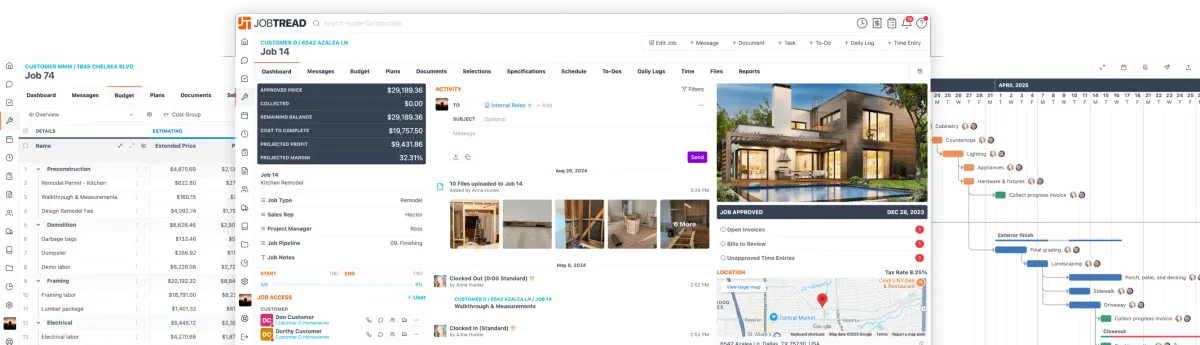

Meredith Dobbs is a Digital Marketing Specialist at JobTread with a background in education, research, and strategic communication. She specializes in creating clear, trustworthy messaging that is rooted in research, crafted for connection, and driven by a deep care for customers and their businesses.