How Contractors Can Handle Disputes and Avoid Costly Lawsuits
By Karalynn Cromeens, The Cromeens Law Firm

Disputes are an inevitable part of contracting, but lawsuits don’t have to be. Contractors who invest in clear contracts, thorough documentation, proactive communication, and modern project management tools like JobTread can resolve most conflicts before they escalate, saving thousands of dollars and years of stress.
Every contractor will face a dispute at some point. The question isn’t whether it will happen. It’s whether you’ll be ready when it does.
Most disputes don’t start as lawsuits. They start as a complaint, a misunderstanding, or a client who feels unheard. Left unaddressed, they grow. What began as a $3,000 disagreement over a change order can turn into a $100,000 judgment. That’s not a hypothetical. It happened to Kelly, and his story is one every contractor needs to hear.
This post draws from the “Disputes” chapter of Trust Your Gut, a guide written for contractors navigating the legal and operational realities of running a construction business. Whether you’re a general contractor, subcontractor, or specialty trade, the principles here apply. You’ll learn how to prevent disputes before they start, respond when they do, and use tools like JobTread to protect your business every step of the way.
Kelly’s $100,000 Mistake
Kelly was a successful remodeling contractor with years of experience and a solid reputation. When a client grew unhappy with a kitchen renovation, Kelly did what a lot of contractors do: he avoided the conversation. The client sent a demand letter. Kelly ignored it, assuming the complaint would go away on its own.
It didn’t.
The client filed suit. Kelly still didn’t take it seriously. He was too busy running jobs, and the claim seemed overblown to him. He failed to respond properly, and eventually, a court entered a default judgment against him for over $100,000.
A demand letter that could have been resolved for a fraction of that amount, with a quick conversation, a minor concession, or a written response, turned into a six-figure loss that threatened his entire business.
Kelly’s mistake wasn’t that he had a dispute. His mistake was assuming silence was a strategy.
Why Disputes Are Inevitable, and What That Means for Your Business
Construction is one of the most dispute-prone industries in the country. Projects involve dozens of variables: weather delays, supply chain issues, subcontractor scheduling, client expectations, and scope changes that evolve in real time. Even the most experienced contractors, working with the most cooperative clients, encounter friction.
That’s not a failure of professionalism. That’s the nature of the work.
What separates contractors who thrive long-term from those who don’t isn’t the absence of disputes. It’s how they handle them. Contractors who treat dispute resolution as a core business competency, not an afterthought, are the ones who protect their margins, their reputations, and their peace of mind.
Why You Should Never Ignore a Complaint
When a client complains, the instinct for many contractors is to get defensive or go quiet. Neither response serves you well.
Ignored complaints don’t disappear. They escalate. A client who feels dismissed is far more likely to post a negative review, call an attorney, or file a complaint with a licensing board. Contrast that with a client who receives a prompt, professional response, even if the response is simply, “We hear your concern and we’re looking into it.” That acknowledgment alone can de-escalate tension and buy you the time you need to assess the situation.
The sooner you engage with a complaint, the more options you have. Delay shrinks those options fast.
The Three Stages of a Dispute: Prevention, Demand Letter, and Lawsuit
Understanding where a dispute is in its lifecycle determines how you should respond.
Stage 1 — Prevention: This is where most disputes should be resolved. Clear contracts, documented change orders, and consistent communication prevent the majority of conflicts from ever becoming formal complaints.
Stage 2 — Demand Letter: A demand letter signals that a client has escalated their complaint, often with the help of an attorney. This is a critical moment. Responding promptly and professionally, ideally with legal guidance, keeps the door open for settlement. Ignoring it, as Kelly learned, is never the right move.
Stage 3 — Lawsuit: Once litigation begins, costs escalate sharply. Legal fees, time away from your business, and the emotional toll of litigation make this the worst place to resolve a dispute. The goal is always to resolve conflicts before they reach this stage.
Six Practical Tips for Avoiding Disputes
Start with a clear, comprehensive contract
A well-drafted contract is your first and most important line of defense. It should clearly define the scope of work, payment schedule, timeline, change order procedures, and what happens when things go wrong. Vague language invites interpretation, and interpretation invites conflict.
If your contracts were drafted years ago or downloaded from a generic template, have a construction attorney review them. The cost of that review is a fraction of what one bad dispute can cost you.
Document everything, from day one
Documentation isn’t just about protecting yourself in court. It’s about creating a shared record that keeps everyone aligned throughout a project. Photograph work before it’s covered up. Log daily conditions. Record verbal conversations in writing with a quick follow-up email: “As we discussed today...”
If a dispute arises six months after a project closes, your documentation is the difference between having evidence and having nothing.
Overcommunicate with your clients
Clients who feel informed are clients who feel respected. Regular updates, even when there’s nothing dramatic to report, reduce anxiety and build trust. A quick message saying “work is on track, we’ll be back on site Thursday” takes sixty seconds and prevents the kind of silence that makes clients nervous.
Overcommunication doesn’t mean overwhelming your clients with technical detail. It means keeping them in the loop at a frequency that matches their expectations.
Keep a paper trail on every change
Scope creep is one of the leading causes of contractor-client disputes. A client asks for an addition here, an upgrade there, and suddenly, the project has grown by 20% with no written record of what was agreed.
Every change to the original scope should be documented in a formal change order, signed by both parties before work begins. This protects your compensation and protects the client from surprise costs.
Consider arbitration clauses
Including an arbitration clause in your contracts gives both parties a faster, more private, and often less expensive alternative to litigation. Arbitration keeps disputes out of the court system and allows them to be resolved by someone with relevant industry knowledge. More on this below.
Know when to offer a little extra
Sometimes, the fastest path to resolution is a goodwill gesture. Offering to repaint a wall, fix a minor punch list item at no charge, or extend a warranty can resolve a complaint that might otherwise grow into a lawsuit. This isn’t about admitting fault. It’s about prioritizing the business relationship and protecting your reputation.
The key is to make these gestures strategically and to document them clearly, so they aren’t later interpreted as an admission of liability.
Simplify and Centralize Your Business.
Learn how JobTread can help you focus on what matters most.
How Technology Helps You Avoid and Resolve Disputes
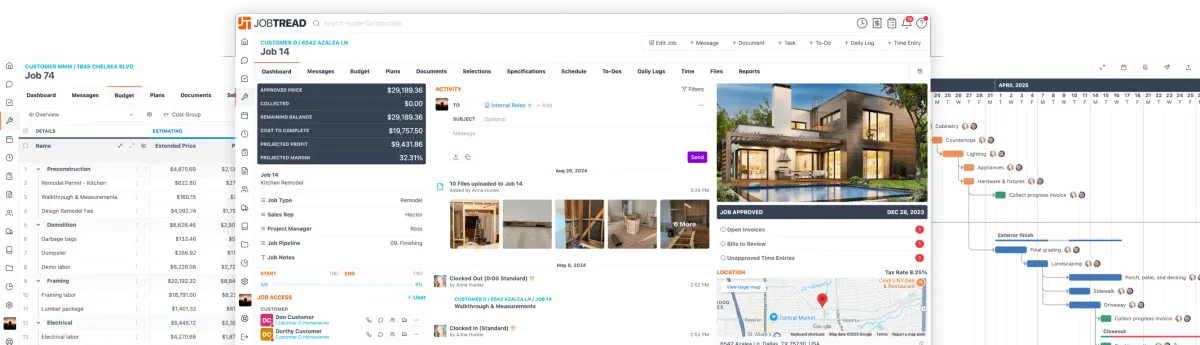
The construction industry has historically lagged behind other sectors in adopting technology, but that’s changing fast. Platforms like JobTread, a CRM built specifically for contractors, give construction businesses the operational infrastructure they need to prevent disputes and defend themselves when they arise.
Here’s how JobTread supports dispute prevention across your business:
Centralized Documentation
JobTread stores all project-related documents, including contracts, photos, daily logs, and notes, in one place. When a client claims work was done incorrectly, or that a conversation never happened, your records are organized, accessible, and timestamped.
Instant Client Communication
JobTread’s client communication tools keep a documented record of every exchange. No more reconstructing a timeline from scattered emails and text threads. Every message is tied to the project, creating a clear and chronological paper trail.
Efficient Project Management
Delays and miscommunication around scheduling are frequent sources of conflict. JobTread’s project management features help contractors plan, track, and update project timelines, reducing the ambiguity that leads to disputes.
Digital Contracts and E-Signatures
JobTread supports digital contracts and e-signatures, making it easy to execute agreements quickly and store them securely. A signed contract is unambiguous evidence of what was agreed, and digital execution removes the “I never received that” defense.
Financial Tracking and Job Costing
Budget disputes often come down to transparency. JobTread’s financial tracking tools give contractors a clear view of job costs, payments, and outstanding balances, and allow them to share that information with clients in a professional, organized format.
Change Orders on the Spot
With JobTread, contractors can create and send change orders directly from the field, and clients can approve them digitally. This eliminates the gap between a verbal agreement and a written record, the gap where most scope creep disputes are born.
Accountability and Mobility
JobTread is designed for contractors who are on the move. Whether you’re on a job site or meeting with a client, you have full access to your project data, communication history, and financial records. That mobility means no detail gets lost between the field and the office.
The Benefits of Arbitration for Contractors
Arbitration is an alternative dispute resolution process in which a neutral third party, the arbitrator, reviews the evidence and renders a binding decision. For contractors, it offers several meaningful advantages over traditional litigation.
- Speed: Court cases can take years to resolve. Arbitration typically concludes in months.
- Cost: While arbitration isn’t free, it’s generally less expensive than full litigation, primarily because discovery is more limited and hearings are shorter.
- Privacy: Unlike court proceedings, arbitration is private. Your business dispute doesn’t become public record.
- Industry expertise: Arbitrators in construction disputes are often selected for their knowledge of the industry, which means decisions are made by someone who understands the realities of contracting, not just legal procedure.
- Finality: Arbitration decisions are binding and difficult to appeal, which provides both parties with a clear resolution.
To take advantage of arbitration, you need to include an arbitration clause in your contracts before a dispute arises. Once a client has filed suit, it’s often too late to elect arbitration. Work with a construction attorney to draft an arbitration clause that is enforceable in your state and appropriate for the types of projects you take on.
Plan for the Best, Prepare for the Worst
No contractor goes into a project expecting a dispute. But the ones who survive and thrive long-term are the ones who plan as though disputes are possible, because they are.
That means investing in clear contracts, maintaining thorough documentation, communicating proactively with clients, and using tools like JobTread to build an operational infrastructure that protects you. It means taking demand letters seriously, responding promptly, and knowing when to seek legal counsel. And it means understanding that the best time to prepare for a dispute is before one ever starts.
Kelly’s story doesn’t have to be yours. The contractors who learn from it, who treat dispute prevention as a professional discipline rather than an inconvenience, are the ones who build businesses that last.
If you’re not sure whether your current contracts, documentation habits, or dispute resolution processes are adequate, that’s worth finding out now. The cost of prevention is always lower than the cost of litigation.
Frequently Asked Questions
Karalynn Cromeens is the owner and manager of The Cromeens Law Firm, a construction law practice that helps contractors protect their businesses with contracts, lien filings, and dispute resolution. She is the author of Trust Your Gut, a guide for contractors navigating the legal realities of running a construction business. Learn more about the JobTread and Cromeens Law Firm partnership.
Ready to take your business to the next level?
Explore it for yourself or let one of our knowledgeable staff members show you how.
Book a Demo