
How Much Does Construction Management Software Cost?
By Meredith Dobbs

If you are considering construction management software for your business, one of the first questions you are likely to ask is: how much does construction management software cost? The short answer is that prices typically range from about $50 per month for entry-level tools to $2,000 or more per month for enterprise platforms with most growing contractors landing somewhere between $150 and $1,000 per month.
The longer answer depends on your team size, the features you actually need, the pricing model the vendor uses, and whether the company is upfront about what you will pay. This guide breaks down everything that goes into construction software pricing so that you can make a confident, informed decision for your business.
What Is Construction Management Software?
Construction management software is a centralized platform that helps builders, remodelers, and specialty contractors run their businesses from lead to final payment. The best systems combine estimating, job costing, scheduling, project management, document storage, customer communication, and financial reporting into one connected workflow.
According to Fortune Business Insights’ Construction Software Market Report, the builders and contractors segment accounted for $4.88 billion of the construction software market in 2024, with adoption driven by faster takeoffs, automated estimating, and real-time cost monitoring that enhance efficiency and profitability.
How Is Construction Software Priced? The Three Most Common Pricing Models
Construction software providers generally use one of three pricing models. Understanding them is the first step in evaluating the true cost of any platform.
- Per-User Pricing (Subscription)
You pay a monthly or annual fee for each internal team member who needs access. Some vendors offer discounts for larger teams. The key question to ask is whether subcontractors, vendors, and customers count against your user count. Platforms that charge for external collaborators can quickly multiply your bill as your projects scale. - Tiered Plans
Tiered pricing bundles features into packages like Starter, Professional, and Enterprise. Lower tiers typically exclude advanced tools such as job costing, change orders, or integrations, forcing you to upgrade just to unlock one or two features you actually need. Always map the feature list against your workflow before choosing a tier. - Custom or Enterprise Pricing (Quote-Based)
Many large platforms require you to speak with a sales representative for pricing. According to Software Advice, quote-based pricing is most common among enterprise-focused vendors and can range from several thousand dollars per month to six-figure annual contracts depending on company size and modules purchased.
What Actually Drives the Cost?
Several factors determine where a platform lands in the pricing spectrum.
Number of users. More internal users almost always means a higher bill. Look closely at how each vendor defines a user and whether external collaborators count.
Feature access. Robust tools like estimating, job costing, construction CRM, scheduling, and integrations add to the price. Some platforms charge for features that should be standard. All features are included in the same monthly price for JobTread.
Implementation and training fees. Onboarding costs can range from a few hundred dollars to tens of thousands. The Construction Financial Management Association notes that implementation is one of the most commonly underestimated line items in construction technology budgets. However, JobTread does not charge an implementation fee at all, which is a rarity in the construction management industry.
Support level. Premium support, dedicated account managers, and priority response times often cost extra. Ask what is included in the base subscription. Note that JobTread includes robust training in its one, core price.
Contract length. Annual commitments are usually cheaper than month-to-month, but lock you in. Make sure the platform is worth the commitment before signing a long-term contract. With JobTread, you have the option of choosing either a monthly or yearly plan.
Integrations. Connecting your software to QuickBooks, payment processors, takeoff tools, or your accounting system can carry additional fees. JobTread has 20+ integrations that are included in the base price.
Simplify and Centralize Your Business.
Learn how JobTread can help you focus on what matters most.
Construction Management Software Cost Breakdown
Here is a realistic cost range for what contractors are paying in 2026, based on published pricing, industry reporting, and buyer reviews on G2 and Capterra.
| Software Tier | Typical Monthly Cost | Best For |
|---|---|---|
| Entry-level tools | $50–$150 | Solo operators, very small crews |
| Mid-market platforms | $150–$1,000 | Growing residential and specialty contractors |
| Enterprise systems | $1,000–$2,000+ | Large commercial and multi-division firms |
| Add-on modules | $25 to $500 per module | Specialty features like takeoff or CRM |
| Implementation fees | $500 to $25,000 (one-time) | Onboarding, data migration, training |
These are general ranges. Always request a detailed quote that includes every line item, not just the base subscription.
While most construction software is built for a specific size of contractor, JobTread is different.
Whether you are a solo remodeler, a growing home builder, a pool builder, a roofer, a specialty trade, or a commercial firm, you get the same full-featured platform at every stage.
- No stripped-down starter tier. Every plan includes the full feature set.
- No enterprise paywall. Advanced tools are not locked behind a sales call.
- No platform switching as you grow. The system flexes with your team, job volume, and workflows.
That is why contractors across every segment of the industry run their businesses on JobTread. Despite what other companies may claim, JobTread powers thousands of businesses ranging from hundreds of thousands to $50+ million in annual revenue. It truly breaks the mold.
Why Price Transparency Matters in Construction Software
Price transparency is one of the most underrated factors in choosing construction management software. Hidden fees, forced upgrades, and quote-based pricing that requires a sales call are all red flags that can cost you money and trust over time.
A Gartner research on B2B buying behavior finds that price transparency directly increases consumer trust and reduces perceived risk in purchasing decisions. The same principle applies to B2B software. When a vendor publishes clear pricing, it signals confidence in the product and respect for the buyer’s time.
Research from PwC’s Global Consumer Insights Survey found that transparency is one of the top drivers of long-term vendor loyalty. For contractors, this matters because construction management software is a multi-year decision. If you cannot see what you are paying for up front, you have no way of knowing what you will be paying three years from now.
Red Flags to Watch for in Construction Software Pricing
When evaluating platforms, watch for these warning signs:
- Pricing that is only available through a sales call
- Mandatory implementation fees that are quoted separately or after the fact
- Per-user charges that include subcontractors, vendors, or customers
- Feature paywalls that force tier upgrades for one or two tools
- Contracts with aggressive annual escalators or autorenewal clauses
- Training and support that are sold as separate packages
If a vendor cannot give you a straight answer about what you will pay in year one and year two, that is information in itself.
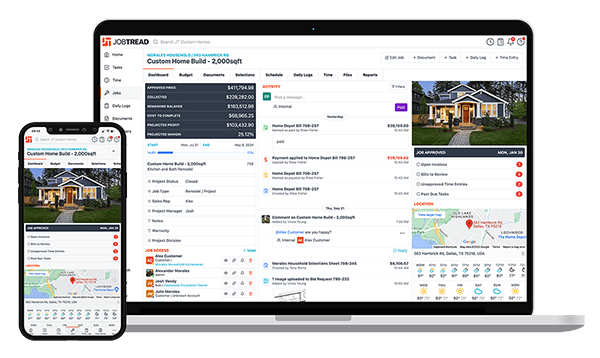
See JobTread's Pricing
Transparent pricing, no hidden fees - just the tools you need to grow confidently.
Learn MoreHow to Calculate the ROI of Construction Management Software
Cost is only half the equation. The real question is whether the software will pay for itself. When contractors ask how much construction management software should cost, the better question is often: what is it worth to my business?
According to a McKinsey & Company construction industry report, contractors who adopt integrated digital platforms see productivity improvements of 14 to 15 percent. Deloitte’s 2024 Engineering and Construction Industry Outlook reports similar gains with digitally-mature construction firms consistently outperforming peers on margin and project delivery.
To calculate your own ROI, add up what you expect the software to save you in these areas:
- Time spent on manual data entry and duplicate work
- Errors in estimates, invoices, and change orders
- Missed billable items and underbilled change orders
- Lost jobs due to slow estimates or poor communication
- Labor costs on administrative tasks that could be automated
If those savings exceed the subscription cost, the math works. Most growing contractors find the break-even point is surprisingly fast once the platform is fully implemented.
How JobTread Prices Construction Management Software
JobTread offers transparent, published, per-user pricing for internal team members and unlimited free access for subcontractors, vendors, and customers. This means you can collaborate with your entire project team without racking up additional fees as your business grows.
You also get access to a robust suite of features including:
- Estimating and takeoff
- Job costing and budgeting
- Scheduling and task management
- Daily logs and time tracking
- Document, photo, and video management
- Change orders and purchase orders
- Subcontractor and customer portals
- AI Connector for automated workflows
- QuickBooks Online integration
There are no hidden fees, no forced upgrades for core functionality, and no charges for your external collaborators. You can see the exact pricing at jobtread.com/pricing without scheduling a sales call.
Final Thoughts: Look Beyond the Price Tag
Construction management software costs can vary widely, but the price tag is only one piece of the decision. What matters more is the value you get in return, the transparency of the vendor, and how well the platform supports the way your business actually runs.
When evaluating your options, look for published pricing, clear feature lists, reasonable implementation costs, and a vendor that treats you like a long-term partner rather than a sales target. The right software should pay for itself in efficiency, profitability, and growth.
Want a closer look at how JobTread compares? Check out our pricing or schedule a demo today.
Frequently Asked Questions About Construction Management Software Cost
JobTread uses transparent, published per-user pricing for internal team members, with unlimited free access for subcontractors, vendors, and customers. Unlike many platforms, JobTread does not require a sales call to see pricing, does not lock core features behind higher tiers, and does not charge for external collaborators. You can view current pricing directly at jobtread.com/pricing.
Elevate your company to new levels of success!
Let one of our experts show you how JobTread will get you organized, save your time, and increase your profits.
Book a Demo

Meredith Dobbs is a Digital Marketing Specialist at JobTread with a background in education, research, and strategic communication. She specializes in creating clear, trustworthy messaging that is rooted in research, crafted for connection, and driven by a deep care for customers and their businesses.